How to Create a Study Plan for Exams: Proven Step-by-Step Guide

If you’re searching for how to create a study plan for exams, start by building a simple, structured roadmap you can actually follow for 2–8 weeks. You’ll map goals, block time, choose high-yield methods, and track progress with quick checkpoints. Do this right and you’ll lower stress, retain more, and walk into the exam with data-driven confidence.
Below is a step-by-step system you can adapt whether you’re in middle school, college, test prep, or returning to learning as an adult. It blends proven learning science with real-world time management for students, including an easy study schedule, a reusable study timetable, and a study planner template you can sketch on paper or in your favorite app.
Want a broader strategy toolkit before you start? Bookmark the ultimate guide to smart studying and pair it with this planning playbook. You’ll move faster and avoid common traps.
1) What Is a Study Plan and Why It Works
A study plan is a written roadmap that sets your goals, timelines, methods, and checkpoints so you know exactly what to do each day. It works because it matches how memory forms and strengthens over time.
Think of the core components as four pillars: goals (what to achieve and by when), scope (topics and materials), schedule (when you’ll study), and methods (how you’ll study). Add two more: checkpoints (practice tests, review dates) and feedback (office hours, peers, tutors).
The science behind the plan is solid. The forgetting curve shows recall drops quickly without review, while the spacing effect and retrieval practice sharply boost retention across days and weeks. Interleaving, mixing related topics, improves transfer and discrimination skills. For deeper dives, see APA’s overview of retrieval practice and Vanderbilt’s guide to interleaving.
Who should use a plan? Everyone with an exam on the calendar: middle and high school students, college and grad students, test-prep candidates (SAT, ACT, GRE, MCAT, LSAT), and professionals earning certifications. Plans especially help if you juggle work, parenting, or multiple courses.
Expect measurable outcomes. Track practice test scores, accuracy rates, time-on-task, and completion metrics (e.g., chapters finished, problem sets solved). A well-run plan can lift a course grade by one band (B- to A-) in 4–8 weeks, depending on baseline and exam weight.
2) Clarify Goals, Deadlines, and Constraints
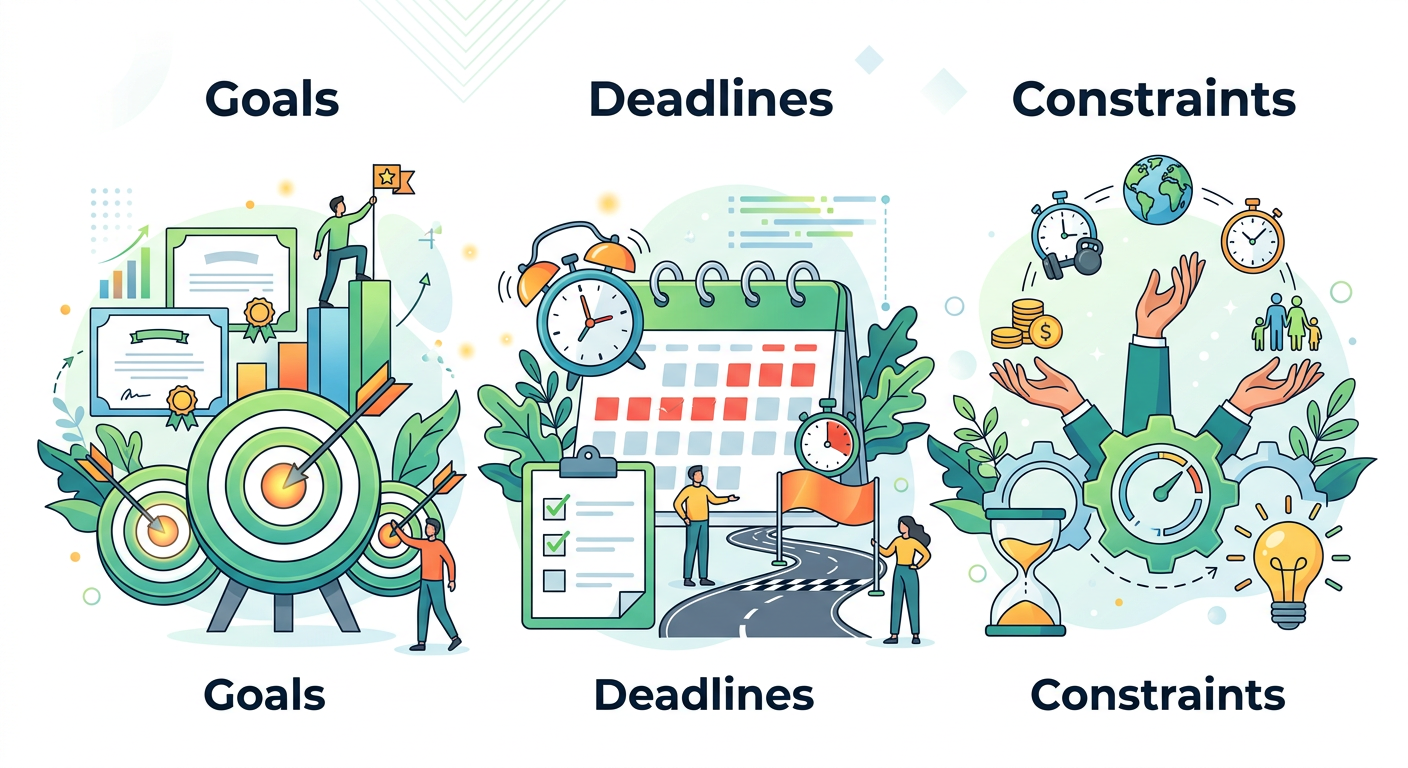
Start by translating vague hopes into SMART goals that match your exam format and deadlines. Specificity prevents drift and creates daily clarity.
Write one or two SMART goals per course. Examples: “Raise biology from 82% to 90% by the final on May 20 with three full-length practice exams and weekly spaced reviews.” Or “Score 165+ on GRE Quant by July 10 with four sections per week and two full-length tests.”
Map every key date on a master calendar: exam dates, paper/project deadlines, labs, sports, trips, holidays, and family events. Then add work shifts, commute windows, and non-negotiables. This keeps your study timetable honest.
List your resources: textbooks and solution manuals, LMS modules, lecture slides, review guides, question banks, office hours, tutors, and past papers. For a structure you can reuse, adapt our study schedule for exams plan or this study timetable for exams format.
Align methods to exam format. Multiple-choice demands question banks and pacing drills. Essays reward outlining and timed write-ups. Practical exams hinge on procedures and checklists. Tailor early so you don’t overinvest in the wrong skill.
3) Audit Your Starting Point (Diagnostic)
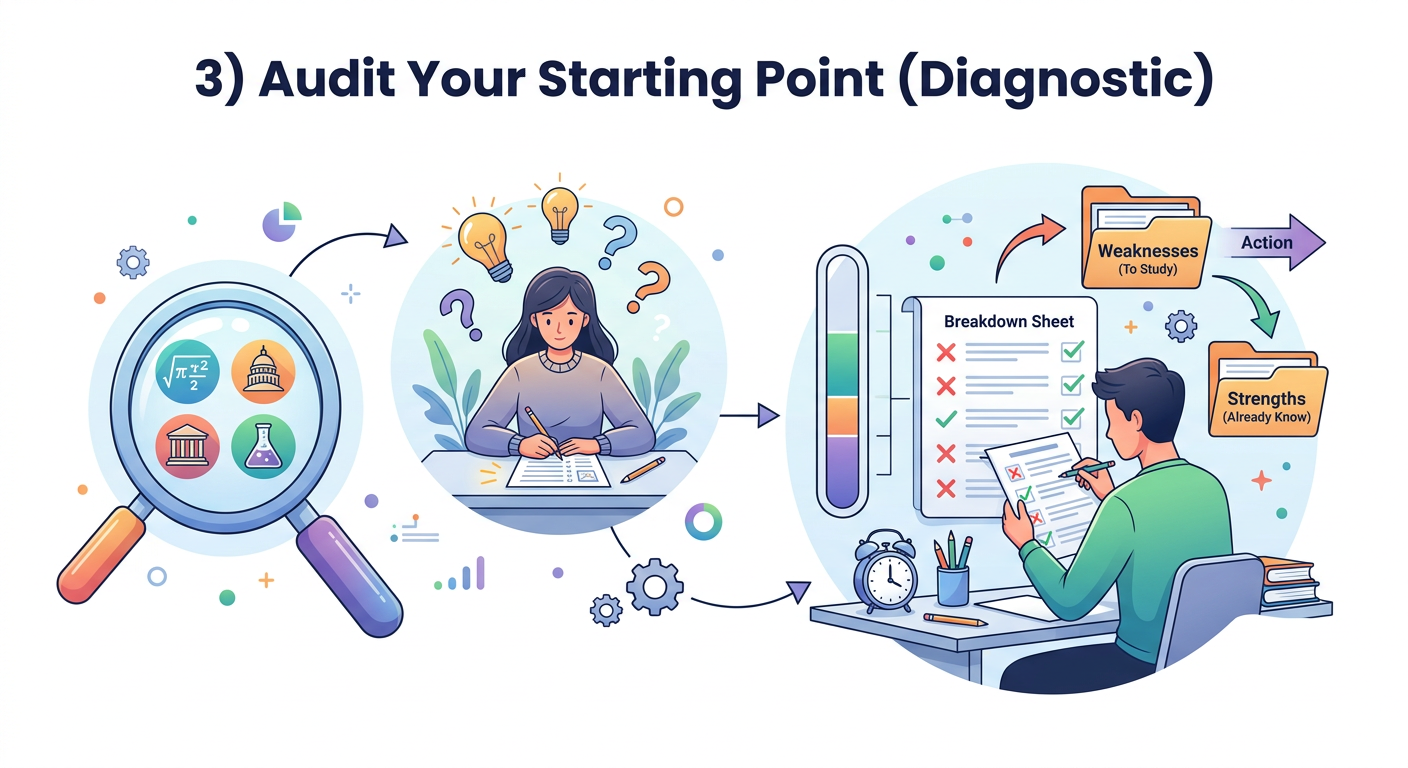
Run a quick diagnostic to see what you know, where you’re shaky, and how fast you work under pressure. This baseline drives your priorities.
Use short quizzes, past exams, and concept checklists. Try a 20–30 minute closed-book quiz per major unit (or one full past paper if you have it). Record accuracy, time, and confidence for each section.
Inventory the syllabus down to granular topics. Tag each with green (strong), yellow (OK), or red (weak). For example: “Photosynthesis: light reactions (yellow), Calvin cycle (red), limiting factors (green).” Keep this inventory visible in your study planner template.
Review graded work for error patterns: misread questions, formula slips, weak evidence, skipped steps. Separate conceptual gaps (don’t understand) from procedural gaps (know it but execute poorly). Fixes differ.
Beware of overconfidence. Compare your perceived mastery with data such as quiz scores, speed, and accuracy. If your “feel” says green but your numbers say yellow, trust the numbers.
4) Prioritize What to Study First
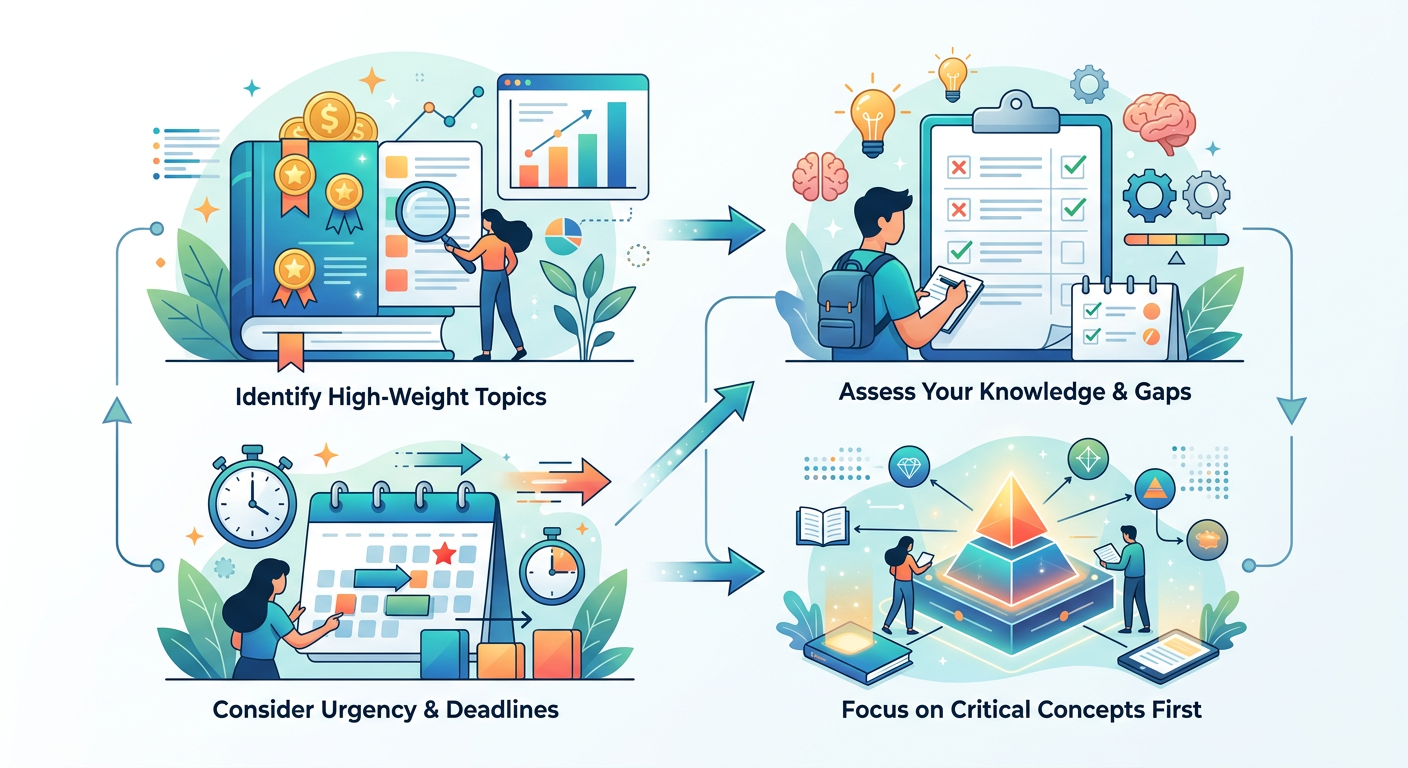
Rank topics by exam weight, difficulty, and your current mastery so you attack the highest ROI first. This prevents busywork from eating your week.
Assign each topic three numbers: percent of exam (e.g., 20%), difficulty (1–5), and your mastery color. Multiply weight by difficulty, then bump priority if your diagnostic flagged red. You’ll spot the big rocks fast.
Balance heavy hitters with quick wins. If genetics (20%, red) looks daunting, pair it with a 30-minute yellow topic to keep momentum. Wins fuel motivation, which fuels consistency.
Sort tasks with a simple matrix. A-level: high weight or red mastery. B-level: medium weight or yellow mastery. C-level: low weight or green mastery. Within each level, sequence topics logically: prerequisites first, then applications. Avoid random hopping that shreds coherence.
5) Choose Your Planning Framework
Pick either time-blocking (calendar hours) or task-batching (units of work) as your backbone, then add buffers so the plan survives real life. Your chronotype should guide when you do hard tasks.
Time-blocking assigns fixed hours to topics (e.g., “Chemistry 7–9 pm”). It’s great for routine and pacing. Task-batching sets units like “2 chapters + 20 problems,” which flexes nicely around variable days. Many students blend both: block anchor hours, then list exact tasks for each block.
Design a weekly template with your anchors: classes, work, workouts, meals, commutes, and sleep. Fill remaining slots with study blocks by course priority. Keep 10–20% of weekly time as buffer for spillover and life events.
Match study times to your peak-focus windows. Morning larks put dense problem-solving early; night owls reserve evenings for deep work and use mornings for lighter review. Hard tasks deserve your best brain.
6) How to Create a Study Plan for Exams: Build Your Study Calendar (Step-by-Step)
Start top-down—term overview, monthly milestones, weekly plans, then daily checklists—so every session ladders up to your exam goal. This structure removes guesswork.
Term overview: list exams, their weight, target scores, and key resources. Monthly/biweekly milestones: chapters to finish, practice tests to complete, labs or essays to draft. Weekly: convert milestones into calendar blocks and color-code by course or topic.
Daily: write a micro-checklist with 3–5 tasks and time estimates. Example: “Active recall: Ch. 6 flashcards (20m). Solve 10 stoichiometry problems (40m). Review error log (15m).” End each day with a 2-minute next-day preview.
Sample starting roadmaps:
8 weeks out: Weeks 1–4 focus on new learning + light review; Weeks 5–6 shift to mixed practice + first full-length tests; Weeks 7–8 emphasize cumulative review + 2–3 timed tests.
4 weeks out: Weeks 1–2 cover remaining content and build error logs; Week 3 runs one full-length test + targeted fixes; Week 4 runs 2 timed tests + consolidation.
2 weeks out: Prioritize high-weight topics and errors; run 2–3 half- or full-length tests; schedule daily spaced reviews and short mixed sets to keep everything warm.
If you prefer a ready-made map, adapt this 30-day study plan or the 7-day exam study plan when time is tight.
7) Design High-Impact Study Sessions
Use active recall, spaced repetition, interleaving, and the Pomodoro technique because these tools multiply retention per minute. Passive rereading simply can’t compete.
Active recall starts simple: close the book and retrieve. Try flashcards, blank-page summaries from memory, or problem sets without notes. For a deeper walkthrough, see how to study for exams using active recall.
Spaced repetition fits neatly into a weekly routine. Review on Day 1, 3, 7, 14, and 30, increasing intervals as recall strengthens. Use tags by topic and difficulty so you schedule more time for reds and less for greens.
Interleaving boosts discrimination. Mix two or three related topics in one session, like quadratic equations, exponent rules, and word problems, rather than blocking a single type. It feels harder but sticks better.
Protect focus with work/rest rhythms. Try 25/5 Pomodoros or 50/10 deep work blocks. Phone in another room, single task on screen, notifications off. One strong hour beats three distracted ones.
Teach concepts back to yourself (Feynman technique). Write a three-sentence explanation for each idea as if to a 12-year-old, then refine it. Add elaboration (why/how connections) and dual coding (simple diagrams + text) for complex topics.
8) Create a Review and Testing System
Run weekly cumulative reviews and a steady cadence of practice tests so nothing fades and your pacing improves. Your error log becomes the map for targeted fixes.
Block one 60–90 minute cumulative review per course each week. Cycle older material with brief retrieval sets and flashcard bursts. Keep it light but consistent.
Schedule practice tests under exam-like conditions every 7–10 days, then tighten timing as you near the exam. Track section times, score per unit, and where you guessed. Use that data to retarget study blocks.
Maintain a simple error log: What was the error? Why did it happen? What’s the fix? When will I revisit it? Re-quiz errors after 48 hours and again after a week.
Close the loop with feedback. Bring sticky questions to office hours or tutors, or run a 10-minute peer review. If practice testing clicks for you, extend it with this practice testing guide.
9) Plan for Different Exam Types
Match strategies to format: multiple-choice needs pacing and distractor skills; essays need outlining and argumentation; STEM demands stepwise problem-solving; open-book requires organized references and retrieval-first practice.
Multiple-choice: drill question banks and track accuracy by topic. Practice elimination, flagging, and educated guessing. Set pacing checkpoints (e.g., 15 questions every 20 minutes) and rehearse them in timed sets.
Essay/short-answer: outline fast. Practice thesis statements in 60 seconds, then add two evidence points. Run timed 10–20 minute writing sprints and review with a rubric. Build a quote bank or evidence list you can recall without notes.
Problem-solving/STEM: use mixed-problem sets to avoid pattern matching. Rebuild formula sheets from memory, then solve step by step with unit checks. For chemistry-style practice, try an ICE table practice set with answers or level-based sets like equilibrium constant (Kc) questions to sharpen application skills.
Open-book/take-home: prepare reference sheets with clear headers and page numbers. But still practice retrieval without notes first: speed matters, and flipping through pages eats time.
10) Tools, Apps, and Templates
Use the simplest tool that you’ll actually open daily: a printable weekly/daily planner, a digital calendar, and one task app. Add flashcards, focus aids, and time trackers as needed.
Printable templates: create a weekly grid with fixed anchors and 6–10 study blocks, plus a daily sheet with 3–5 tasks, checkboxes, and time estimates. Keep a small box for “next-day preview.”
Digital calendars and task apps: Google Calendar or Apple Calendar for blocks; Notion, Trello, or Todoist for tasks. Color-code by course and tag by topic/priority. Keep recurring spaced reviews on repeating events.
Flashcards/SRS: Anki and Quizlet shine for spaced repetition. Tag by chapter and difficulty, limit daily new cards (15–30), and enforce “bury related” to avoid cramming variants together.
Focus and tracking: Forest or Freedom for blocking distractions; iOS/Android Focus modes; Toggl or RescueTime to quantify time. Better data, better adjustments.
Notes and file hygiene: consistent filenames (“BIO_Unit3_Enzymes_Notes”), one folder per course, and a master index doc with links. Future-you will be grateful.
11) Balance, Energy, and Mental Health
Protect sleep, move your body, and eat for stable energy because cognition depends on biology. Short, intentional breaks beat endless scrolling every time.
Aim for 7–9 hours of sleep; it consolidates memory and keeps attention steady. See the CDC’s sleep duration guidance for age-specific targets.
Plan restoring breaks: 5-minute walks, stretching, water and protein-heavy snacks, or a 15–20 minute power nap if you’re cooked. Save social media for post-study rewards.
Manage test anxiety with proven tactics: paced breathing (4–6 breaths/min), progressive muscle relaxation, and mock exams to build familiarity. For more, scan Mayo Clinic’s take on test anxiety.
Set boundaries with roommates or family. Post your study schedule on the fridge or in a shared calendar and guard 1–2 critical daily blocks guilt-free.
12) Overcoming Common Obstacles
Beat procrastination by shrinking tasks, lowering friction, and starting before you feel ready. Distraction-proof your environment and reward consistency.
Use 2-minute starters: open the doc, write a first line, solve the first problem. Try if-then plans: “If it’s 7 pm, then I start a 25-minute Pomodoro for biology.” Count down 5–4–3–2–1 and move.
Control the digital environment. Remove social apps from the home screen, use website blockers, and create a dedicated study space, even a corner counts. External timers add helpful pressure.
When motivation dips, show progress visually. Track streaks, check off boxes, and use small rewards after sessions (tea, a walk, one episode). Commitment devices help, study with a friend or schedule a library table.
Fight perfectionism with “good enough” rules: 80% clarity beats 0% progress. Set stop times so sessions don’t sprawl. For ADHD, prefer shorter sprints (15–25 minutes), body-doubling, movement breaks, and tactile timers.
13) Studying While Working or Parenting
Use micro-sessions, batch heavy lifts on weekends, and coordinate calendars with your support system. Every 10–20 minute pocket counts.
Micro-study tactics: flashcards while pasta boils, one practice set before bed, or a 12-minute audio summary on a walk. Keep materials prepped so you can start fast.
Weekend strategy: reserve two 90-minute deep work blocks for heavy tasks; use weekdays for maintenance: reviews, quick drills, short readings. Protect those blocks like appointments.
Coordinate openly. Share schedules with partners or caregivers, trade coverage, and set quiet hours. Use commutes for audio notes, recorded lectures, or mental recall drills, no screen required.
14) Group Study and Accountability
Use groups for problem-solving, explanations, and mock exams—not for passive reading together. Clear agendas keep you efficient.
Before you meet, set the goal, time limit, and roles: facilitator, scribe, timer. Open with a 10-minute quiz battle, then rotate explaining sticky concepts.
Peer teaching cements understanding. Try lightning rounds, whiteboard problems, and 2-minute teach-backs. For accountability, schedule a 15-minute weekly check-in to share progress and blockers.
15) Subject-Specific Tips
Tailor methods to the discipline: STEM thrives on problems; humanities on thesis and synthesis; languages on spaced vocab and speaking reps. One size does not fit all.
STEM/quant: prioritize problem sets, derive key formulas from first principles, and check units every step. Mix easy, medium, and hard questions to avoid comfort loops.
Humanities/social sciences: practice outlines with thesis + 2–3 evidence points, maintain a quote or concept bank, and run timed writing drills. Synthesis beats summary.
Languages/vocab-heavy: schedule spaced repetition daily, add listening and speaking drills, use graded readers, and practice shadowing for pronunciation. To expand your toolbox, skim evidence-based study methods backed by research.
16) Optimize and Adjust Your Plan
Hold a 30-minute weekly review to compare progress with your plan, update priorities, and re-block time. Data drives the pivot, not vibes.
Track inputs (hours studied, sessions completed) and outputs (quiz scores, speed, error types). If outputs lag despite high inputs, switch methods, more retrieval, more mixed practice, smaller bursts.
Drop low-yield tasks without guilt. Replace a rereading block with a mixed problem set or a closed-book summary. In the final week, reduce new learning, run 2–3 full-length practice tests, and double down on error patterns.
Day-before checklist: materials packed, route and timing confirmed, light review only, early dinner, screens off by 10 pm, and a wind-down routine. On test day: breakfast with protein, a brief warm-up (5–10 easy questions), and steady breathing before you start.
17) Sample Study Plans and Schedules
Steal these templates and adapt them to your calendar. Split subjects across days, keep daily review blocks, and reserve buffers.
High school student (after-school schedule)
Mon–Thu: 4:00–4:20 snack/reset; 4:20–5:10 block A (hardest subject); 5:10–5:20 break; 5:20–6:00 block B (second priority); 7:30–7:50 spaced review; 8:30–8:50 light reading/flashcards.
Fri: 4:30–5:30 project/essay or catch-up; 20-minute review.
Sat: 10:00–11:30 deep work block; 20-minute mixed review.
Sun: 60-minute cumulative review + weekly planning.
College student (variable class times)
Mon/Wed: 8:00 class; 10:00–11:30 study block (problem sets); 2:00–3:00 lab prep; 7:00–7:30 spaced review.
Tue/Thu: 9:00–10:30 reading/outlines; 1:00–2:00 office hours/tutor; 6:30–7:00 flashcards.
Fri: 10:00–11:30 practice test section; 3:00–3:30 error log.
Weekend: one 90-minute deep block + 60-minute cumulative review.
Working adult (full-time job)
Mon–Fri: 6:45–7:30 morning block (active recall); lunch 12:30–12:50 micro-drill; 8:00–8:50 focus block (alternating subjects).
Sat: two 90-minute deep blocks + 30-minute spaced review.
Sun: 60-minute cumulative review + planning + light reading.
7-day crash plan (last-minute)
Day 1: diagnostic + priority map; build error log; schedule all 7 days.
Days 2–3: high-weight topics first; 3–4 focused blocks/day; short reviews at night.
Day 4: half-length practice test; fix errors; flashcards.
Days 5–6: mixed sets + targeted mini-lessons; 2–3 Pomodoros per topic.
Day 7: light review + sleep; 30–45 minutes of easy retrieval in the morning.
If your finals stack up, pair these samples with our science-backed ways to study and a structured menu of effective techniques.
18) How to Create a Study Plan for Exams in 10 Steps (Quick-Start)
Use this 30-minute build to get moving today. Then refine during your first weekly review.
Write one SMART goal per exam (target score + date).
List all topics from the syllabus and tag green/yellow/red.
Pick your methods: active recall, spaced repetition, interleaving, Pomodoro technique.
Choose your framework: time-blocking, task-batching, or a hybrid.
Block 5–12 study hours on your weekly calendar (adjust to load).
Assign top priorities to your best-focus windows.
Create your first week’s checklist: 3–5 tasks per day with time estimates.
Schedule one cumulative review and one practice test (or section) this week.
Start an error log and plan two revisits for each error (48 hours and 1 week).
Plan your next review (30 minutes) to adjust scope, blocks, and methods.
Prefer a printable? Draft a one-page checklist with boxes for goals, blocks, daily tasks, and reviews. For speed, use the structures in our step-by-step exam study guide and cut setup time in half.
Two more helpful reads while you build: study for exams fast without panic and how to study effectively without rereading. Both pair neatly with this planning system.
Build a Smarter Study Plan in Minutes with Bevinzey
Turn this guide into action with Bevinzey Tools & Modules—auto-generate spaced repetition schedules, track active recall sessions, and convert your study timetable into daily checklists. Spend less time planning and more time learning.
Get Started FreeFrequently Asked Questions
How many hours a day should I study for exams?
Most students perform well with 1.5–3 hours on weekdays and 3–5 hours on weekends during peak prep, adjusted for course load and exam proximity. Focus on quality: two concentrated 50-minute blocks with active recall and mixed practice often beats four distracted hours.
When should I start creating a study plan before an exam?
Eight weeks out is ideal for major finals; four weeks works for midterms; two weeks is a focused sprint. If you have just one week, adopt a crash plan with daily mixed practice and one or two timed tests.
Is it better to study in the morning or at night?
Study when your focus peaks. Morning larks do hard problem-solving early; night owls push deep work to evenings. Regardless, protect one 60–90 minute prime block daily and use lighter reviews at off-peak times.
How do I make a study plan if I only have one week?
Run a 60-minute diagnostic, list high-weight topics, and schedule 3–4 focused blocks each day with nightly spaced reviews. Include at least one half- or full-length practice test by Day 4 and fix errors aggressively.
What is the best study-to-break ratio (Pomodoro)?
Start with 25/5 if you’re building stamina; graduate to 50/10 for deeper focus. After three cycles, take a longer 20–30 minute break. Adjust to your attention curve.
How can I balance multiple exams at the same time?
Rotate subjects daily, schedule one weekly cumulative review per course, and weight time by exam date and difficulty. Use a color-coded calendar and a shared error log so nothing slips through the cracks. For ready-made structures, adapt our study schedule framework.
Ready for a structured sprint? Use the 7-day template above, or go deeper with a 30-day plan and a strategic set of proven study tips to lock in your gains.
Enjoyed this article?
Share it with others who might find it helpful.
Related Articles

How to Solve Molarity Problems: Step-by-Step Mastery
Learn how to solve molarity problems step-by-step with formulas, unit tips, and worked examples so you can calculate concentration with confidence.
Mar 26, 2026

Avoid These 7 Common Molarity Mistakes in Chemistry
Master chemistry calculations! Avoid common molarity mistakes with our expert guide on unit conversions, dilution errors, and proper lab techniques.
Mar 26, 2026

What Is Molarity? The Complete Guide to Molar Concentration
Master molarity with our complete guide. Learn the formula, step-by-step calculations, and the critical differences between molarity and molality.
Mar 26, 2026
Molarity Formula Explained: Master Concentration with Examples
Master chemistry with our guide to the molarity formula. Learn how to calculate concentration with step-by-step examples, units, and practical lab tips.
Mar 26, 2026

Molarity vs Molality: The Essential Difference Explained
Master the difference between molarity vs molality. Learn the formulas, key differences, and when to use each in this comprehensive chemistry guide.
Mar 26, 2026