Study Timetable for Exams: Proven Plan That Works

A study timetable for exams is the closest thing to a “calm button” you can press during a chaotic semester. When you can see exactly what you’re doing and when you’re doing it, your brain stops negotiating at 9:47 p.m. and starts executing. That’s the real win: less panic, more reps, better scores.
This plan will help you build an exam study schedule that fits a real U.S. student life: classes, sports, part-time shifts, commutes, family responsibilities, and the occasional curveball assignment. You’ll also see sample templates, practical time math, and what to put inside each block so your revision timetable actually improves recall (not just “time spent”).
1. What a Study Timetable for Exams Is (and Why It Works)
A study timetable for exams is a time-blocked plan that assigns specific subjects and tasks to specific days and times. It’s not “study chemistry sometime this weekend.” It’s “Saturday 10:00–11:15 a.m.: equilibrium practice set #2 + error log.”
Timetable vs. to-do list: the difference that matters
A to-do list tells you what to do; a timetable tells you when you’ll do it. That “when” eliminates the daily bargaining that leads to procrastination.
If you’ve ever rewritten the same to-do list three days in a row, you already know the problem. A list doesn’t protect time. A timetable does.
How timetables reduce cramming and decision fatigue
A good exam study schedule reduces cramming by forcing spaced review. Instead of doing 6 hours of history the day before, you touch it for 45 minutes on Monday, revisit on Thursday, and do a timed essay the next week.
It also cuts decision fatigue. The American Psychological Association has written about how self-control and decision-making draw from a limited pool of mental resources; fewer daily decisions often means better follow-through. You don’t need to obsess over the theory, just notice the effect when your plan tells you what’s next.
What makes a timetable realistic in the US school/college context
A realistic study timetable for exams accounts for fixed commitments first: class blocks, labs, practice, shifts, commuting time, meals, and sleep. U.S. schedules often include odd gaps (a 2-hour break between lectures) and late-day extracurriculars, so your best study time might be Tuesday 11:00 a.m. to 12:15 p.m., not “every night after dinner.”
It also respects the fact that many students work. According to the National Center for Education Statistics, large numbers of college students are employed while enrolled, especially part-time. That reality changes your weekly study schedule math fast. Reference: NCES education data.
What a timetable can and cannot do
A timetable supports effort; it doesn’t replace learning techniques. If your blocks are filled with rereading and highlighting, you’ll feel busy and still blank on test day.
Pair your schedule with methods that force retrieval (practice questions, flashcards, teaching-back). If you want a science-backed starting point, use evidence-based study methods for exams and build your timetable around them.
2. Start With Your Exam Map: Dates, Topics, and Priorities

You build a strong study timetable for exams by mapping every exam, every topic, and every priority before you start time-blocking. Otherwise, you’ll “schedule” a week of studying and still miss two entire units.
List every exam, format, and weighting
Create one exam calendar. Include the date, start time, location (room or online platform), time limit, and permitted materials (calculator model, formula sheet rules, open-note rules).
Example: Biology Final — Tue May 14, 1:30–3:30 p.m., Room 204, closed note, one-page teacher-provided formula sheet
Example: Statistics Midterm — Fri Oct 11, 9:00–10:15 a.m., online proctoring, calculator allowed, one 3x5 card
If your course gives weightings, write them down. A final worth 35% deserves more blocks than a quiz worth 5%, even if you like the quiz content more.
Break each subject into topics and subtopics
For each exam, list the exact topics and the resources you’ll use: textbook chapters, lecture slides, old homework sets, review packets, and practice exams.
Keep it concrete. “Chemistry: equilibrium” isn’t enough. “Equilibrium: ICE tables, Kc vs Kp, Le Chatelier shifts, reaction quotient Q” is schedulable.
Use a quick diagnostic to find weak areas
Run a baseline quiz or practice test early—ideally 30–45 minutes per subject. Score it, then label each topic: green (solid), yellow (shaky), red (weak).
Want an evidence-friendly approach? Practice testing works because it forces retrieval and exposes gaps. See how to study for exams using practice testing and bake those diagnostics into your weekly study schedule.
Set clear targets for each week
Convert priorities into weekly goals that include output and feedback. Good goals are measurable and slightly uncomfortable.
Bad: “Study algebra.”
Good: “Complete 40 mixed factoring questions + review every missed step in an error log.”
Good: “Write 2 timed DBQ outlines + compare to rubric.”
Now you have the raw material for your study plan for exams. Next, you’ll figure out how many hours you truly have.
3. Calculate Your Available Study Time (Without Guessing)

You can’t make a workable study timetable for exams until you know your real weekly hours. Guessing leads to fantasy schedules, and fantasy schedules collapse on Tuesday.
Do a 7-day time audit in 20 minutes
Pull up last week in your calendar (or texts/shift app if that’s what you use). On paper, draw a simple grid from 6 a.m. to midnight for each day.
Block your fixed items first: class, commute, practice, work, meals, and sleep. You’ll immediately see your true open windows. Some students find only 12–18 usable hours; others find 25+. Both can work with the right structure.
Choose your weekly study hours target
Set a target that matches your timeline. For many students, 10–15 hours/week works for steady prep, while 18–25 hours/week fits heavy finals periods. If you’re working 15–20 hours/week, you might land closer to 8–12 and compensate with higher-quality blocks.
If you want a more detailed pacing model, the pillar page Study Schedule for Exams: Proven Plan to Ace Your Tests pairs well with this time audit step.
Plan around energy levels, not just free time
Your best hours matter more than your available hours. If you’re sharp from 8–11 a.m., schedule your hardest tasks there: problem sets, timed writing, practice exams.
Save low-energy slots for lighter admin: organizing notes, building flashcards, making a formula sheet, or reviewing an error log.
Build in buffer time for life happening
Add a 10–20% buffer to your plan. If you think you have 15 hours, schedule 12–13. That buffer absorbs sick days, surprise assignments, family stuff, and the one study block that runs 25 minutes long because you finally got momentum.
That buffer is also psychological. When you fall behind, you won’t panic. You’ll just slide into the built-in space.
4. Choose the Right Timetable Structure for Your Exams
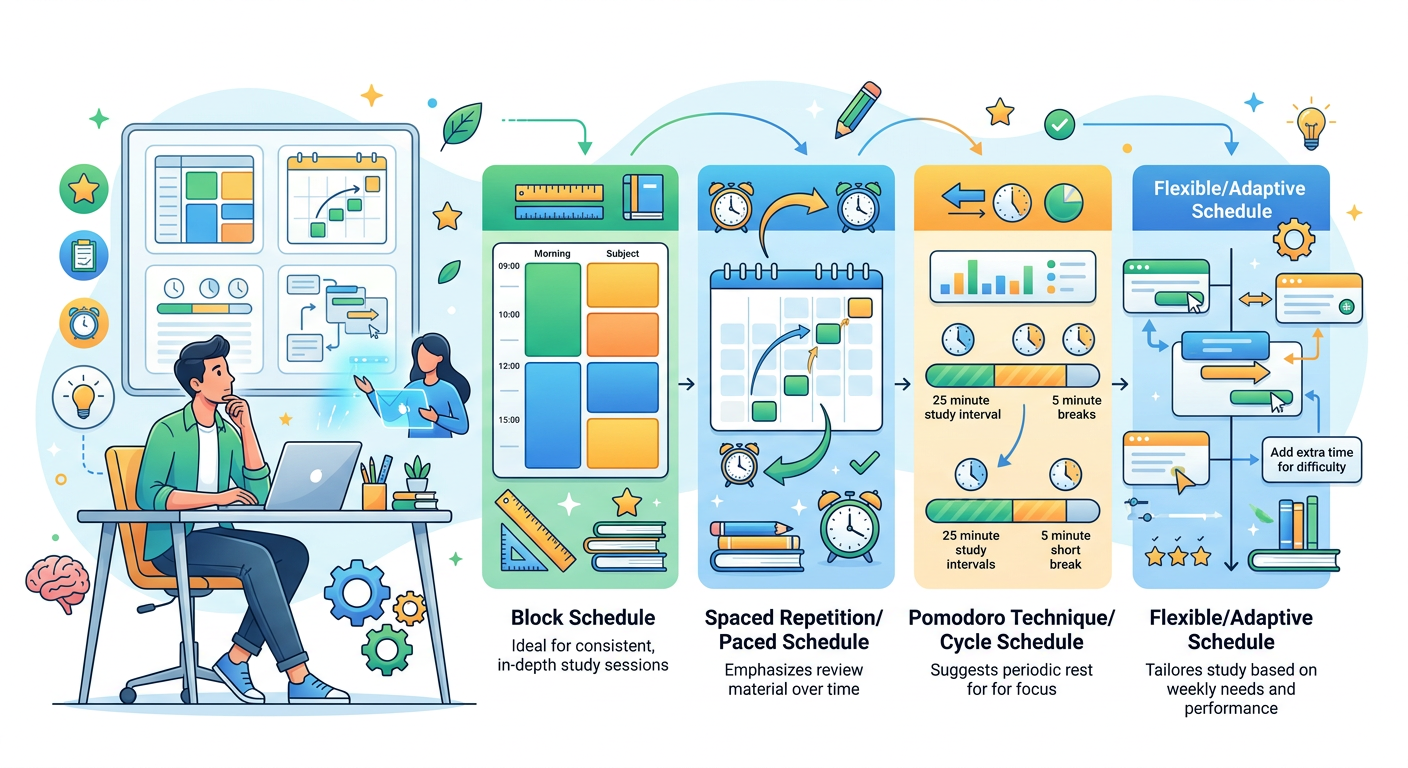
The best study timetable for exams structure depends on your time horizon and the number of exams you’re juggling. Pick the wrong structure and you’ll either over-plan or scramble.
Weekly repeating schedule (best for multi-week prep)
Use a weekly repeating schedule when you have 3–8 weeks before exams. You’ll repeat the same anchor blocks each week, then change the content inside them.
This works well for consistency. Monday might always be “math practice,” but the specific unit changes: week 1 quadratics, week 2 trig, week 3 stats review.
Countdown plan (best for 1–2 weeks before finals)
Use a countdown plan when you’re close to the exam window and every day has a job. This is where you schedule timed practice exams, targeted error-fixing, and short refreshers.
If you’re down to a single week, you’ll like Ultimate 7-Day Exam Study Plan as a plug-and-play framework.
Hybrid approach: stable base + flexible review blocks
A hybrid schedule gives you stable anchors (same times each week) plus flexible review blocks you can move. This is the structure most students stick to because it survives real life.
Example: You keep Tue/Thu 6:00–7:15 p.m. as non-negotiable study routine anchors, and you float a weekend review block based on work shifts.
How many subjects per day is too many?
For most students, 2–4 study blocks per day max is sustainable. More than that invites sloppy work and constant context switching.
Group similar tasks to reduce friction. Put two problem-solving blocks back-to-back (math, physics, chem), then do reading-heavy blocks (history, English) on a different day or later slot.
Start Learning Smarter Today
Bevinzey Tools & Modules helps you turn your exam dates, weak topics, and available hours into a clean study timetable for exams—complete with reminders, practice-test slots, and built-in buffer time.
Get Started Free5. How to Build Your Study Timetable Step by Step
You build a study timetable for exams by locking in sleep, placing anchor sessions, then assigning subjects using spacing and interleaving. It’s simple. It’s also where most people cut corners and pay later.
Step 1: Block the non-negotiables (sleep included)
Start with sleep. Protect 7–9 hours like it’s part of studying, because it is.
Sleep supports memory consolidation and attention. If you want a credible overview, the Sleep Foundation’s summary of sleep and memory is a solid reference you can read in 6 minutes.
Step 2: Add ‘anchor’ study sessions you never skip
Anchors are the same time on the same days. They’re habit builders.
Pick 3–5 anchors per week. Example: Mon/Wed/Fri 6:00–7:15 p.m. and Sunday 11:00 a.m.–12:30 p.m. When your day goes sideways, anchors keep your weekly study schedule intact.
Step 3: Assign subjects using spacing and interleaving
Spacing means revisiting material across multiple days; interleaving means mixing related topics instead of doing one unit in a single long stretch. Both tend to outperform massed practice for durable learning.
If you want a practical way to apply it, read how to study for exams using interleaving and then schedule “mixed sets” rather than chapter-by-chapter blocks.
Step 4: Plan practice tests and error review
Schedule practice exams under timed conditions. Then schedule a separate block to review mistakes—because the score isn’t the lesson, the corrections are.
A simple rhythm that works: Practice → Check → Error log → Redo. You can apply it to math, science, languages, and even essay writing (outline, compare to rubric, rewrite weak sections).
Step 5: Add quick daily reviews and a weekly reset
Add a 10–15 minute daily recap: pull yesterday’s error log, flip through flashcards, or write a “what do I remember?” page. Short, consistent retrieval beats occasional marathons.
Then schedule a 30–60 minute weekly reset (Sunday works for many). You’ll move unfinished tasks, adjust time estimates, and set new priorities. That one reset often saves an entire week of drifting.
6. What to Put in Each Study Block (So It Actually Improves Scores)
The best study timetable for exams fails if your blocks are vague or passive. Your block needs a clear output, a feedback loop, and a finishing step that makes tomorrow easier.
Use active recall instead of rereading
Active recall means you pull information from memory instead of re-consuming notes. That’s what exams demand.
Flashcards: 30 cards, keep the ones you miss
Blurting: write everything you know about “cellular respiration” in 5 minutes, then compare to notes
Teach-back: explain a concept out loud in 2 minutes like you’re tutoring a friend
Question first: attempt questions before reviewing
If you want a clean method for this, use how to study for exams using active recall and build it into your revision timetable as the default.
Retrieval + feedback loop: practice, check, fix
Do questions. Check them immediately. Fix what you missed. Then redo similar problems without notes.
For problem-based classes, keep an error log with three columns: (1) what I did, (2) why it was wrong, (3) the correct pattern. This sounds small. It’s brutal in the best way.
Make tasks specific and measurable
Every block should answer: “What will I have finished when time is up?”
Better: “Finish 20 multiple-choice questions on photosynthesis + review all wrong answers.”
Better: “Write 1 timed intro + thesis + outline for an essay prompt; compare to rubric.”
Better: “Do 12 derivative problems; star any that take >3 minutes; redo starred problems at the end.”
The 50/10 and 25/5 break methods
Use 50/10 for deep work (50 minutes on, 10 minutes off) or 25/5 when you’re low energy and need more frequent resets. During breaks, stand up, drink water, and keep your phone out of reach.
For distraction control, consider site blockers. Even the Chrome Web Store documentation can help you quickly find reputable extensions and avoid sketchy downloads.
End each block with a next-step note
Spend 30 seconds writing: “Next time: redo #7–#12 without notes; then attempt the challenge set.” That tiny note reduces friction, which reduces procrastination.
7. Sample Study Timetables (Templates You Can Copy)
These study timetable for exams templates reflect real U.S. schedules: after-school blocks, campus gaps, and weekend longer sessions. Copy them, then swap in your subjects and tasks.
Template A: High school finals (2–3 weeks out)
Assume school 8:00 a.m.–3:00 p.m., sports 3:30–5:30 p.m. twice weekly.
Mon: 6:00–7:15 Math (mixed practice) • 7:30–8:00 English (flashcards/quotes)
Tue: 6:00–7:15 Biology (active recall + 15 MCQs) • 7:30–8:00 History (timeline blurting)
Wed: 6:00–7:15 Math (error log + redo) • 7:30–8:00 Chemistry (formula sheet drill)
Thu: 6:00–7:15 English (timed outline) • 7:30–8:00 Biology (flashcards)
Fri: 5:30–6:15 Light review + plan weekend
Sat: 10:00–11:30 Practice test (rotating subject) • 1:00–2:00 Review mistakes
Sun: 11:00–12:00 Cumulative review • 6:00–6:45 Weekly reset
Template B: College midterms (4–6 weeks out)
Assume classes scattered, with two 90-minute gaps on campus.
Mon/Wed: Campus gap 11:00–12:15 (hard class problem sets) • Evening 7:00–7:30 (flashcards)
Tue/Thu: Campus gap 1:00–2:15 (reading + retrieval questions) • Evening 6:30–7:45 (practice quiz)
Fri: 2:30–3:30 Weekly consolidation (error logs + plan next week)
Sat: 10:00–12:00 Timed practice exam (rotate) • 2:00–3:00 Corrections
Sun: 4:00–5:00 Light review + upcoming week preview
If you want a more structured 30-day runway, use The Ultimate 30-Day Study Plan for Exams and treat these blocks as the “containers” you fill.
Template C: Working student (evenings + weekends)
Assume part-time work 20 hours/week, mostly afternoons/evenings.
Mon: 8:00–9:15 a.m. (hardest subject) • 9:15–9:25 break • 9:25–10:10 review
Tue: 8:00–9:15 a.m. (practice questions) • 9:30–10:00 flashcards
Wed: 8:00–9:15 a.m. (timed writing/problem set) • 9:30–10:00 error log
Thu: 8:00–9:15 a.m. (mixed set) • 9:30–10:00 recap
Fri: 45-minute light review only (protect recovery)
Sat: 10:00–12:00 practice exam • 1:00–2:00 corrections
Sun: 11:00–12:30 cumulative review • 30-minute weekly reset
Template D: Last 7 days before exams
Use the final week for practice, correction, and recall—not brand-new units.
Day -7 to -5: 1 timed section per day + 1 corrections block + 20-minute flashcards
Day -4 to -3: Mixed-topic drills, formula/essay framework memorization, redo hardest problems
Day -2: One final timed set (short) + light review of error log
Day -1: Logistics + light recall (no marathon) + early sleep
8. Tools to Create and Stick to Your Timetable
You can build a study timetable for exams with paper, Google Calendar, Notion, or anything that lets you time-block and revise quickly. The best tool is the one you’ll open twice a day without resentment.
Paper planner vs. Google Calendar vs. Notion
Paper works when you like visual simplicity and you’re on the move. Put it where you’ll see it: taped near your desk, inside your binder, or on the fridge.
Google Calendar works when your schedule changes often (work shifts, labs). Color-code subjects and block types: Learn (blue), Practice (red), Review (green), Admin (gray).
Notion works when you want your timetable and materials in one place. Keep it minimal: a weekly view plus a task database tagged by exam.
Best apps for focus and habit tracking
Use a timer app you trust, plus a simple habit tracker. You don’t need 12 dashboards. You need a start button and a record of consistency.
Even a basic iPhone/Android timer plus a checkbox habit list can beat fancy systems. The fancy systems often become procrastination in a tuxedo.
Using reminders and visual cues
Set reminders for your anchor blocks and your practice tests. Practice tests are the first thing students “mean to do later,” which is why they should be scheduled like appointments.
Use visual cues: leave your textbook open to the next problem set, put flashcards on your desk, keep your calculator and formula sheet together in one pouch.
How to review and update your timetable weekly
During your weekly reset, move unfinished tasks into buffer blocks, then adjust your time estimates. If you scheduled 45 minutes for a chapter and it took 80, that’s data—not failure.
Then update your priorities based on performance. Your diagnostic results and error logs should drive next week’s plan, not guilt.
9. Common Mistakes That Break Study Timetables (and Fixes)
Most study timetable for exams failures come from predictable mistakes: overpacking, skipping practice, sacrificing sleep, and treating a bad day like a disaster. You can fix all of them.
Overpacking the schedule
If you routinely miss blocks, your timetable is too tight. Scale back by 20% and add more buffer.
A workable plan feels slightly underbooked. That’s not laziness. That’s engineering.
Ignoring practice tests until it’s too late
If your schedule has zero timed practice, you’re training the wrong skill. Knowledge isn’t the only issue; performance under time pressure matters.
Add at least one timed block per week per major exam course, even if it’s short (25 minutes). Then review mistakes immediately.
Not planning for burnout and sleep debt
Add one rest block per day and one lighter day per week when possible. Rest isn’t a reward; it’s maintenance.
The Mayo Clinic also highlights how sleep affects brain function and performance. If you keep cutting sleep to “create study time,” you’re borrowing against your score. Reference: Mayo Clinic on sleep.
Letting one bad day derail the whole plan
Use a “minimum viable day” plan: 20 minutes of flashcards + 20 minutes of error log + 10 minutes of planning. That’s it.
Momentum matters. One small win protects the habit, and the habit protects your grades.
10. How to Adapt Your Timetable for Different Exam Types
You should adapt your study timetable for exams to the exam format because different exams reward different reps. The calendar stays. The block content changes.
Multiple-choice and standardized tests
Prioritize timed sections, review analytics, and spaced flashcards for facts and formulas. Track question types you miss (misread, content gap, careless error, time pressure).
Schedule “two-pass” practice: first pass under time, second pass as corrections with notes, third pass redo without notes.
Essay-based exams and short answers
Schedule outline drills and thesis practice early, then timed essays closer to the exam. Use the rubric as a checklist and grade yourself brutally.
A strong block looks like: 10 minutes plan, 25 minutes write, 15 minutes revise against rubric.
Math, science, and problem-solving courses
Use mixed sets and an error log. Repetition matters, but variety matters more.
If you’re studying chemistry equilibrium, for example, rotate question types: ICE tables, Q vs K comparisons, and Le Chatelier predictions. Then redo the ones you missed two days later. If you need targeted problem sets, you can plug in practice like ICE table practice questions with answers or reaction quotient (Q) practice questions into your timetable blocks.
Language and memorization-heavy subjects
Schedule daily exposure. Ten minutes every day beats two hours every Saturday.
Use spaced repetition for vocabulary, plus speaking/writing practice 3–5 times per week. Memorization sticks when you retrieve it under slight pressure.
11. Week-Of and Day-Before Exam Timetable Adjustments
Your study timetable for exams should shift during exam week toward high-yield practice and logistics. This is where calm execution beats heroics.
What to do 5–7 days before
Switch to consolidation: timed practice sections, targeted drills on weak areas, and rapid recall sessions. Avoid starting brand-new units unless your teacher explicitly says they’re guaranteed on the exam.
Run at least one full-length practice (or two half-length) for major exams. Then spend equal time reviewing mistakes.
The day before: light review and logistics
Do light recall only: flashcards, error log skim, one-page summaries, or a short mixed set. Keep it under 60–90 minutes total for most students.
Confirm location, pack materials, plan meals, and set alarms. Remove friction now so you don’t leak mental energy tomorrow.
Morning of the exam: warm-up routine
Do a short warm-up: 5–10 easy-to-moderate questions or a quick outline plan. You’re activating recall, not exhausting yourself.
Skip the “learn something new” sprint. It rarely lands, and it spikes anxiety.
How to schedule multiple exams in one week
Between exams, do targeted review of the next test’s weakest topics and protect sleep. Your brain needs recovery to perform again 24 hours later.
Use short, sharp blocks: 45–60 minutes of practice + 30 minutes corrections beats 3 hours of foggy rereading.
Start Learning Smarter Today
Bevinzey Tools & Modules helps you turn your exam dates, weak topics, and available hours into a clean study timetable for exams—complete with reminders, practice-test slots, and built-in buffer time.
Get Started Free12. Quick Checklist: Your Exam Study Timetable in 15 Minutes
You can set up a usable study timetable for exams in 15 minutes if you focus on the essentials: dates, priorities, time blocks, and practice slots. Fancy comes later.
One-page setup checklist
List every exam date/time + format + permitted materials.
Break each subject into topics/subtopics (at least 8–15 items per course).
Do a 30-minute diagnostic per subject; label red/yellow/green topics.
Time-audit your next 7 days: block school/work/commute/meals/sleep first.
Pick 3–5 anchor study sessions for the week.
Schedule at least 1 timed practice block + 1 corrections block per major exam.
Add 10–20% buffer time.
Daily execution checklist
Start with the first block on the calendar (no renegotiating).
Make the block specific: questions/outline/pages + corrections.
Use a timer (50/10 or 25/5).
End with a next-step note for tomorrow.
Log misses in one place (error log or “missed concepts” list).
Weekly review checklist
Move unfinished tasks into buffer blocks (don’t delete them).
Update priorities based on diagnostics and error logs.
Increase time for red topics; reduce time for green topics.
Confirm next week includes: learn + practice + review (rule of thirds).
Check sleep blocks are intact (no silent erosion).
Frequently Asked Questions
How many hours a day should I study for exams?
Most students do well with 1–3 hours per day during steady prep and 3–5 hours per day during finals week, depending on course load and work obligations. Quality matters more than raw time: prioritize timed practice and error review inside your study timetable for exams.
How far in advance should I make a study timetable for exams?
Create your study timetable for exams 4–6 weeks ahead when possible, then tighten it into a countdown plan in the final 7–14 days. If you only have 1–2 weeks, focus on practice tests, corrections, and spaced recall.
What’s the best study timetable for exams if I work part-time?
The best exam study schedule for working students uses morning or campus-gap anchors (3–5 per week) plus one longer weekend practice block. Keep daily blocks short (45–75 minutes), and protect one lighter day to prevent burnout.
How do I stick to a study timetable when I keep procrastinating?
Make each block smaller and more specific: “12 questions + corrections” beats “study chapter 7.” Also add a minimum viable day plan (30–50 minutes total) so you don’t break the habit when motivation dips.
Should I study one subject per day or mix subjects?
Mix subjects across the week and often within a day using 2–3 blocks, especially for problem-solving courses. Interleaving and spaced review usually beat single-subject marathons for long-term retention, and they fit a realistic study timetable for exams.
How do I plan a revision timetable the week before finals?
Use a revision timetable that prioritizes timed practice, error review, and light recall. Schedule one timed set per day for major exams, dedicate a separate block to corrections, and keep the day before each exam mostly for logistics and short warm-ups.
Enjoyed this article?
Share it with others who might find it helpful.
Related Articles

How to Solve Molarity Problems: Step-by-Step Mastery
Learn how to solve molarity problems step-by-step with formulas, unit tips, and worked examples so you can calculate concentration with confidence.
Mar 26, 2026

Avoid These 7 Common Molarity Mistakes in Chemistry
Master chemistry calculations! Avoid common molarity mistakes with our expert guide on unit conversions, dilution errors, and proper lab techniques.
Mar 26, 2026

What Is Molarity? The Complete Guide to Molar Concentration
Master molarity with our complete guide. Learn the formula, step-by-step calculations, and the critical differences between molarity and molality.
Mar 26, 2026

Why Molarity Matters: Converting Mass to Moles for Lab Solutions
Master chemistry with our guide to the molarity formula. Learn how to calculate concentration with step-by-step examples, units, and practical lab tips.
Mar 26, 2026

Molarity vs Molality: The Essential Difference Explained
Master the difference between molarity vs molality. Learn the formulas, key differences, and when to use each in this comprehensive chemistry guide.
Mar 26, 2026