7-Day Finals Recovery: Converting Exam Panic into Active Recall

Staring at a two hundred page syllabus forty-eight hours before a final usually triggers a cortisol spike that shuts down the prefrontal cortex, making it physically impossible to retain the very facts you are trying to memorize. Most students fall into the fluency trap, where re-reading highlighted text feels like learning but actually fails to build the neural pathways required for retrieval under pressure. When you spend six hours straight on one chapter, you succumb to the middle slump of the Serial Position Effect, losing the bulk of that data to cognitive fatigue before you even reach the practice questions.
This seven-day framework functions as a logistical audit that respects your brain's working memory limits. Instead of a desperate all-nighter, you will categorize every topic by its difficulty level and distribute the heavy lifting across one hundred and sixty-eight hours. By prioritizing the structural skeleton of your subject on day one and leveraging specific REM sleep cycles for memory consolidation, you move from passive recognition to active mastery. This approach ensures that your mental energy remains consistent from the first hour of foundations to the final hour of self-testing.
The Psychology of Focused Learning: Why a 7-Day Plan Works
A Study Plan for Exams (7-Day Plan) works because it leverages the psychological principles of momentum and cognitive load management to transform panic into structured productivity. When you face a massive syllabus, the brain often defaults to a "fight or flight" response, leading to procrastination or ineffective "bulk cramming" where information is forgotten as quickly as it is read. By spreading the intensity over 168 hours, you give your neurons time to form the physiological connections required for long-term storage.
Research on the Serial Position Effect suggests that we tend to remember the first and last items in a series best. A week-long schedule creates multiple "starts" and "ends" throughout the days, minimizing the "middle slump" where data often gets lost. Unlike a 24-hour cram session, this timeline allows you to enter the REM sleep cycles necessary for memory consolidation, which is why scientists at Harvard Medical School emphasize sleep as a non-negotiable part of the learning process.
Setting realistic expectations is the final pillar of this psychological approach. Using a Study Plan for Exams (7-Day Plan) acknowledges Cognitive Load Theory: the idea that our working memory has a limited capacity. By breaking a subject into seven digestible chunks, you avoid "blowing a fuse" mentally, ensuring that by hour 50, you are still absorbing information as effectively as you were at hour one.
Preparation Phase: What to do Before Day 1 Starts
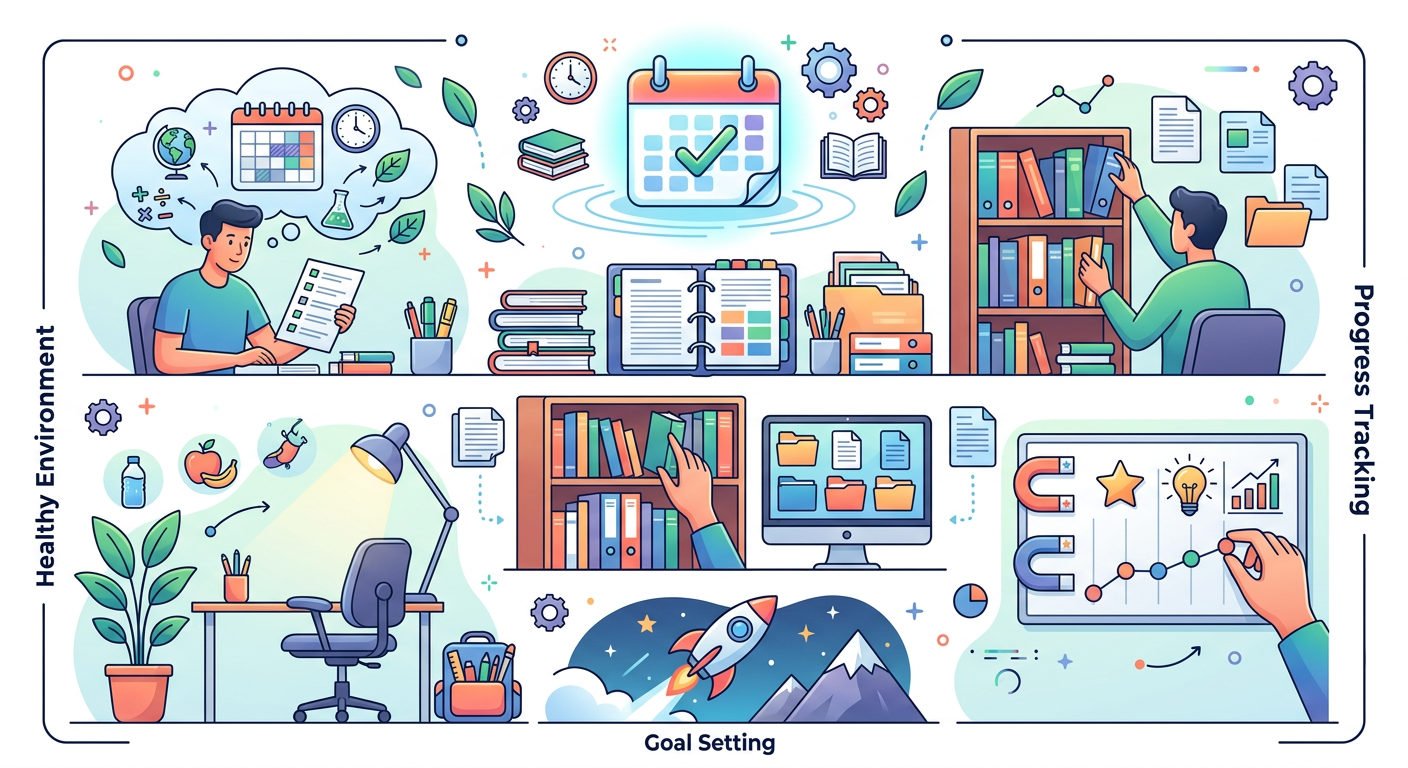
The preparation phase is about removing friction so that when the clock starts on Day 1, you aren't wasting precious cognitive energy looking for a Highlighter or a missing PDF. Successful students treat the day before their study week as a "logistics audit." You want to gather every syllabus, textbook, and set of lecture notes into one physical or digital space.
Once your resources are gathered, perform a "Red-Yellow-Green" audit of your material. Mark topics you understand perfectly as "Green," those you vaguely recall as "Yellow," and the ones that feel like a foreign language as "Red." This prevents you from falling into the trap of studying what you already know just to feel productive—a common mistake addressed in our guide on the best way to study for exams.
Finally, establish your "Golden Zone." This is a dedicated space where your phone is in another room and your computer is locked to study-only tabs. According to the National Center for Education Statistics, environmental factors significantly impact academic performance. If your environment is chaotic, your recall will be too.
Ready to Supercharge Your Prep?
Use our specialized tools to organize your 7-day sprint and master difficult concepts faster.
Get Started FreeDay 1: The Macro View and Foundation Building

Day one focused on "breadth over depth" to ensure your brain understands the structural "skeleton" of the subject before you try to add the "muscle" of detail. Instead of starting on page one of chapter one, scan the entire syllabus to build a mental concept map. This high-level summary allows you to see how different modules interact, which is a key component of smart studying for exams.
Your goal today is to define the "Big Picture" and create a master list of key terms. If you are studying chemistry, this might involve categorizing your ICE table practice questions or understanding why Le Chatelier's Principle matters before solving every specific equation. By the end of Day 1, you should be able to explain the "what" and "why" of every major chapter, even if you haven't mastered the "how" yet.
Research suggests that tackling difficult concepts early, while your mental energy is at its peak, prevents the "procrastination spiral" later in the week. Spend the final two hours of Day 1 reviewing the most intimidating "Red" topics from your audit. You don't need to master them yet; you just need to demystify them so they don't cause anxiety on Day 4.
Day 2-3: Deep Dives and Active Recall Phase
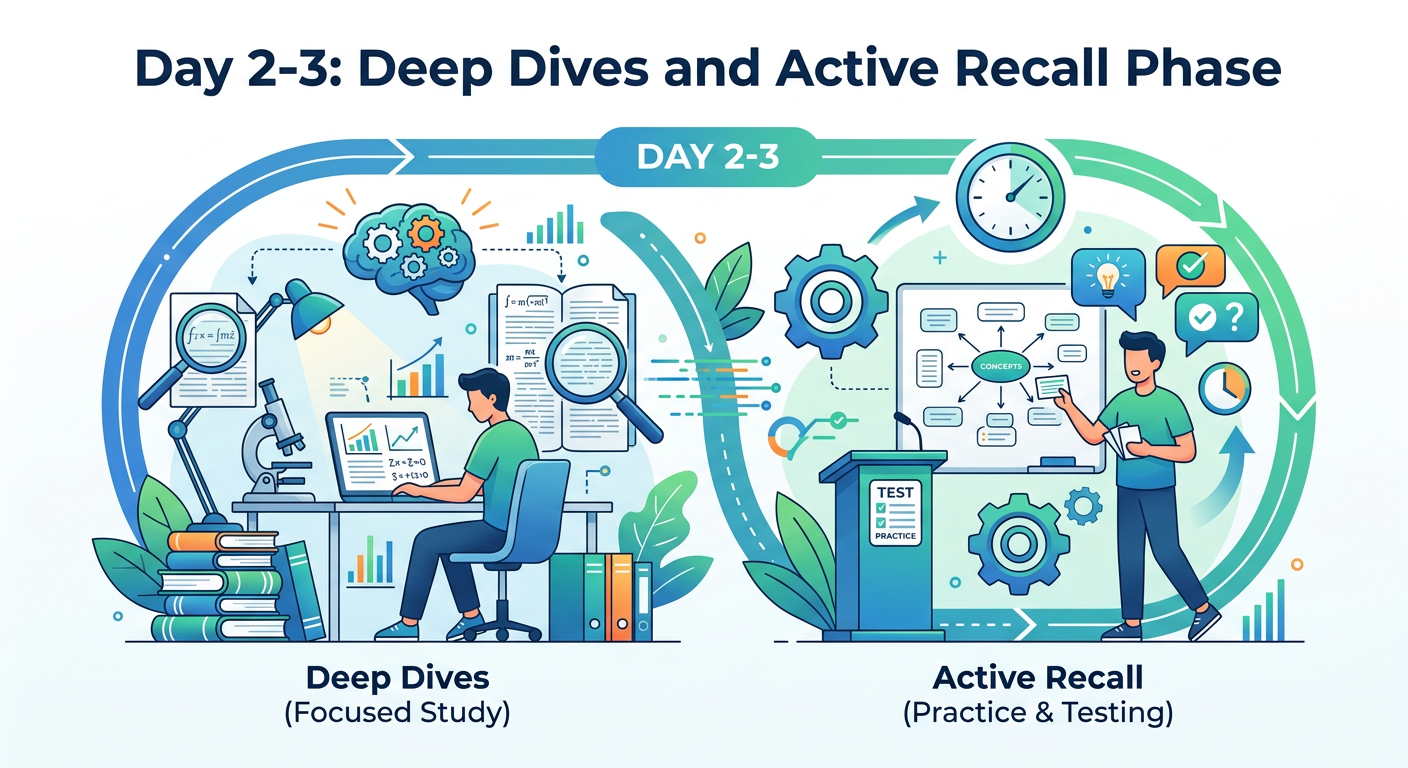
Days two and three transition from passive reading to active struggle, which is where real learning happens. You must stop looking at your notes and start asking your brain to retrieve information from scratch. This is the cornerstone of using active recall, a technique that forces the brain to strengthen neural pathways.
Focus on the "heavy hitters", those topics that historically make up 60-70% of the exam grade. Utilize the Feynman Technique for these: try to explain a complex concept as if you were teaching it to a sixth-grader. If you can't explain it simply, you don't understand it well enough. For quantitative subjects, this is the time to work through Equilibrium Constant (Kc) practice questions or similar high-weight problems.
Instead of highlighting text, create 10-15 "Gold Standard" flashcards for each major topic. These shouldn't just be definitions; they should be "Why" and "How" questions that require deep thought. Pairing this with practice testing ensures that you are actually simulating the exam experience rather than just recognizing familiar words on a page.
Day 4: The Mid-Point Review and Pivot
Day four is a "sanitized check" to ensure your Study Plan for Exams (7-Day Plan) is actually moving the needle. It is easy to spend three days feeling busy but learning very little. Start today with a "Blurting Session": take a blank sheet of paper and write down everything you remember about a specific topic in five minutes. What you miss is your new priority list.
This is the time to pivot your schedule based on your actual performance on Days 2 and 3. If you find that Hess's Law practice questions are still confusing, you must reallocate time from your "Green" topics to fix this gap. It is vital to be ruthless here, do not spend time on what you already know just to boost your ego.
The middle of the week is often when motivation dips. Remind yourself that the "Heavy Lifting" is 70% done. Use this day to organize your messy notes into clean, one-page summaries or "cheat sheets" (not for use in the exam, of course, but for the sake of synthesis). This process of condensing information is a subtle form of retrieval practice that cements concepts in your mind.
Day 5: Synthesis and Connection Phase
Day five is about developing "mental scaffolding," where you stop seeing chapters as isolated islands and start seeing them as a connected continent. Many exams, particularly at the university level, require you to apply concepts from Chapter 2 to solve a problem in Chapter 9. This is the perfect time to experiment with interleaving, which involves mixing up different topics in one study session.
Advanced mnemonic techniques become your best friend today. For bulk data, like lists of anatomical structures or chronological historical events, build "Memory Palaces" or acronyms. If you are struggling with specific calculations, such as Kp calculations practice questions, try to find the shared logic between them and other equilibrium problems you've studied.
If you have a reliable study group, Day 5 is the optimal time to meet. Don't use this time for first-time learning; use it for peer-testing. Explain concepts to each other and challenge each other with "What if?" scenarios. If you can defend your answer against a peer's critique, you are ready for the examiner's questions.
Day 6: Full Simulation and Exam Conditions
Day six is a dress rehearsal designed to desensitize you to the pressure of the exam hall. You need to sit for a full-length, timed mock exam without any notes or distractions. This isn't just about testing your knowledge; it's about testing your stamina and your ability to manage time effectively.
After finishing the mock, spend at least two hours reviewing every single mistake. Why did you get it wrong? Was it a "silly" error, a misunderstanding of the question, or a genuine knowledge gap? For instance, if you struggled with enthalpy change practice questions, go back and solve three more until the logic feels instinctive. This "Corrective Feedback" loop is the most accelerated way to gain points in the final 48 hours.
Simulating the physical environment is also key. If your exam is at 9:00 AM, take your mock at 9:00 AM. Study at a desk, not a bed. These small environmental cues help reduce the "novelty" of the exam day, allowing your brain to focus entirely on the content rather than the stress of the surroundings. This strategy is part of a broader last-minute study strategy that prioritizes high-impact activities.
Day 7: Light Review and Mental Priming
Day seven is not for learning new material; it is for maintenance and confidence. Trying to learn a new complex topic 12 hours before the exam often leads to "Interference," where the new, half-baked information confuses the solid concepts you learned earlier in the week. Instead, stick to a "No-Panic" review of your one-page summaries and flashcards.
Logistics are the priority for the second half of the day. Check your exam location, pack your bag (calculators, pens, ID), and plan your breakfast. The Mayo Clinic highlights that even mild dehydration or sleep deprivation can impair cognitive function by up to 20%. Your 7-day effort is wasted if your brain is too foggy to retrieve the information.
End your study session by 6:00 PM or 7:00 PM. Give your brain a "buffer zone" to wind down. Watch a light movie, eat a healthy meal, and go to bed early. You are no longer a student trying to learn; you are an athlete preparing for a performance. Confidence is your greatest asset on the morning of the exam.
Optimizing Your Performance: Habits for the 7-Day Sprint
To sustain the Study Plan for Exams (7-Day Plan), you must manage your biology as carefully as your books. The Pomodoro Technique, working for 25 minutes followed by a 5-minute break, is effective because it respects the natural attention span of the human brain. Use these 5-minute breaks to move your body, not to scroll on social media, which provides "junk dopamine" and increases mental fatigue.
Nutrition plays a massive role in concentration. Focus on "brain foods" like blueberries, walnuts, and complex carbohydrates that provide a steady release of glucose. Avoid the "Caffeine Rollercoaster", too much coffee leads to jitters and an eventual crash that can wreck an afternoon of productivity. Balanced habits are a core part of evidence-based study methods.
If you hit a wall mid-week, don't try to power through with sheer willpower. Take a longer break, go for a 30-minute walk or a nap. Burnout usually stems from a lack of "recovery periods," not a lack of effort. By treating your 7-day plan as a series of sprints rather than a marathon, you'll arrive at the exam center sharp, prepared, and ready to succeed.
Turn Your Study Week Into a Success Story
Don't leave your exam results to chance. Bevinzey provides the practice tools, interactive questions, and structured modules you need to execute your 7-day plan with clinical precision.
Get Started FreeFrequently Asked Questions
Is 7 days enough time to study for a major final exam?
Yes, seven days is sufficient if you use a high-intensity, structured approach like active recall and practice testing. It allows for the necessary sleep cycles to consolidate memory, which is superior to 24 or 48-hour cramming.
How many hours a day should I study during a 7-day plan?
Aim for 6 to 8 hours of "deep work" per day. Quality matters more than quantity; four hours of focused Pomodoro sessions are more effective than twelve hours of distracted reading with a phone nearby.
What is the best way to memorize a lot of information in one week?
The most effective combo is using the Feynman Technique to understand the concept, followed by spaced repetition flashcards and mock exams to ensure long-term retrieval and application.
Should I pull an all-nighter the night before the exam?
Absolutely not. Sleep deprivation impairs memory recall and logical reasoning. Going into an exam with six hours of sleep and 80% coverage is always better than 100% coverage and zero sleep.
How do I manage exam anxiety during a high-intensity study week?
Stick to your schedule and complete mock exams. Anxiety often comes from the "unknown." By simulating the exam and seeing that you can answer the questions, you replace fear with evidence-based confidence.
Enjoyed this article?
Share it with others who might find it helpful.
Related Articles

How to Solve Molarity Problems: Step-by-Step Mastery
Learn how to solve molarity problems step-by-step with formulas, unit tips, and worked examples so you can calculate concentration with confidence.
Mar 26, 2026

Avoid These 7 Common Molarity Mistakes in Chemistry
Master chemistry calculations! Avoid common molarity mistakes with our expert guide on unit conversions, dilution errors, and proper lab techniques.
Mar 26, 2026

What Is Molarity? The Complete Guide to Molar Concentration
Master molarity with our complete guide. Learn the formula, step-by-step calculations, and the critical differences between molarity and molality.
Mar 26, 2026
Why Molarity Matters: Converting Mass to Moles for Lab Solutions
Master chemistry with our guide to the molarity formula. Learn how to calculate concentration with step-by-step examples, units, and practical lab tips.
Mar 26, 2026

Molarity vs Molality: The Essential Difference Explained
Master the difference between molarity vs molality. Learn the formulas, key differences, and when to use each in this comprehensive chemistry guide.
Mar 26, 2026