Master Your Exams: The Ultimate Guide to Smart Studying

Exams loom large for most students, creating a unique blend of anxiety and pressure. Many instinctively hit the books for marathon cramming sessions, hoping sheer volume of study hours translates to success. Yet, countless students discover this approach often falls short. The secret isn't necessarily more time studying, but knowing how to study smart for exams. This isn't just about memorizing facts; it's about employing strategic, science-backed methods that maximize retention, understanding, and recall. It's the difference between merely seeing information and truly owning it.
Adopting a smart studying approach transforms the often grueling process of exam preparation into a more efficient and less stressful journey. You won't just improve your grades; you'll build robust learning habits that serve you far beyond the classroom.
Beyond Cramming: What Does 'Studying Smart' Really Mean?
Studying smart means engaging with your material actively and strategically, rather than passively absorbing it. Traditional cramming often involves re-reading notes or textbooks repeatedly, a method cognitive psychologists largely dismiss as inefficient for long-term retention. Research shows passive review creates an illusion of knowing, making information feel familiar without solidifying it in your memory.
Effective learning, by contrast, taps into principles of cognitive psychology like spaced repetition and active recall. These aren't just buzzwords; they're proven techniques designed to literally rewire your brain for better information storage and retrieval. Imagine your brain as a library: cramming shoves books onto random shelves, while smart studying meticulously catalogs them for easy access later.
Embracing a strategic approach to exams offers a multitude of benefits. You'll experience greatly improved retention of complex material, reducing that dreaded "blanking out" during a test. It significantly lowers stress levels because you're confident in your preparation, and it invariably leads to better academic performance and grades. Moreover, these study habits for success become lifelong skills, proving invaluable in any field requiring continuous learning.
Setting the Stage for Success: Planning Your Study Strategy

A well-thought-out plan forms the bedrock of how to study smart for exams. Without a clear roadmap, even the best intentions can dissolve into last-minute panic or unproductive study sessions.
Creating an Effective Study Schedule (and Sticking to It)
Effective study schedules are realistic, not aspirational. Start by mapping out all your obligations, classes, work, social events, then slot in dedicated study blocks. Break down large assignments into smaller, manageable chunks; tackling "read Chapter 5" feels less daunting than "study for biology final." Incorporate short, scheduled breaks every 45-60 minutes; this actually boosts focus and prevents burnout.
Crucially, treat your study schedule like a non-negotiable appointment. Consistency builds momentum and ensures you cover material without feeling overwhelmed. For more detailed insights on time management, check out our guide on How to Study for Exams Step-by-Step: The Proven Science-Backed Guide.
Understanding Your Learning Style (and Adapting Your Methods)
Knowing your preferred learning style helps tailor your exam preparation strategies. Visual learners might benefit from diagrams, color-coding notes, or mind maps. Auditory learners often thrive by listening to lectures, recording themselves explaining concepts, or discussing topics with peers. Kinesthetic learners benefit from hands-on activities, movement during study breaks, or writing out notes physically.
While some identify strongly with one style, most people are a blend. The key is to experiment and adapt your methods. If traditional textbook reading isn't sticking, try turning the concepts into a flow chart or teaching them to an imaginary student.
Gathering and Organizing Your Study Materials
Efficient studying begins with organized materials. Collect all your notes, lecture slides, textbooks, and supplemental readings well before exam season hits. Consolidate information from various sources into a single, comprehensive study guide or set of notes. This process of synthesis helps you identify gaps in your understanding and reinforces learned concepts.
Digital tools like Evernote or Notion can help, but even a well-organized binder works wonders. The goal is easy access and a clear overview of everything you need to know. Remember, the act of organizing itself can be a powerful memory aid.
Active Recall and Engagement: Techniques That Boost Retention
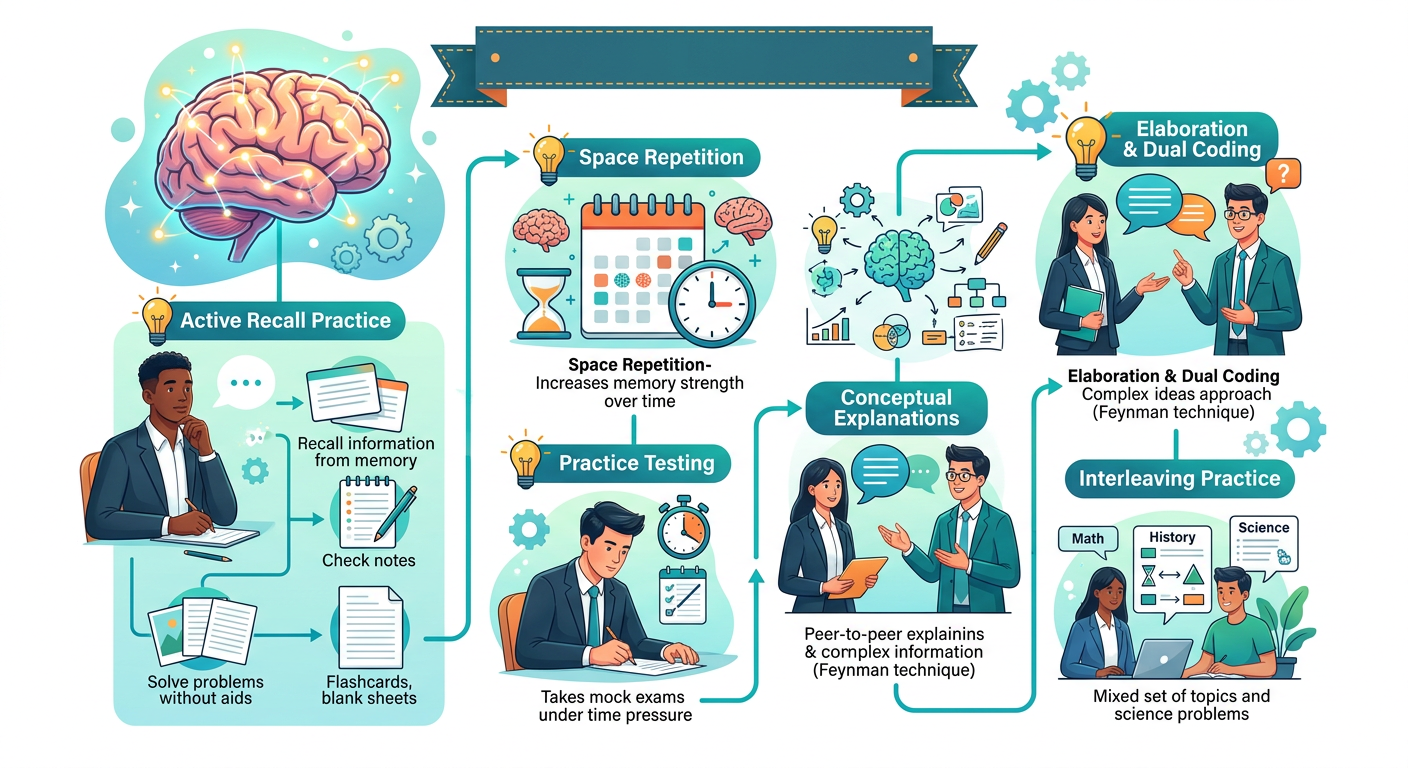
Passive reading yields passive results. To truly retain information, you must actively engage with it. These are some of the most powerful effective study techniques.
The Power of Active Recall: Testing Yourself Constantly
Active recall involves retrieving information from your memory without looking it up. This is arguably the most potent study technique. Instead of re-reading a chapter, close the book and try to explain the main points aloud or write them down. Flashcards are a classic active recall tool; create them yourself or use digital apps like Anki.
Practice questions, especially those simulating exam conditions, are invaluable. For challenging subjects like chemistry, diving into specific practice questions, such as ICE Table Practice Questions with Answers, forces you to apply concepts rather than just recognize them. This process not only identifies knowledge gaps but also strengthens neural pathways, making future retrieval faster and more reliable.
Spaced Repetition: Remembering More, For Longer
Spaced repetition optimizes when you review material. Instead of cramming, you review information at increasing intervals over time. For example, review today's lecture notes tomorrow, then three days later, then a week later, and so on. This leverages the "spacing effect," a cognitive phenomenon where learning is more effective when study sessions are spread out.
This method directly combats the Forgetting Curve, the natural decline of memory retention over time. Software like Anki is built around spaced repetition algorithms, making it easy to implement, but manual tracking with a simple calendar works too.
Elaboration and Interleaving: Making Connections for Deeper Understanding
Elaboration involves linking new information to existing knowledge. When you learn a new concept, ask yourself: How does this relate to what I already know? Can I give an example? How would I explain this to a 5-year-old? The more connections you make, the stronger and more accessible the memory becomes.
Interleaving means mixing different subjects or types of problems during a single study session. Instead of studying all of calculus for two hours, then all of history for two hours, you might alternate between segments of each. This technique not only improves your ability to distinguish between different concepts but also strengthens your problem-solving flexibility, a crucial test taking strategy.
Mind Mapping and Summarization: Visualizing and Condensing Information
Mind mapping is a visual note-taking strategy that uses a central idea with branching sub-topics, images, and keywords. It helps to organize information hierarchically and make connections explicit. This visual representation can be particularly helpful for understanding complex relationships and overarching themes.
Summarization, on the other hand, forces you to distill large amounts of text into its essential components. Try writing a one-paragraph summary of an entire chapter or a one-sentence summary of a complex theory. This act of condensing requires deep comprehension and helps reinforce key concepts.
Optimizing Your Study Environment and Well-being

Your physical and mental state significantly impact your ability to study effectively. Neglecting these aspects can sabotage even the best exam preparation strategies.
Creating an Ideal Study Space: Minimizing Distractions
Your study space should be a dedicated sanctuary for learning. Find a quiet spot free from interruptions – this might be a library, a quiet corner of your home, or even a local coffee shop with minimal chatter. Keep your space organized and tidy, as clutter can be a visual distraction.
Crucially, minimize digital distractions. Put your phone on silent and out of reach, close unnecessary tabs on your computer, or even use website blockers during study sessions. A dedicated, distraction-free environment signals to your brain that it's time to focus.
The Importance of Sleep, Nutrition, and Exercise
These three pillars are non-negotiable for cognitive functioning. Adequate sleep (7-9 hours for adults) is vital for memory consolidation; your brain actively processes and stores information while you slumber. Skimping on sleep dramatically impairs your ability to learn and recall.
Fuel your brain with nutritious food – whole grains, lean proteins, fruits, and vegetables. Avoid excessive sugar and processed foods, which can lead to energy crashes and poor concentration. Regular exercise, even a 30-minute walk, boosts blood flow to the brain, reduces stress, and improves mood and cognitive performance. The CDC recommends at least 150 minutes of moderate-intensity activity per week.
Managing Stress and Preventing Burnout
High stress levels impair memory and focus. Incorporate stress-reducing activities into your routine: mindfulness meditation, deep breathing exercises, spending time in nature, or engaging in hobbies. Recognize the signs of burnout – persistent fatigue, irritability, difficulty concentrating – and proactively take breaks.
Remember, productivity isn't about working continuously; it's about working effectively. Step away from your studies when you feel overwhelmed. A fresh perspective, even after a short break, can make all the difference.
Mastering the Exam Day: Strategies for Peak Performance
All your hard work culminates on exam day. Having a strategy for the day itself ensures you perform your best.
Pre-Exam Routines: The Night Before and Morning Of
The night before an exam, avoid last-minute cramming. Instead, do a light review of key concepts, then prioritize a good night's sleep. Lay out your clothes and pack your bag (calculators, pens, ID) so you're not rushing in the morning. A relaxing activity can help settle your nerves.
On exam day, eat a healthy, balanced breakfast. Arrive early at the exam venue to avoid any last-minute stress. Take a few deep breaths to calm yourself. Avoid discussing the exam content with peers right before the test, as this can introduce new anxieties or confuse previously learned material.
During the Exam: Time Management and Answering Techniques
Once the exam starts, quickly scan the entire paper to understand its structure, point distribution, and question types. Allocate your time propor tionally to the marks for each section. Tackle easier questions first to build confidence and ensure you secure those points. If you encounter a difficult question, make an educated guess or mark it to return to later; don't get stuck.
For multiple-choice questions, eliminate obviously wrong answers. For essay questions, quickly outline your answer before writing to ensure coherence. Always read instructions carefully. If you finish early, review your answers thoroughly; look for simple mistakes, omissions, or unclear explanations. This review is a critical test taking strategy.
Post-Exam Reflection: Learning from Every Experience
The learning doesn't stop when you hand in the paper. Once you receive your graded exam, take time to review it. Understand where you lost points: Was it a conceptual misunderstanding, a silly mistake, or poor time management? Did certain types of questions consistently trip you up?
Use this feedback to refine your future study habits for success. This meta-learning process helps you grow as a student and ensures you don't repeat the same errors. Each exam, regardless of the outcome, provides valuable data for continuous improvement.
Ready to Transform Your Study Habits?
Discover how Bevinzey can help you apply these smart study strategies with personalized tools and resources. Take the guesswork out of effective learning and achieve academic excellence.
Get Started FreeFrequently Asked Questions
What is the most effective study technique for exams?
Active recall, through self-quizzing and practice questions, combined with spaced repetition, is widely considered the most effective study technique for long-term retention and exam success.
How can I remember everything I study for an exam?
You won't remember "everything," but you can significantly improve recall by using active learning techniques like making flashcards, explaining concepts aloud, linking new information to old, and spreading out your study sessions over time.
Is studying smarter better than studying longer?
Absolutely. Studying smarter, by employing effective, science-backed strategies, is far more productive and less stressful than simply studying longer with inefficient methods. Quality of study trumps quantity.
How do I create a study schedule that actually works?
Create a realistic schedule that breaks down material into small chunks, includes regular breaks, and is consistent. Prioritize challenging topics and review previous material regularly. For a detailed approach, consider our article on Ace Your Exams: The Ultimate Guide on How to Study for Exams Fast.
What are some common mistakes students make when studying for exams?
Common mistakes include passive re-reading, cramming everything at the last minute, neglecting sleep, studying in a distracting environment, and not practicing active recall or self-testing.
How can I reduce anxiety before and during an exam?
Reduce anxiety by thorough preparation, getting enough sleep, eating well, engaging in stress-reducing activities, and arriving early on exam day. During the exam, deep breathing exercises and focusing on one question at a time can help maintain composure.
Enjoyed this article?
Share it with others who might find it helpful.
Related Articles

How to Solve Molarity Problems: Step-by-Step Mastery
Learn how to solve molarity problems step-by-step with formulas, unit tips, and worked examples so you can calculate concentration with confidence.
Mar 26, 2026

Avoid These 7 Common Molarity Mistakes in Chemistry
Master chemistry calculations! Avoid common molarity mistakes with our expert guide on unit conversions, dilution errors, and proper lab techniques.
Mar 26, 2026

What Is Molarity? The Complete Guide to Molar Concentration
Master molarity with our complete guide. Learn the formula, step-by-step calculations, and the critical differences between molarity and molality.
Mar 26, 2026

Why Molarity Matters: Converting Mass to Moles for Lab Solutions
Master chemistry with our guide to the molarity formula. Learn how to calculate concentration with step-by-step examples, units, and practical lab tips.
Mar 26, 2026

Molarity vs Molality: The Essential Difference Explained
Master the difference between molarity vs molality. Learn the formulas, key differences, and when to use each in this comprehensive chemistry guide.
Mar 26, 2026