Calculating Kc: Mastering the Ratio of Equilibrium Concentrations

When a chemical system reaches equilibrium, the reaction does not stop; rather, the forward and reverse rates become identical. A common point of confusion for students is the numerical value of the equilibrium constant (Kc), which provides a snapshot of this balance. If you find yourself wondering why a large Kc value implies a product-heavy mixture, remember that the mathematical structure of the expression places products in the numerator. A value of 50, for instance, tells you the top half of the fraction is significantly larger than the bottom.
A frequent error in these calculations is the inclusion of every species listed in the chemical equation. In reality, the active masses of pure solids and liquids do not change enough to affect the ratio, so they are assigned a value of 1 and essentially vanish from the formula. This guide will walk you through the process of setting up these quotients correctly, handling stoichiometric coefficients as exponents, and solving for missing concentrations when the system has settled into its steady state.
1. Concept Explanation
The Equilibrium Constant (Kc) is a numerical value that describes the ratio of product concentrations to reactant concentrations for a chemical reaction at equilibrium at a specific temperature. This value is derived from the law of mass action, which states that for a reversible chemical reaction, the rate of the forward reaction is proportional to the product of the active masses of the reactants. When a system reaches equilibrium, the concentrations of products and reactants remain constant over time, though the molecules continue to react. Understanding Kc is essential for predicting the direction of a reaction and the extent to which it will proceed. This concept is closely related to other thermodynamic properties, such as those explored in Heat of Reaction Practice Questions with Answers.
For a generalized reversible reaction:
aA + bB ⇌ cC + dD
The expression for the equilibrium constant Kc is written as:
| Formula | Components |
|---|---|
| Kc = [C]c[D]d / [A]a[B]b |
|
A high Kc value (Kc > 1) indicates that at equilibrium, the products are favored, while a low Kc value (Kc < 1) suggests that the reactants are favored. If you are also studying acid-base equilibria, you might find Ka and Kb Calculations Practice Questions with Answers helpful for understanding specific types of equilibrium constants. For more in-depth study of chemical principles, resources like Wikipedia's Equilibrium Constant page or Khan Academy's Chemistry modules offer excellent foundational knowledge.
2. Solved Examples
Example 1: Writing the Kc Expression
Write the equilibrium constant expression for the following reaction: 2NOCl(g) ⇌ 2NO(g) + Cl2(g).
- Identify the products and reactants. Products: NO and Cl2. Reactants: NOCl.
- Determine the coefficients: NO has 2, Cl2 has 1, and NOCl has 2.
- Place products in the numerator and reactants in the denominator, raising each to the power of its coefficient.
- Result: Kc = [NO]2[Cl2] / [NOCl]2
Example 2: Calculating Kc from Equilibrium Concentrations
For the reaction H2(g) + I2(g) ⇌ 2HI(g), the equilibrium concentrations are [H2] = 0.10 M, [I2] = 0.20 M, and [HI] = 1.0 M. Calculate Kc.
- Write the expression: Kc = [HI]2 / ([H2][I2]).
- Substitute the values: Kc = (1.0)2 / (0.10 × 0.20).
- Solve the math: Kc = 1.0 / 0.02 = 50.
Example 3: Reaction with a Solid
Write the Kc expression for CaCO3(s) ⇌ CaO(s) + CO2(g).
- Identify the states of matter. CaCO3 and CaO are solids.
- Exclude solids from the expression, treating them as 1.
- Kc = [CaO][CO2] / [CaCO3] simplifies to Kc = (1)[CO2] / (1).
- Result: Kc = [CO2]
3. Practice Questions
- Write the Kc expression for the synthesis of ammonia: N2(g) + 3H2(g) ⇌ 2NH3(g).
- At a certain temperature, the equilibrium concentrations for the reaction A(g) + B(g) ⇌ C(g) are [A] = 0.5 M, [B] = 0.2 M, and [C] = 2.0 M. Calculate Kc.
- Determine the Kc expression for the reaction: 2H2O(l) ⇌ 2H2(g) + O2(g).
Want unlimited practice questions like these?
Generate AI-powered questions with step-by-step solutions on any topic.
Try Question Generator Free →- If Kc for 2SO2(g) + O2(g) ⇌ 2SO3(g) is 4.0, what is the Kc for the reverse reaction: 2SO3(g) ⇌ 2SO2(g) + O2(g)?
- For the reaction PCl5(g) ⇌ PCl3(g) + Cl2(g), the equilibrium concentrations are [PCl5] = 0.04 M, [PCl3] = 0.2 M, and [Cl2] = 0.2 M. Calculate Kc.
- Write the equilibrium expression for: C(s) + CO2(g) ⇌ 2CO(g).
- If Kc = 100 for a reaction, are the products or reactants favored at equilibrium?
- A reaction 2A(g) ⇌ B(g) has Kc = 0.5. If the equilibrium concentration of A is 2.0 M, what is the concentration of B?
- How does increasing the temperature affect Kc for an exothermic reaction? (Refer to Le Chatelier's Principle).
- Write the Kc expression for: AgCl(s) ⇌ Ag+(aq) + Cl-(aq).
4. Answers & Explanations
- Kc = [NH3]2 / ([N2][H2]3). The products are in the numerator and reactants in the denominator, each raised to the power of their stoichiometric coefficients.
- 20. Kc = [C] / ([A][B]) = 2.0 / (0.5 × 0.2) = 2.0 / 0.1 = 20.
- Kc = [H2]2[O2]. Because H2O is a pure liquid, it is omitted from the expression.
- 0.25. The Kc for a reverse reaction is the reciprocal of the forward reaction's Kc (1 / 4.0 = 0.25).
- 1.0. Kc = ([PCl3][Cl2]) / [PCl5] = (0.2 × 0.2) / 0.04 = 0.04 / 0.04 = 1.0.
- Kc = [CO]2 / [CO2]. Carbon (C) is a solid and is excluded.
- Products are favored. Since Kc > 1, the concentration of products is higher than that of reactants at equilibrium.
- 2.0 M. Kc = [B] / [A]2. 0.5 = [B] / (2.0)2. 0.5 = [B] / 4. [B] = 0.5 × 4 = 2.0 M.
- Kc decreases. For an exothermic reaction, heat is a product. Increasing temperature shifts the equilibrium toward the reactants, decreasing the value of Kc. This is a key concept when calculating Enthalpy Change Practice Questions with Answers.
- Kc = [Ag+][Cl-]. AgCl is a solid and is excluded from the expression.
1. Which of the following is excluded from the Kc expression?
6. Frequently Asked Questions
What is the difference between Kc and Kp?
Kc is the equilibrium constant expressed in terms of molar concentrations (mol/L), while Kp is expressed in terms of partial pressures of gases. They are related by the equation Kp = Kc(RT)^Δn, where Δn is the change in moles of gas.
Can Kc ever be a negative value?
No, Kc cannot be negative because it is calculated using concentrations and coefficients, which are always positive or zero. A value of zero would imply no products have formed.
Does a catalyst change the value of Kc?
A catalyst does not change the value of Kc or the position of equilibrium. It only speeds up the rate at which equilibrium is reached by lowering the activation energy for both the forward and reverse reactions.
Why are solids and liquids omitted from Kc?
The concentrations of pure solids and liquids are essentially constant regardless of how much of the substance is present. Therefore, their activity is defined as 1 and they do not affect the ratio in the equilibrium expression.
How is Kc affected by pressure changes?
Kc is only dependent on temperature; changes in pressure or volume may shift the position of equilibrium according to Le Chatelier's principle, but the numerical value of Kc remains the same.
Enjoyed this article?
Share it with others who might find it helpful.
Related Articles

Calculating High-Stakes Meds: BSA Mosteller Formula Practice
Master hard body surface area-based dosage calculations with our comprehensive guide, solved examples, and practice questions for healthcare students.
May 17, 2026
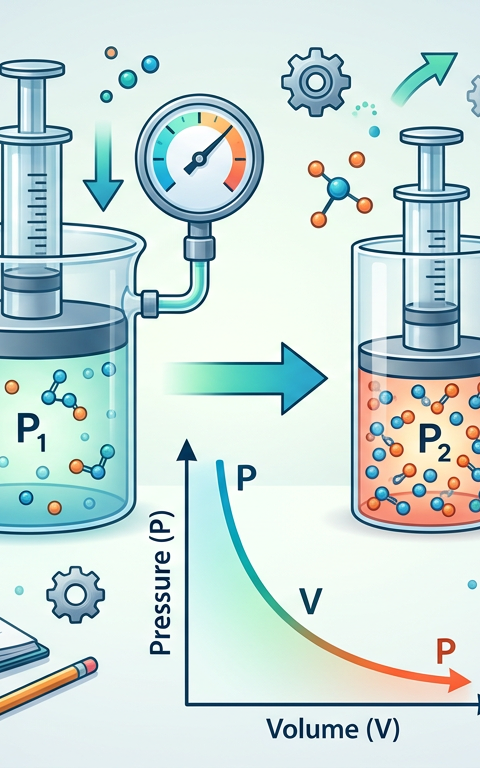
Solve Boyle's Law Problems Without Flipping the Pressure Ratio
Master Boyle’s Law with these easy practice questions and step-by-step solutions. Learn how pressure and volume interact at constant temperatures.
Apr 2, 2026
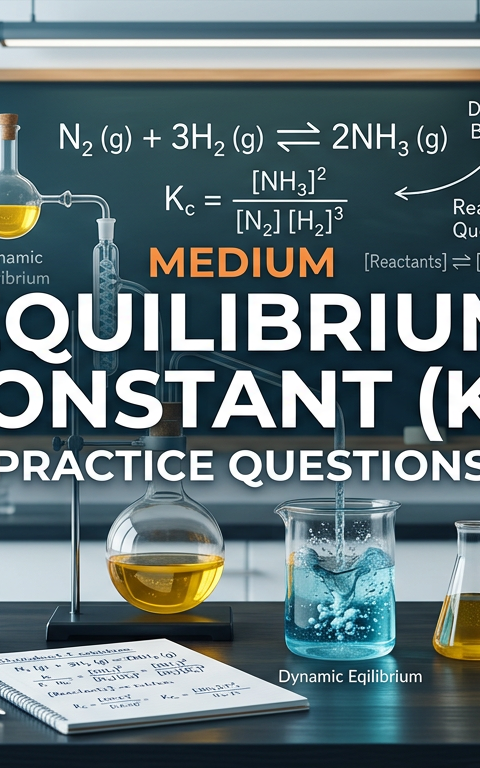
Medium Equilibrium Constant (Kc) Practice Questions
Medium Equilibrium Constant (Kc) Practice Questions
Mar 30, 2026
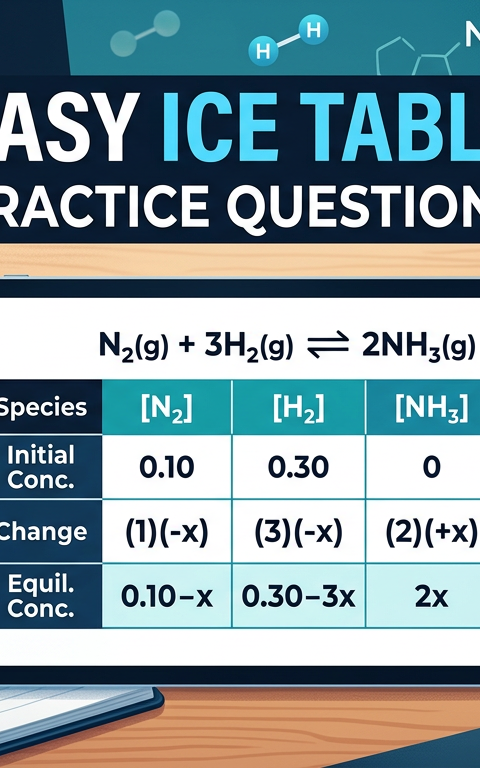
Solving Equilibrium Problems Without Losing Your Stoichiometry
Master chemical equilibrium with these easy ICE table practice questions. Learn to calculate concentrations and K values with step-by-step solved examples.
Mar 30, 2026
Easy Equilibrium Constant (Kc) Practice Questions
Master the basics of chemical equilibrium with our easy Equilibrium Constant (Kc) practice questions, including step-by-step solved examples and a quick quiz.
Mar 30, 2026

Calculating Enthalpy Changes Using Bond Enthalpy Data
Master bond energy calculations with our comprehensive guide. Includes solved examples, practice questions, and detailed explanations for chemistry students.
Mar 29, 2026
Calculating Enthalpy Changes: Hess’s Law Puzzle Solving Guide
Master Hess’s Law with our comprehensive guide featuring solved examples, step-by-step practice questions, and detailed answers for chemistry students.
Mar 29, 2026
Mastering the Log Ratio: Henderson-Hasselbalch Buffer Problems
Master the Henderson-Hasselbalch equation with our detailed guide, solved examples, and practice problems to ace your chemistry exams.
Mar 28, 2026