Best Study Tips for Exams: Master Your Finals Like a Pro

Success in academics isn't about working harder; it’s about working in alignment with how your brain actually functions. Utilizing effective study tips for exams can mean the difference between staring blankly at a test paper and recalling complex formulas with ease. Whether you are navigating a massive medical board exam or a high school history final, understanding the mechanics of memory allows you to bypass the stress of last-minute panic.
Most students default to reading and highlighting, but these are statistically the least effective ways to learn. Instead, high achievers focus on cognitive efficiency. By the time you finish this guide, you will have a toolkit designed to turn your brain into a high-speed data processor, ensuring you walk into your next exam with total confidence.
1. Understanding the Science of Learning: Why Cramming Fails
Cramming fails because your brain has a structural limit on how much new information it can move from short-term to long-term memory in a single window. When you pull an all-nighter, you are essentially trying to pour a gallon of water into a thimble; most of it simply spills over and disappears. This is why studying effectively requires a rhythmic approach rather than a frantic one.
The Ebbinghaus Forgetting Curve
In the late 19th century, psychologist Hermann Ebbinghaus discovered that humans lose roughly 70% of new information within 24 hours if no attempt is made to retain it. This phenomenon, known as the Forgetting Curve, illustrates that memory is a "use it or lose it" system. To combat this, you must interrupt the curve by reviewing material at specific intervals. You can explore this further in our guide on The Forgetting Curve: Why We Forget.
Neuroplasticity and Neural Pathways
Learning is a physical process. When you study, your neurons form new connections called synapses. Think of a new concept like a path through a dense forest; the first time you walk it, the path is barely visible. Every time you revisit that information, you "tread" the path deeper, making it easier to navigate. Passive reading doesn't tread the path; it’s like looking at a map without ever leaving your house.
The Role of Sleep in Memory Consolidation
Sleep is when the real "saving" happens. During the REM and slow-wave sleep cycles, your hippocampus replays the day’s learning and transfers it to the neocortex for long-term storage. Research from Harvard Medical School suggests that sleep deprivation doesn't just make you tired, it actually blocks the brain's ability to form new memories. If you don't sleep after studying, you are essentially hitting "delete" on your hard work.
Ready to Supercharge Your Memory?
Access custom practice sets designed to make your study sessions twice as productive.
Get Started Free2. High-Impact Study Strategies for Maximum Retention
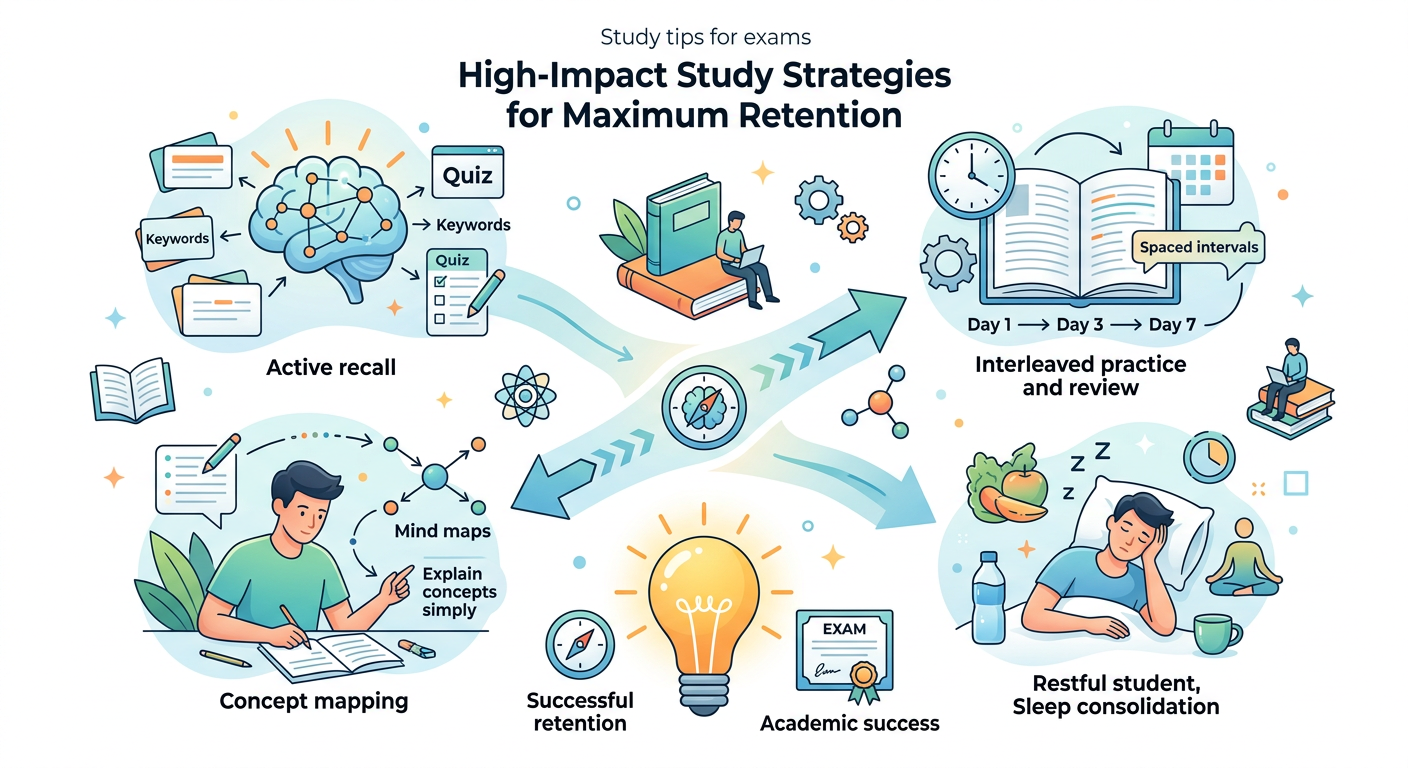
Active study tips for exams focus on retrieval rather than recognition. Recognition is when you look at your notes and think, "I know this," only to find you can't explain it during the test. Retrieval is the hard work of pulling an answer out of your brain without looking, which is what builds true mastery.
Active Recall vs. Passive Review
Active recall techniques are the gold standard of learning. Instead of reading a chapter three times, read it once and then close the book. Write down everything you remember or answer practice questions immediately. Dealing with ICE table practice questions or other specific technical problems forces your brain to engage in this high-level retrieval process.
Spaced Repetition Systems (SRS)
The spaced repetition method involves reviewing information at increasing intervals: 1 day later, 3 days later, 1 week later, and 1 month later. This timing hits the "sweet spot" where you are just about to forget the information, forcing the brain to work harder to recall it. Apps like AIflashcard.net or standard flashcards are perfect for implementing this strategy to ensure items move into your permanent knowledge bank.
The Feynman Technique: Teach it to Learn It
Named after physicist Richard Feynman, this technique requires you to explain a concept to a metaphorical six-year-old. If you cannot explain a topic in simple terms without using jargon, you don't understand it well enough. This method exposes "knowledge gaps", the specific parts of a concept where your understanding is fuzzy. It’s one of the most proven science-backed strategies available to students today.
Mind Mapping for Visual Learners
Mind mapping helps you see the "big picture" by connecting central ideas to sub-topics through branches. This is particularly effective for subjects like history or literature where relationships between events or characters are more important than isolated facts. Use different colors to stimulate visual memory and create spatial associations that are easier to recall during high-stress exams.
3. Building the Ultimate Exam Study Schedule
A study schedule for students is often a list of things they hope to do, but a successful one is a rigid framework of time-blocked tasks. To build one that works, you need to move away from "studying for four hours" and toward "solving 20 stoichiometry problems in 60 minutes."
The Power of Interleaving Subjects
Interleaving is the practice of mixing different topics or subjects within a single study session. While it feels harder than focusing on one subject (blocking), research shows it leads to better long-term retention. Fore example, by switching between Le Chatelier's Principle and biology definitions, your brain learns to distinguish between different types of problems, which is exactly what you’ll have to do on the real exam.
How to Use the Pomodoro Technique Correctly
The Pomodoro technique for studying involves 25 minutes of deep focus followed by a 5-minute break. After four cycles, take a longer 30-minute break. The secret is the "hard stop", when the timer goes off, you must stop, even if you are in the middle of a sentence. This creates a sense of urgency and prevents the mental fatigue that leads to mindless scrolling on social media.
Prioritizing Topics: The ABCDE Method
Conduct a 'syllabus audit' before you start. Assign each topic a letter: 'A' for things that are definitely on the test and you don't know, down to 'E' for things that are optional or you’ve mastered. Always tackle your 'A' tasks first when your energy is highest. Setting SMART goals (Specific, Measurable, Achievable, Relevant, Time-bound) ensures that every session has a clear "win" state.
4. Optimizing Your Physical and Mental Study Environment
Where you study is just as important as how you study. Your environment acts as a series of triggers; if you study in bed, your brain is primed for sleep, not for improving concentration while studying. You need a dedicated space that signals "work mode" the moment you sit down.
Creating a Distraction-Free Zone
Clear your desk of everything except the materials you need for the current task. Visual clutter leads to mental fatigue. Ensure your space has natural light if possible, as it helps regulate your circadian rhythm and keeps you alert. If you are in a noisy dorm, use white noise machines or noise-canceling headphones to create a cognitive bubble.
The 'Focus Mode' Digital Minimalist Strategy
Your phone is the single greatest threat to your GPA. Use apps like Forest or Freedom to lock your devices during study blocks. If you find yourself reflexively checking Instagram, leave your phone in another room. The goal is to reduce the "friction" of staying focused and increase the friction of getting distracted. For more on this, see our ultimate guide to smart studying.
Best Power Foods for Brain Health
What you eat affects your cognitive clarity. Avoid "sugar crashes" from candy or soda. Instead, opt for complex carbohydrates and healthy fats. Blueberries, walnuts, and fatty fish (rich in Omega-3s) have been linked to better focus and memory. According to the Mayo Clinic, staying hydrated is equally vital, as even mild dehydration can impair short-term memory and concentration.
5. Subject-Specific Study Tactics: Science, Humanities, and Math
General study tips for exams are great, but different subjects require different cognitive tools. You wouldn't use a hammer to turn a screw; don't use rote memorization for a calculus test.
Mastering Quantitative Subjects (Math & Physics)
In math and physics, your goal is pattern recognition. Don't just read the solutions in the back of the book. Work through dozens of problems, such as Kp calculations or complex mechanics problems. Once you can identify which formula to use for a word problem without checking your notes, you have achieved mastery. Use "no-calculator" practice to strengthen your mental arithmetic for timed conditions.
Strategies for Rote Memorization in Biology and History
When you have a mountain of facts to memorize, use mnemonics and "memory palaces." Associate a list of terms with specific rooms in your childhood home. For biology, visualize the cellular processes as a factory floor. If you are preparing for a chemistry final, practicing enthalpy change questions repeatedly helps solidify the definitions of exothermic and endothermic reactions through application.
Essay Prep and Thesis Outlining for Humanities
For humanities exams, don't try to memorize entire essays. Instead, memorize "skeleton outlines", a thesis statement, three core arguments, and two pieces of evidence for each. This allows you to stay flexible regardless of the specific prompt given. Focus on understanding the "why" behind historical events rather than just the "when."
6. Exam Day Performance and Stress Management
Even the best preparation can be undone by poor test-day execution. Managing memory hacks for exams is only half the battle; the other half is emotional regulation. If your heart is racing, your prefrontal cortex, the part of the brain responsible for logical thinking—shuts down.
Deep Breathing and Mindfulness for Test Anxiety
If you feel panic rising, use the "Box Breathing" method: inhale for 4 seconds, hold for 4, exhale for 4, and hold for 4. This physiological hack forces your nervous system to switch from "fight or flight" back to "rest and digest." Scientific studies published in National Institutes of Health (NIH) journals confirm that brief mindfulness exercises can significantly reduce cortisol levels during high-stakes testing.
Strategic Guessing and Time Management
Use the "First Pass" method. Go through the entire exam and answer only the questions you are 100% sure about. This builds momentum and ensures you don't leave easy points on the table because you got stuck on a hard question at the beginning. If you must guess on a multiple-choice question, eliminate the two most obvious wrong answers first to move your odds from 25% to 50%.
The 24-Hour Pre-Exam Checklist
The day before the exam, stop intense studying by 6:00 PM. Gather your pens, student ID, and water bottle. Review your "condensed" notes, the one-page summary of your most difficult concepts, but do not learn anything new. If you followed a step-by-step guide leading up to this point, the final 24 hours should be about maintaining your mental state, not building it.
Master Your Exams with Precision
Stop guessing and start mastering. Our interactive database of practice questions and AI-powered study tools are designed to help you ace your finals in record time.
Get Started FreeFrequently Asked Questions
How can I study for an exam in 24 hours?
Focus exclusively on high-yield topics and use active recall. Avoid re-reading and instead solve as many practice problems as possible. Prioritize getting at least 6 hours of sleep to ensure your brain can actually retrieve the information the next morning.
What is the best study method for long-term retention?
A combination of spaced repetition and the Feynman technique is most effective. This ensures you both understand the deep logic of the subject and can recall it at specific intervals to prevent the forgetting curve from taking effect.
How many hours should I study per day for finals?
Quality beats quantity. Most students find that 4 to 6 hours of high-intensity Pomodoro sessions are more effective than 10 hours of semi-distracted "studying" at a library desk. Always include frequent breaks to prevent cognitive burnout.
Does listening to music help you study better?
It depends on the music. Instrumental, lo-fi, or classical music can help mask distractions and maintain a steady flow. However, music with lyrics often competes for the same cognitive processing power you need for reading and writing, which can reduce efficiency.
How do I manage exam anxiety and stress?
Practice "exam simulations" by taking timed practice tests in a quiet room. The more you normalize the testing environment, the less "scary" it becomes. On the day of, use deep breathing techniques to keep your heart rate stable.
Enjoyed this article?
Share it with others who might find it helpful.
Related Articles

How to Solve Molarity Problems: Step-by-Step Mastery
Learn how to solve molarity problems step-by-step with formulas, unit tips, and worked examples so you can calculate concentration with confidence.
Mar 26, 2026

Avoid These 7 Common Molarity Mistakes in Chemistry
Master chemistry calculations! Avoid common molarity mistakes with our expert guide on unit conversions, dilution errors, and proper lab techniques.
Mar 26, 2026

What Is Molarity? The Complete Guide to Molar Concentration
Master molarity with our complete guide. Learn the formula, step-by-step calculations, and the critical differences between molarity and molality.
Mar 26, 2026
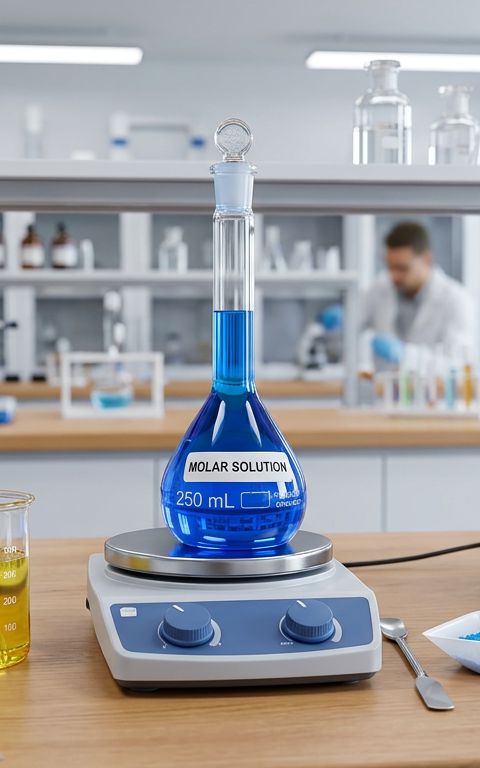
Why Molarity Matters: Converting Mass to Moles for Lab Solutions
Master chemistry with our guide to the molarity formula. Learn how to calculate concentration with step-by-step examples, units, and practical lab tips.
Mar 26, 2026
Molarity vs Molality: The Essential Difference Explained
Master the difference between molarity vs molality. Learn the formulas, key differences, and when to use each in this comprehensive chemistry guide.
Mar 26, 2026