How to Study for Exams Using Practice Testing
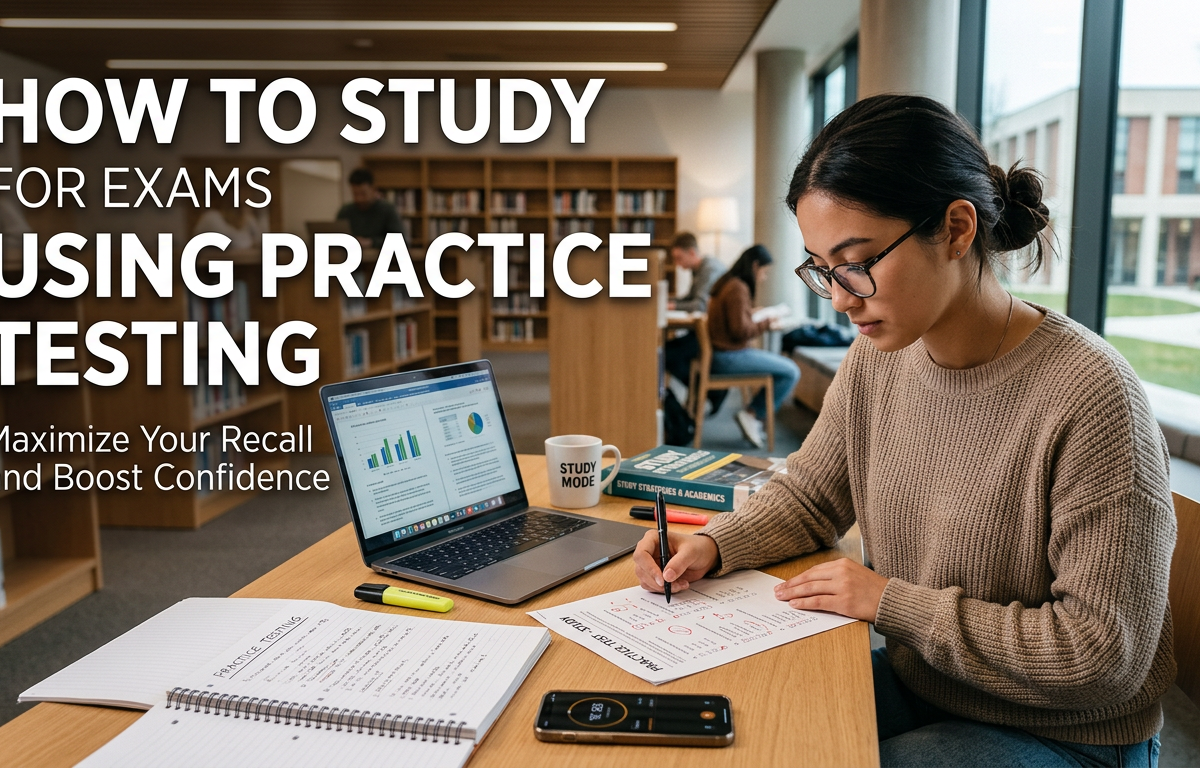
Practice testing is one of the most powerful learning strategies available, involving the active retrieval of information from memory to strengthen long-term retention. Unlike passive review methods like highlighting or rereading, practice testing forces your brain to reconstruct knowledge, creating durable neural pathways that make it easier to recall facts under pressure. Research consistently shows that students who engage in regular self-testing outperform those who rely on traditional study methods, making it an essential tool for anyone looking to improve their grades. By integrating this technique into your routine, you can transform the way you prepare for midterms and finals.
What is Practice Testing and Why Does It Work?
Practice testing is an evidence-based learning strategy that requires students to answer questions or recall information without looking at their notes. This method leverages the "testing effect," a psychological phenomenon where the act of retrieving information from memory significantly increases the likelihood of remembering that information later. According to the American Psychological Association, self-testing is far more effective than passive study habits because it identifies gaps in knowledge and forces the brain to organize information more logically.
To understand why this is effective, we must look at how the brain processes data. When you read a textbook, you are primarily using recognition memory. You feel like you know the material because it looks familiar. However, exams require recall memory: the ability to pull information out of your head without a prompt. Practice testing bridges this gap. It serves as a "mental workout" that strengthens the connections between different concepts. For more on the science behind these strategies, check out our guide on Evidence-Based Study Methods: 8 Science-Backed Ways to Ace Exams.
How to Use Practice Testing for Different Subjects
Developing a successful practice testing routine involves tailoring your retrieval methods to the specific demands of the subject you are studying. While flashcards might work for vocabulary, complex subjects like chemistry or physics require problem-based retrieval. For example, if you are studying thermodynamics, you shouldn't just memorize the definition of enthalpy; you should actively solve Enthalpy Change Practice Questions with Answers to ensure you can apply the theory to numerical problems.
Quantitative Subjects (Math and Science)
In STEM fields, practice testing should focus on problem-solving. Instead of looking at a solved example in your textbook, cover the solution and try to work through it from scratch. This is particularly useful for topics involving complex calculations. You can find specific resources to test yourself, such as ICE Table Practice Questions with Answers, which provide the necessary rigor to prepare for chemistry exams.
Qualitative Subjects (History and Literature)
For humanities, practice testing often involves essay prompts or concept mapping. Try to write out the causes of a historical event from memory or explain a literary theme to an imaginary audience. This helps you synthesize information rather than just memorizing dates and names.
The Benefits of High-Frequency Practice Testing
Regular practice testing reduces test anxiety and improves time management by familiarizing students with the format and pressure of an actual examination. When you test yourself frequently, the actual exam becomes just another session of retrieval, which lowers the cortisol levels associated with high-stakes testing. A study published in Nature Partner Journals: Science of Learning highlights that frequent low-stakes testing is one of the most robust ways to enhance classroom performance.
Beyond anxiety reduction, practice testing provides immediate feedback. You quickly learn what you don't know, allowing you to focus your remaining study time on your weakest areas. This is a core component of learning how to study smart for exams. Instead of spending hours reviewing material you already understand, you can target specific gaps, such as mastering Kp Calculations Practice Questions with Answers if you struggle with gas-phase equilibria.
Steps to Implement Practice Testing in Your Routine
To implement practice testing effectively, you must move beyond simple rote memorization and incorporate varied formats that challenge your understanding. Start by identifying the core concepts of your syllabus and creating a schedule that alternates between different topics. This approach, known as interleaving, is more effective than focusing on a single topic for hours.
Create your own questions: While reading, write down questions based on the text. Return to these questions 24 hours later to test your recall.
Use past papers: Obtain previous exams from your instructor. These are the gold standard for understanding question phrasing and difficulty.
Utilize digital tools: Platforms like Anki or Quizlet allow you to use spaced repetition alongside practice testing.
The Blank Page Method: Take a blank sheet of paper and write down everything you remember about a topic. Compare it to your notes afterward to see what you missed.
Teach someone else: Explaining a concept to a peer requires you to retrieve and organize information, which is a form of verbal practice testing.
Common Mistakes to Avoid with Practice Testing
The most common mistake students make with practice testing is checking the answers too early, which prevents the brain from doing the hard work of retrieval. If you look at the solution the moment you feel stuck, you are essentially reverting to passive reading. You must give yourself at least 60 to 90 seconds of focused effort to recall the information before consulting your notes.
Another error is "massed practice," or cramming all your practice tests into a single day. The brain requires time to consolidate information. It is better to do 20 minutes of practice testing every day for a week than to do three hours on a Sunday. This distributed practice ensures that the information moves from short-term to long-term memory. For more strategies on avoiding these pitfalls, see our article on how to ace your exams without rereading.
FAQs About Practice Testing
Is practice testing better than rereading?
Yes, practice testing is significantly more effective than rereading because it requires active retrieval, which builds stronger neural pathways. Rereading often creates an "illusion of competence" where you recognize the text but cannot recall it during an exam.
How often should I use practice testing?
You should use practice testing in every study session. Start with a quick review of the previous day's material through retrieval and end your session by testing yourself on the new concepts you just covered.
Can I use practice testing for essay-based exams?
Absolutely. For essay exams, practice testing involves outlining arguments from memory or writing timed practice essays. This trains your brain to organize complex thoughts quickly under exam conditions.
What should I do if I get most of the questions wrong?
Getting questions wrong is a valuable part of the process. It highlights exactly what you need to relearn. Review the correct answers, wait a few hours, and then test yourself on those specific questions again until you get them right.
Start Learning Smarter Today
Join thousands of students using AI-powered study tools to achieve better results.
Get Started FreeEnjoyed this article?
Share it with others who might find it helpful.
Related Articles

How to Solve Molarity Problems: Step-by-Step Mastery
Learn how to solve molarity problems step-by-step with formulas, unit tips, and worked examples so you can calculate concentration with confidence.
Mar 26, 2026

Avoid These 7 Common Molarity Mistakes in Chemistry
Master chemistry calculations! Avoid common molarity mistakes with our expert guide on unit conversions, dilution errors, and proper lab techniques.
Mar 26, 2026

What Is Molarity? The Complete Guide to Molar Concentration
Master molarity with our complete guide. Learn the formula, step-by-step calculations, and the critical differences between molarity and molality.
Mar 26, 2026
Why Molarity Matters: Converting Mass to Moles for Lab Solutions
Master chemistry with our guide to the molarity formula. Learn how to calculate concentration with step-by-step examples, units, and practical lab tips.
Mar 26, 2026
Molarity vs Molality: The Essential Difference Explained
Master the difference between molarity vs molality. Learn the formulas, key differences, and when to use each in this comprehensive chemistry guide.
Mar 26, 2026