Study Schedule for Exams: Proven Plan to Ace Your Tests

You build a stronger brain when you follow a study schedule for exams. A clear plan slashes decision fatigue, spaces practice over days, and protects time for the techniques that actually move scores. It also keeps nerves in check, because you always know what to do next and when.
What Is a Study Schedule for Exams?
A study schedule for exams is a time-bound plan that maps what you’ll study, when you’ll study, and how you’ll review until test day. It reduces decision fatigue by turning “What should I do now?” into a short list of pre‑decided blocks you simply execute.
The benefits are real. The spacing effect shows that distributing practice over time boosts retention compared with massed cramming; university learning centers consistently recommend spaced practice as a top method (UNC Learning Center). Add the testing effect, retrieving information from memory improves long‑term recall over rereading, and your exam study plan starts compounding gains with each session (APA on retrieval practice). Consistency, not heroic marathons, drives results.
An effective plan includes six essentials: clear goals, a topic list with weightings, time blocks, review cycles (a spaced repetition schedule), buffers, and rest. You can call it a study timetable, study calendar template, or finals week schedule, if it covers those six, it’ll work.
Skip the myths. More hours don’t automatically beat quality hours. Last‑minute cramming produces short-term fluency that fades fast. And there’s no one-size-fits-all schedule; the right study schedule for exams matches your course mix, energy patterns, and deadlines. For a broad strategy primer, see Master Your Exams: The Ultimate Guide to Smart Studying.
Step-by-Step: Build Your Exam Study Schedule

You build a strong study schedule for exams by listing dates and topics, estimating hours, prioritizing high-yield areas, time-blocking sessions, and layering review cycles and buffers. Here’s the process you can finish in under an hour.
First, inventory every syllabus. Record exam dates, topics, and weightings in a single sheet. Note format (multiple choice, short-answer, essay), open/closed book rules, and allowed aids (formula sheet, calculator, notecards).
Next, work backward. If your calculus final is in 21 days and you estimate 18 focused hours to cover derivatives, integrals, and word problems, you need roughly 6 hours/week. Do this for each course. Then compare weekly hours needed vs. hours available on your calendar. If the gap is >20%, trim scope or add time, don’t assume future you will find extra energy.
Now prioritize by weakness and impact. Rank topics by payoff: high weight × low confidence goes first. For example, if stoichiometry is 25% of the grade and you’re shaky, it outranks a 5% lab safety quiz. Tackle high‑yield topics early to bank points.
Time‑block your week using 25/5, 50/10, or 90/20 cycles (work/break). Pick 25/5 (Pomodoro study routine) when you feel resistance, 50/10 for moderate depth, and 90/20 for deep problem solving. Assign SMART goals to each block: “Finish 20 practice derivatives at 85%+” beats “study calculus.”
Build review cycles and buffers. Use a simple spaced repetition schedule, review on days 1, 3, 7, 14, 30 after first learning, or automate it with flashcards. Add 10–20% buffer time to every week and one catch‑up day to absorb overruns. Color‑code by subject to view cognitive load at a glance and avoid stacking two heavy subjects back‑to‑back.
Finally, balance your week. Mix problem-heavy blocks (STEM) with lighter reading or summarizing (humanities). If you must double up, separate hard blocks with a walk or admin task to reset attention. For a plug‑and‑play outline, see How to Study for Exams Step‑by‑Step.
Pick Evidence-Based Study Techniques
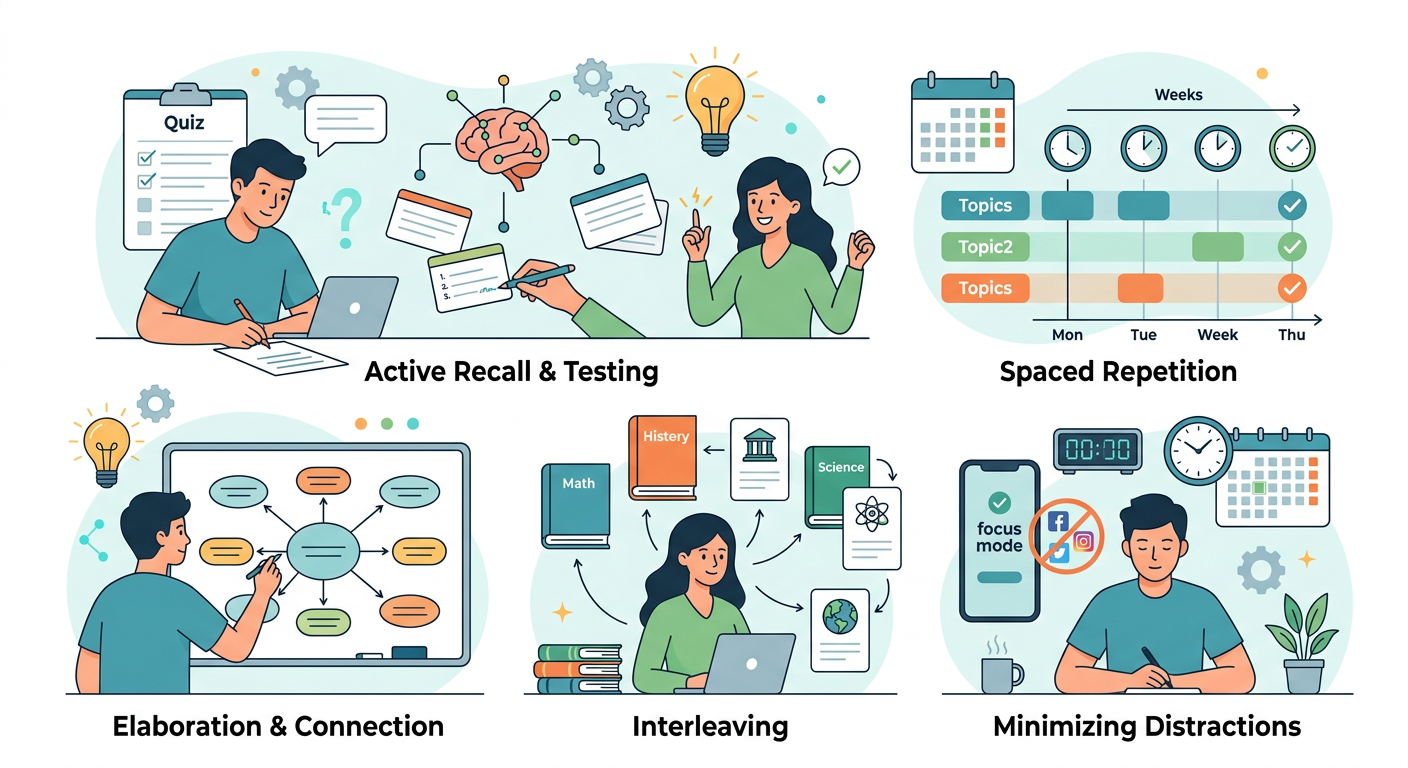
The best study schedule for exams uses active recall and practice testing as the default, then layers spacing, interleaving, and deliberate breaks. These methods win in randomized studies and classroom trials.
Lead with retrieval. Do closed‑book practice questions, past papers, or self‑quizzing before any open‑book review. Retrieval exposes gaps fast and improves retention more than rereading. If you want a walkthrough, start with How to Study for Exams Using Active Recall and follow with Practice Testing for building mock‑exam stamina.
Make spacing simple. Use a 1–3–7–14–30 day ladder for new material. Tools like Anki or Quizlet can automate scheduling and track stability of your recall intervals. Research summaries highlight spacing and retrieval as high-utility strategies for long-term learning (Psychological Science in the Public Interest).
Match session length to task depth. Use 50/10 for readings and outlines; use 90/20 for proofs, case analyses, or lab calculations. Keep breaks screen‑free to allow your attentional system to recover. A short walk or stretch beats a scroll.
Interleave topics. Alternate subjects and problem types in the same block to strengthen discrimination and transfer. For example: 3 calculus integrals, 3 physics kinematics, 3 chemistry equilibrium questions, repeat. Close the loop with an error log and a one‑page summary per topic, write the key formulas, rules, and common traps you keep missing.
Start Learning Smarter Today
Plan your study schedule for exams, run Pomodoro timers, and automate spaced reviews—all in one dashboard. Stop guessing and start executing with Bevinzey Tools & Modules.
Get Started FreeSample Study Schedule for Exams by Timeline

You can shape a study schedule for exams around your runway: one week, a few weeks, or a full semester. Here are concrete blueprints you can tweak.
One‑week accelerated plan (smart cramming): Day 1 triage your topics using weight × weakness. Days 1–5 run 3–4 mixed practice blocks per day (50/10), and every night do a light 20‑minute flashcard review. Slot two timed mini‑mocks (40–60 minutes) on Days 3 and 5; analyze errors the same day.
Two‑ to four‑week plan: Weekdays feature two focus blocks after class (50/10 or 90/20), with rotation by subject. Weekends host one full timed mock per major course, followed by targeted error repair. Spaced reviews hit at 1, 3, and 7 days for each new chunk you learn. For a done‑for‑you template, see our 7‑Day Exam Study Plan and extend its structure to 14 or 28 days.
Six‑ to twelve‑week semester plan: Use spiral review. Weeks 1–4: light load, breadth first. Weeks 5–8: deepen problem sets, add weekly mocks. Weeks 9–12: consolidate, interleave, and run two full dress rehearsals per course. Schedule a deload week every 4th week by cutting total volume 30% to prevent burnout. If you want a full roadmap, try The Ultimate 30‑Day Study Plan as a building block.
If you work part‑time or full‑time, anchor two predictable AM/PM blocks (e.g., 6:30–7:30 a.m. and 7:00–8:30 p.m.), stack micro‑sessions of 10–15 minutes for flashcards during commutes, and protect one long weekly block (2–3 hours) on the weekend. Keep expectations realistic: 8–12 focused hours/week beats a fantasy 20 that never happens. For science‑backed tactics to maximize limited time, see The Best Way to Study for Exams.
Daily and Weekly Templates for Your Study Schedule for Exams
The ideal week includes five study days, one consolidation day, and one true rest day. Theme days by subject or task type to reduce context switching.
Weekly layout example: Mon (Calculus + flashcards), Tue (Chemistry + lab write‑ups), Wed (Psych + essay outlines), Thu (Calculus + Physics), Fri (Mixed review + admin), Sat (Mock exam + deep review), Sun (Rest). That’s a study timetable your brain can trust.
A focused study day: Run 3–4 blocks. Block 1 practice (closed‑book). Block 2 review and fix errors. Block 3 summarize and teach back. End with a 5‑minute “tomorrow plan” so morning you starts fast. Protect 10–20% of the day as buffer space.
Morning vs. evening: Match study to your chronotype. If you’re sharper before noon, put heavy lifting there. Keep sleep consistent; avoid heavy late‑night sessions within 24 hours of a big exam, as sleep drives memory consolidation (CDC on sleep and performance).
Weekend catch‑up and consolidation: Run one full mock, then spend equal time analyzing it. Do admin tasks, printing formula sheets, packing your bag, emailing questions, booking office hours, so weekdays stay focused. Build in buffer days to absorb surprises without panic.
Tools and Templates to Make It Stick
Use simple tools to lock your study schedule for exams into your calendar and brain. The goal isn’t fancy; it’s frictionless.
Digital calendars: Time‑block in Google Calendar. Set default durations (50 or 90 minutes), alerts at start and 5 minutes before, and color coding per subject. Create recurring “Review Ladder” events at 1–3–7–14–30 days for new topics to automate your spaced repetition schedule.
Task managers and dashboards: Use Notion, Trello, or Asana to Kanban your topics: To Learn, Practicing, Mastered. Track percent complete and surface today’s priorities. For method choice and scheduling logic, peek at our Evidence‑Based Study Methods.
Flashcards and notes: Leverage Anki or Quizlet to schedule retrieval. Pair with Cornell notes and one‑page summary sheets to convert lectures into prompts, not paragraphs. Active cards beat pretty notes.
Printable study calendar template: Create a monthly grid labeled in MM/DD format with daily checkboxes for “Focus,” “Review,” and “Mock.” Example instructions: print a blank month, write exam dates in red, block 3–4 weekly focus sessions in blue, schedule 1–2 mocks in black on weekends, and add green checkmarks when done. Keep the sheet on your desk as a public commitment.
Optimize Focus, Energy, and Environment
Set up a distraction‑proof study zone and guard your energy so your study schedule for exams pays off. Even a 10% focus bump adds hours over a month.
Environment: Aim for bright but indirect light, a comfortable chair, and minimal clutter. Libraries and quiet campus spaces often set the tone better than bedrooms. Keep pens, a timer, and water within arm’s reach.
Sleep and nutrition: Target 7–9 hours. Eat protein‑forward meals and time caffeine 60–90 minutes after waking to avoid a mid‑morning crash. Breaks should include movement: two 5‑minute walks per hour can lift alertness without spiking stress (HBR on timeboxing and energy).
Phone and apps: Use Focus modes and app/site blockers like Forest or Freedom. Batch notifications and messages at set times so your prefrontal cortex isn’t whiplashed.
ADHD‑ and anxiety‑friendly tweaks: Try body‑doubling (study beside a friend or on a focus call), short sprints (15–20 minutes), external accountability (shared calendar), and bite‑sized tasks (“Do 5 problems,” not “Study chapters 3–5”). Small wins stack confidence.
Track Progress and Adjust Your Plan
Review your study schedule for exams every week and adjust based on data, not vibes. A 15‑minute check‑in saves hours of drift.
Weekly review checklist: Compare plan vs. done. Identify blockers (noise, unclear goals, fatigue). Update next week’s blocks to fix the top one or two bottlenecks. Book any office hours you need.
Metrics to watch: Q‑bank accuracy (% correct), recall interval stability (how often Anki says “again”), hours in deep work, and mock scores and timing. If accuracy stalls below 70% for a topic, increase practice intensity or seek help.
How to catch up: Triage low‑yield topics, increase practice density (timed sets), and add temporary buffers. Re‑allocate time based on exam proximity and weight. Communicate with professors or tutors early—clarity beats silent worry. For targeted practice methods, read Study Without Rereading.
Review Week and Exam‑Day Strategy
Use review week to consolidate, not to chase new content. Treat it like a taper before a race.
Final review checklist: Focus on summaries, formula sheets, top flashcards, and your error logs. Create a one‑page “If I blank, do this” checklist for each course to calm nerves.
Mock exams: Replicate conditions that is timing, allowed materials, no music, no pausing. After, analyze errors and fix root causes the same day. That loop is where scores jump.
Day‑before pacing: Light review, brief movement, and an early bedtime. Pack your ID, allowed calculator, pencils, snacks, and water. Morning‑of: eat a steady breakfast, arrive early, and use a 4‑4‑4 box breath (inhale 4, hold 4, exhale 4) to reset your stress response.
Avoid These Common Study Schedule Mistakes
Avoid overplanning without action by launching with a tiny first task: open the book, set a 5‑minute timer, and write three prompts. Then iterate weekly instead of perfecting the plan upfront.
Skip passive review. Replace rereading with active recall, teaching a concept aloud, or doing five past questions. Log key takeaways after each session.
Protect rest days and 10–20% buffers so you can stay on track when life happens. Keep an error log and hit weaknesses daily with short, focused drills. For technique refreshers, see Proven Study Techniques for Success.
Special Cases and Exam Types
When multiple exams land in the same week, rotate subjects and weight by date and importance. Maintain 15–20 minutes of nightly maintenance review for each course to keep facts warm.
For open‑book and take‑home exams, build searchable outlines and tabbed sections. Practice under time limits using your actual materials so you learn to navigate quickly, not just read slowly.
Standardized tests (SAT, ACT, GRE) need a longer runway (8–12+ weeks). Drill section‑specific skills, run official practice tests, and use analytics to find timing issues. For finals week schedule ideas that fit tight timelines, check How to Study for Exams Fast.
STEM courses reward problem sets and worked examples; essay‑heavy courses reward timed outlines and thesis reps. Build your study schedule for exams around the task that earns the most points. For retrieval‑first approaches, try Retrieval Practice for Exams.
Start Learning Smarter Today
Plan your study schedule for exams, run Pomodoro timers, and automate spaced reviews—all in one dashboard. Stop guessing and start executing with Bevinzey Tools & Modules.
Get Started FreeFrequently Asked Questions
How many hours a day should I study for exams?
Most students do well with 2–4 focused hours on weekdays and 4–6 on weekends during peak prep. If you’re working, aim for 8–12 focused hours per week. Measure in completed blocks (e.g., four 50/10s), not clock time.
Is it better to study at night or in the morning?
Study when your energy peaks. Many people produce deeper work before noon, but some hit flow in the evening. Keep sleep consistent and avoid heavy late‑night sessions the night before an exam, as sleep consolidates memory (CDC).
How do I make a study schedule if I have a job?
Anchor two daily blocks (e.g., 60–90 minutes before work and 60–90 after). Add micro‑sessions (10–15 minutes) for flashcards and protect one 2–3 hour weekend block. Keep your plan at 8–12 focused hours/week and scale only if you’re hitting goals easily.
What is the best study schedule for finals week?
Run one full mock early in the week, then alternate high‑yield practice with focused review. Keep nightly light flashcards, maintain one rest evening, and plan the day before as a taper—light review, pack your bag, early sleep. For templates, see Best Study Tips for Finals.
How far in advance should I start studying for exams?
For standard midterms/finals, start 2–4 weeks out. For cumulative or standardized exams, start 8–12 weeks out. If you’re behind, run the one‑week accelerated plan with two mini‑mocks and daily mixed practice.
How long should individual study sessions be?
Use 25/5 to get started or beat procrastination, 50/10 for regular coursework, and 90/20 for deep problem solving or writing. Cap total deep blocks at 3–4 per day to avoid diminishing returns.
References: spacing and retrieval effects are widely supported by cognitive science and educational psychology (UNC Learning Center; APA). Energy management and timeboxing recommendations align with productivity research (Harvard Business Review).
Enjoyed this article?
Share it with others who might find it helpful.
Related Articles

How to Solve Molarity Problems: Step-by-Step Mastery
Learn how to solve molarity problems step-by-step with formulas, unit tips, and worked examples so you can calculate concentration with confidence.
Mar 26, 2026

Avoid These 7 Common Molarity Mistakes in Chemistry
Master chemistry calculations! Avoid common molarity mistakes with our expert guide on unit conversions, dilution errors, and proper lab techniques.
Mar 26, 2026

What Is Molarity? The Complete Guide to Molar Concentration
Master molarity with our complete guide. Learn the formula, step-by-step calculations, and the critical differences between molarity and molality.
Mar 26, 2026
Why Molarity Matters: Converting Mass to Moles for Lab Solutions
Master chemistry with our guide to the molarity formula. Learn how to calculate concentration with step-by-step examples, units, and practical lab tips.
Mar 26, 2026

Molarity vs Molality: The Essential Difference Explained
Master the difference between molarity vs molality. Learn the formulas, key differences, and when to use each in this comprehensive chemistry guide.
Mar 26, 2026