Master Your Exams: Proven Study Techniques for Success

Facing exams can feel daunting, whether you’re a high school student tackling APs or a university scholar preparing for comprehensive finals. Success isn't just about how many hours you clock; it's about employing the right study techniques for exams that align with how your brain best processes and retrieves information. Think of it less as a grueling marathon and more as a strategic game where you refine your approach with every test.
This isn't about cramming the night before, a practice proven to be largely ineffective. Instead, we'll explore science-backed methods designed for deep learning, strong memory retention, and confident test-taking. From understanding your unique learning style to mastering active recall, these strategies build a robust foundation for academic achievement.
Understanding Learning Styles: Finding Your Edge
Identifying your personal learning style is foundational to developing effective study techniques for exams. You wouldn't use a hammer to drive a screw, would you? Similarly, employing study methods ill-suited to your natural inclinations can make learning feel like an uphill battle.
Research suggests that while people may have a dominant style, effective learning often involves a blend. Understanding your primary preference, however, can provide a powerful starting point for optimizing your exam prep strategies.
Visual Learners: Seeing is Believing
Visual learners thrive on imagery, color, and spatial relationships. For them, information truly comes to life when they can see it laid out. If you find yourself remembering charts from a textbook rather than the accompanying text, you likely lean visual.
Specific techniques for visual learners include creating detailed diagrams, flowcharts, or mind maps. Use different colored pens to highlight key sections in notes or textbooks. Visual learners often benefit from watching educational videos or documentaries that explain concepts graphically. Flashcards with images on one side can also be incredibly effective.
Auditory Learners: The Power of Sound
Auditory learners process information best through sound. They often recall what they've heard in lectures, discussions, or even by reading text aloud. If you prefer listening to podcasts or explanations over reading dense chapters, this might be your leaning.
Techniques for auditory learners involve recording lectures and replaying them, participating actively in study groups for verbal discussion, or even creating rhymes and jingles to memorize facts. Reading notes aloud to yourself, explaining concepts to a pet, or using text-to-speech software can reinforce learning through sound.
Kinesthetic Learners: Learning by Doing
Kinesthetic learners learn through direct experience, movement, and hands-on activities. They need to engage physically with the material to truly grasp it. Sitting still for long periods can be challenging for them; they often learn by doing, building, or moving.
For kinesthetic learners, effective strategies include taking frequent breaks to move around, pacing while reciting information, or using physical objects to represent concepts. Think about using manipulatives for math, conducting experiments for science, or even role-playing historical events. Writing notes by hand, rather than typing, can also be a valuable kinesthetic activity.
Tailoring Techniques to Your Style
While identifying your primary style is useful, don't limit yourself. The most robust learning often comes from combining different approaches. For instance, a visual learner might benefit from drawing a mind map (visual) and then explaining it aloud to a study partner (auditory). A kinesthetic learner might watch a video (visual), discuss it (auditory), and then apply the concept through a hands-on project (kinesthetic).
Refine Your Study Approach
Discover personalized insights and tools to match your unique learning style and optimize your exam prep.
Get Started FreeStrategic Planning: Before the Books Open
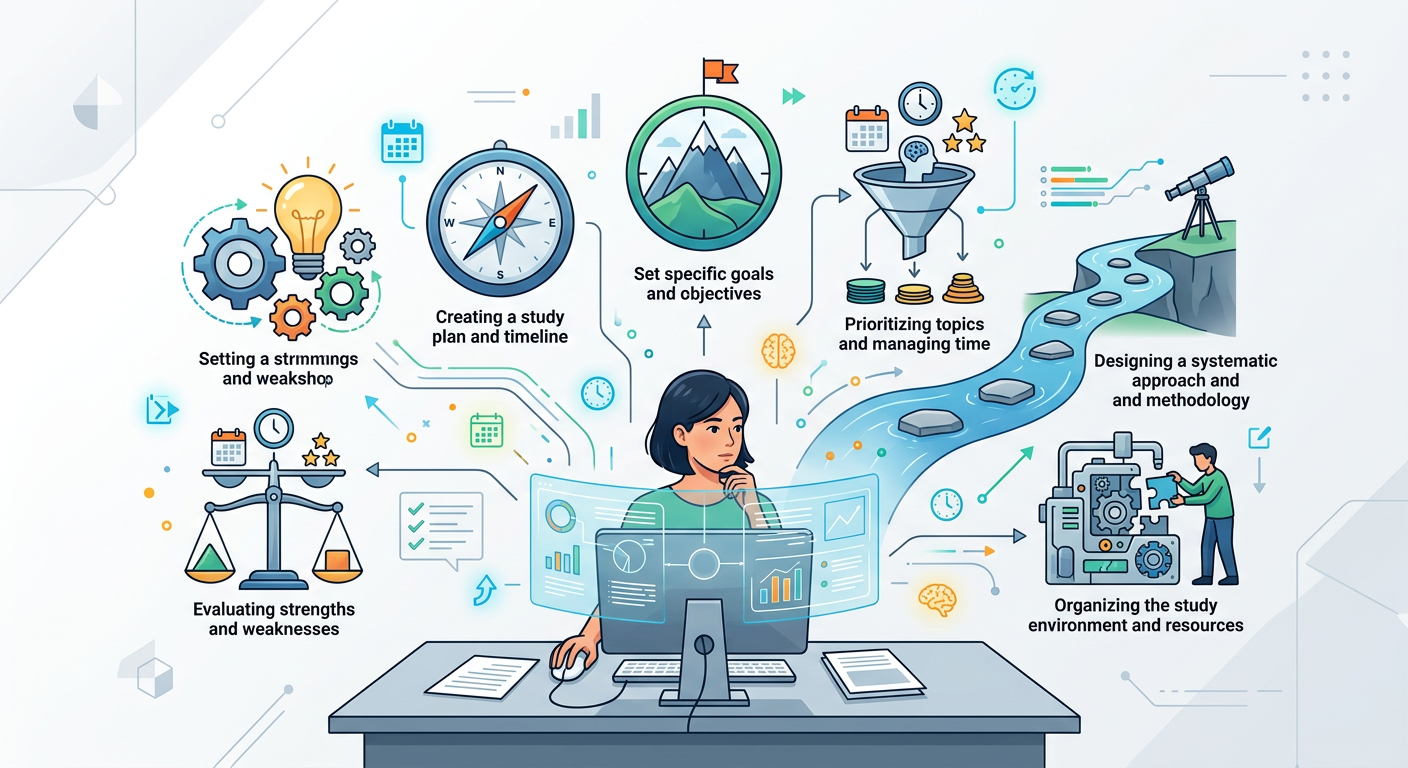
Effective exam prep strategies begin long before you crack open a textbook. Without a solid plan, even the most meticulous study techniques for exams can fall short. Think of it like building a house: you wouldn't start hammering nails before you have blueprints.
Strategic planning provides structure, reduces stress, and ensures you cover all necessary material. It’s about being proactive, not reactive, in your academic life.
Setting SMART Study Goals
Goals provide direction and motivation. Merely saying "I want to do well on the exam" isn't enough. Instead, adopt the SMART framework: Specific, Measurable, Achievable, Relevant, and Time-bound. For example, a SMART goal might be: "By Friday, I will have reviewed chapters 1-3, completed all practice questions for those chapters, and achieved at least 80% on the self-quiz."
Specific goals clarify what you need to do. Measurable goals allow you to track progress. Achievable goals keep you motivated. Relevant goals ensure your efforts align with the exam. Time-bound goals create a sense of urgency and prevent procrastination.
Crafting a Realistic Study Schedule
A well-structured study timetable is your roadmap to success. Don't just block out huge chunks of "study time." Instead, schedule specific subjects and topics. For example, "Monday 2-4 PM: Biology - Chapter 5 active recall and flashcards."
Crucially, build in flexibility while allowing for breaks, meals, exercise, and sleep. Over-scheduling leads to burnout and rarely sticks. Consider using a digital calendar or a planner to visually organize your time. Need to develop effective study habits? Learn more about creating how to study smart for exams effectively.
The Art of Breaking Down Material
Large quantities of material can feel overwhelming. The key is to break them into manageable chunks. If you have five chapters to review for a history exam, don't try to read them all in one sitting. Divide them by topic, concept, or even subheading.
This strategy makes the task seem less daunting and allows you to focus deeply on one section before moving to the next. It also makes it easier to schedule your study sessions and track your progress.
Minimizing Distractions: Creating Your Study Sanctuary
Your environment profoundly impacts your focus. Identify typical distractions – phone notifications, social media, noisy roommates – and proactively minimize them. Turn off non-essential notifications, use website blockers if necessary, and communicate your study hours to those around you.
Find a dedicated study space, whether it's a quiet corner in a library or a tidy desk at home. Ensure it's well-lit, comfortable, and free from clutter. This study sanctuary signals to your brain that it's time to focus, strengthening your concentration.
Active Learning: Engaging Your Brain for Better Retention

Passive learning, like simply re-reading notes or highlighting textbooks, often provides an illusion of knowledge. You recognize the information, but you might not actually recall or understand it. True memory retention tips rely on active engagement, forcing your brain to work hard to retrieve and process information.
This section explores powerful active recall learning methods that are scientifically proven to boost understanding and recall for even the toughest exams. For more on effective strategies, take a look at the best way to study for exams.
The Power of Active Recall: Testing Yourself
Active recall, also known as retrieval practice, is arguably the most potent of all study techniques for exams. Instead of passively reviewing, you force yourself to retrieve information from memory. This process strengthens the neural pathways associated with that information.
How do you do it? After reading a section, close your book and try to explain the key concepts aloud, write them down, or answer self-created questions. Don't just check if you "know" it; prove it by recalling it without prompts. This method helps pinpoint what you truly understand versus what you only vaguely recognize.
Spaced Repetition: The Science of Remembering More
Spaced repetition leverages the natural forgetting curve. Our brains are designed to forget information we don't deem important. Instead of cramming, you review material at increasing intervals over time, just before you're about to forget it. This scientifically optimized scheduling significantly enhances long-term memory.
Tools like AIflashcard.net, Anki or Quizlet incorporate spaced repetition algorithms, making it easy to implement. When you answer a flashcard, you tell the system how well you knew it, and it schedules the next review based on that input. Regularly utilizing these tools is an excellent way to consolidate learning for the long haul.
Elaboration: Connecting New Information to Old
Elaboration involves linking new information to existing knowledge or personal experiences. When you elaborate, you're not just memorizing facts; you're building a richer, more interconnected web of understanding in your brain. This makes the information more meaningful and easier to retrieve.
The Feynman Technique is a prime example of elaboration. Imagine you have to teach the concept to someone else, even a child. If you can explain it simply and clearly, identify areas where your explanation falters, and then go back to the source material to strengthen those weak points, you’ve truly elaborated your understanding. You might find this strategy covered in detail in our guide on how to study for exams step-by-step.
Practice Testing: Simulating Exam Conditions
Practice testing isn't just about assessing what you know; it's a powerful learning tool in itself. By simulating exam conditions, you train your brain to perform under pressure and become familiar with the format and types of questions you might encounter. This also helps reduce test anxiety.
Utilize past exams, textbook questions, or self-created quizzes. Time yourself, don't use notes, and treat it as the real thing. Afterward, review your answers, paying close attention to mistakes. Understand why you got something wrong, not just what you got wrong. For instance, if you're studying chemistry, tackling ICE table practice questions under timed conditions can greatly improve your conceptual understanding and speed.
Effective Note-Taking and Organization
Your notes are more than just a record of information; they are personalized tools for understanding and recall. Simply copying down what a lecturer says or what a textbook states is often a passive act. Effective note-taking and organization transform raw information into a usable format, bolstering your study techniques for exams.
The method you choose should actively engage your brain in processing the material, rather than just transcribing it. Need help with organizing your thought process? Check out this post on the forgetting curve to aid your memory retention.
Beyond Linear: Mind Maps and Cornell Notes
Traditional linear notes, while familiar, can sometimes obscure connections between ideas. Mind maps offer a dynamic, visual approach, radiating ideas from a central theme with keywords, images, and colors. They encourage divergent thinking and can be excellent for brainstorming or summarizing broad topics.
The Cornell Note-Taking System divides your notes into three sections: a main note-taking area, a smaller cue column for keywords and questions, and a summary section at the bottom. This structure encourages active listening and forces you to synthesize information, making review highly efficient.
Summarization Techniques: Condensing Key Information
The act of summarizing compels you to identify the core arguments and most crucial details, separating the signal from the noise. This is an active learning process that strengthens comprehension.
Try the "2-minute rule": after a lecture or reading a chapter, challenge yourself to summarize the main points in just two minutes. Alternatively, create an outline of the material, using only headings and subheadings, then try to fill in the details from memory. This method is particularly useful for identifying gaps in your knowledge and refining test taking skills.
Digital vs. Traditional: Choosing Your Tools
Both digital and traditional note-taking methods have their merits. Handwritten notes, for example, often lead to better memory retention because the slower, more deliberate act of writing forces your brain to process and synthesize information rather than transcribe it verbatim. There's a strong kinesthetic component involved.
Digital notes, however, offer unparalleled organization, searchability, and ease of sharing. Tools like Notion, Evernote, or OneNote allow you to integrate multimedia, link notes, and quickly find specific information. The best approach might be a hybrid: handwriting initial notes for deeper processing, then digitizing and organizing them for easy access and review. Sometimes, digital tools can help with more complex problems, like solving specific hard ICE Table practice questions.
Organizing Study Materials for Quick Access
A cluttered study space often translates to a cluttered mind. Systematize your resources. Use binders or digital folders for each subject or module. Label everything clearly and consistently. For physical notes, color-coding can be very helpful.
The goal is to reduce cognitive load during study sessions. When you need to find a specific concept or worksheet, you want to retrieve it instantly, not waste valuable study time searching. A well-organized system allows for seamless transitions between topics and efficient review.
Mastering Memory: Techniques to Boost Recall
Memory isn't a passive vault; it's an active process of encoding, storage, and retrieval. To truly master your exams, you need study techniques for exams that actively strengthen your ability to recall information. These aren't just clever tricks; they're cognitive shortcuts that can vastly improve memory retention.
Understanding how memory works and applying these specific strategies can transform how you approach even the most fact-heavy subjects. These are powerful exam prep strategies.
Mnemonic Devices: Clever Tricks for Tough Info
Mnemonic devices are memory aids that help you remember difficult-to-recall information by associating it with something easier to remember. They create distinct, often vivid, internal cues that trigger your memory.
Acronyms (like ROY G. BIV for the colors of the rainbow) and acrostics (phrases where the first letter of each word helps you remember a sequence, e.g., "My Very Educated Mother Just Served Us Nine Pizzas" for the planets in order) are common examples. Creating these takes a little effort upfront but can save immense time during recall.
Visualization: Creating Mental Pictures
Our brains are incredibly adept at remembering images. When you translate abstract facts into vivid mental pictures, you make them more memorable. This is particularly effective for remembering sequences, locations, or even complex processes.
Try to create a "memory palace" or "method of loci." Imagine a familiar building (your house, school, etc.) and place pieces of information at distinct locations within it. When you need to recall the information, take a mental walk through your memory palace, retrieving each item as you encounter its associated location.
Chunking: Grouping for Easier Recall
Chunking involves breaking down large pieces of information into smaller, more manageable units or "chunks." Our short-term memory has a limited capacity (often cited as about 7 items, plus or minus 2). Chunking allows us to bypass this limitation by increasing the information contained within each "item."
Think about memorizing a long phone number (e.g., 5551234567). It's easier to remember it as 555-123-4567. For studying, this might involve grouping related facts, dates, or concepts into logical units. For instance, when studying historical events, group together all events related to a specific period or cause.
The Link Method and Storytelling
The Link Method connects items in a list by forming a vivid, often bizarre, image between the first and second item, then the second and third, and so on. The more outlandish the mental image, the more memorable it becomes. For instance, to remember a shopping list, milk, bread, eggs, you might visualize a milk carton wearing a tiny hat made of bread, and the bread is sitting on a giant egg.
Storytelling takes this a step further by weaving a narrative around the information you need to remember. Our brains are hardwired for stories, and creating a narrative (even an absurd one) provides a cohesive structure, making disparate facts feel connected and easier to recall in sequence. This is particularly effective for chronological information or complex processes. You can apply these memory retention tips to topics like Le Chatelier's Principle, by creating a story for how the system responds to different stresses.
Exam Day Strategies: Performing Under Pressure
All the diligent studying and clever study techniques for exams in the world won't matter if you can't perform effectively on exam day. Test-taking skills extend beyond just knowing the material; they involve managing time, understanding question types, and maintaining composure under pressure.
A calm, strategic approach significantly increases your chances of realizing your full potential. This is where your exam prep strategies culminate.
Pre-Exam Routine: The Final Preparations
The night before and the morning of an exam are critical. Prioritize sleep; a well-rested brain performs significantly better than an exhausted one. Aim for 7-9 hours. Avoid cramming at the last minute; instead, do a light review of key concepts or flashcards.
Eat a nutritious, balanced breakfast to fuel your brain, but avoid anything too heavy or sugary that might lead to a crash. Arrive early at the exam venue to avoid rushing, find your seat, and settle in. Take a few deep breaths to calm any jitters.
Time Management During the Exam
Before answering the first question, scan the entire exam. Note the number of questions, their point values, and the recommended time allocation. Allocate your time strategically. Don't spend 20 minutes on a 5-point question if a 20-point essay awaits. If allowed, do a "brain dump" of formulas or key dates on scrap paper immediately after reading the instructions, so you don't have to recall them later.
If you encounter a difficult question, don't get stuck. Make a note to come back to it, move on, and return if time permits. This ensures you attempt all questions you can answer confidently first, maximizing your points.
Approaching Different Question Types
Each question type requires a slightly different approach. For multiple-choice questions, read the question thoroughly, try to answer it in your head first, then look at the options. Eliminate obviously wrong answers before choosing the best fit. Be wary of "all of the above" or "none of the above" options.
For essay questions, quickly outline your main points before writing. Ensure your argument is clear, supported by evidence, and directly addresses the prompt. For problem-solving questions, show all your work, even if you make a calculation error; partial credit is often awarded. Understand what the question is asking for, whether it's a specific numerical answer or a concept, as with Reaction Quotient (Q) practice questions.
Managing Test Anxiety and Staying Calm
A certain level of anxiety can be motivating, but excessive test anxiety cripples performance. Recognize the physical symptoms – racing heart, sweaty palms – and have strategies to counter them. Deep breathing exercises can be very effective: breathe in slowly through your nose for four counts, hold for four, and exhale slowly through your mouth for six.
Remind yourself that you've prepared. Focus on one question at a time. If your mind wanders to negative thoughts, gently redirect it back to the task at hand. Visualize success. Trust your preparation and your mastery of these study techniques for exams.
Post-Exam Reflection: Learning from the Experience
The end of an exam isn't the end of the learning process. Post-exam reflection is one of the most overlooked, yet powerful, study techniques for exams. It provides invaluable feedback for refining your approach and ensuring continuous improvement in your academic journey.
Without this critical step, you risk repeating the same mistakes and missing opportunities to grow. Take a look at these tips on how to study for exams effectively.
Analyzing Your Performance Honestly
Once your exam results return, resist the urge to simply file them away. Carefully review your performance, especially any feedback provided by your instructor. Which areas did you excel in? Where did you struggle? This isn't about dwelling on failures, but about extracting actionable insights.
Don't just look at the grade; look at the specific questions you got wrong. Was it a conceptual misunderstanding, a careless error, or a lack of recall? Be brutally honest with yourself about the reasons behind your performance.
Identifying Strengths and Weaknesses
Based on your analysis, clearly articulate your strengths and weaknesses. Perhaps you consistently aced the multiple-choice section but struggled with the essay portion. Maybe you excelled in applied problems but fumbled with theoretical definitions. This granular understanding is key to targeted improvement.
Recognizing strengths boosts confidence and confirms which study techniques for exams are working well for you. Identifying weaknesses allows you to focus your future efforts where they're most needed, preventing you from wasting time on areas you've already mastered.
Adjusting Your Study Approach for Future Success
With a clear understanding of your strengths and weaknesses, you can now adjust your study approach. If theory questions were a problem, perhaps you need more active recall learning on definitions next time, or more practice with elaborative rehearsal. If time management in the exam was an issue, incorporate more timed practice tests into your study schedule.
This is where your exam prep strategies evolve. Don't be afraid to experiment with new methods based on past results. Even small tweaks, like dedicating an extra 15 minutes to a specific weak area or trying a new note-taking method, can yield significant improvements.
The Continuous Cycle of Improvement
Learning is rarely a straight line; it's a continuous cycle of preparation, execution, and reflection. Embrace this growth mindset. Each exam, regardless of the outcome, is an opportunity to learn not just about the subject matter, but about yourself as a learner. Consider this a core part of effective time management for students.
Consistently engaging in post-exam reflection will make your study habits more efficient, your knowledge more robust, and your exam performance steadily improve over time. It's about building resilience and intelligent adaptability, skills that extend far beyond the classroom.
Transform Your Exam Preparation
Ready to move beyond basic study and apply these proven techniques for unprecedented exam success? Bevinzey offers tools and modules designed to integrate active recall, spaced repetition, and personalized learning into your routine.
Get Started FreeFrequently Asked Questions
What are the most effective study techniques for retaining information long-term?
The most effective techniques for long-term retention are active recall (testing yourself without looking at notes) and spaced repetition (reviewing material at increasing intervals over time). These methods actively strengthen memory retrieval pathways and combat the natural forgetting curve.
How can I create a realistic and effective study schedule?
Create a realistic study schedule by setting SMART (Specific, Measurable, Achievable, Relevant, Time-bound) goals. Break down large study blocks into smaller, subject-specific sessions, and intentionally build in breaks, meals, and leisure activities to avoid burnout. Use a planner or digital calendar to visualize and track your commitments.
Is it better to study alone or in a group for exams?
Both solo and group study have benefits. Studying alone allows for deep, focused work, active recall, and personalized pace. Group study offers opportunities for discussion, explaining concepts to others (a powerful learning method itself), and gaining different perspectives. A balanced approach incorporating both is often ideal.
What are some strategies to overcome test anxiety?
To overcome test anxiety, ensure thorough preparation, practice timed exams, and maintain a healthy lifestyle (sleep, nutrition). During the exam, use deep breathing exercises, focus on one question at a time, and challenge negative thoughts with positive affirmations. Try to view the exam as an opportunity to demonstrate your knowledge, rather than a threat.
How do different learning styles impact study technique choices?
Learning styles guide your technique choices by suggesting methods that naturally align with how you process information. Visual learners benefit from diagrams and mind maps, auditory learners from discussions and recorded lectures, and kinesthetic learners from hands-on practice. However, combining techniques from various styles typically leads to the most robust and flexible understanding.
Can active recall truly improve my exam performance?
Yes, active recall is one of the most scientifically validated methods for improving exam performance. By repeatedly forcing your brain to retrieve information from memory, you strengthen the neural connections for that knowledge, making it more accessible and robust during an exam. It also helps you accurately identify gaps in your understanding.
Enjoyed this article?
Share it with others who might find it helpful.
Related Articles

How to Solve Molarity Problems: Step-by-Step Mastery
Learn how to solve molarity problems step-by-step with formulas, unit tips, and worked examples so you can calculate concentration with confidence.
Mar 26, 2026

Avoid These 7 Common Molarity Mistakes in Chemistry
Master chemistry calculations! Avoid common molarity mistakes with our expert guide on unit conversions, dilution errors, and proper lab techniques.
Mar 26, 2026

What Is Molarity? The Complete Guide to Molar Concentration
Master molarity with our complete guide. Learn the formula, step-by-step calculations, and the critical differences between molarity and molality.
Mar 26, 2026

Why Molarity Matters: Converting Mass to Moles for Lab Solutions
Master chemistry with our guide to the molarity formula. Learn how to calculate concentration with step-by-step examples, units, and practical lab tips.
Mar 26, 2026

Molarity vs Molality: The Essential Difference Explained
Master the difference between molarity vs molality. Learn the formulas, key differences, and when to use each in this comprehensive chemistry guide.
Mar 26, 2026