15 Common MCAT Mistakes That Will Tank Your Score

The medical school admissions process often hinges on a single, grueling 7.5-hour day. While many students believe that grueling undergraduate coursework in organic chemistry or physics prepares them for the challenge, they soon discover that the Medical College Admission Test (MCAT) is a different beast entirely. Common MCAT Mistakes usually stem from treating this exam like a standard college final rather than a high-level test of critical thinking and stamina. If you approach this test with the wrong mindset, even a 4.0 GPA won't save your score. High-achieving students frequently struggle because the MCAT does not just ask what you know; it asks how you can apply that knowledge to novel, complex scenarios.
According to The Association of American Medical Colleges (AAMC), the exam is designed to predict success in the first two years of medical school. This means the test focuses heavily on data interpretation and integrated reasoning. You must shift your focus from rote memorization to active application to avoid the pitfalls that tank thousands of scores every year. Setting realistic expectations is the first step toward success. Many students expect a linear progression in their practice scores, but improvement often happens in plateaus and sudden jumps. You are not just learning facts; you are learning a new language of logic. Below, we break down the most frequent errors that derail pre-med students and how you can sidestep them to secure your white coat.
Strategic Planning and Scheduling Blunders
Directly put, the most frequent scheduling mistake is failing to account for the "review" phase of practice, treating the calendar like a checklist of chapters rather than a cycle of refinement. Most students start too late or build "perfect" schedules that break the moment real life intervenes. A rigid schedule without buffer days is a recipe for a mid-prep meltdown. The "Late Start" trap is particularly lethal. If you attempt to cram for this exam in six weeks, you are essentially gambling with your medical career.
Reliable data from various National Center for Education Statistics reports suggest that cognitive retention drops significantly under high-stress, short-duration learning environments. You need a minimum of 300 to 500 hours of study time, usually spread over three to six months. Consistency trumps intensity every single time. Studying for three hours every day for four months is vastly superior to studying for 12 hours a day on weekends. Your brain requires sleep and downtime to move laboratory concepts into long-term memory. If you aren't building in "buffer days", completely free days to catch up or rest, you will hit a wall of burnout long before the actual test date.
The Dangers of Neglecting Post-Exam Review Time
Many students spend eight hours taking a full-length practice exam but only two hours reviewing it. This is a catastrophic error. You should spend at least as much time reviewing a test as you did taking it. Every missed question is a gold mine of information, yet students often rush to see their score and move on to the next resource.
The biggest mistake in content review is the "passive learning trap," where students spend months reading textbooks without ever testing their ability to retrieve that information. Reading and highlighting feels productive, but it is often an illusion of competence. If you aren't constantly challenging your brain to produce the answer from scratch, you aren't learning. To truly master the science sections, you need to transition quickly from books to practice. For example, after studying cellular processes, you should immediately jump into MCAT Transcription Practice Questions with Answers to see how the exam actually asks about these mechanisms.
This moves the information from "recognition" to "recall," which is where high scores are built. Don't fall into the "Content Rabbit Hole" by obsessing over low-yield details. While it is tempting to memorize every obscure reaction in organic chemistry, your time is better spent mastering amino acids, enzymes, and metabolic pathways. If you feel overwhelmed by the sheer volume of biology, start with Easy MCAT Biochemistry Practice Questions to build a foundation before moving to complex concepts.
The Importance of Active Recall and Spaced Repetition
Tools like Aiflashcard.net, Anki use spaced repetition algorithms to ensure you see difficult concepts just before you are about to forget them. This is essential for the MCAT because the sheer volume of information is too large for the average human memory to hold without assistance. Many students make the mistake of making cards that are too complex. Keep your cards simple: one concept, one card.
Quality beats quantity when it comes to MCAT materials. Many students suffer from "resource overload," buying every book set from Kaplan, Princeton Review, and Blueprint, only to realize they don't have time to use any of them effectively. This leads to a fragmented understanding of the material and unnecessary financial stress. The golden rule of MCAT prep is that AAMC materials are the only truly representative resources. Everything else is a second-best approximation. A common error is saving the AAMC materials until the very last two weeks.
While you want some official material fresh for the end, you should integrate official question packs much earlier to calibrate your "BS detector" against the test-maker's logic. Avoid relying solely on free, unverified resources found on social media forums. While some are excellent, others lack the rigorous psychometric testing required to simulate an actual MCAT question. If you are struggling with specific sections like protein folding, look for targeted, high-quality resources like Hard MCAT Protein Structure Practice Questions rather than generic biology quizzes.
When to Integrate AAMC Official Resources
A common strategy is to use third-party resources for the first 60% of your prep and switch exclusively to AAMC for the final 40%. This allows you to learn the content from various perspectives but ensures your "test-taking brain" is fully tuned to the way the AAMC phrases questions. If you find yourself consistently missing questions on enzyme kinetics, revisit the basics with Medium MCAT Enzyme Practice Questions before jumping into the official AAMC section bank.
Critical Analysis and Reasoning Skills (CARS) Errors
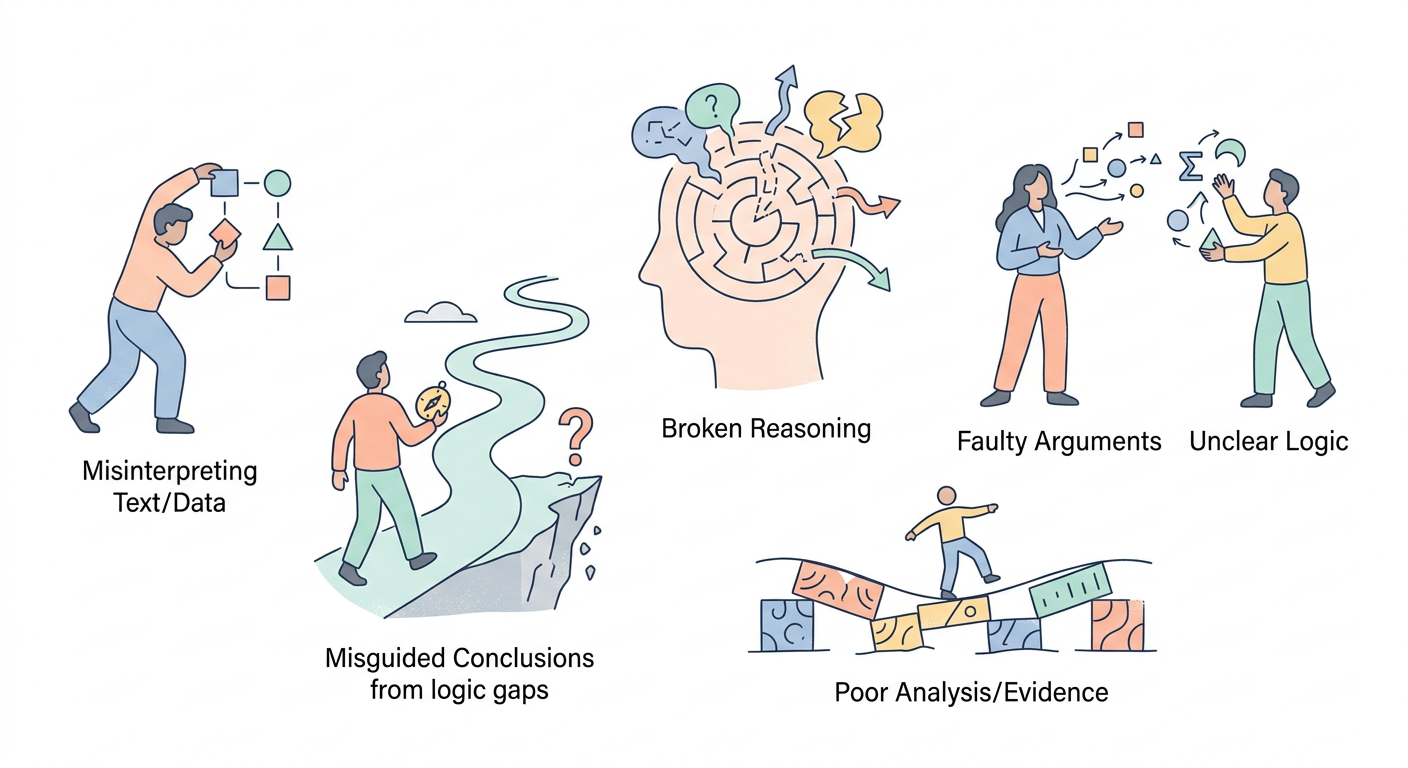
CARS scores often tank because students treat the section like an English lit class or, conversely, a science section. The most dangerous CARS habit is bringing in outside knowledge. If a passage claims that the sky is green, and a question asks what color the sky is, the answer is green. The test-makers do not care what you learned in your philosophy or history classes; they care if you can analyze the specific text provided. Over-highlighting is another silent killer. When you highlight everything, you effectively highlight nothing.
Your goal should be to map the passage, identify the main idea, the author’s tone, and any "pivot" words (like however, despite, or moreover). These words indicate a change in the argument’s direction and are frequent targets for questions. Success in CARS requires identifying wrong answer patterns. The AAMC loves to use "out of scope" answers or answers that are "too extreme" (using words like always, never, or only). If you aren't reviewing your CARS practice by categorizing why you picked the wrong answer, you will continue to make the same logic errors on test day.
Practice Test and Simulation Mistakes
The biggest mistake students make during full-length exams is testing in a "comfort zone." If you take your practice tests in a quiet bedroom with snacks, music, and a comfortable chair, you are setting yourself up for a shock at the Prometric center. The actual exam environment is sterile, often noisy with the sound of other people typing, and strictly timed. Untimed practice is a common crutch. While it has its place in the early weeks of content review, doing hundreds of questions without a clock can ruin your pacing.
You have roughly 95 minutes per section, stick to it. If you spend too much time on one difficult physics passage, you may never reach the Medium MCAT Metabolism Practice Questions at the end of the section that you could have answered easily. The "Click-Through" failure refers to the habit of looking at a missed question, reading the explanation, saying "Oh, I knew that," and moving on. You didn't know it; if you did, you would have gotten it right. You must force yourself to explain *why* the wrong answer was tempting and *why* the right answer is objectively better based only on the evidence in the passage.
Master the MCAT with Precision
Stop guessing and start performing. Access thousands of expert-level practice questions designed to mimic the AAMC's logic and difficulty.
Feel more confident on exam day.Psychological and Physical Health Oversights
Your brain is a biological engine that requires specific inputs to function at a high level. Neglecting sleep in favor of an extra two hours of studying is one of the most counterproductive **Common MCAT Mistakes**. According to the Centers for Disease Control and Prevention (CDC), sleep deprivation significantly impairs cognitive performance and memory consolidation. If you are tired, your ability to perform complex logic, which is 70% of the MCAT, will plummet. Test anxiety is real, but it is also manageable.
Many students suffer from "Test-Day Paralysis" because they have tied their entire self-worth to a single three-digit number. Remember that the MCAT is a hurdle, not a wall. Incorporating mindfulness or even just practicing deep-breathing exercises during your breaks can lower cortisol levels and keep your prefrontal cortex online. Finally, be wary of the "Full-Time Study" myth. While it sounds ideal to study 40 hours a week, many students find that without the structure of a job or school, they drift and lose focus. Productive study sessions are more important than total hours spent sitting at a desk. If you feel your focus slipping, it’s better to take a walk than to keep staring at a page of Medium MCAT Glycolysis Practice Questions that no longer make sense.
Building a Bulletproof MCAT Strategy
A bulletproof strategy relies on radical honesty and a "Mistake Log." This is a spreadsheet where you document every question you get wrong. You should record the topic, why you missed it (content gap, reading error, or logic error), and what you will do differently next time. If you see a pattern, perhaps you are consistently struggling with Hard MCAT DNA Replication Practice Questions, it’s time to stop and rebuild that specific foundation. Adaptability is your greatest asset. If your practice scores haven't budged in a month, don't keep doing the same thing. Change your resources, adjust your schedule, or find a study partner. Mastery of the MCAT isn't just about knowing more science; it’s about becoming a better version of yourself: more disciplined, more logical, and more resilient. You are training to be a doctor, and this test is your first real patient. Treat the process with the respect it deserves.
Frequently Asked Questions
How many months before the MCAT should I start studying?
Most students require 3 to 6 months of preparation. This timeframe allows for a dedicated content review phase followed by 2 months of intensive practice questions and full-length exams.
Is it a mistake to retake the MCAT?
Retaking the MCAT is not inherently a mistake if your second score shows a significant improvement (typically 5+ points). However, retaking without changing your study strategy often leads to a stagnant score, which can be a red flag for medical school admissions committees.
How many practice full-length exams should I take?
A competitive candidate should aim for 6 to 10 full-length exams. This includes the 5 official AAMC exams and several reputable third-party exams to build stamina and test-taking endurance.
Can I skip certain subjects if I did well in them in college?
No. College courses often focus on different priorities than the MCAT. Even if you aced Organic Chemistry, you must still practice MCAT-style questions to ensure you can apply that knowledge within the exam's unique passage-based format.
What is the most common reason for a low CARS score?
The most common reason is overthinking the text and bringing in outside knowledge or personal opinions. Success in CARS depends entirely on finding evidence within the provided passage to support every answer.
Reviewed by
Michael Danquah, MS, PhD
Dr. Michael Danquah is a professor of pharmaceutical sciences and founder of several educational technology platforms focused on improving student learning and performance.
Enjoyed this article?
Share it with others who might find it helpful.
Related Articles

Skyrocket Your MCAT Score: The Ultimate Improvement Guide
Unlock strategies to significantly improve your MCAT score. This comprehensive guide covers proven study plans, test-taking tips, and resource recommendations for pre-meds.
May 14, 2026

Hard MCAT Philosophy Passage Practice Questions
Master Hard MCAT Philosophy Passage Practice Questions with our comprehensive guide featuring solved examples, practice questions, and expert explanations.
May 17, 2026

Hard MCAT Humanities Passage Practice Questions
Master Hard MCAT Humanities Passage Practice Questions with our comprehensive guide featuring solved examples, practice questions, and expert strategies.
May 17, 2026

Hard MCAT Critical Analysis Practice Questions
Hard MCAT Critical Analysis Practice Questions
May 17, 2026

Hard MCAT Reading Comprehension Practice Questions
Hard MCAT Reading Comprehension Practice Questions
May 17, 2026

Hard MCAT CARS Passage Practice Questions
Master high-difficulty MCAT CARS passages with our expert guide featuring solved examples, practice questions, and detailed logical analysis.
May 17, 2026

Hard MCAT CARS Practice Questions
Master Hard MCAT CARS Practice Questions with our comprehensive guide featuring solved examples, practice passages, and expert reasoning strategies.
May 17, 2026

Hard MCAT Sensation and Perception Practice Questions
Master advanced MCAT Sensation and Perception concepts with hard practice questions, Weber's Law calculations, and detailed explanations of sensory pathways.
May 17, 2026