Mastering the Log Ratio: Henderson-Hasselbalch Buffer Problems
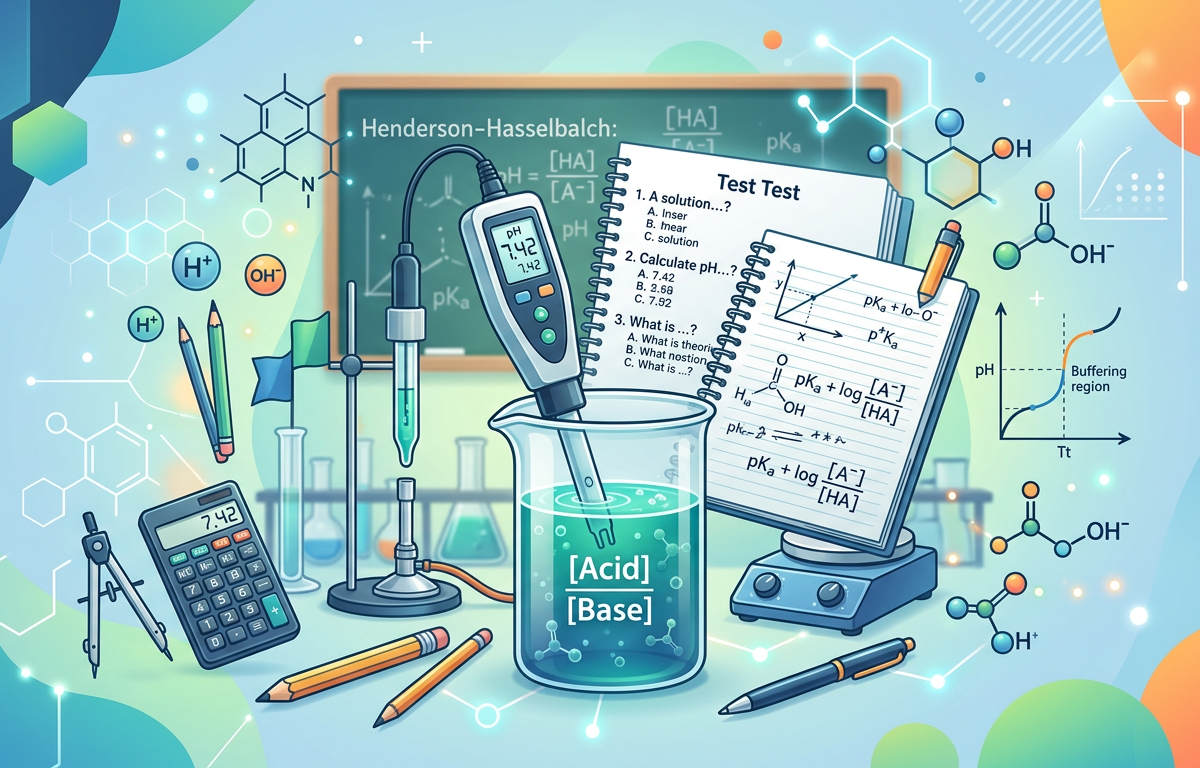
When a student stares at a buffer problem, the first instinct is often to reach for the Henderson-Hasselbalch equation without checking the stoichiometry. However, the most frequent error occurs before the log function is even touched. If you are mixing a weak acid with a strong base, you must determine the final concentrations of the conjugate pair after the neutralization reaction finishes. Simply plugging the initial molarities into the formula is a guaranteed way to get the wrong pH. The equation only describes the equilibrium state, not the journey to get there.
Another common stumbling block is the logarithmic relationship between the ratio of base to acid and the resulting pH. A pH shift of exactly one unit away from the pKa requires a tenfold change in the concentration ratio. If your calculated pH is higher than the pKa, your solution must contain more conjugate base than acid. If it is lower, the acid dominates. Keeping this mental check in place prevents the common mistake of flipping the fraction inside the log term. These practice questions focus on navigating those ratios and handling the algebraic shifts required for real-world laboratory scenarios.
Calculating Equilibrium in Buffer Systems
The Henderson-Hasselbalch equation is a mathematical formula used to calculate the pH of a buffer solution by relating the pKa of a weak acid to the molar concentrations of the acid and its conjugate base. This equation is fundamental in biochemistry and analytical chemistry for understanding how buffer solutions maintain a stable environment despite the addition of small amounts of acid or base. The standard form of the equation is pH = pKa + log([A⁻]/[HA]), where [A⁻] represents the concentration of the conjugate base and [HA] represents the concentration of the weak acid. According to the Wikipedia entry on the Henderson-Hasselbalch equation, it is also applicable to bases using the pKb, though it is most commonly expressed in terms of pH and pKa for simplicity.
Understanding this relationship is vital for calculating the ionization of drugs in pharmacology or maintaining the physiological pH of blood (approximately 7.4). When the concentration of the acid equals the concentration of the base, the log term becomes zero (log(1) = 0), and the pH of the solution is exactly equal to the pKa. This point is known as the half-equivalence point in a titration. To use this equation effectively, you must first ensure you have the correct pKa and pKb values for the substances involved.
Solved Examples
Calculating pH from Concentrations: A buffer is prepared with 0.50 M acetic acid (CH₃COOH) and 0.25 M sodium acetate (CH₃COONa). The pKa of acetic acid is 4.76. What is the pH?
Identify the components: [HA] = 0.50 M, [A⁻] = 0.25 M, pKa = 4.76.
Apply the formula: pH = 4.76 + log(0.25 / 0.50).
Calculate the ratio: 0.25 / 0.50 = 0.5.
Calculate the log: log(0.5) = -0.301.
Solve: pH = 4.76 - 0.301 = 4.46.
Finding the Required Ratio: To prepare a phosphate buffer with a pH of 7.00 using H₂PO₄⁻ (pKa = 7.21), what ratio of [HPO₄²⁻]/[H₂PO₄⁻] is needed?
Set up the equation: 7.00 = 7.21 + log([base]/[acid]).
Isolate the log term: 7.00 - 7.21 = log(ratio) → -0.21 = log(ratio).
Take the antilog (10^x): ratio = 10^(-0.21).
Solve: ratio = 0.617. The base concentration should be 0.617 times the acid concentration.
Calculating pKa from pH: A solution containing 0.1 M of a weak acid and 0.4 M of its conjugate base has a pH of 5.60. What is the pKa of the acid?
Identify the components: [HA] = 0.1 M, [A⁻] = 0.4 M, pH = 5.60.
Apply the formula: 5.60 = pKa + log(0.4 / 0.1).
Calculate the log: log(4) = 0.602.
Solve for pKa: pKa = 5.60 - 0.602 = 4.998 (approx 5.00).
Practice Questions
1. Calculate the pH of a buffer solution that is 0.15 M in ammonia (NH₃) and 0.35 M in ammonium chloride (NH₄Cl). The pKa of ammonium is 9.25.
2. A biochemist needs a buffer at pH 7.40. If they use a lactic acid/lactate system (pKa = 3.86), what is the ratio of lactate to lactic acid required?
3. What is the pH of a solution made by mixing 50 mL of 0.20 M formic acid (pKa = 3.75) with 50 mL of 0.10 M sodium formate?
Want unlimited practice questions like these?
Generate AI-powered questions with step-by-step solutions on any topic.
Try Question Generator Free →4. If a buffer solution has a pH of 8.5 and the pKa of the weak acid is 8.2, what is the concentration of the conjugate base if the acid concentration is 0.05 M?
5. Calculate the change in pH when 0.01 moles of HCl are added to 1.0 L of a buffer containing 0.1 M acetic acid and 0.1 M sodium acetate (pKa = 4.76). (Assume no volume change).
6. A solution of 0.10 M HEPES buffer (pKa = 7.55) is adjusted to pH 8.0. What are the individual concentrations of the acid and base forms?
7. Which of the following acids would be the best choice to create a buffer with a pH of 4.5: Acetic acid (pKa 4.76), Formic acid (pKa 3.75), or Nitrous acid (pKa 3.34)?
8. A buffer is prepared using 0.25 M of a weak base (Kb = 1.8 x 10⁻⁵) and 0.40 M of its conjugate acid. Calculate the pH.
9. How many grams of sodium acetate (MW = 82.03 g/mol) must be added to 500 mL of 0.2 M acetic acid (pKa 4.76) to reach a pH of 5.0?
10. If the ratio of [A⁻]/[HA] is 100:1, how many pH units above the pKa is the solution?
Answers & Explanations
1. pH = 8.88: Using pH = pKa + log([base]/[acid]), we have pH = 9.25 + log(0.15 / 0.35). log(0.428) = -0.368. pH = 9.25 - 0.368 = 8.882.
2. Ratio = 3467:1: 7.40 = 3.86 + log(ratio). 3.54 = log(ratio). 10^3.54 = 3467.3. This shows lactic acid is a poor choice for a pH 7.4 buffer because the ratio is too extreme.
3. pH = 3.45: Since volumes are equal, the concentrations are halved, but the ratio remains the same (0.10 / 0.20). pH = 3.75 + log(0.5) = 3.75 - 0.301 = 3.449.
4. [A⁻] = 0.10 M: 8.5 = 8.2 + log([A⁻]/0.05). 0.3 = log([A⁻]/0.05). 10^0.3 = 2.0. So, [A⁻]/0.05 = 2.0, meaning [A⁻] = 0.10 M.
5. ΔpH = -0.09: Initial pH = 4.76. After adding 0.01 mol HCl, [HA] becomes 0.11 M and [A⁻] becomes 0.09 M. New pH = 4.76 + log(0.09/0.11) = 4.76 - 0.087 = 4.67. Change = 4.67 - 4.76 = -0.09.
6. [Acid] = 0.026 M, [Base] = 0.074 M: 8.0 = 7.55 + log(B/A). 0.45 = log(B/A). B/A = 2.818. Since A + B = 0.10, A + 2.818A = 0.10. 3.818A = 0.10 → A = 0.0262 M. B = 0.0738 M.
7. Acetic Acid: A buffer is most effective when the pKa is within ±1 unit of the target pH. Acetic acid (4.76) is closest to 4.5. This is related to the strength of the acid and its ability to resist pH changes.
8. pH = 9.05: First find pKb = -log(1.8 x 10⁻⁵) = 4.74. Then pKa = 14 - 4.74 = 9.26. pH = 9.26 + log(0.25 / 0.40) = 9.26 - 0.204 = 9.056.
9. 14.27 grams: 5.0 = 4.76 + log([A⁻]/0.2). 0.24 = log([A⁻]/0.2). 1.737 = [A⁻]/0.2 → [A⁻] = 0.347 M. Moles needed = 0.347 M * 0.5 L = 0.174 mol. Mass = 0.174 * 82.03 = 14.27 g. For more on mass and moles, see grams to moles practice.
10. 2 units: pH = pKa + log(100/1). log(100) = 2. Therefore, pH = pKa + 2.
1. What happens to the pH of a buffer if the concentration of both the weak acid and its conjugate base are doubled?
Frequently Asked Questions
When can you not use the Henderson-Hasselbalch equation?
The equation becomes inaccurate when the concentrations of the acid or base are extremely low (less than 10⁻³ M) or when the acid is very strong or very weak. In these cases, the assumption that the equilibrium concentrations equal the initial concentrations fails.
What is the difference between pH and pKa?
pH measures the acidity or alkalinity of a specific solution based on hydrogen ion concentration, whereas pKa is a constant property of a specific molecule indicating its acid strength. The Henderson-Hasselbalch equation links these two values via the ratio of ionized to unionized forms.
Can this equation be used for basic buffers?
Yes, for basic buffers, you can use the form pOH = pKb + log([BH⁺]/[B]). Alternatively, you can convert the pKb to pKa and use the standard pH form of the equation to find the pH directly.
What is the "buffering region"?
The buffering region is the pH range within which a buffer effectively resists changes in pH, typically defined as pKa ± 1. Outside of this range, the ratio of base to acid becomes too lopsided to neutralize additional protons or hydroxide ions efficiently.
How does temperature affect the Henderson-Hasselbalch equation?
Temperature affects the equation because the pKa value of an acid is temperature-dependent. As temperature changes, the equilibrium constant Ka shifts, which in turn changes the pKa and the resulting pH of the buffer solution.
Want unlimited practice questions like these?
Generate AI-powered questions with step-by-step solutions on any topic.
Try Question Generator Free →
Want unlimited practice questions like these?
Generate AI-powered questions with step-by-step solutions on any topic.
Try Question Generator Free →Enjoyed this article?
Share it with others who might find it helpful.
Related Articles
Solve Boyle's Law Problems Without Flipping the Pressure Ratio
Master Boyle’s Law with these easy practice questions and step-by-step solutions. Learn how pressure and volume interact at constant temperatures.
Apr 2, 2026
Solving Equilibrium Problems Without Losing Your Stoichiometry
Master chemical equilibrium with these easy ICE table practice questions. Learn to calculate concentrations and K values with step-by-step solved examples.
Mar 30, 2026
Calculating Kc: Mastering the Ratio of Equilibrium Concentrations
Master the Equilibrium Constant (Kc) with our comprehensive guide featuring solved examples, practice questions, and detailed explanations for chemistry students.
Mar 30, 2026
Medium Henderson-Hasselbalch Equation Practice Questions
Master the Henderson-Hasselbalch equation with these medium-level practice questions, solved examples, and a quick quiz to boost your chemistry grades.
Mar 29, 2026
Medium Buffer Solution Practice Questions
Master medium-level buffer solution problems with our guide. Includes solved examples, the Henderson-Hasselbalch equation, and 10 practice questions with answers.
Mar 29, 2026
Easy Henderson-Hasselbalch Equation Practice Questions
Master the Henderson-Hasselbalch equation with these easy practice questions, solved examples, and a quick quiz to boost your chemistry grades.
Mar 29, 2026
Hard Henderson-Hasselbalch Equation Practice Questions
Master the Henderson-Hasselbalch equation with hard practice questions, step-by-step solutions, and expert tips for buffer calculations.
Mar 29, 2026
Mastering pKa Calculations: Converting Ka and Conjugate Pairs
Master pKa and pKb calculations with this comprehensive guide, featuring concept explanations, solved examples, and practice questions.
Mar 28, 2026