Hard Henderson-Hasselbalch Equation Practice Questions
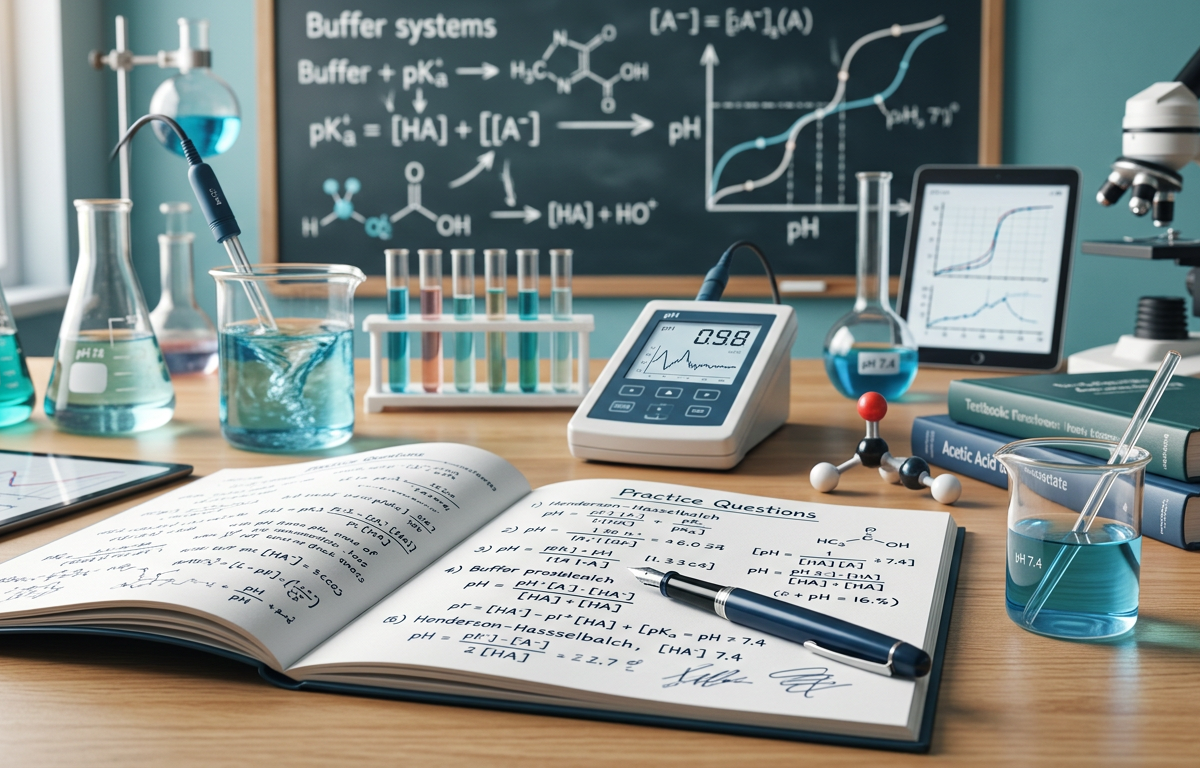
Concept Explanation
The Henderson-Hasselbalch equation is a mathematical expression used to calculate the pH of a buffer solution by relating the pKa of a weak acid to the equilibrium concentrations of the acid and its conjugate base. This equation, derived from the acid dissociation constant (), is expressed as , where represents the molar concentration of the conjugate base and $[HA]$ represents the molar concentration of the weak acid. It serves as a cornerstone in biochemistry and analytical chemistry for understanding how biological systems maintain homeostasis. When students master pH calculation practice questions, they quickly realize that this equation is most accurate when the concentrations of the buffering components are significantly higher than the and within a pH range of unit from the pKa. In complex scenarios involving polyprotic acids or amino acids, the equation must be applied to the specific ionization state relevant to the environment's pH. Understanding this relationship is vital for fields ranging from pharmacology to environmental science, as detailed by resources like the LibreTexts Chemistry project.
Solved Examples
Calculating pH after Strong Acid Addition: A 1.0 L buffer solution contains 0.50 M acetic acid () and 0.50 M sodium acetate (). Calculate the pH after 0.05 moles of HCl gas are dissolved in the solution. (pKa of acetic acid = 4.76).
Identify the initial moles: mol and mol.
Determine the reaction: $HCl$ reacts with the conjugate base: .
Calculate new moles: mol; mol.
Apply the equation: .
Solve: .
Finding the Required Mass for a Specific pH: You need to prepare 500 mL of a buffer at pH 7.40 using 0.10 M and solid . How many grams of (MW = 174.18 g/mol) are needed? ( of phosphoric acid = 7.21).
Set up the equation: $7.40 = 7.21 + \log([HPO_4^{2-}] / [H_2PO_4^-])$.
Isolate the ratio: $0.19 = \log([HPO_4^{2-}] / 0.10)$.
Solve for concentration: $10^{0.19} = [HPO_4^{2-}] / 0.10 \Rightarrow 1.548 = [HPO_4^{2-}] / 0.10 \Rightarrow [HPO_4^{2-}] = 0.1548$ M.
Calculate moles: $0.1548$ mol/L L = 0.0774 moles.
Calculate mass: $0.0774$ mol g/mol = 13.48 g.
Determining pKa from Titration Data: A solution is made by mixing 30.0 mL of 0.15 M weak base B with 15.0 mL of 0.10 M HCl. The resulting pH is 9.25. Calculate the $pKa$ of the conjugate acid .
Calculate initial moles of B: $0.030$ L M = 0.0045 mol.
Calculate moles of added: $0.015$ L M = 0.0015 mol.
Reaction: . Moles B remaining: $0.0045 - 0.0015 = 0.0030$ mol. Moles formed: 0.0015 mol.
Apply equation: $9.25 = pKa + \log(0.0030 / 0.0015)$.
Solve: $9.25 = pKa + \log(2) \Rightarrow 9.25 = pKa + 0.301 \Rightarrow pKa = 8.95$.
Practice Questions
1. Calculate the pH of a solution prepared by mixing 250 mL of 0.20 M formic acid ($HCOOH$, pKa = 3.75) with 150 mL of 0.40 M sodium formate ($HCOONa$).
2. A buffer is prepared with 0.10 M and 0.20 M (pKa of = 9.25). Calculate the pH change when 0.01 moles of NaOH are added to 1.0 L of this buffer.
3. How many grams of sodium lactate (, MW = 112.06 g/mol) must be added to 2.0 L of 0.15 M lactic acid (pKa = 3.86) to result in a buffer with a pH of 4.00?
Want unlimited practice questions like these?
Generate AI-powered questions with step-by-step solutions on any topic.
Try Question Generator Free →4. You are titrating 50.0 mL of 0.10 M propanoic acid (pKa = 4.87) with 0.10 M NaOH. What is the pH after 25.0 mL of NaOH has been added?
5. A biochemist needs a buffer at pH 7.00. They have and (pKa = 7.21). What is the required molar ratio of ?
6. Calculate the pH of a solution formed by mixing 100 mL of 0.50 M and 50 mL of 0.50 M $NaOH$. (Note: This is a limiting reactant problem involving phosphoric acid species; check Ka and Kb calculations practice questions for background).
7. A 500 mL buffer solution contains 0.25 M (methylamine) and 0.25 M . If the pH is 10.64, what is the $Kb$ of methylamine?
8. What volume of 0.50 M must be added to 100 mL of 0.10 M (pKa = 4.76) to reach a pH of 5.00?
9. A buffer is made by dissolving 0.10 moles of a weak acid () and 0.05 moles of its conjugate base in 1.0 L of water. If the solution is diluted to 10.0 L, what is the new pH?
10. Calculate the pH of a solution containing 0.01 M Glycine in its zwitterionic form () given and . (Hint: Review buffer solution practice questions for amphiprotic species).
Answers & Explanations
Answer: 3.83. Moles mol. Moles mol. .
Answer: pH increases by 0.07. Initial . After adding 0.01 mol NaOH: . New mol, New mol. New . .
Answer: 46.4 g. $4.00 = 3.86 + \log([A^-]/0.15) \Rightarrow 0.14 = \log([A^-]/0.15) \Rightarrow [A^-] = 0.15 \times 10^{0.14} = 0.207$ M. Moles = $0.207 \times 2.0 = 0.414$ mol. Mass = $0.414 \times 112.06 = 46.39$ g.
Answer: 4.87. 25.0 mL of NaOH is exactly half the volume needed to reach the equivalence point (50.0 mL). At the half-equivalence point, , so .
Answer: 0.617. $7.00 = 7.21 + \log(Ratio) \Rightarrow -0.21 = \log(Ratio) \Rightarrow Ratio = 10^{-0.21} = 0.617$.
Answer: 7.21. Moles mol. Moles mol. reacts with to produce . Result: 0.025 mol and 0.025 mol . Since concentrations are equal, .
Answer: $4.37 \times 10^{-4}$. . (since ratio is 1:1). . .
Answer: 34.7 mL. $5.00 = 4.76 + \log(n_{base} / n_{acid})$. $0.24 = \log(n_{base} / 0.01) \Rightarrow n_{base} = 0.01 \times 10^{0.24} = 0.01738$ mol. Volume = $0.01738 / 0.50 = 0.03476$ L = 34.8 mL.
Answer: 5.20. Dilution changes the volume but the ratio of moles of conjugate base to weak acid remains the same. The pH of a buffer is independent of volume (within reasonable limits). .
Answer: 5.97. For a zwitterion (isoelectric point), . .
1. Which condition must be met for the Henderson-Hasselbalch equation to be most accurate?
Frequently Asked Questions
When should I not use the Henderson-Hasselbalch equation?
Avoid using this equation when the acid or base is very strong, the solution is extremely dilute, or the pKa is very high or low. In these cases, the assumption that the equilibrium concentrations of the species are equal to their initial concentrations fails.
Does the Henderson-Hasselbalch equation work for polyprotic acids?
Yes, but you must use the specific pKa corresponding to the ionization step occurring at that pH. For example, use for a buffer consisting of and .
How does temperature affect the results of the equation?
Temperature changes the value of $Ka$ (and thus $pKa$), which directly alters the pH calculated. Most $pKa$ values are reported at 25°C, so adjustments are needed for biological temperatures like 37°C, as noted by the Nature Portfolio research standards.
Can I use the equation for a mixture of a weak base and its conjugate acid?
Yes, the equation is universal for conjugate pairs. Simply use the $pKa$ of the conjugate acid; if you only have the $Kb$ of the base, calculate $pKa$ using .
What is the "buffer capacity" in the context of this equation?
Buffer capacity refers to the amount of acid or base a buffer can neutralize before the pH changes significantly. It is highest when the concentrations of the acid and base are high and equal to each other ().
Want unlimited practice questions like these?
Generate AI-powered questions with step-by-step solutions on any topic.
Try Question Generator Free →
Want unlimited practice questions like these?
Generate AI-powered questions with step-by-step solutions on any topic.
Try Question Generator Free →Enjoyed this article?
Share it with others who might find it helpful.
Related Articles
Medium Henderson-Hasselbalch Equation Practice Questions
Master the Henderson-Hasselbalch equation with these medium-level practice questions, solved examples, and a quick quiz to boost your chemistry grades.
Mar 29, 2026
Easy Henderson-Hasselbalch Equation Practice Questions
Master the Henderson-Hasselbalch equation with these easy practice questions, solved examples, and a quick quiz to boost your chemistry grades.
Mar 29, 2026
Mastering the Log Ratio: Henderson-Hasselbalch Buffer Problems
Master the Henderson-Hasselbalch equation with our detailed guide, solved examples, and practice problems to ace your chemistry exams.
Mar 28, 2026

Calculating High-Stakes Meds: BSA Mosteller Formula Practice
Master hard body surface area-based dosage calculations with our comprehensive guide, solved examples, and practice questions for healthcare students.
May 17, 2026

Solving High-Stakes IV Titrations and Weight-Based Infusions
Master advanced IV flow rate calculations with these hard practice questions. Covers weight-based dosing, titrations, and dimensional analysis for nurses.
May 17, 2026

Solving Weight-Based Dosing: The 2.2 Conversion and Rounding Logic
Weight-Based Dosage Calculations Practice Questions with Answers
May 17, 2026
Predicting Periodic Anomalies: Beyond Basic Trend Rules
Hard Periodic Trends Practice Questions
Apr 4, 2026
Hard Electron Configuration Practice Questions
Hard Electron Configuration Practice Questions
Apr 4, 2026