Grams to Moles Practice Questions with Answers
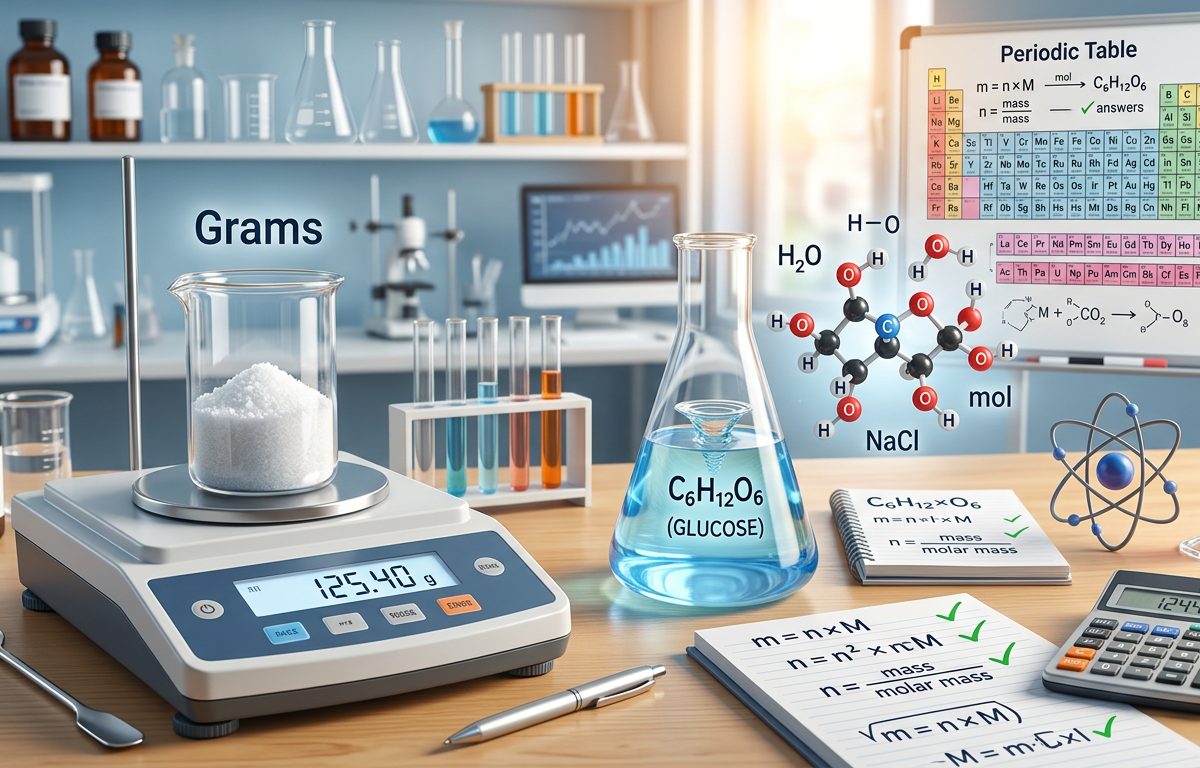
Converting grams to moles is a fundamental skill in chemistry that allows scientists to bridge the gap between the measurable mass of a substance and the number of particles it contains. By using the molar mass of an element or compound as a conversion factor, you can determine exactly how many moles are present in any given sample. This process is the cornerstone of stoichiometry and is essential for calculating reactant quantities in laboratory settings.
Concept Explanation
Converting grams to moles is the process of dividing the mass of a substance by its molar mass to determine the amount of substance in moles. The mole is a standard unit in chemistry, defined by Avogadro's number (6.022 × 10²³), which represents the number of atoms or molecules in one mole of a substance. To perform this conversion, you must first identify the chemical formula of the substance and then find its molar mass using the periodic table.
The standard formula for this conversion is:
Moles (n) = Mass (g) / Molar Mass (g/mol)
Molar mass is the sum of the atomic masses of all atoms in a molecule. For example, water (H2O) has two hydrogen atoms (1.01 g/mol each) and one oxygen atom (16.00 g/mol), resulting in a molar mass of 18.02 g/mol. Once you have the molar mass, you can easily shift between mass and moles, which is the first step in solving more complex mass-to-mass stoichiometry problems. Understanding this relationship is vital because chemical equations are written in terms of mole ratios, not mass ratios.
Solved Examples
Review these step-by-step examples to see how the formula is applied to different types of substances.
Example 1: Single Element
How many moles are in 46.0 grams of Sodium (Na)?Identify the molar mass of Sodium from the periodic table: 22.99 g/mol.
Use the formula: Moles = Mass / Molar Mass.
Calculation: 46.0 g / 22.99 g/mol = 2.00 moles.
Answer: 2.00 moles of Na.
Example 2: Simple Compound
Convert 90.1 grams of Water (H2O) to moles.Calculate the molar mass of H2O: (2 × 1.01) + 16.00 = 18.02 g/mol.
Use the formula: Moles = 90.1 g / 18.02 g/mol.
Calculation: 5.00 moles.
Answer: 5.00 moles of H2O.
Example 3: Complex Molecule
Find the number of moles in 342.3 grams of Sucrose (C12H22O11).Calculate the molar mass: (12 × 12.01) + (22 × 1.01) + (11 × 16.00) = 342.34 g/mol.
Use the formula: Moles = 342.3 g / 342.34 g/mol.
Calculation: 0.9999... ≈ 1.00 mole.
Answer: 1.00 mole of Sucrose.
Practice Questions
Test your skills with these practice problems. You will need a periodic table to find the atomic masses.
1. How many moles are in 100.0 grams of Iron (Fe)?
2. Convert 25.5 grams of Ammonia (NH3) to moles.
3. Calculate the moles present in 12.0 grams of Carbon (C).
Want unlimited practice questions like these?
Generate AI-powered questions with step-by-step solutions on any topic.
Try Question Generator Free →4. Determine the number of moles in 200.0 grams of Calcium Carbonate (CaCO3).
5. How many moles are in 5.0 grams of Hydrogen gas (H2)?
6. Convert 500.0 grams of Glucose (C6H12O6) to moles.
7. A sample of Gold (Au) weighs 39.4 grams. How many moles is this?
8. How many moles are in 150.0 grams of Sulfuric Acid (H2SO4)?
9. Convert 10.0 grams of Helium (He) to moles.
10. Calculate the moles in 64.1 grams of Sulfur Dioxide (SO2).
Answers & Explanations
Check your work against the detailed solutions below.
1.79 moles: Molar mass of Fe is 55.85 g/mol. 100.0 g / 55.85 g/mol = 1.79 mol.
1.50 moles: Molar mass of NH3 is 14.01 + (3 × 1.01) = 17.04 g/mol. 25.5 g / 17.04 g/mol = 1.50 mol.
1.00 mole: Molar mass of C is 12.01 g/mol. 12.0 g / 12.01 g/mol = 1.00 mol.
2.00 moles: Molar mass of CaCO3 is 40.08 + 12.01 + (3 × 16.00) = 100.09 g/mol. 200.0 g / 100.09 g/mol = 2.00 mol.
2.48 moles: Molar mass of H2 is 2 × 1.01 = 2.02 g/mol. 5.0 g / 2.02 g/mol = 2.48 mol.
2.78 moles: Molar mass of Glucose is (6 × 12.01) + (12 × 1.01) + (6 × 16.00) = 180.18 g/mol. 500.0 g / 180.18 g/mol = 2.78 mol.
0.20 moles: Molar mass of Au is 196.97 g/mol. 39.4 g / 196.97 g/mol = 0.20 mol.
1.53 moles: Molar mass of H2SO4 is (2 × 1.01) + 32.06 + (4 × 16.00) = 98.08 g/mol. 150.0 g / 98.08 g/mol = 1.53 mol.
2.50 moles: Molar mass of He is 4.00 g/mol. 10.0 g / 4.00 g/mol = 2.50 mol.
1.00 mole: Molar mass of SO2 is 32.06 + (2 × 16.00) = 64.06 g/mol. 64.1 g / 64.06 g/mol = 1.00 mol.
1. What information is required to convert mass (grams) into moles?
Frequently Asked Questions
What is the difference between molar mass and atomic mass?
Atomic mass is the mass of a single atom (usually in amu), while molar mass is the mass of one mole of those atoms (in grams/mol). Numerically, they are the same value from the periodic table, but they represent different scales of matter.
Can I use this formula for gases?
Yes, the grams-to-moles formula applies to all states of matter, including solids, liquids, and gases. However, for gases at standard temperature and pressure, you might also use the molar volume (22.4 L/mol) if you are starting with volume instead of mass.
How many decimals should I use for molar mass?
Most chemistry instructors recommend using at least two decimal places for molar mass to ensure accuracy in your final answer. Always follow the significant figures rules provided in your specific assignment or lab manual.
What happens if I multiply grams by molar mass instead of dividing?
Multiplying grams by g/mol would result in units of g²/mol, which is physically meaningless in this context. To find the number of moles, you must divide mass by molar mass so the gram units cancel out.
Is a mole always the same number of particles?
Yes, one mole of any substance always contains exactly 6.02214076 × 10²³ particles. This constant allows chemists to count atoms by weighing them, much like one dozen always refers to twelve items regardless of what those items are.
Want unlimited practice questions like these?
Generate AI-powered questions with step-by-step solutions on any topic.
Try Question Generator Free →Enjoyed this article?
Share it with others who might find it helpful.
Related Articles
Why Molarity Matters: Converting Mass to Moles for Lab Solutions
Master chemistry with our guide to the molarity formula. Learn how to calculate concentration with step-by-step examples, units, and practical lab tips.
Mar 26, 2026

Why Molarity Ratios Fail: Solving the Moles per Liter Logic Gap
Master molarity with ease. Discover why chemistry students struggle with concentration units and learn proven strategies to solve molarity problems fast.
Mar 26, 2026

Calculating High-Stakes Meds: BSA Mosteller Formula Practice
Master hard body surface area-based dosage calculations with our comprehensive guide, solved examples, and practice questions for healthcare students.
May 17, 2026

Solving High-Stakes IV Titrations and Weight-Based Infusions
Master advanced IV flow rate calculations with these hard practice questions. Covers weight-based dosing, titrations, and dimensional analysis for nurses.
May 17, 2026

Solving Weight-Based Dosing: The 2.2 Conversion and Rounding Logic
Weight-Based Dosage Calculations Practice Questions with Answers
May 17, 2026
Predicting Periodic Anomalies: Beyond Basic Trend Rules
Hard Periodic Trends Practice Questions
Apr 4, 2026
Hard Electron Configuration Practice Questions
Hard Electron Configuration Practice Questions
Apr 4, 2026
Medium Electron Configuration Practice Questions
Master medium-level electron configuration with our comprehensive guide, including solved examples, stability exceptions, and practice questions with answers.
Apr 4, 2026