Medium Henderson-Hasselbalch Equation Practice Questions
Concept Explanation
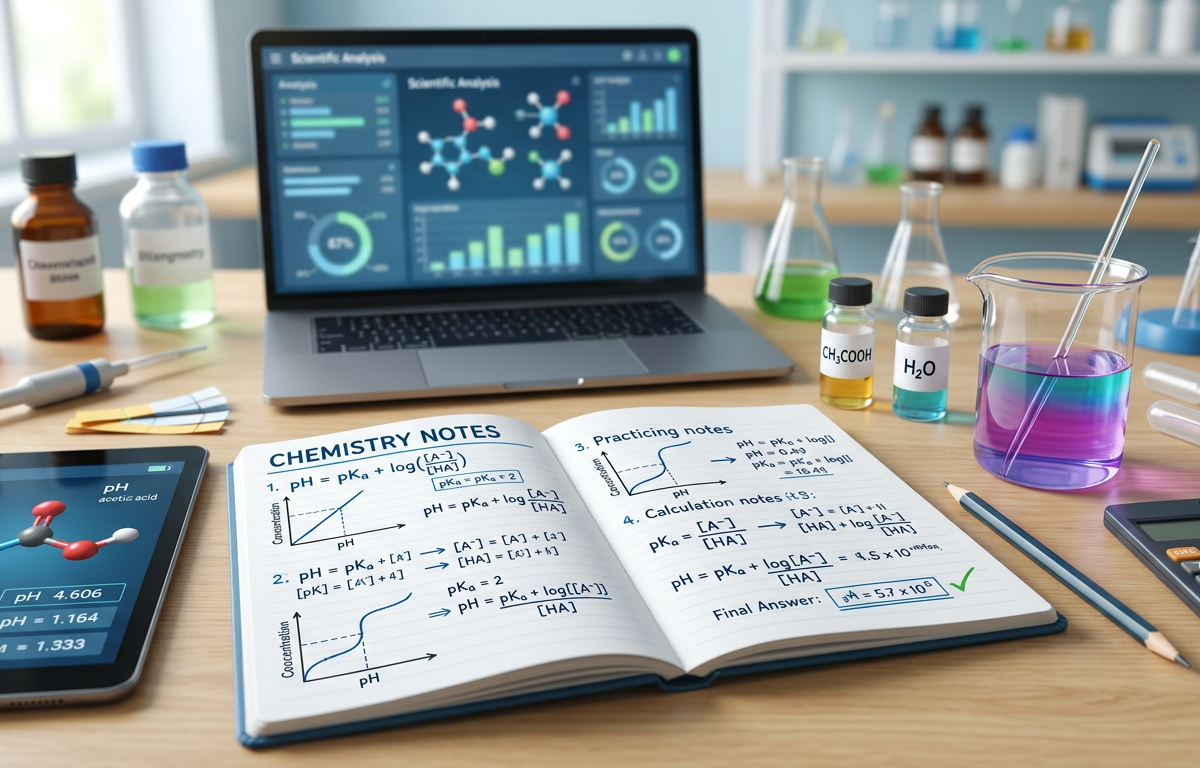
The Henderson-Hasselbalch equation is a mathematical formula used to calculate the pH of a buffer solution by relating the pKa of a weak acid to the molar concentrations of the acid and its conjugate base. This equation is fundamental in chemistry and biology because it allows scientists to predict how the pH will change when small amounts of acid or base are added to a system. For a weak acid (HA) and its conjugate base (A-), the equation is expressed as pH = pKa + log([A-] / [HA]). This relationship is derived from the acid dissociation constant (Ka) expression and is most accurate when the concentrations of the buffer components are significantly higher than the Ka value. Understanding this concept is a stepping stone to mastering buffer solution practice questions and biological systems like blood pH regulation.
In practical applications, the Henderson-Hasselbalch equation is used to prepare buffers of a specific pH in laboratory settings. According to Wikipedia, the equation was developed independently by Lawrence Joseph Henderson and Karl Albert Hasselbalch in the early 20th century. It is particularly useful when the ratio of conjugate base to acid is between 0.1 and 10. When the concentrations of the acid and base are equal, the log term becomes zero (log 1 = 0), and the pH equals the pKa. This point is known as the halfway point in a titration or the point of maximum buffering capacity. For more foundational work on acidity, you might also explore pH calculation practice questions to sharpen your skills.
Solved Examples
Below are fully worked examples demonstrating how to apply the Henderson-Hasselbalch equation to common chemical scenarios.
Calculating pH from Molarity: Calculate the pH of a buffer solution that is 0.45 M in acetic acid (CH3COOH) and 0.60 M in sodium acetate (CH3COONa). The pKa of acetic acid is 4.76.
Identify the components: [HA] = 0.45 M, [A-] = 0.60 M, pKa = 4.76.
Apply the equation: pH = 4.76 + log(0.60 / 0.45).
Calculate the ratio: 0.60 / 0.45 = 1.333.
Calculate the log: log(1.333) = 0.125.
Final addition: pH = 4.76 + 0.125 = 4.885. Rounding to two decimal places gives 4.89.
Finding the Required Ratio: At what ratio of [Formate] / [Formic Acid] will a buffer have a pH of 4.00? The pKa of formic acid is 3.75.
Set up the equation: 4.00 = 3.75 + log([A-] / [HA]).
Isolate the log term: 4.00 - 3.75 = 0.25.
Remove the log: 10^0.25 = [A-] / [HA].
Calculate the value: [A-] / [HA] = 1.78. The ratio is 1.78 to 1.
Calculating pKa from pH: A buffer solution containing 0.20 M of a weak acid and 0.50 M of its conjugate base has a pH of 9.50. What is the pKa of the acid?
Arrange the formula to solve for pKa: pKa = pH - log([A-] / [HA]).
Substitute values: pKa = 9.50 - log(0.50 / 0.20).
Calculate the ratio: 0.50 / 0.20 = 2.5.
Calculate the log: log(2.5) = 0.398.
Subtract: pKa = 9.50 - 0.398 = 9.10.
Practice Questions
Test your knowledge with these medium-level practice problems. Ensure you have a calculator and a table of pKa values if needed.
Calculate the pH of a buffer solution made from 0.15 M propanoic acid (pKa = 4.87) and 0.25 M sodium propanoate.
A chemist needs to prepare a buffer with a pH of 7.20 using NaH2PO4 and Na2HPO4. If the pKa of H2PO4- is 7.21, what is the required [HPO4^2-] / [H2PO4-] ratio?
What is the pH of a solution containing 0.12 M ammonia (NH3) and 0.45 M ammonium chloride (NH4Cl)? The pKa of NH4+ is 9.25.
[CTA_BLOCK_0]
A buffer is prepared by mixing 500 mL of 0.10 M HF (pKa = 3.17) with 500 mL of 0.20 M NaF. What is the pH of the resulting solution?
If you have a 0.10 M solution of a weak acid with a pKa of 5.00, how many moles of its conjugate base must be added to 1.0 L of the acid to achieve a pH of 5.50?
Calculate the pH of a solution containing 0.30 M benzoic acid (pKa = 4.20) and 0.15 M sodium benzoate.
A buffer solution has a pH of 8.40. It is composed of a weak acid (pKa = 8.60) and its conjugate base. Which component is in higher concentration?
Calculate the pH of a buffer system where the concentration of the weak acid is 0.050 M and the concentration of the conjugate base is 0.050 M, given the pKa is 6.35.
A solution is 0.25 M in HCN (pKa = 9.21). How much NaCN must be added to 1 liter of this solution to reach a pH of 9.00?
What is the pH of a buffer solution prepared by adding 0.05 moles of KOH to 1.0 L of a 0.20 M solution of a weak acid HA (pKa = 4.50)? (Hint: KOH reacts with HA to form A-).
Answers & Explanations
pH = 5.09. pH = 4.87 + log(0.25 / 0.15). log(1.67) = 0.22. 4.87 + 0.22 = 5.09.
Ratio = 0.977. 7.20 = 7.21 + log(Ratio). -0.01 = log(Ratio). Ratio = 10^-0.01 = 0.977.
pH = 8.68. pH = 9.25 + log(0.12 / 0.45). log(0.267) = -0.57. 9.25 - 0.57 = 8.68.
pH = 3.47. Since the volumes are equal, the concentrations are halved, but the ratio remains the same (0.20 / 0.10). pH = 3.17 + log(2) = 3.17 + 0.30 = 3.47.
0.316 moles. 5.50 = 5.00 + log([A-] / 0.10). 0.50 = log([A-] / 0.10). 10^0.50 = 3.16. [A-] = 3.16 * 0.10 = 0.316 M. In 1 L, this is 0.316 moles.
pH = 3.90. pH = 4.20 + log(0.15 / 0.30). log(0.5) = -0.30. 4.20 - 0.30 = 3.90.
The weak acid. Since pH (8.40) is less than pKa (8.60), the log([A-]/[HA]) term must be negative, meaning [HA] > [A-].
pH = 6.35. When [A-] = [HA], pH = pKa. log(1) = 0.
0.154 M. 9.00 = 9.21 + log([A-] / 0.25). -0.21 = log([A-] / 0.25). 10^-0.21 = 0.617. [A-] = 0.617 * 0.25 = 0.154 M.
pH = 4.02. KOH reacts with HA: 0.20 M HA - 0.05 M KOH = 0.15 M HA remaining. 0.05 M A- is formed. pH = 4.50 + log(0.05 / 0.15) = 4.50 + (-0.477) = 4.023.
1. Under what condition does the pH of a buffer solution exactly equal the pKa of the weak acid?
Frequently Asked Questions
What is the primary purpose of the Henderson-Hasselbalch equation?
The primary purpose is to calculate the pH of a buffer solution and to determine the necessary ratio of acid to conjugate base to achieve a specific target pH. It simplifies the calculation by using pKa and molar concentrations rather than solving complex equilibrium expressions from scratch.
Can the Henderson-Hasselbalch equation be used for strong acids?
No, the equation is specifically designed for weak acids and their conjugate bases because it assumes the dissociation of the weak acid is negligible compared to the initial concentrations. Strong acids dissociate completely in water, making this specific logarithmic relationship inapplicable. For more on this distinction, see strong acid vs weak acid practice questions.
How does temperature affect the results of this equation?
Temperature affects the value of the acid dissociation constant (Ka) and consequently the pKa. Since pH is dependent on pKa, a change in temperature will shift the pH of the buffer, even if the concentrations of the components remain the same.
What is the difference between pH and pKa?
The pH is a measure of the hydrogen ion concentration in a solution at a specific moment, while the pKa is a constant property of a specific weak acid that indicates its strength. According to Khan Academy, pKa is the pH at which the acid is exactly 50% dissociated.
Why is the log ratio of [A-]/[HA] used?
The log ratio is used because the relationship between hydrogen ion concentration and the acid dissociation constant is exponential. Taking the negative logarithm of both sides of the Ka expression linearizes the relationship, making it easier to calculate and interpret pH changes. You can practice related concepts in pKa and pKb practice questions.
Want unlimited practice questions like these?
Generate AI-powered questions with step-by-step solutions on any topic.
Try Question Generator Free →Enjoyed this article?
Share it with others who might find it helpful.
Related Articles

Easy Henderson-Hasselbalch Equation Practice Questions
Master the Henderson-Hasselbalch equation with these easy practice questions, solved examples, and a quick quiz to boost your chemistry grades.
Mar 29, 2026
Hard Henderson-Hasselbalch Equation Practice Questions
Master the Henderson-Hasselbalch equation with hard practice questions, step-by-step solutions, and expert tips for buffer calculations.
Mar 29, 2026
Mastering the Log Ratio: Henderson-Hasselbalch Buffer Problems
Master the Henderson-Hasselbalch equation with our detailed guide, solved examples, and practice problems to ace your chemistry exams.
Mar 28, 2026

Calculating High-Stakes Meds: BSA Mosteller Formula Practice
Master hard body surface area-based dosage calculations with our comprehensive guide, solved examples, and practice questions for healthcare students.
May 17, 2026

Solving High-Stakes IV Titrations and Weight-Based Infusions
Master advanced IV flow rate calculations with these hard practice questions. Covers weight-based dosing, titrations, and dimensional analysis for nurses.
May 17, 2026

Solving Weight-Based Dosing: The 2.2 Conversion and Rounding Logic
Weight-Based Dosage Calculations Practice Questions with Answers
May 17, 2026
Predicting Periodic Anomalies: Beyond Basic Trend Rules
Hard Periodic Trends Practice Questions
Apr 4, 2026
Hard Electron Configuration Practice Questions
Hard Electron Configuration Practice Questions
Apr 4, 2026