Medium Buffer Solution Practice Questions
Concept Explanation
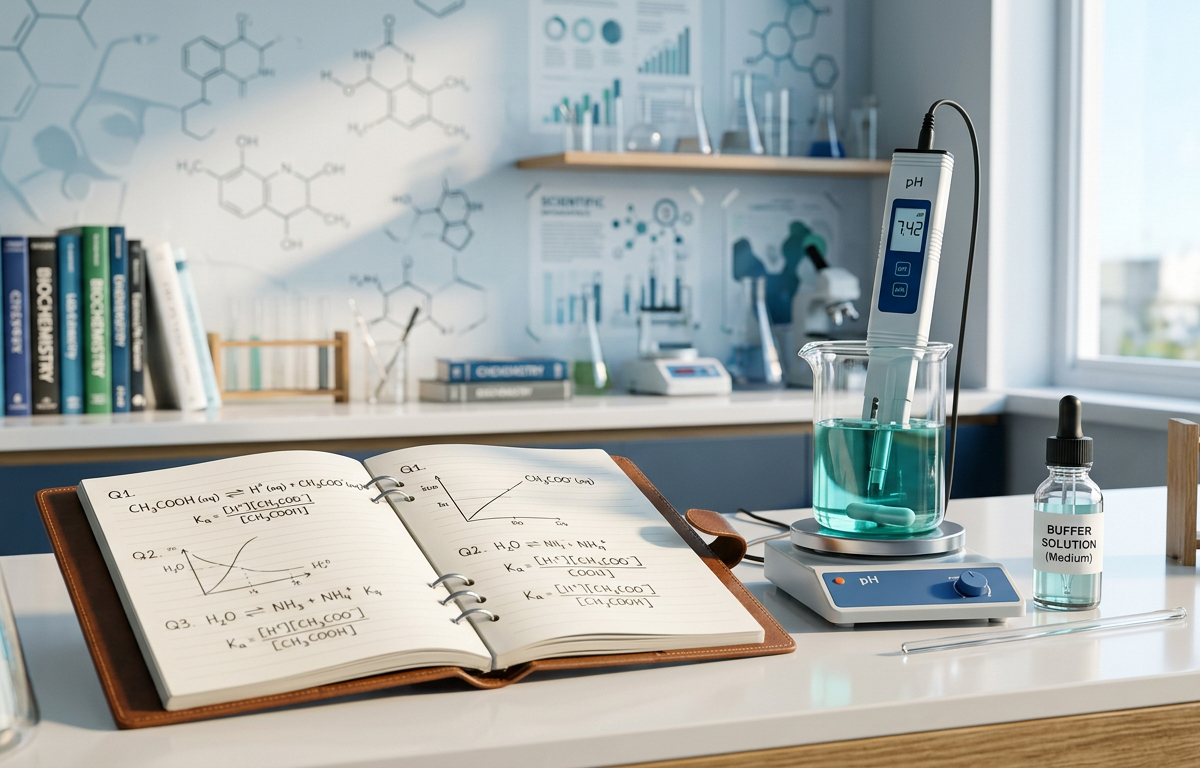
A buffer solution is a chemical system consisting of a weak acid and its conjugate base (or a weak base and its conjugate acid) that resists significant changes in pH when small amounts of strong acid or base are added. This resistance occurs because the buffer components neutralize added hydronium or hydroxide ions through equilibrium shifts. For example, in a blood buffer system, bicarbonate ions neutralize excess acid to maintain a stable physiological pH around 7.4. To calculate the pH of these systems, chemists rely on the Henderson-Hasselbalch equation, which relates the pH to the pKa of the weak acid and the ratio of the concentrations of the conjugate base and acid.
The effectiveness of a buffer is determined by its buffer capacity, which is highest when the concentrations of the acid and base are equal and high. According to Wikipedia, the buffering range generally spans one pH unit above and below the pKa of the acid component. Understanding these principles is essential for laboratory work, such as protein purification or enzymatic assays, where even slight pH fluctuations can denature biological molecules. You may also find it helpful to review Ka and Kb calculations to better understand how these constants influence buffer behavior.
Solved Examples
Example 1: Calculating pH from Molarities
Calculate the pH of a buffer solution that is 0.25 M in acetic acid (CH₃COOH) and 0.15 M in sodium acetate (CH₃COONa). The Ka of acetic acid is 1.8 × 10⁻⁵.
Find the pKa by taking the negative log of Ka: pKa = -log(1.8 × 10⁻⁵) = 4.74.
Identify the concentrations: [Acid] = 0.25 M, [Base] = 0.15 M.
Apply the Henderson-Hasselbalch equation: pH = pKa + log([Base]/[Acid]).
pH = 4.74 + log(0.15 / 0.25) = 4.74 + (-0.22) = 4.52.
Example 2: Buffer Preparation by Partial Neutralization
What is the pH of a solution formed by mixing 100 mL of 0.50 M NH₃ (Kb = 1.8 × 10⁻⁵) with 50 mL of 0.20 M HCl?
Calculate initial moles: Moles NH₃ = 0.100 L × 0.50 M = 0.050 mol. Moles HCl = 0.050 L × 0.20 M = 0.010 mol.
React the strong acid with the weak base: NH₃ + HCl → NH₄⁺ + Cl⁻.
Remaining NH₃ = 0.050 - 0.010 = 0.040 mol. Produced NH₄⁺ = 0.010 mol.
Find pKa of the conjugate acid (NH₄⁺): pKb = 4.74, so pKa = 14 - 4.74 = 9.26.
Apply the equation: pH = 9.26 + log(0.040 / 0.010) = 9.26 + 0.60 = 9.86.
Example 3: pH Change after Adding Base
A 1.0 L buffer contains 0.30 M HF and 0.30 M NaF (pKa = 3.17). Calculate the new pH after adding 0.05 moles of NaOH.
Initial moles: HF = 0.30 mol, F⁻ = 0.30 mol.
Reaction: HF + OH⁻ → F⁻ + H₂O.
New moles: HF = 0.30 - 0.05 = 0.25 mol. F⁻ = 0.30 + 0.05 = 0.35 mol.
New pH = 3.17 + log(0.35 / 0.25) = 3.17 + 0.146 = 3.32.
Practice Questions
1. Calculate the pH of a solution containing 0.45 M formic acid (HCOOH) and 0.55 M sodium formate (HCOONa). The Ka for formic acid is 1.77 × 10⁻⁴.
2. A buffer solution is prepared by dissolving 0.20 moles of cyanic acid (HCNO) and 0.15 moles of sodium cyanate (NaCNO) in 500 mL of water. If the pKa of HCNO is 3.46, what is the pH?
3. How many grams of sodium lactate (NaC₃H₅O₃, molar mass = 112.06 g/mol) must be added to 1.0 L of 0.15 M lactic acid (pKa = 3.86) to create a buffer with a pH of 4.00?
Want unlimited practice questions like these?
Generate AI-powered questions with step-by-step solutions on any topic.
Try Question Generator Free →4. Determine the pH of a buffer system consisting of 0.12 M propanoic acid and 0.10 M sodium propanoate after 0.02 moles of HCl are added to 1.0 L of the solution. (pKa of propanoic acid = 4.87).
5. A chemist mixes 250 mL of 0.40 M methylamine (CH₃NH₂) with 150 mL of 0.25 M methylammonium chloride (CH₃NH₃Cl). Find the pH if the Kb of methylamine is 4.4 × 10⁻⁴.
6. What is the ratio of [A⁻]/[HA] required to create a buffer with a pH of 5.50 using an acid with a pKa of 5.12?
7. Calculate the pH of a solution made by adding 50.0 mL of 0.10 M NaOH to 150.0 mL of 0.20 M CH₃COOH (Ka = 1.8 × 10⁻⁵).
8. You have a 1.0 L buffer of 0.50 M NH₃ and 0.50 M NH₄Cl. What is the pH change if 0.10 mol of KOH is added? (pKa of NH₄⁺ = 9.25).
9. A buffer is made with 0.60 M nitrous acid (HNO₂) and 0.40 M nitrite ion (NO₂⁻). If the pH is 3.22, what is the Ka of nitrous acid?
10. Which of the following pairs would make the most effective buffer at pH 7.00: (a) Acetic acid/Acetate (pKa 4.74) or (b) MOPS/MOPS-salt (pKa 7.20)? Explain based on buffer capacity.
Answers & Explanations
Answer: 3.84. First, pKa = -log(1.77 × 10⁻⁴) = 3.75. Using pH = 3.75 + log(0.55/0.45), we get 3.75 + 0.087 = 3.84.
Answer: 3.34. The volume cancels out in the ratio. pH = 3.46 + log(0.15/0.20) = 3.46 + (-0.12) = 3.34.
Answer: 23.2 g. Use Henderson-Hasselbalch: 4.00 = 3.86 + log([Base]/0.15). 0.14 = log([Base]/0.15). 10^0.14 = [Base]/0.15 → 1.38 = [Base]/0.15 → [Base] = 0.207 M. Moles = 0.207 mol/L × 1.0 L = 0.207 mol. Mass = 0.207 mol × 112.06 g/mol = 23.2 g.
Answer: 4.63. Initial moles: Acid = 0.12, Base = 0.10. Adding 0.02 mol HCl converts base to acid. New Acid = 0.14, New Base = 0.08. pH = 4.87 + log(0.08/0.14) = 4.87 - 0.24 = 4.63.
Answer: 11.07. First, find pKb = -log(4.4 × 10⁻⁴) = 3.36. pKa = 14 - 3.36 = 10.64. Moles base = 0.25 L × 0.40 M = 0.10 mol. Moles acid = 0.15 L × 0.25 M = 0.0375 mol. pH = 10.64 + log(0.10/0.0375) = 10.64 + 0.43 = 11.07.
Answer: 2.40. 5.50 = 5.12 + log(ratio). 0.38 = log(ratio). ratio = 10^0.38 = 2.40.
Answer: 4.26. Moles NaOH = 0.005. Moles CH₃COOH = 0.030. Reaction: 0.005 mol NaOH consumes 0.005 mol acid to make 0.005 mol acetate. Remaining acid = 0.025 mol. Acetate = 0.005 mol. pH = 4.74 + log(0.005/0.025) = 4.74 - 0.70 = 4.04. (Wait, recalculating: log(0.2) = -0.698... 4.74 - 0.70 = 4.04).
Answer: pH increases by 0.18. Initial pH = 9.25 + log(0.5/0.5) = 9.25. Adding 0.10 mol KOH: Acid = 0.40, Base = 0.60. New pH = 9.25 + log(0.6/0.4) = 9.25 + 0.176 = 9.426. Change = 0.176.
Answer: 4.5 × 10⁻⁴. 3.22 = pKa + log(0.40/0.60). 3.22 = pKa - 0.176. pKa = 3.396. Ka = 10^-3.396 = 4.0 × 10⁻⁴.
Answer: MOPS. A buffer is most effective when the desired pH is close to its pKa. Since 7.00 is closer to 7.20 than 4.74, MOPS provides better resistance to both acid and base addition.
1. Which equation is most commonly used to calculate the pH of a buffer solution?
Frequently Asked Questions
What is the primary purpose of a buffer?
The primary purpose of a buffer is to maintain a stable pH environment by neutralizing small additions of acids or bases. This is critical in biological systems and industrial processes where chemical stability is required for function.
Can a strong acid and its salt form a buffer?
No, a strong acid and its salt cannot form a buffer because the conjugate base of a strong acid is too weak to react with added protons. Buffers require a weak species and its conjugate to establish a reversible equilibrium, as explained in LibreTexts Chemistry resources.
How does dilution affect the pH of a buffer?
Dilution generally does not change the pH of a buffer significantly because the ratio of the conjugate base to the weak acid remains constant. However, extreme dilution can eventually weaken the buffer capacity and lead to slight shifts as the water's autoionization becomes relevant.
Why is blood pH buffering so important?
Blood pH must stay within a narrow range (7.35–7.45) to ensure that proteins and enzymes maintain their three-dimensional shapes and functions. If the pH deviates significantly, it can lead to medical conditions like acidosis or alkalosis, which can be fatal.
What is the difference between a buffer and a neutral solution?
A neutral solution has a pH of 7.0 but no inherent ability to resist pH changes upon the addition of an acid or base. In contrast, a buffer solution can have any pH value (depending on its components) and possesses the chemical capacity to resist changes to that specific pH.
Want unlimited practice questions like these?
Generate AI-powered questions with step-by-step solutions on any topic.
Try Question Generator Free →Enjoyed this article?
Share it with others who might find it helpful.
Related Articles
Mastering the Log Ratio: Henderson-Hasselbalch Buffer Problems
Master the Henderson-Hasselbalch equation with our detailed guide, solved examples, and practice problems to ace your chemistry exams.
Mar 28, 2026
Mastering M1V1 = M2V2: Solving Complex Solution Dilutions
Master dilution calculations with our comprehensive guide. Includes the M1V1=M2V2 formula, solved examples, and 10 practice questions with detailed answers.
Mar 27, 2026

Calculating High-Stakes Meds: BSA Mosteller Formula Practice
Master hard body surface area-based dosage calculations with our comprehensive guide, solved examples, and practice questions for healthcare students.
May 17, 2026

Solving High-Stakes IV Titrations and Weight-Based Infusions
Master advanced IV flow rate calculations with these hard practice questions. Covers weight-based dosing, titrations, and dimensional analysis for nurses.
May 17, 2026

Solving Weight-Based Dosing: The 2.2 Conversion and Rounding Logic
Weight-Based Dosage Calculations Practice Questions with Answers
May 17, 2026
Predicting Periodic Anomalies: Beyond Basic Trend Rules
Hard Periodic Trends Practice Questions
Apr 4, 2026
Hard Electron Configuration Practice Questions
Hard Electron Configuration Practice Questions
Apr 4, 2026
Medium Electron Configuration Practice Questions
Master medium-level electron configuration with our comprehensive guide, including solved examples, stability exceptions, and practice questions with answers.
Apr 4, 2026