Mastering pKa Calculations: Converting Ka and Conjugate Pairs
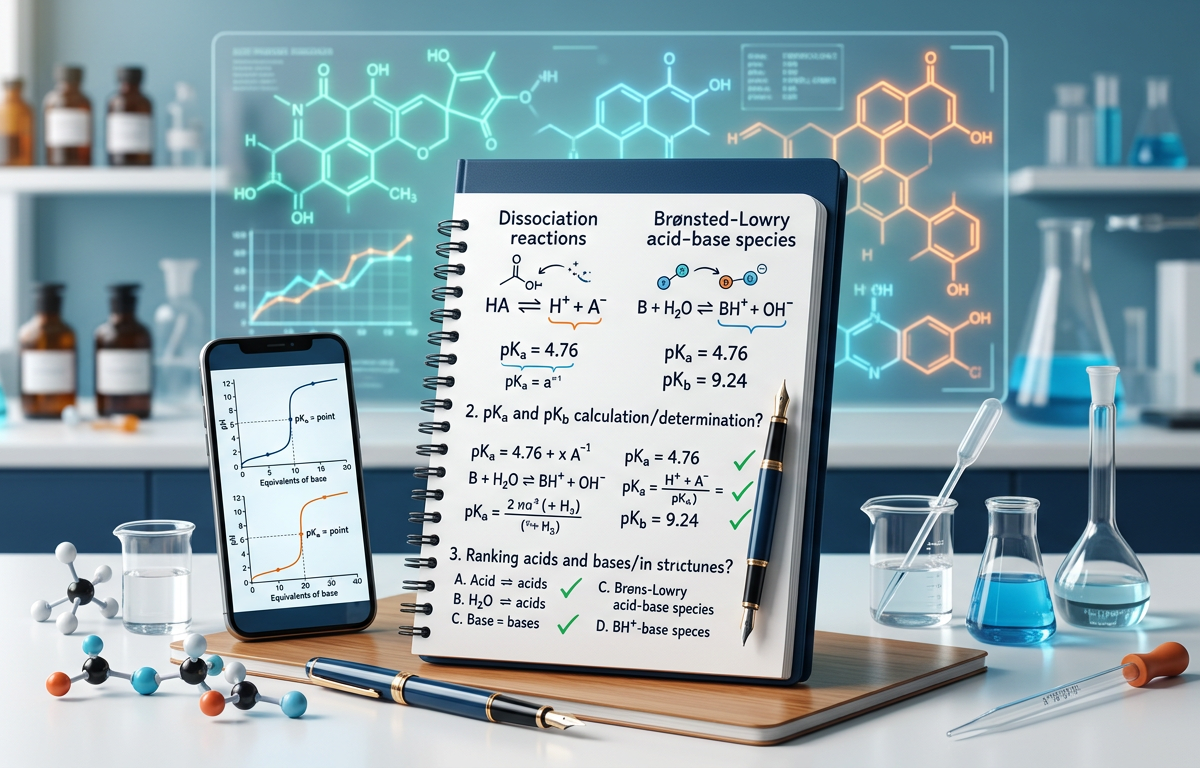
When you see a Ka of 1.8 x 10^-5 for acetic acid, the raw number is difficult to compare mentally against other substances. This is why we use the p-scale. The most common mistake students make is forgetting that the negative in the pKa = -log(Ka) formula creates an inverse relationship. A smaller, more positive pKa always represents a larger Ka and therefore a more aggressive acid. If you calculate a pKa and get a negative value for a weak acid, you likely missed a sign change in your arithmetic.
Another frequent stumbling block is the pKa + pKb = 14 identity. This relationship only applies to conjugate acid-base pairs, such as NH4+ and NH3, at 25 degrees Celsius. You cannot simply add the pKa of one random acid to the pKb of an unrelated base and expect them to equal 14. This guide provides specific practice problems to help you navigate these logarithmic conversions and correctly identify the strength of acids and bases based on their dissociation constants.
Logarithmic Scales and Dissociation Constants
pKa and pKb are logarithmic measures that quantify the strength of an acid or a base, respectively, providing a convenient way to express very small equilibrium constants. The pKa (acid dissociation constant) is defined as the negative base-10 logarithm of the acid dissociation constant (Ka), or pKa = -log(Ka). Similarly, the pKb (base dissociation constant) is defined as the negative base-10 logarithm of the base dissociation constant (Kb), or pKb = -log(Kb).
A lower pKa value indicates a stronger acid, meaning it dissociates more extensively in solution, while a higher pKa indicates a weaker acid. Conversely, a lower pKb value indicates a stronger base, meaning it accepts protons more readily, and a higher pKb indicates a weaker base. The relationship between pKa and pKb for a conjugate acid-base pair in aqueous solution at 25°C is given by pKa + pKb = 14, which derives from the ion product of water (Kw = 1.0 x 10⁻¹⁴ at 25°C) where Kw = Ka * Kb.
Understanding these values is crucial for predicting reaction direction, buffer preparation, and analyzing acid-base behavior in various chemical and biological systems. For more on understanding fundamental chemical concepts, you might find our guide on how to study effectively helpful.
Solved Examples
Example 1: Calculating pKa from Ka
Calculate the pKa of acetic acid (CH₃COOH) if its Ka is 1.8 x 10⁻⁵.
Identify the given value: Ka = 1.8 x 10⁻⁵.
Recall the formula for pKa: pKa = -log(Ka).
Substitute the Ka value into the formula: pKa = -log(1.8 x 10⁻⁵).
Calculate the logarithm: log(1.8 x 10⁻⁵) ≈ -4.74.
Multiply by -1: pKa = -(-4.74) = 4.74.
State the answer: The pKa of acetic acid is 4.74.
Example 2: Calculating pKb from Kb
Given that the base dissociation constant (Kb) for ammonia (NH₃) is 1.8 x 10⁻⁵, determine its pKb.
Identify the given value: Kb = 1.8 x 10⁻⁵.
Recall the formula for pKb: pKb = -log(Kb).
Substitute the Kb value into the formula: pKb = -log(1.8 x 10⁻⁵).
Calculate the logarithm: log(1.8 x 10⁻⁵) ≈ -4.74.
Multiply by -1: pKb = -(-4.74) = 4.74.
State the answer: The pKb of ammonia is 4.74.
Example 3: Calculating Ka from pKa
The pKa of hydrocyanic acid (HCN) is 9.21. What is its Ka?
Identify the given value: pKa = 9.21.
Recall the inverse relationship: Ka = 10-pKa.
Substitute the pKa value: Ka = 10-9.21.
Calculate the value: Ka ≈ 6.17 x 10⁻¹⁰.
State the answer: The Ka of hydrocyanic acid is 6.17 x 10⁻¹⁰.
Example 4: Calculating pKb from pKa of a Conjugate Acid-Base Pair
If the pKa of the ammonium ion (NH₄⁺) is 9.25, what is the pKb of its conjugate base, ammonia (NH₃), at 25°C?
Identify the given value: pKa (NH₄⁺) = 9.25.
Recall the relationship for conjugate acid-base pairs: pKa + pKb = 14 (at 25°C).
Rearrange the formula to solve for pKb: pKb = 14 - pKa.
Substitute the pKa value: pKb = 14 - 9.25.
Calculate the result: pKb = 4.75.
State the answer: The pKb of ammonia (NH₃) is 4.75.
Practice Questions
1. Calculate the pKa of hypochlorous acid (HClO) if its Ka is 3.0 x 10⁻⁸.
2. A weak base, methylamine (CH₃NH₂), has a Kb of 4.4 x 10⁻⁴. What is its pKb?
3. The pKa of benzoic acid (C₆H₅COOH) is 4.20. Determine its acid dissociation constant (Ka).
Want unlimited practice questions like these?
Generate AI-powered questions with step-by-step solutions on any topic.
Try Question Generator Free →4. Given that the pKb of the fluoride ion (F⁻) is 10.83, calculate the pKa of its conjugate acid, hydrofluoric acid (HF), at 25°C.
5. Which is a stronger acid: an acid with pKa = 3.5 or an acid with pKa = 5.0? Explain your reasoning.
6. If the Ka of phenol (C₆H₅OH) is 1.0 x 10⁻¹⁰, what is the pKb of its conjugate base, phenoxide (C₆H₅O⁻), at 25°C?
7. A solution has a pH of 9.5. Is it more likely to contain a weak acid with pKa = 7.0 or a weak base with pKb = 4.0? Justify your choice.
8. Calculate the Kb for a base whose pKb is 2.80.
9. A biochemist is studying two amino acids. Amino acid A has an alpha-carboxyl group with pKa = 2.34, and amino acid B has an alpha-carboxyl group with pKa = 2.10. Which amino acid's alpha-carboxyl group is a stronger acid?
10. The pKa of a certain indicator is 7.2. What will be the ratio of its conjugate base form to its acid form ([In⁻]/[HIn]) when the pH of the solution is 8.2? (Hint: Use the Henderson-Hasselbalch equation: pH = pKa + log([A⁻]/[HA]))
Answers & Explanations
1. pKa of hypochlorous acid (HClO):
Given Ka = 3.0 x 10⁻⁸.
pKa = -log(Ka) = -log(3.0 x 10⁻⁸).
pKa ≈ 7.52.
2. pKb of methylamine (CH₃NH₂):
Given Kb = 4.4 x 10⁻⁴.
pKb = -log(Kb) = -log(4.4 x 10⁻⁴).
pKb ≈ 3.36.
3. Ka of benzoic acid (C₆H₅COOH):
Given pKa = 4.20.
Ka = 10-pKa = 10-4.20.
Ka ≈ 6.31 x 10⁻⁵.
4. pKa of hydrofluoric acid (HF):
Given pKb (F⁻) = 10.83.
For a conjugate acid-base pair, pKa + pKb = 14 (at 25°C).
pKa (HF) = 14 - pKb (F⁻) = 14 - 10.83.
pKa (HF) = 3.17.
5. Stronger acid comparison:
An acid with pKa = 3.5 is a stronger acid than an acid with pKa = 5.0.
A lower pKa value corresponds to a higher Ka value, which indicates a stronger acid because it dissociates more completely in solution.
6. pKb of phenoxide (C₆H₅O⁻):
Given Ka (phenol) = 1.0 x 10⁻¹⁰.
First, calculate pKa (phenol): pKa = -log(1.0 x 10⁻¹⁰) = 10.00.
For a conjugate acid-base pair, pKa + pKb = 14.
pKb (phenoxide) = 14 - pKa (phenol) = 14 - 10.00.
pKb (phenoxide) = 4.00.
7. Solution pH analysis:
A solution with pH 9.5 is basic.
A weak acid with pKa = 7.0 would have its conjugate base present in significant amounts at pH 9.5, but the solution would only be basic if the conjugate base was strong enough.
A weak base with pKb = 4.0 corresponds to a relatively strong weak base (Kb = 10-4 = 1.0 x 10⁻⁴). This base would produce OH⁻ ions, making the solution basic.
Therefore, it is more likely to contain a weak base with pKb = 4.0.
8. Kb for a base with pKb = 2.80:
Given pKb = 2.80.
Kb = 10-pKb = 10-2.80.
Kb ≈ 1.58 x 10⁻³.
9. Stronger acid comparison (amino acids):
Amino acid A: pKa = 2.34.
Amino acid B: pKa = 2.10.
A lower pKa indicates a stronger acid.
Therefore, amino acid B's alpha-carboxyl group (pKa = 2.10) is a stronger acid than amino acid A's (pKa = 2.34).
10. Ratio of conjugate base to acid form:
Given pKa = 7.2 and pH = 8.2.
Using the Henderson-Hasselbalch equation: pH = pKa + log([A⁻]/[HA]).
8.2 = 7.2 + log([In⁻]/[HIn]).
1.0 = log([In⁻]/[HIn]).
[In⁻]/[HIn] = 101.0 = 10.
The ratio of conjugate base to acid form is 10:1.
1. What does a lower pKa value indicate about an acid?
Frequently Asked Questions
What is the difference between Ka and pKa?
Ka is the acid dissociation constant, representing the equilibrium constant for the dissociation of a weak acid into its conjugate base and a proton. pKa is the negative logarithm of Ka (pKa = -log Ka), providing a more convenient scale for expressing acid strength, especially for very small Ka values.
Why is pKa used instead of Ka?
pKa is used because Ka values for weak acids are often very small numbers (e.g., 10-5, 10-10), making them cumbersome to compare. The logarithmic pKa scale converts these small values into more manageable positive numbers, simplifying comparisons of acid strengths. For example, a pKa of 5 is easier to grasp than a Ka of 10-5.
How does temperature affect pKa and pKb?
pKa and pKb values are temperature-dependent because the underlying equilibrium constants (Ka and Kb) are temperature-dependent. The ion product of water (Kw) also changes with temperature, which in turn affects the relationship pKa + pKb = pKw. This relationship is exactly 14 only at 25°C.
What is the significance of the pKa + pKb = 14 relationship?
This relationship, valid at 25°C, highlights the inverse strength of a conjugate acid-base pair. If an acid is strong (low pKa), its conjugate base will be weak (high pKb), and vice-versa. It is derived from the autoionization of water, where Kw = Ka * Kb for a conjugate pair.
How do pKa and pKb relate to pH?
pKa and pKb relate to pH through the Henderson-Hasselbalch equation (pH = pKa + log([A⁻]/[HA])) for acids and an analogous equation for bases (pOH = pKb + log([BH⁺]/[B])). These equations show that when the concentrations of the acid/base and its conjugate are equal, pH = pKa or pOH = pKb, respectively, which is critical for understanding buffer solutions.
Can pKa or pKb be negative?
Yes, pKa or pKb can be negative. A negative pKa indicates a very strong acid (Ka > 1), meaning it dissociates almost completely. For example, the pKa of hydrochloric acid (HCl) is approximately -7. Similarly, a negative pKb would indicate a very strong base.
Want unlimited practice questions like these?
Generate AI-powered questions with step-by-step solutions on any topic.
Try Question Generator Free →
Want unlimited practice questions like these?
Generate AI-powered questions with step-by-step solutions on any topic.
Try Question Generator Free →Enjoyed this article?
Share it with others who might find it helpful.
Related Articles
Calculating Kc: Mastering the Ratio of Equilibrium Concentrations
Master the Equilibrium Constant (Kc) with our comprehensive guide featuring solved examples, practice questions, and detailed explanations for chemistry students.
Mar 30, 2026
Mastering the Log Ratio: Henderson-Hasselbalch Buffer Problems
Master the Henderson-Hasselbalch equation with our detailed guide, solved examples, and practice problems to ace your chemistry exams.
Mar 28, 2026
Mastering Acid Ionization: Solving for Ka and pH in Weak Solutions
Master the difference between strong and weak acids with practice questions, detailed explanations, and a quick quiz.
Mar 28, 2026
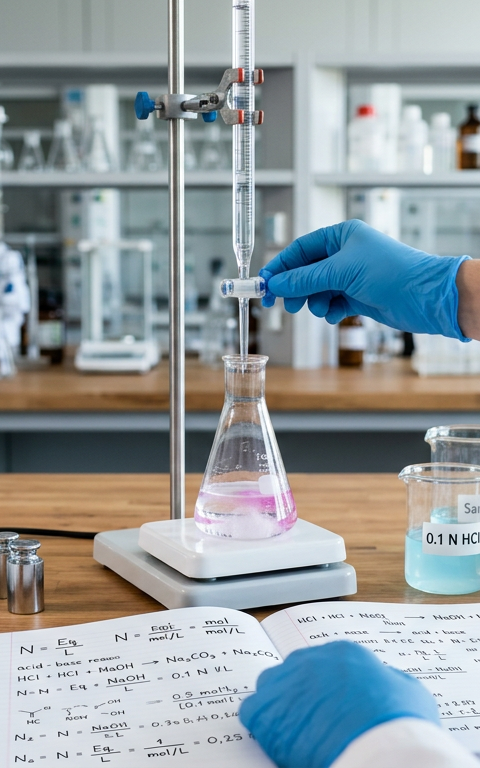
Mastering Reactive Capacity: Normality Calculations and n-factors
Master normality calculations with our guide. Includes concept explanations, solved examples, and practice questions to help you ace your chemistry exams.
Mar 27, 2026
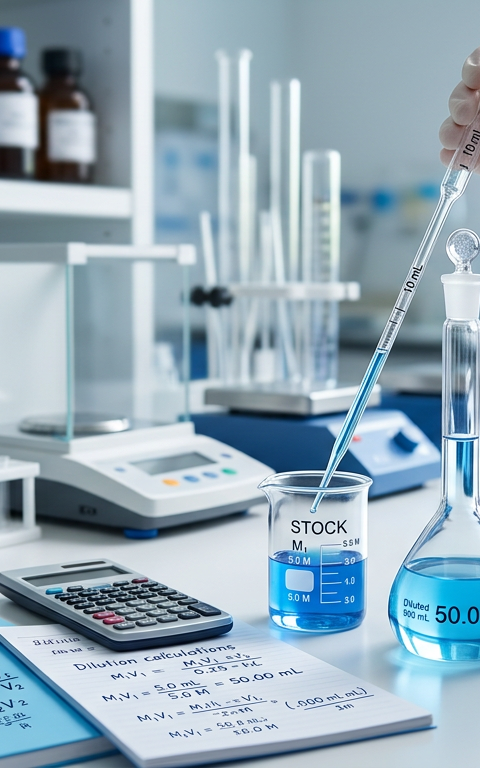
Mastering M1V1 = M2V2: Solving Complex Solution Dilutions
Master dilution calculations with our comprehensive guide. Includes the M1V1=M2V2 formula, solved examples, and 10 practice questions with detailed answers.
Mar 27, 2026
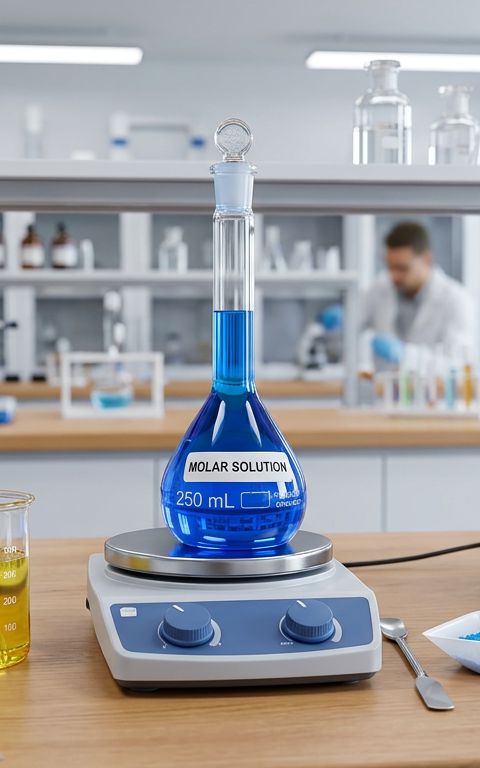
Why Molarity Matters: Converting Mass to Moles for Lab Solutions
Master chemistry with our guide to the molarity formula. Learn how to calculate concentration with step-by-step examples, units, and practical lab tips.
Mar 26, 2026

Calculating High-Stakes Meds: BSA Mosteller Formula Practice
Master hard body surface area-based dosage calculations with our comprehensive guide, solved examples, and practice questions for healthcare students.
May 17, 2026

Solving High-Stakes IV Titrations and Weight-Based Infusions
Master advanced IV flow rate calculations with these hard practice questions. Covers weight-based dosing, titrations, and dimensional analysis for nurses.
May 17, 2026