Buffer Solution Practice Questions with Answers
Concept Explanation
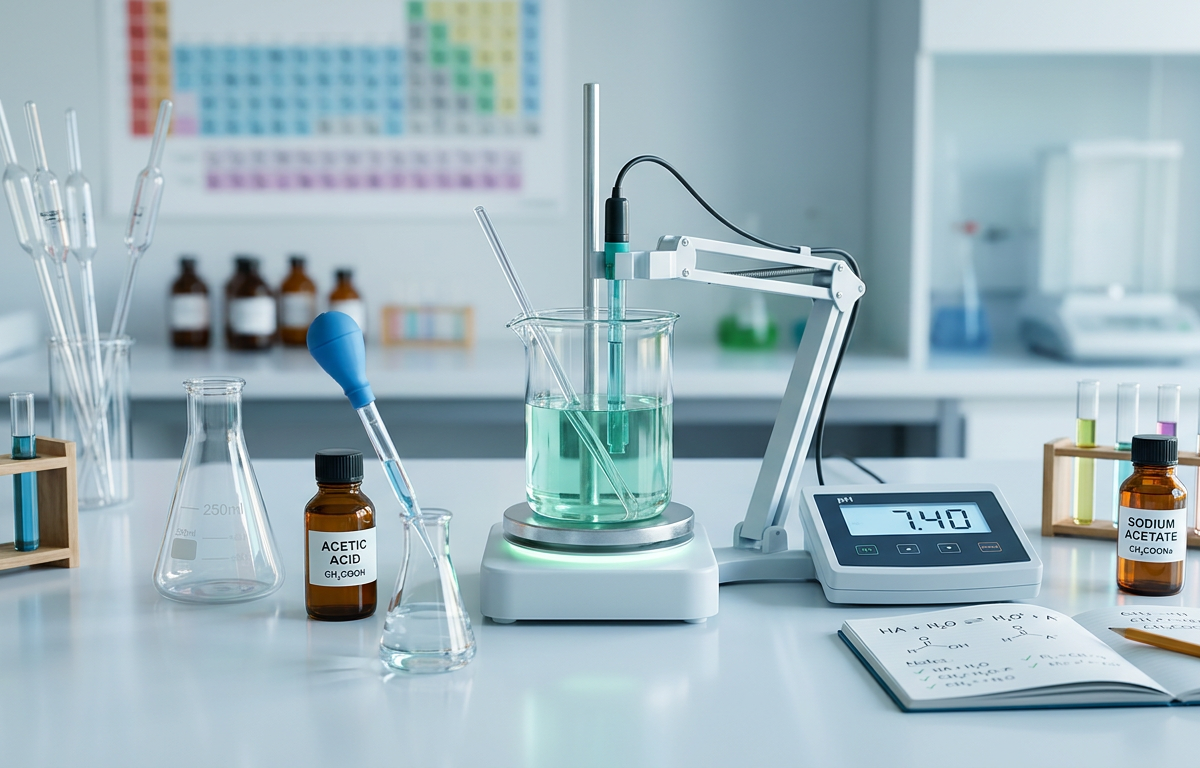
A buffer solution is an aqueous solution that resists changes in pH upon the addition of small amounts of an acid or a base. This resistance to pH change is crucial in many chemical and biological systems, such as blood, which maintains a pH of around 7.4. Buffer solutions typically consist of a weak acid and its conjugate base, or a weak base and its conjugate acid. The components of a buffer work by neutralizing added H+ or OH- ions, thereby preventing significant fluctuations in pH. For example, if a small amount of strong acid is added to a buffer containing a weak acid (HA) and its conjugate base (A-), the conjugate base (A-) reacts with the added H+ ions to form the weak acid (HA), which dissociates minimally. Conversely, if a small amount of strong base is added, the weak acid (HA) reacts with the added OH- ions to form water and the conjugate base (A-). The Henderson-Hasselbalch equation, pH = pKa + log([A-]/[HA]), is often used to calculate the pH of a buffer solution and understand its buffering capacity. The effectiveness of a buffer depends on the concentrations of its components and the ratio between the weak acid and its conjugate base (or weak base and its conjugate acid).
Solved Examples
Example 1: Calculating pH of a Buffer Solution
Calculate the pH of a buffer solution containing 0.10 M acetic acid (CH₃COOH) and 0.10 M sodium acetate (CH₃COONa). The pKa of acetic acid is 4.76. 1. **Identify the components:** Acetic acid (CH₃COOH) is the weak acid, and sodium acetate (CH₃COONa) provides the conjugate base (CH₃COO⁻). 2. **State the given concentrations:** [CH₃COOH] = 0.10 M, [CH₃COO⁻] = 0.10 M. 3. **Apply the Henderson-Hasselbalch equation:** pH = pKa + log([A⁻]/[HA]). 4. **Substitute the values:** pH = 4.76 + log(0.10 M / 0.10 M). 5. **Calculate the pH:** pH = 4.76 + log(1) = 4.76 + 0 = 4.76.
Example 2: pH Change After Adding a Strong Acid to a Buffer
What is the pH of the buffer from Example 1 after adding 0.010 mol of HCl to 1.0 L of the buffer? Assume no volume change. 1. **Initial moles:** Moles of CH₃COOH = 0.10 M * 1.0 L = 0.10 mol. Moles of CH₃COO⁻ = 0.10 M * 1.0 L = 0.10 mol. 2. **Reaction with added HCl:** HCl (strong acid) reacts with the conjugate base (CH₃COO⁻). CH₃COO⁻(aq) + H⁺(aq) → CH₃COOH(aq) 3. **Change in moles:** Added H⁺ = 0.010 mol. * Moles of CH₃COO⁻ decrease by 0.010 mol: 0.10 - 0.010 = 0.090 mol. * Moles of CH₃COOH increase by 0.010 mol: 0.10 + 0.010 = 0.110 mol. 4. **New concentrations (assuming 1.0 L volume):** [CH₃COO⁻] = 0.090 M, [CH₃COOH] = 0.110 M. 5. **Apply the Henderson-Hasselbalch equation:** pH = pKa + log([A⁻]/[HA]). 6. **Substitute the new values:** pH = 4.76 + log(0.090 M / 0.110 M). 7. **Calculate the pH:** pH = 4.76 + log(0.818) = 4.76 - 0.087 = 4.67.
Example 3: Preparing a Buffer with a Specific pH
How many grams of sodium formate (HCOONa, MW = 68.01 g/mol) must be added to 500.0 mL of 0.15 M formic acid (HCOOH, pKa = 3.75) to prepare a buffer with a pH of 3.85? 1. **Identify knowns:** pH = 3.85, pKa = 3.75, [HCOOH] = 0.15 M, Volume = 0.500 L. 2. **Use Henderson-Hasselbalch to find the ratio [A⁻]/[HA]:** pH = pKa + log([HCOO⁻]/[HCOOH]) 3.85 = 3.75 + log([HCOO⁻]/[0.15 M]) 0.10 = log([HCOO⁻]/[0.15 M]) 10^(0.10) = [HCOO⁻]/[0.15 M] 1.2589 = [HCOO⁻]/[0.15 M] 3. **Calculate [HCOO⁻]:** [HCOO⁻] = 1.2589 * 0.15 M = 0.1888 M. 4. **Calculate moles of HCOO⁻ needed:** Moles = Concentration * Volume = 0.1888 mol/L * 0.500 L = 0.0944 mol. 5. **Convert moles to grams of HCOONa:** Mass = Moles * Molar Mass = 0.0944 mol * 68.01 g/mol = 6.42 g.
Practice Questions
1. Calculate the pH of a buffer solution containing 0.25 M ammonia (NH₃, Kb = 1.8 × 10⁻⁵) and 0.40 M ammonium chloride (NH₄Cl). 2. A buffer solution contains 0.30 M propanoic acid (CH₃CH₂COOH, Ka = 1.3 × 10⁻⁵) and 0.20 M sodium propanoate (CH₃CH₂COONa). What is the pH of this buffer? 3. If 0.020 mol of NaOH is added to 1.0 L of the buffer described in question 2, what will be the new pH? Assume no volume change.
Want unlimited practice questions like these?
Generate AI-powered questions with step-by-step solutions on any topic.
Try Question Generator Free →4. You need to prepare a buffer with a pH of 9.50. You have a 0.50 M solution of a weak acid, HA, with a pKa of 9.20, and its conjugate base, NaA. What ratio of [A⁻]/[HA] is required? 5. A buffer is made by mixing 120 mL of 0.30 M HClO (hypochlorous acid, Ka = 3.0 × 10⁻⁸) with 80 mL of 0.45 M NaClO (sodium hypochlorite). What is the pH of the resulting buffer solution? 6. Which of the following mixtures would form a buffer solution? a) HCl and NaCl b) H₂SO₄ and Na₂SO₄ c) HF and KF d) HNO₃ and KNO₃ 7. A buffer solution has a pH of 5.20. If the pKa of the weak acid component is 5.00, what is the ratio of the conjugate base concentration to the weak acid concentration ([A⁻]/[HA])? 8. Calculate the buffering capacity of a 1.0 L buffer solution containing 0.50 M CH₃COOH and 0.50 M CH₃COONa (pKa = 4.76) when 0.10 mol of HCl is added. What is the new pH? 9. What is the pH of a solution formed by mixing 200 mL of 0.10 M CH₃COOH (Ka = 1.8 × 10⁻⁵) and 100 mL of 0.050 M NaOH? 10. Describe how a buffer solution resists changes in pH when a small amount of strong base is added. 11. What is the effective pH range for a buffer solution made from a weak acid with a pKa of 6.80? 12. If you have 500 mL of a 0.20 M solution of a weak base, B, and you want to prepare a buffer with a pH of 9.00, how many moles of its conjugate acid, BH⁺, would you need to add? Assume the pKb of the weak base is 4.75 and ignore volume changes.
Answers & Explanations
1. **Calculate the pH of a buffer solution containing 0.25 M ammonia (NH₃, Kb = 1.8 × 10⁻⁵) and 0.40 M ammonium chloride (NH₄Cl).** * NH₃ is a weak base, and NH₄Cl provides its conjugate acid, NH₄⁺. We need pKa for the Henderson-Hasselbalch equation for pH, or we can calculate pOH first. * pKb = -log(Kb) = -log(1.8 × 10⁻⁵) = 4.74. * Using the Henderson-Hasselbalch equation for bases: pOH = pKb + log([conjugate acid]/[weak base]) * pOH = 4.74 + log(0.40 M / 0.25 M) = 4.74 + log(1.6) = 4.74 + 0.20 = 4.94. * pH = 14 - pOH = 14 - 4.94 = **9.06**. 2. **A buffer solution contains 0.30 M propanoic acid (CH₃CH₂COOH, Ka = 1.3 × 10⁻⁵) and 0.20 M sodium propanoate (CH₃CH₂COONa). What is the pH of this buffer?** * pKa = -log(Ka) = -log(1.3 × 10⁻⁵) = 4.89. * pH = pKa + log([A⁻]/[HA]) * pH = 4.89 + log(0.20 M / 0.30 M) = 4.89 + log(0.667) = 4.89 - 0.18 = **4.71**. 3. **If 0.020 mol of NaOH is added to 1.0 L of the buffer described in question 2, what will be the new pH? Assume no volume change.** * Initial moles: HA = 0.30 mol, A⁻ = 0.20 mol (since volume is 1.0 L). * Added NaOH (strong base) reacts with the weak acid (HA): HA + OH⁻ → A⁻ + H₂O * Change in moles: * HA decreases by 0.020 mol: 0.30 - 0.020 = 0.28 mol. * A⁻ increases by 0.020 mol: 0.20 + 0.020 = 0.22 mol. * New concentrations (for 1.0 L): [HA] = 0.28 M, [A⁻] = 0.22 M. * pH = pKa + log([A⁻]/[HA]) = 4.89 + log(0.22 M / 0.28 M) = 4.89 + log(0.786) = 4.89 - 0.10 = **4.79**. 4. **You need to prepare a buffer with a pH of 9.50. You have a 0.50 M solution of a weak acid, HA, with a pKa of 9.20, and its conjugate base, NaA. What ratio of [A⁻]/[HA] is required?** * pH = pKa + log([A⁻]/[HA]) * 9.50 = 9.20 + log([A⁻]/[HA]) * 0.30 = log([A⁻]/[HA]) * [A⁻]/[HA] = 10^(0.30) = **2.0**. 5. **A buffer is made by mixing 120 mL of 0.30 M HClO (hypochlorous acid, Ka = 3.0 × 10⁻⁸) with 80 mL of 0.45 M NaClO (sodium hypochlorite). What is the pH of the resulting buffer solution?** * Calculate moles of each component: * Moles HClO = 0.30 M * 0.120 L = 0.036 mol. * Moles ClO⁻ = 0.45 M * 0.080 L = 0.036 mol. * Total volume = 120 mL + 80 mL = 200 mL = 0.200 L. * New concentrations: * [HClO] = 0.036 mol / 0.200 L = 0.18 M. * [ClO⁻] = 0.036 mol / 0.200 L = 0.18 M. * pKa = -log(3.0 × 10⁻⁸) = 7.52. * pH = pKa + log([ClO⁻]/[HClO]) = 7.52 + log(0.18 M / 0.18 M) = 7.52 + log(1) = 7.52 + 0 = **7.52**. 6. **Which of the following mixtures would form a buffer solution?** * a) HCl and NaCl (Strong acid and its salt, not a buffer) * b) H₂SO₄ and Na₂SO₄ (Strong acid and its salt, not a buffer) * c) HF and KF (Weak acid and its conjugate base salt, **forms a buffer**) * d) HNO₃ and KNO₃ (Strong acid and its salt, not a buffer) 7. **A buffer solution has a pH of 5.20. If the pKa of the weak acid component is 5.00, what is the ratio of the conjugate base concentration to the weak acid concentration ([A⁻]/[HA])?** * pH = pKa + log([A⁻]/[HA]) * 5.20 = 5.00 + log([A⁻]/[HA]) * 0.20 = log([A⁻]/[HA]) * [A⁻]/[HA] = 10^(0.20) = **1.58**. 8. **Calculate the buffering capacity of a 1.0 L buffer solution containing 0.50 M CH₃COOH and 0.50 M CH₃COONa (pKa = 4.76) when 0.10 mol of HCl is added. What is the new pH?** * Initial moles: CH₃COOH = 0.50 mol, CH₃COO⁻ = 0.50 mol. * Added HCl (strong acid) reacts with CH₃COO⁻: CH₃COO⁻(aq) + H⁺(aq) → CH₃COOH(aq) * Change in moles: * Moles CH₃COO⁻ decrease by 0.10 mol: 0.50 - 0.10 = 0.40 mol. * Moles CH₃COOH increase by 0.10 mol: 0.50 + 0.10 = 0.60 mol. * New concentrations (assuming 1.0 L volume): [CH₃COO⁻] = 0.40 M, [CH₃COOH] = 0.60 M. * pH = pKa + log([A⁻]/[HA]) = 4.76 + log(0.40 M / 0.60 M) = 4.76 + log(0.667) = 4.76 - 0.18 = **4.58**. * The pH changed from 4.76 to 4.58, a change of 0.18 pH units, indicating effective buffering. 9. **What is the pH of a solution formed by mixing 200 mL of 0.10 M CH₃COOH (Ka = 1.8 × 10⁻⁵) and 100 mL of 0.050 M NaOH?** * Moles of CH₃COOH = 0.10 M * 0.200 L = 0.020 mol. * Moles of NaOH = 0.050 M * 0.100 L = 0.0050 mol. * NaOH (strong base) reacts with CH₃COOH (weak acid): CH₃COOH + NaOH → CH₃COONa + H₂O * After reaction: * CH₃COOH remaining = 0.020 mol - 0.0050 mol = 0.015 mol. * CH₃COONa formed = 0.0050 mol. * Total volume = 200 mL + 100 mL = 300 mL = 0.300 L. * New concentrations: * [CH₃COOH] = 0.015 mol / 0.300 L = 0.050 M. * [CH₃COO⁻] = 0.0050 mol / 0.300 L = 0.0167 M. * pKa = -log(1.8 × 10⁻⁵) = 4.74. * pH = pKa + log([A⁻]/[HA]) = 4.74 + log(0.0167 M / 0.050 M) = 4.74 + log(0.334) = 4.74 - 0.48 = **4.26**. 10. **Describe how a buffer solution resists changes in pH when a small amount of strong base is added.** * When a small amount of strong base (OH⁻) is added to a buffer, the weak acid component (HA) of the buffer reacts with the added hydroxide ions. This reaction forms water and the conjugate base (A⁻), consuming the strong base and preventing a significant increase in pH. Since the weak acid is only slightly dissociated, its concentration is high enough to neutralize the added base effectively. 11. **What is the effective pH range for a buffer solution made from a weak acid with a pKa of 6.80?** * The effective buffering range for a weak acid/conjugate base buffer is generally considered to be within ±1 pH unit of the pKa value. Therefore, for a weak acid with a pKa of 6.80, the effective pH range is approximately from 6.80 - 1 = **5.80 to 6.80 + 1 = 7.80**. 12. **If you have 500 mL of a 0.20 M solution of a weak base, B, and you want to prepare a buffer with a pH of 9.00, how many moles of its conjugate acid, BH⁺, would you need to add? Assume the pKb of the weak base is 4.75 and ignore volume changes.** * First, convert the desired pH to pOH: pOH = 14 - pH = 14 - 9.00 = 5.00. * Use the Henderson-Hasselbalch equation for bases: pOH = pKb + log([BH⁺]/[B]). * 5.00 = 4.75 + log([BH⁺]/[0.20 M]) * 0.25 = log([BH⁺]/[0.20 M]) * [BH⁺]/[0.20 M] = 10^(0.25) = 1.778 * [BH⁺] = 1.778 * 0.20 M = 0.3556 M. * Moles of BH⁺ needed = Concentration * Volume = 0.3556 mol/L * 0.500 L = **0.178 mol**.
1. Which of the following best describes a buffer solution?
Frequently Asked Questions
What is the primary function of a buffer solution?
A buffer solution's primary function is to maintain a relatively stable pH level in a solution, even when small amounts of strong acids or bases are added. This pH stability is critical for many chemical reactions and biological processes.
How do buffer solutions work?
Buffer solutions work by containing both a weak acid and its conjugate base (or a weak base and its conjugate acid). The weak acid neutralizes added base, while the conjugate base neutralizes added acid, preventing drastic changes in the solution's pH. This equilibrium allows for the absorption of H+ or OH- ions.
What is the Henderson-Hasselbalch equation used for?
The Henderson-Hasselbalch equation is a mathematical expression used to calculate the pH of a buffer solution, given the pKa of the weak acid and the concentrations of the weak acid and its conjugate base. It is also used to determine the ratio of acid to base needed to achieve a desired pH.
What factors determine a buffer's effectiveness?
A buffer's effectiveness is determined by the absolute concentrations of the weak acid and conjugate base components, as well as their ratio. Buffers are most effective when the concentrations of the weak acid and conjugate base are high and when their ratio is close to 1:1, meaning the pH is near the pKa of the weak acid. For more on solution concentrations, you can check out our articles on molarity and percent concentration.
Can any weak acid and its conjugate base form a buffer?
Yes, any weak acid and its conjugate base can form a buffer solution, provided they are present in significant concentrations. The choice of which weak acid/conjugate base pair to use depends on the desired pH range for the buffer, as the buffer will be most effective near the pKa of the weak acid.
Why are buffer solutions important in biology?
Buffer solutions are incredibly important in biology because biological systems, such as blood and cellular fluids, require very stable pH levels to function correctly. Enzymes, proteins, and other biomolecules are highly sensitive to pH changes, and buffers help maintain the optimal environment for their activity. This concept is vital for understanding how the body maintains homeostasis, a key biological principle you might study using active recall techniques.
Want unlimited practice questions like these?
Generate AI-powered questions with step-by-step solutions on any topic.
Try Question Generator Free →
Want unlimited practice questions like these?
Generate AI-powered questions with step-by-step solutions on any topic.
Try Question Generator Free →Enjoyed this article?
Share it with others who might find it helpful.
Related Articles
Hard Le Chatelier’s Principle Practice Questions
Master Hard Le Chatelier’s Principle Practice Questions with our comprehensive guide featuring solved examples, practice problems, and detailed explanations.
Mar 30, 2026
Hard Reaction Quotient (Q) Practice Questions
Hard Reaction Quotient (Q) Practice Questions
Mar 30, 2026
Grams to Moles Practice Questions with Answers
Master grams to moles conversions with our comprehensive guide. Includes step-by-step examples, practice questions, and detailed answers for chemistry students.
Mar 26, 2026
Avogadro’s Number Practice Questions with Answers
Master the mole concept with our Avogadro’s Number practice questions. Includes step-by-step solved examples, a quick quiz, and detailed explanations.
Mar 26, 2026
Empirical Formulas: Solving Ratios from Mass and Percent Data
Master empirical formula calculations with 10 practice questions, worked answers, and a free step-by-step calculator for mass, percentage, and combustion problems.
Mar 26, 2026