Solving Equilibrium Problems Without Losing Your Stoichiometry
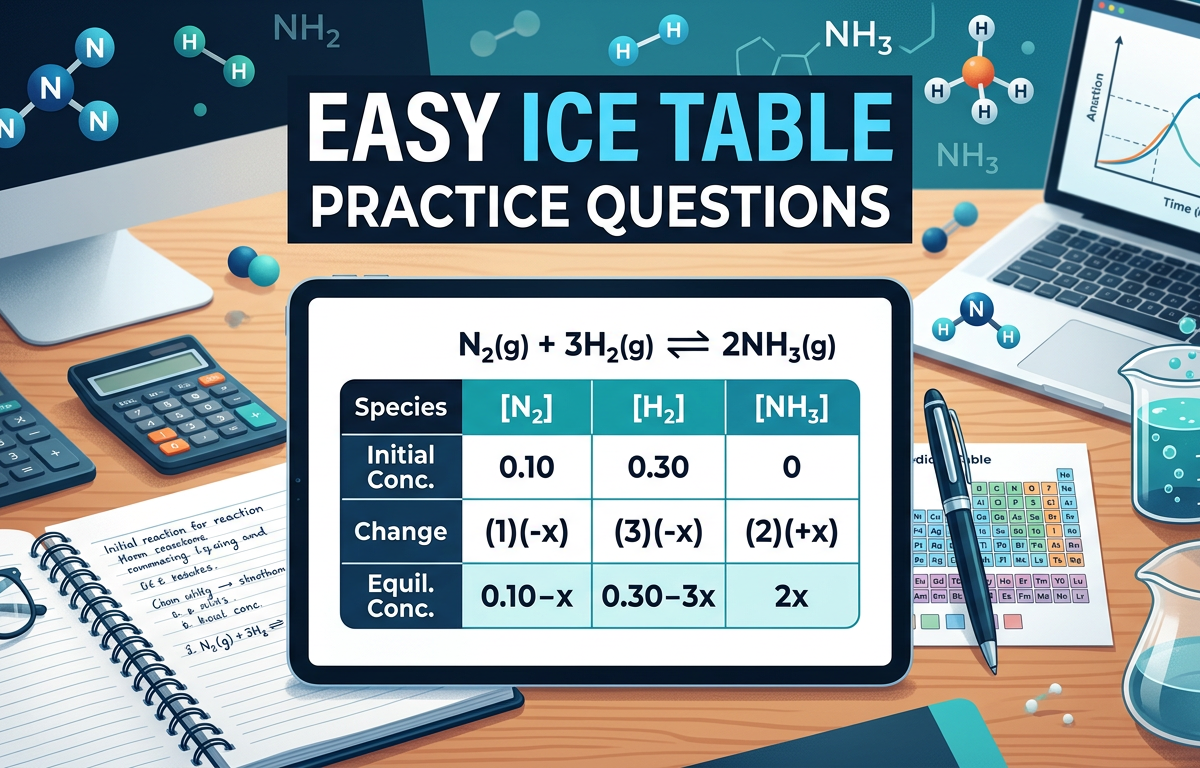
When you see a reaction like 2A ⇌ B starting with 1.0 M of A, your first instinct might be to subtract x from A and add x to B. However, the stoichiometry dictates that A decreases by 2x for every single x that B gains. Forgetting this coefficient ratio is the most frequent reason students arrive at an incorrect equilibrium constant. The ICE table exists specifically to prevent these mental lapses by forcing you to align your molar ratios with the balanced chemical equation before you ever touch a calculator.
Setting up the grid is only half the battle. You must also decide when the small x approximation is valid, such as when a weak acid has a Ka value less than 1.0 x 10⁻⁵. If you fail to recognize this, you will find yourself trapped in a quadratic equation that takes ten minutes to solve when it should have taken thirty seconds. These practice problems focus on identifying those shortcuts and ensuring your change row correctly reflects the moles reacting in the system.
Mapping Reactant Depletion and Product Gain
An ICE table is a systematic accounting tool used in chemistry to calculate the changing concentrations of reactants and products in a chemical reaction as it reaches equilibrium. The acronym ICE stands for Initial concentration, Change in concentration, and Equilibrium concentration. This method is essential for solving problems involving the equilibrium constant (K), such as those found in Easy Ka and Kb Calculations Practice Questions. To set up the table, you list the chemical species across the top and the ICE categories down the left side. By using the stoichiometry of the balanced equation, you can represent the change in concentrations as a variable (usually 'x'), allowing you to solve for the final state of the system. This approach is widely used in general chemistry courses, as described by LibreTexts Chemistry, to simplify complex algebraic relationships in reversible reactions.
Solved Examples
Reviewing these worked examples will help you understand the logical flow of setting up and solving an ICE table for various equilibrium scenarios.
Example 1: Finding Equilibrium Concentrations
A reaction A ⇌ B has an equilibrium constant K = 2.0. If you start with 1.0 M of A, what are the equilibrium concentrations?Initial: [A] = 1.0, [B] = 0.
Change: Since A reacts to form B, [A] decreases by x and [B] increases by x.
Equilibrium: [A] = 1.0 - x, [B] = x.
Solve: K = [B]/[A] → 2.0 = x / (1.0 - x).
Result: 2.0(1.0 - x) = x → 2.0 - 2x = x → 3x = 2.0 → x = 0.67. [A] = 0.33 M, [B] = 0.67 M.
Example 2: Calculating K from Equilibrium Data
In the reaction H₂ + I₂ ⇌ 2HI, the initial concentrations of H₂ and I₂ are both 0.50 M. At equilibrium, [HI] is 0.20 M. Calculate K.Initial: [H₂] = 0.50, [I₂] = 0.50, [HI] = 0.
Change: Use stoichiometry. If [HI] increases by 2x, then H₂ and I₂ decrease by x. Since [HI] at equilibrium is 0.20, 2x = 0.20, so x = 0.10.
Equilibrium: [H₂] = 0.50 - 0.10 = 0.40; [I₂] = 0.50 - 0.10 = 0.40; [HI] = 0.20.
Solve: K = [HI]² / ([H₂][I₂]) = (0.20)² / (0.40 * 0.40) = 0.04 / 0.16 = 0.25.
Example 3: Weak Acid Dissociation
Calculate the [H⁺] of a 0.10 M solution of a weak acid HA with Ka = 1.0 x 10⁻⁵.Initial: [HA] = 0.10, [H⁺] = 0, [A⁻] = 0.
Change: [HA] decreases by x, [H⁺] and [A⁻] increase by x.
Equilibrium: [HA] = 0.10 - x, [H⁺] = x, [A⁻] = x.
Solve: Ka = [H⁺][A⁻] / [HA] → 1.0 x 10⁻⁵ = x² / (0.10 - x). (Assume x is small: 0.10 - x ≈ 0.10).
Result: x² = 1.0 x 10⁻⁶ → x = 1.0 x 10⁻³ M.
Practice Questions
Test your skills with these easy ICE table practice questions. Remember to always check the stoichiometry of the balanced equation.
A reaction X ⇌ Y starts with 0.80 M of X. At equilibrium, the concentration of Y is 0.20 M. Calculate the equilibrium constant K.
For the reaction 2A ⇌ B, the initial concentration of A is 1.00 M. At equilibrium, [B] is 0.25 M. What is the equilibrium concentration of A?
In a 1.0 L flask, 0.50 moles of N₂O₄ are placed. The reaction is N₂O₄ ⇌ 2NO₂. At equilibrium, 0.10 moles of NO₂ are present. Calculate K.
Want unlimited practice questions like these?
Generate AI-powered questions with step-by-step solutions on any topic.
Try Question Generator Free →A generic acid HA dissociates as HA ⇌ H⁺ + A⁻. If the initial [HA] is 0.20 M and Ka = 2.0 x 10⁻⁴, calculate the equilibrium concentration of H⁺ (use the small x approximation).
For the reaction PCl₅ ⇌ PCl₃ + Cl₂, the initial concentration of PCl₅ is 0.60 M. If K = 0.050, find the equilibrium concentration of Cl₂.
Consider the reaction CO + H₂O ⇌ CO₂ + H₂. If the initial concentrations of CO and H₂O are both 1.0 M and K = 1.0, what is the equilibrium concentration of CO₂?
A solution starts with 0.40 M of a reactant B. It reacts according to B ⇌ C + D. At equilibrium, [C] is 0.15 M. Calculate K.
In the reaction 2SO₂ + O₂ ⇌ 2SO₃, you start with 2.0 M SO₂ and 1.0 M O₂. At equilibrium, [SO₃] is 0.80 M. Calculate the equilibrium concentration of O₂.
A weak base B reacts with water: B + H₂O ⇌ BH⁺ + OH⁻. If the initial [B] is 0.15 M and [OH⁻] at equilibrium is 0.003 M, calculate Kb.
For the reaction A + B ⇌ C, initial concentrations are [A] = 0.5 M and [B] = 0.5 M. If K = 100, calculate the equilibrium concentration of C.
Answers & Explanations
K = 0.33. Initial: [X]=0.80, [Y]=0. Change: [X]=-0.20, [Y]=+0.20. Equilibrium: [X]=0.60, [Y]=0.20. K = 0.20 / 0.60 = 0.33.
[A] = 0.50 M. Initial: [A]=1.00. Change: [B] increased by 0.25 (x). According to stoichiometry, [A] decreases by 2x = 0.50. Equilibrium [A] = 1.00 - 0.50 = 0.50 M.
K = 0.022. Initial: [N₂O₄]=0.50. Change: [NO₂] increased by 0.10 (2x), so x = 0.05. [N₂O₄] decreases by 0.05. Equilibrium: [N₂O₄]=0.45, [NO₂]=0.10. K = (0.10)² / 0.45 = 0.01 / 0.45 = 0.022.
[H⁺] = 0.0063 M. Ka = x² / (0.20 - x) ≈ x² / 0.20. x² = 4.0 x 10⁻⁵. x = 0.0063 M. This is similar to calculations in Easy pH Calculation Practice Questions.
[Cl₂] = 0.15 M. 0.050 = x² / (0.60 - x). x² + 0.05x - 0.03 = 0. Using quadratic or approximation, x ≈ 0.15.
[CO₂] = 0.50 M. K = x² / (1.0 - x)² = 1.0. Take the square root: x / (1.0 - x) = 1.0. x = 1.0 - x → 2x = 1.0 → x = 0.50.
K = 0.09. Initial: [B]=0.40. Change: [C]=+0.15, [D]=+0.15, [B]=-0.15. Equilibrium: [B]=0.25, [C]=0.15, [D]=0.15. K = (0.15 * 0.15) / 0.25 = 0.09.
[O₂] = 0.60 M. Initial: [O₂]=1.0. Change: [SO₃] increased by 0.80 (2x), so x = 0.40. [O₂] decreases by x. Equilibrium [O₂] = 1.0 - 0.40 = 0.60 M.
Kb = 6.12 x 10⁻⁵. [BH⁺] = [OH⁻] = 0.003. [B] = 0.15 - 0.003 = 0.147. Kb = (0.003)² / 0.147 = 6.12 x 10⁻⁵. For more on bases, see Easy pOH Calculation Practice Questions.
[C] ≈ 0.45 M. 100 = x / (0.5 - x)². Because K is large, most reactants turn to products. Let x = 0.5 - y. Solving yields [C] very close to 0.45-0.48 M.
1. What does the "I" in ICE table stand for?
Frequently Asked Questions
What is the primary purpose of an ICE table?
The primary purpose of an ICE table is to organize the known and unknown concentrations of substances in a reversible chemical reaction. It allows chemists to apply the Law of Mass Action and solve for equilibrium concentrations or the equilibrium constant.
Can I use moles instead of molarity in an ICE table?
You can use moles in an ICE table only if the volume of the container is 1.0 liter or if the total number of moles of gas is the same on both sides of the equation. However, it is standard practice to use molarity (mol/L) to avoid errors when plugging values into the equilibrium expression.
How do I know if 'x' should be added or subtracted?
The sign of 'x' depends on the direction the reaction moves to reach equilibrium. If you start with only reactants, the reactants will decrease (-x) and the products will increase (+x); if you start with only products, the opposite occurs.
What is the small x approximation?
The small x approximation is a mathematical simplification used when the equilibrium constant K is very small. It assumes that the change in concentration 'x' is negligible compared to the initial concentration, allowing you to treat (Initial - x) as simply the Initial value.
How does stoichiometry affect the Change row?
Stoichiometry dictates the coefficients used in the Change row. For a balanced equation like 3A ⇌ B, the change for A would be -3x while the change for B would be +x, reflecting the 3:1 ratio of the molecules involved.
What should I do if the ICE table leads to a quadratic equation?
If the small x approximation is not valid, you must use the quadratic formula to solve for x. Ensure the equation is in the form ax² + bx + c = 0, and choose the root that results in physically possible (positive) equilibrium concentrations.
Want unlimited practice questions like these?
Generate AI-powered questions with step-by-step solutions on any topic.
Try Question Generator Free →
Want unlimited practice questions like these?
Generate AI-powered questions with step-by-step solutions on any topic.
Try Question Generator Free →Enjoyed this article?
Share it with others who might find it helpful.
Related Articles

Solving High-Stakes IV Titrations and Weight-Based Infusions
Master advanced IV flow rate calculations with these hard practice questions. Covers weight-based dosing, titrations, and dimensional analysis for nurses.
May 17, 2026

Solving Weight-Based Dosing: The 2.2 Conversion and Rounding Logic
Weight-Based Dosage Calculations Practice Questions with Answers
May 17, 2026
Stop Guessing: How to Balance Redox Charges Without Losing Electrons
Master the basics of oxidation-reduction with these easy balancing redox practice questions and step-by-step solutions for students.
Apr 4, 2026
Solve Boyle's Law Problems Without Flipping the Pressure Ratio
Master Boyle’s Law with these easy practice questions and step-by-step solutions. Learn how pressure and volume interact at constant temperatures.
Apr 2, 2026
Solving Combined Gas Law Problems: Managing Three Changing Variables
Master the Combined Gas Law with this comprehensive guide featuring clear explanations, step-by-step solved examples, and 10 practice questions with answers.
Apr 2, 2026
Solving Charles’s Law: Avoiding the Celsius Temperature Trap
Master Charles’s Law with our comprehensive guide featuring solved examples, practice questions, and step-by-step explanations for chemistry students.
Apr 2, 2026
Solving PV=nRT: Why Units and Constants Trip Up Every Student
Master the Ideal Gas Law with these easy practice questions. Includes step-by-step solved examples, unit conversion tips, and a quick quiz to test your skills.
Apr 2, 2026
Predicting Radioactive Decay: Solving for Mass and Time Intervals
Master half-life calculations with our comprehensive guide featuring step-by-step solved examples, practice questions, and detailed answers for students.
Apr 2, 2026