Solve Boyle's Law Problems Without Flipping the Pressure Ratio
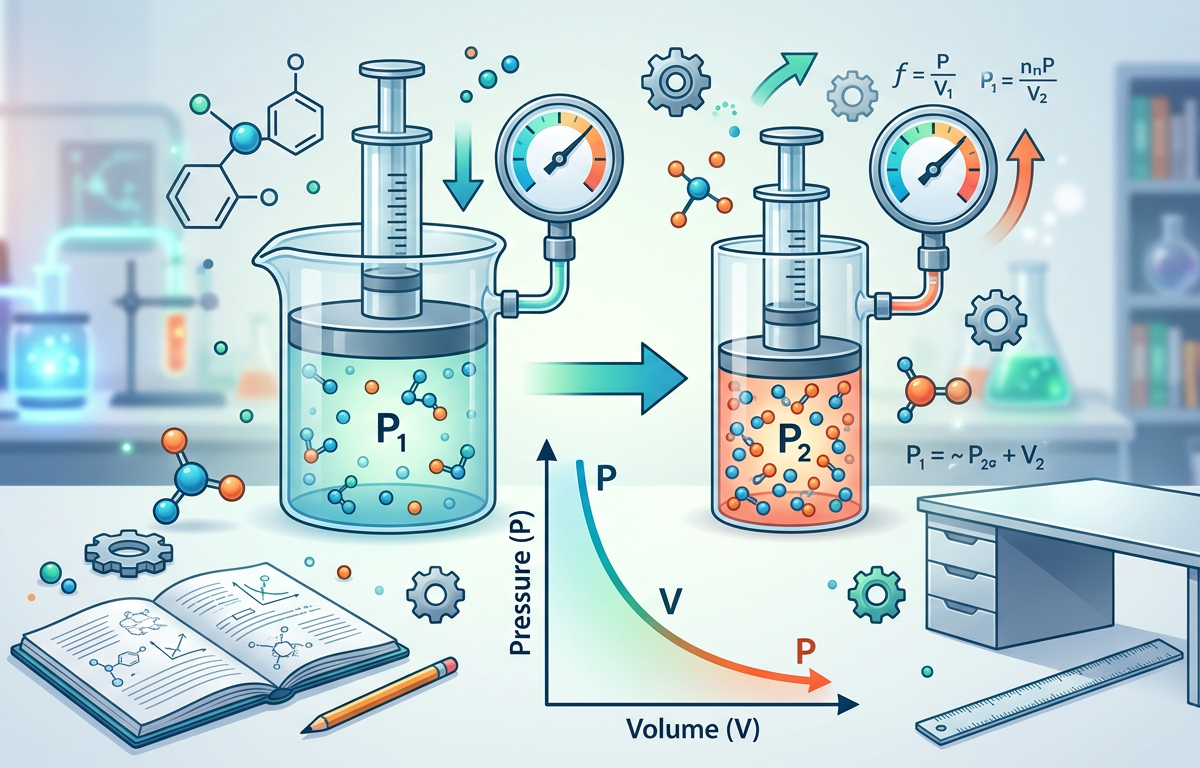
When you push down on a bicycle pump, you are performing a real-time experiment in gas dynamics. The resistance you feel is not just friction; it is the physical result of gas particles hitting the walls of the pump more frequently as their available space disappears. The core challenge in these problems is not the multiplication itself, but tracking which pressure belongs to which volume. Students often fail because they pair the initial pressure with the final volume, leading to a result that contradicts the inverse relationship between these two variables.
To get these right every time, you must verify your answer against physical logic. If the volume of a container is cut in half, the pressure must double. If your calculation shows the pressure decreasing while the volume also decreases, you have likely set up your P1V1 = P2V2 equation backwards. This guide focuses on identifying these variables correctly and ensuring your units of atmospheres, kilopascals, or milliliters match on both sides before you ever touch a calculator.
Mastering the Inverse Gas Relationship
Boyle’s Law states that the pressure of a given mass of an ideal gas is inversely proportional to its volume when the temperature and amount of gas remain constant. This means that if you decrease the volume of a container, the gas particles collide with the walls more frequently, resulting in an increase in pressure. Conversely, increasing the volume allows the particles more space, which decreases the pressure. This fundamental principle of gas behavior was first published by Robert Boyle in 1662 and is a cornerstone of introductory chemistry and physics.
The mathematical representation of Boyle’s Law is expressed by the formula:
P₁V₁ = P₂V₂
In this equation:
P₁ is the initial pressure.
V₁ is the initial volume.
P₂ is the final pressure.
V₂ is the final volume.
To use this formula correctly, you must ensure that the units for pressure and volume are consistent on both sides of the equation. For example, if P₁ is in atmospheres (atm), P₂ must also be in atmospheres. Common units for pressure include atm, mmHg, torr, and kPa, while volume is typically measured in liters (L) or milliliters (mL). Understanding this relationship is essential before moving on to more complex topics like the Combined Gas Law or the Ideal Gas Law.
Solved Examples
Reviewing worked problems is a highly effective way to learn how to study for chemistry exams. Here are three step-by-step examples of Boyle's Law in action.
Example 1: Finding Final Pressure
A gas occupies a volume of 2.0 L at a pressure of 1.5 atm. If the volume is compressed to 1.0 L at a constant temperature, what is the new pressure?
Identify the knowns: P₁ = 1.5 atm, V₁ = 2.0 L, V₂ = 1.0 L.
Identify the unknown: P₂.
Set up the equation: (1.5 atm)(2.0 L) = (P₂)(1.0 L).
Solve for P₂: 3.0 / 1.0 = 3.0 atm.
The final pressure is 3.0 atm.
Example 2: Finding Final Volume
A balloon is filled with 500 mL of air at a pressure of 760 mmHg. If the pressure is increased to 1140 mmHg, what will be the new volume of the balloon?
Identify the knowns: P₁ = 760 mmHg, V₁ = 500 mL, P₂ = 1140 mmHg.
Identify the unknown: V₂.
Set up the equation: (760 mmHg)(500 mL) = (1140 mmHg)(V₂).
Calculate: 380,000 = 1140 * V₂.
Solve for V₂: 380,000 / 1140 ≈ 333.33 mL.
Example 3: Working with Different Units
A sample of oxygen gas has a volume of 150 mL at a pressure of 101.3 kPa. What is the volume if the pressure is reduced to 50.65 kPa?
Identify the knowns: P₁ = 101.3 kPa, V₁ = 150 mL, P₂ = 50.65 kPa.
Identify the unknown: V₂.
Set up the equation: (101.3)(150) = (50.65)(V₂).
Calculate: 15195 = 50.65 * V₂.
Solve for V₂: 15195 / 50.65 = 300 mL.
Practice Questions
Test your understanding with these easy Boyle’s Law practice questions. Remember to keep your units consistent!
1. A gas has an initial volume of 4.5 L at a pressure of 0.8 atm. If the pressure is increased to 1.6 atm, what is the new volume?
2. A syringe contains 60 mL of air at 1.0 atm. If the plunger is pushed so the volume is 20 mL, what is the resulting pressure?
3. A tank of helium has a volume of 10 L and a pressure of 2000 psi. If the helium is released into a giant balloon until the pressure is 15 psi, what is the volume of the balloon?
Start Learning Smarter Today
Join thousands of students using AI-powered study tools to achieve better results.
Get Started Free4. A sample of nitrogen occupies 250 mL at 740 torr. What pressure is required to compress the gas to a volume of 125 mL?
5. If a gas at 2.5 atm occupies 15 L, what volume will it occupy at standard pressure (1.0 atm)?
6. A weather balloon contains 100 m³ of helium at sea level (101 kPa). As it rises, the pressure drops to 30 kPa. What is the new volume?
7. A diver exhales a bubble with a volume of 10 mL at a depth where the pressure is 4.0 atm. What is the volume of the bubble when it reaches the surface where the pressure is 1.0 atm?
8. A container with a movable piston has a volume of 5.0 L and a pressure of 150 kPa. If the volume is expanded to 7.5 L, what is the new pressure?
9. A gas occupies 1.56 L at 1.00 atm. What will be the volume of this gas if the pressure becomes 3.00 atm?
10. If the pressure on a 300 mL sample of gas is doubled, what happens to the volume?
Answers & Explanations
2.25 L: Using P₁V₁ = P₂V₂, we have (0.8)(4.5) = (1.6)(V₂). 3.6 = 1.6V₂, so V₂ = 2.25 L. When pressure doubles, volume halves.
3.0 atm: (1.0)(60) = (P₂)(20). 60 = 20P₂, so P₂ = 3.0 atm. Reducing volume to one-third triples the pressure.
1333.3 L: (2000)(10) = (15)(V₂). 20,000 = 15V₂, so V₂ = 1333.3 L.
1480 torr: (740)(250) = (P₂)(125). Since the volume was halved, the pressure must double. 740 * 2 = 1480 torr.
37.5 L: (2.5)(15) = (1.0)(V₂). 37.5 = V₂. The volume increases as the pressure decreases.
336.67 m³: (101)(100) = (30)(V₂). 10100 / 30 = 336.67 m³.
40 mL: (4.0)(10) = (1.0)(V₂). V₂ = 40 mL. This explains why bubbles expand as they rise in water.
100 kPa: (150)(5.0) = (P₂)(7.5). 750 / 7.5 = 100 kPa.
0.52 L: (1.00)(1.56) = (3.00)(V₂). 1.56 / 3 = 0.52 L.
150 mL: According to Boyle's Law, pressure and volume are inversely proportional. If pressure is multiplied by 2, volume must be divided by 2.
1. According to Boyle's Law, if the volume of a gas is halved, what happens to the pressure?
Frequently Asked Questions
What is the real-world application of Boyle's Law?
A common application is the mechanism of breathing; when your diaphragm moves down, the volume of your lungs increases, lowering the internal pressure and drawing air in. Another example is the operation of a bicycle pump or a medical syringe.
Why is temperature held constant in Boyle's Law?
Temperature must be constant because it affects the kinetic energy of gas particles, which would independently change the pressure or volume. If temperature changed, you would need to use the Combined Gas Law instead.
Does Boyle's Law apply to liquids?
No, Boyle's Law only applies to gases because liquids are largely incompressible. The particles in a liquid are already close together, so changing the pressure has a negligible effect on their volume.
What units can be used for pressure in Boyle's Law?
Any unit of pressure can be used, such as atmospheres (atm), kilopascals (kPa), mmHg, or torr, as long as the same unit is used for both P₁ and P₂. Consistency is the key to getting the correct numerical result.
What is an "ideal gas" in the context of Boyle's Law?
An ideal gas is a theoretical gas whose particles have no volume and no intermolecular attractions, perfectly following gas laws under all conditions. While real gases deviate slightly at very high pressures or low temperatures, they behave ideally enough for Boyle's Law to be accurate for most classroom problems.
How do I solve Boyle's Law problems if the units are different?
You must convert one of the values so that both pressure units match and both volume units match before plugging them into the formula. For example, convert 760 mmHg to 1 atm if the other pressure value is given in atmospheres.
Start Learning Smarter Today
Join thousands of students using AI-powered study tools to achieve better results.
Get Started FreeEnjoyed this article?
Share it with others who might find it helpful.
Related Articles
Stop Guessing: How to Balance Redox Charges Without Losing Electrons
Master the basics of oxidation-reduction with these easy balancing redox practice questions and step-by-step solutions for students.
Apr 4, 2026
Solving Equilibrium Problems Without Losing Your Stoichiometry
Master chemical equilibrium with these easy ICE table practice questions. Learn to calculate concentrations and K values with step-by-step solved examples.
Mar 30, 2026

Solving Kp with Dalton’s Law and Partial Pressure Gradients
Master Hard Kp Calculations with our comprehensive guide. Includes solved examples, practice questions on partial pressure, and Kp to Kc conversions.
Mar 30, 2026
Calculating Kc: Mastering the Ratio of Equilibrium Concentrations
Master the Equilibrium Constant (Kc) with our comprehensive guide featuring solved examples, practice questions, and detailed explanations for chemistry students.
Mar 30, 2026
Mastering the Log Ratio: Henderson-Hasselbalch Buffer Problems
Master the Henderson-Hasselbalch equation with our detailed guide, solved examples, and practice problems to ace your chemistry exams.
Mar 28, 2026
Calculate Trace Concentrations: ppm and ppb Chemistry Problems
Master ppm and ppb calculations with this comprehensive guide. Includes formulas, solved examples, and practice questions for chemistry and environmental science.
Mar 27, 2026

Calculating Mass Ratios: Percent Composition Mastery and Problems
Master percentage composition with our comprehensive guide featuring step-by-step solved examples, practice questions, and a quick quiz to test your knowledge.
Mar 26, 2026

How to Solve Molarity Problems: Step-by-Step Mastery
Learn how to solve molarity problems step-by-step with formulas, unit tips, and worked examples so you can calculate concentration with confidence.
Mar 26, 2026