Easy Henderson-Hasselbalch Equation Practice Questions

Concept Explanation
The Henderson-Hasselbalch equation is a mathematical relationship used to calculate the pH of a buffer solution by relating the pKa of a weak acid to the concentrations of the acid and its conjugate base. This equation is fundamental in chemistry and biology because it explains how buffer solutions resist changes in acidity when small amounts of acid or base are added. According to the Wikipedia entry on the equation, it was developed by Lawrence Joseph Henderson and Karl Albert Hasselbalch in the early 20th century to describe the carbonic acid-bicarbonate buffer system in blood.
The standard formula for an acidic buffer is:
pH = pKa + log([A⁻] / [HA])
In this formula:
pH: The negative logarithm of the hydrogen ion concentration.
pKa: The negative logarithm of the acid dissociation constant (Ka).
[A⁻]: The molar concentration of the conjugate base (salt).
[HA]: The molar concentration of the weak acid.
When the concentration of the acid equals the concentration of the conjugate base, the log term becomes log(1), which is zero. In this specific state, the pH of the solution is exactly equal to the pKa. Understanding this relationship is a key step before moving on to more complex pH calculation practice questions.
Solved Examples
Review these step-by-step examples to see how to apply the Henderson-Hasselbalch equation in different scenarios.
Example 1: Basic Substitution
Calculate the pH of a buffer solution that is 0.50 M in acetic acid (pKa = 4.76) and 0.50 M in sodium acetate.Identify the values: [HA] = 0.50 M, [A⁻] = 0.50 M, pKa = 4.76.
Apply the equation: pH = 4.76 + log(0.50 / 0.50).
Simplify: pH = 4.76 + log(1).
Since log(1) = 0, the pH = 4.76.
Example 2: Calculating pH with Different Concentrations
Find the pH of a solution containing 0.10 M formic acid (pKa = 3.75) and 0.20 M sodium formate.Identify the values: [HA] = 0.10 M, [A⁻] = 0.20 M, pKa = 3.75.
Apply the equation: pH = 3.75 + log(0.20 / 0.10).
Simplify: pH = 3.75 + log(2).
Calculate: pH = 3.75 + 0.30 = 4.05.
Example 3: Finding pKa from pH
A buffer solution with 0.25 M weak acid and 0.75 M conjugate base has a pH of 5.48. What is the pKa of the acid?Identify the values: pH = 5.48, [HA] = 0.25 M, [A⁻] = 0.75 M.
Set up the equation: 5.48 = pKa + log(0.75 / 0.25).
Simplify the ratio: 5.48 = pKa + log(3).
Calculate log(3): 5.48 = pKa + 0.477.
Solve for pKa: pKa = 5.48 - 0.477 = 5.00.
Practice Questions
Test your knowledge with these easy Henderson-Hasselbalch equation practice questions. Ensure you have a scientific calculator ready for the logarithmic functions.
1. A buffer solution contains 0.15 M hydrofluoric acid (HF) and 0.15 M sodium fluoride (NaF). If the pKa of HF is 3.17, what is the pH of the solution?
2. Calculate the pH of a buffer that is 0.40 M in nitrous acid (HNO₂) and 0.10 M in potassium nitrite (KNO₂). The pKa of nitrous acid is 3.34.
3. What is the pH of a solution prepared by mixing 0.60 M ammonia (NH₃) and 0.30 M ammonium chloride (NH₄Cl)? The pKa of the ammonium ion is 9.25.
Want unlimited practice questions like these?
Generate AI-powered questions with step-by-step solutions on any topic.
Try Question Generator Free →4. An acetic acid buffer has a pH of 5.00. If the pKa of acetic acid is 4.76, what is the ratio of [acetate] to [acetic acid]?
5. A chemist prepares a buffer using 0.22 M of a weak acid and 0.55 M of its conjugate base. If the pKa is 6.40, what is the resulting pH?
6. If the Ka of a weak acid is 1.8 x 10⁻⁵, first find the pKa, then calculate the pH of a buffer with 0.10 M acid and 0.10 M salt.
7. A buffer is made with 0.12 M benzoic acid and 0.48 M sodium benzoate. The pKa of benzoic acid is 4.20. Calculate the pH.
8. What concentration of conjugate base is needed to create a pH 7.00 buffer using 0.50 M of a weak acid with a pKa of 6.80?
9. A lactic acid buffer (pKa = 3.86) has a pH of 3.50. Is there more lactic acid or more lactate (the conjugate base) in this solution?
10. Calculate the pH of a solution containing 0.05 M propanoic acid and 0.15 M sodium propanoate (pKa = 4.87).
Answers & Explanations
Check your work against the detailed solutions below to master the pKa and pKb concepts associated with these problems.
Answer: 3.17. Since the concentrations of the acid (HF) and the conjugate base (NaF) are equal (0.15 M), the log([base]/[acid]) term is log(1) = 0. Therefore, pH = pKa.
Answer: 2.74. pH = 3.34 + log(0.10 / 0.40) = 3.34 + log(0.25) = 3.34 - 0.60 = 2.74.
Answer: 9.55. pH = 9.25 + log(0.60 / 0.30) = 9.25 + log(2) = 9.25 + 0.30 = 9.55.
Answer: 1.74. 5.00 = 4.76 + log(ratio). 0.24 = log(ratio). Ratio = 10^0.24 = 1.74.
Answer: 6.80. pH = 6.40 + log(0.55 / 0.22) = 6.40 + log(2.5) = 6.40 + 0.40 = 6.80.
Answer: 4.74. pKa = -log(1.8 x 10⁻⁵) = 4.74. Since [acid] = [salt], pH = pKa = 4.74.
Answer: 4.80. pH = 4.20 + log(0.48 / 0.12) = 4.20 + log(4) = 4.20 + 0.60 = 4.80.
Answer: 0.79 M. 7.00 = 6.80 + log([base] / 0.50). 0.20 = log([base] / 0.50). 10^0.20 = [base] / 0.50. 1.58 = [base] / 0.50. [base] = 0.79.
Answer: More lactic acid. When pH < pKa, the acid form predominates. Since 3.50 < 3.86, the concentration of the weak acid [HA] must be higher than the conjugate base [A⁻].
Answer: 5.35. pH = 4.87 + log(0.15 / 0.05) = 4.87 + log(3) = 4.87 + 0.48 = 5.35.
1. Which condition results in pH = pKa?
Frequently Asked Questions
What is the Henderson-Hasselbalch equation used for?
It is primarily used to calculate the pH of buffer solutions and to determine the ratio of acid to conjugate base needed to achieve a specific pH. It is also vital in biochemistry for estimating the charge of amino acids at different pH levels.
Can I use this equation for strong acids?
No, the Henderson-Hasselbalch equation is only applicable to weak acids and their conjugate bases because it assumes the dissociation of the weak acid is negligible compared to the initial concentrations. Strong acids dissociate completely, making this relationship invalid.
What happens if the concentration of acid is higher than the base?
If the acid concentration is higher than the base concentration, the log term in the equation becomes negative. This results in a pH value that is lower than the pKa of the acid.
Does the Henderson-Hasselbalch equation work for bases?
Yes, you can use a modified version: pOH = pKb + log([BH⁺] / [B]). Alternatively, you can convert pKb to pKa (pKa + pKb = 14) and use the standard pH version of the equation.
Why is pH equal to pKa at the half-equivalence point?
At the half-equivalence point of a titration, exactly half of the weak acid has been converted to its conjugate base. Since [HA] = [A⁻], the log(1) term is zero, leaving pH = pKa.
Want unlimited practice questions like these?
Generate AI-powered questions with step-by-step solutions on any topic.
Try Question Generator Free →
Want unlimited practice questions like these?
Generate AI-powered questions with step-by-step solutions on any topic.
Try Question Generator Free →Enjoyed this article?
Share it with others who might find it helpful.
Related Articles
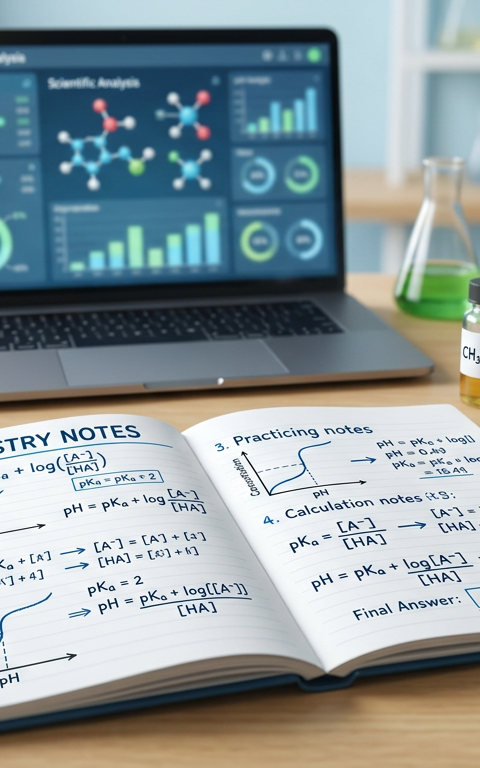
Medium Henderson-Hasselbalch Equation Practice Questions
Master the Henderson-Hasselbalch equation with these medium-level practice questions, solved examples, and a quick quiz to boost your chemistry grades.
Mar 29, 2026
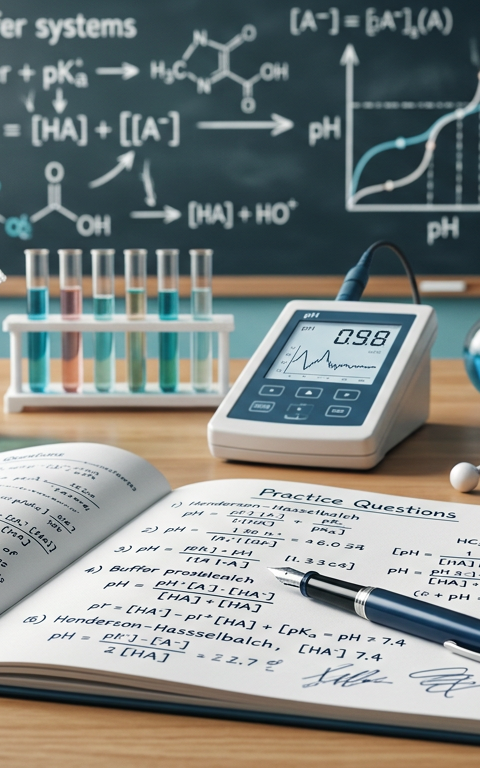
Hard Henderson-Hasselbalch Equation Practice Questions
Master the Henderson-Hasselbalch equation with hard practice questions, step-by-step solutions, and expert tips for buffer calculations.
Mar 29, 2026
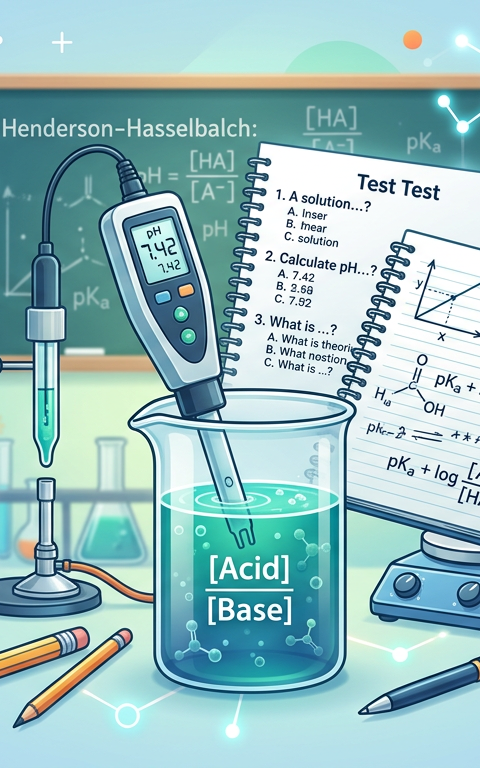
Mastering the Log Ratio: Henderson-Hasselbalch Buffer Problems
Master the Henderson-Hasselbalch equation with our detailed guide, solved examples, and practice problems to ace your chemistry exams.
Mar 28, 2026

Calculating High-Stakes Meds: BSA Mosteller Formula Practice
Master hard body surface area-based dosage calculations with our comprehensive guide, solved examples, and practice questions for healthcare students.
May 17, 2026

Solving High-Stakes IV Titrations and Weight-Based Infusions
Master advanced IV flow rate calculations with these hard practice questions. Covers weight-based dosing, titrations, and dimensional analysis for nurses.
May 17, 2026

Solving Weight-Based Dosing: The 2.2 Conversion and Rounding Logic
Weight-Based Dosage Calculations Practice Questions with Answers
May 17, 2026
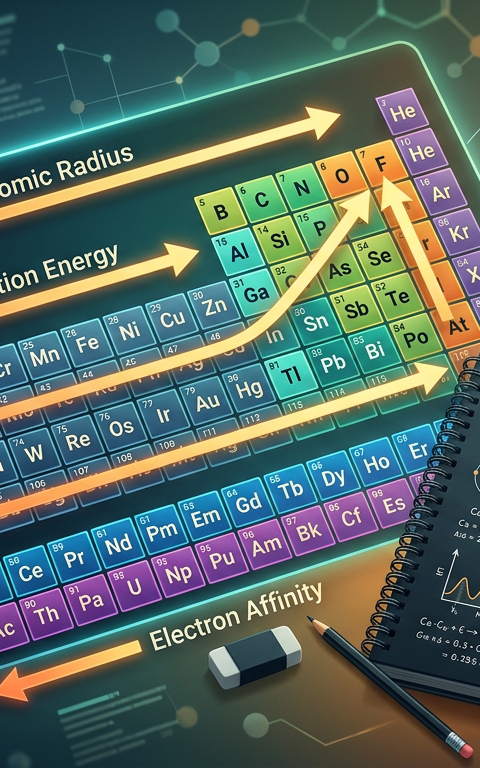
Predicting Periodic Anomalies: Beyond Basic Trend Rules
Hard Periodic Trends Practice Questions
Apr 4, 2026
Hard Electron Configuration Practice Questions
Hard Electron Configuration Practice Questions
Apr 4, 2026