How to Study the Day Before an Exam: Proven Plan

You asked how to study the day before an exam, so here’s the short answer: consolidate what you already know, don’t cram new chapters, and cycle through targeted practice with feedback. The fastest gains in 24 hours come from active recall, short practice testing strategies, and fixing your most common errors. Do that, sleep 7–8 hours, and you’ll walk in sharper, calmer, and faster.
1) Understand the Goal: Consolidation, Not Cramming
You should spend the last 24 hours strengthening recall of high-yield material, not chasing new units. Last-minute cramming fails because you load short-term memory without building retrieval paths, so it fades under pressure. Retrieval practice, micro-spaced reviews, and focused error correction still work because they reinforce the exact cues you need on test day.
What’s actually achievable in 24 hours? You can raise practice accuracy by 10–25% on A-list topics, cut recall time on core formulas and definitions by half, and reduce anxiety with a stable plan. You won’t master every fringe detail, and that’s fine, trade breadth for depth and retrieval strength.
Define success in three metrics you can measure today: higher practice accuracy, quicker recall, and a calmer mindset. Track accuracy on small sets (e.g., 10–20 questions), time yourself on recall drills, and run a 1–2 minute breath drill before sessions to ground your nervous system. If those three trend up, your day is working.
Your objective is simple: focus on retrieval practice and error correction. Close the book, try to recall or solve, then check and repair. Accept trade-offs: breadth drops as depth and retrieval strength rise; prioritize accordingly.
2) Build a 24-Hour Study Plan (Hour-by-Hour): how to study the day before an exam that actually works

The best day-before plan starts with a diagnostic, moves into targeted retrieval sets, spaces reviews, and ends early enough to protect sleep. Use 25–40 minute focus sprints with 5–10 minute breaks, and insert a longer reset every 2–3 cycles. Alternate topics to prevent fatigue and improve discrimination on test day.
Morning: assess and triage (60–90 minutes)
Start with a rapid self-diagnostic: 10–20 questions from past quizzes, a formula list you attempt from memory, or a short practice set modeled on your exam format. Score quickly and mark misses by type. Build your A/B/C list from this snapshot.
Keep your triage ruthless. A = must know for score impact; B = helpful if time allows; C = low-yield or new units you’ll skip unless you finish early. If you struggle to sort, use your syllabus or blueprint weighting to drive choices.
Late morning: targeted retrieval sets (90–120 minutes)
Attack A topics using active recall techniques and practice testing strategies, not rereading. Do 2–3 focused sprints of 25–35 minutes: 10–15 problems or 20–30 flashcards per sprint. Grade immediately; rewrite solutions or explanations from memory to fix errors.
Interleave two related topics, for example, derivatives and integrals, or cell biology and genetics, to improve recognition and reduce context dependence. If you need a method refresher, skim one worked example, then close the notes and reproduce it.
Afternoon: mixed practice and spaced review blocks
Rotate A topics with selected B topics in 25–40 minute blocks. Insert 2–3 “micro-spaced” revisits to the morning’s toughest items. Aim to see your error log at least twice by late afternoon.
Protect one longer break (20–30 minutes) for food and a short walk. If you’re fading, a 15–20 minute nap before 3 p.m. can restore alertness without grogginess, then follow with water and a light snack.
Evening: teach-back, light review, and shutdown routine
Teach-back for 30–45 minutes: explain top concepts out loud to an imaginary student or voice recorder. Keep it simple and stepwise; if you stumble, that’s your cue to refine. Finish with a light confidence pass through your one-pager and error fixes.
Establish a hard cutoff. Power down major screens 60–90 minutes before bed and line up your morning warm-up set. A calm shutdown beats a frantic last lap.
Night: sleep strategy for memory consolidation
Prioritize 7–8 hours. Sleep consolidates memory and improves recall accuracy; all-nighters reliably undercut performance. The CDC’s sleep guidance backs this with strong data—adults who sleep enough think more clearly and make fewer errors.
Exam morning: quick warm-up and logistics
Do a 5–10 minute warm-up with 5–10 quick questions or flashcards. No new content. Confirm logistics: ID, allowed calculator, route, room, timing, and any policies on notes or formula sheets.
If you want a deeper daily structure for future exams, build it with this plan: a proven daily study routine for exams. Today, you’re running the day-before version with tighter loops and earlier bedtime.
3) Prioritize What Matters: The 80/20 Triage

You should identify the highest-yield 20% that drives 80% of points, then go deep. Pull the syllabus, lecture objectives, and past tests to spot recurring, high-weight areas. Map your morning diagnostic against that blueprint.
Sort into A/B/C: A = essential and weighted; B = useful if time; C = low-yield or brand-new. Within each A topic, flag the 2–3 subskills behind most of your errors, like “setting up limiting reagent,” “interpreting graphs,” or “proving with induction.”
Create a one-page brain-dump plan you’ll mentally recreate before the exam starts. Include formulas, definitions, and step orders. Write it tonight and rehearse it tomorrow morning to prime recall.
Need help deciding why certain topics feel harder? This breakdown of bottlenecks will help you fix them fast: why studying for exams feels hard.
4) Use Only High-Impact Techniques for how to study the day before an exam
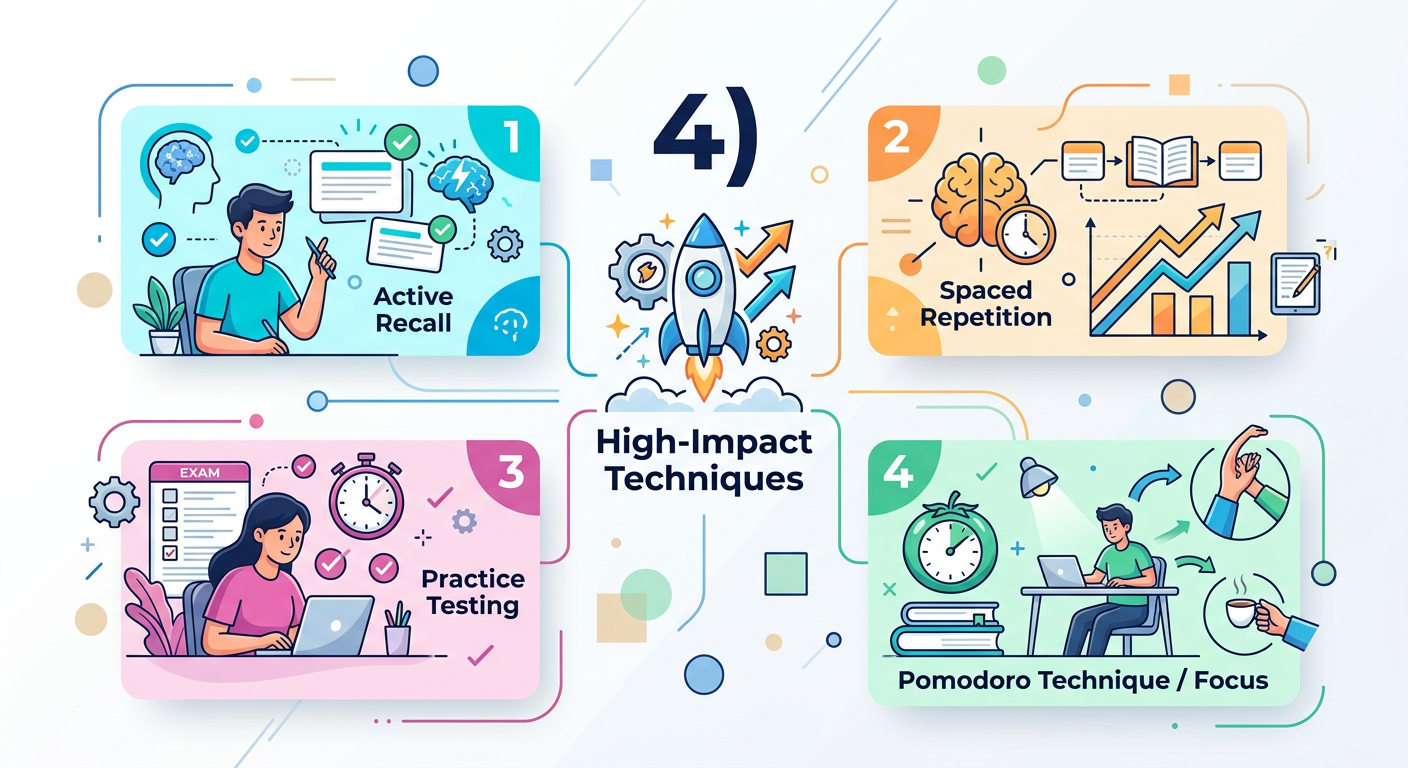
You should lean on active recall, practice testing with immediate feedback, teach-backs, interleaving, micro-spacing, and smart flashcards. Close the book, retrieve from memory, then reopen only to check. Retrieval strengthens memory far more than passive review; the APA’s science of learning summaries highlight this repeatedly.
Do small, timed practice sets and grade instantly. Log errors in a mini error journal; redo variants until you can solve twice in a row without notes. Explain concepts out loud, Feynman style, in plain language. Simplify until it’s clear and runnable.
Interleave similar topics and vary practice formats to improve transfer and recognition. Revisit tough items two or three times across the day to exploit spacing effects. Keep flashcards lean: one fact per card, cloze deletions, and tags by A/B/C priority.
Want a deeper walkthrough of retrieval? Start here: how to study for exams using active recall. And if you’re building a toolkit for beyond tomorrow, bookmark this: evidence-based study methods that actually work.
Practice smarter in minutes
Use Bevinzey’s quick modules to build retrieval sets and error logs fast—perfect for the last 24 hours.
Get Started Free5) Rapid Summaries and One-Pagers
You should compress the essentials to a one-page sheet and a tiny error log. Condense formulas, rules, and key steps that cover about 80% of likely use cases. Keep the layout visual: clusters, arrows, and boxed steps beat walls of text.
Use quick side-by-side comparison charts to separate commonly confused concepts, like mitosis vs. meiosis, or mean vs. median vs. mode. Build a mini error log: list the mistake, the correct fix, and a cue to avoid it next time. Revisit it twice more today.
Create mnemonic cues for five to ten stubborn facts only: acronyms, tiny stories, or vivid images. Don’t overbuild; you’re optimizing retrieval, not designing a textbook.
If you tend to reread instead of recall, switch gears now: effective study without rereading shows you how to convert passive review into performance.
6) Optimize Your Environment and Tools
You should strip distractions and friction from your day. Silence notifications, enable Do Not Disturb, and put your phone in another room during sprints. Set up your desk once: notes, practice sets, water, snacks, and a notepad for brain-dumps.
Use a visible timer for 25–40 minute focus blocks, website blockers for notorious sites, and a simple A/B/C checklist. If screens pull you astray, go analog with printed practice sets. If you stay digital, keep only the tabs you need open.
For a broader system you can reuse each week, pair this setup with a routine: a weekly study plan that compounds gains. You’ll reduce the need to ask how to study the day before an exam because you’ll already be prepared.
7) Manage Energy: Sleep, Nutrition, and Breaks
You should sleep first, fuel steadily, time caffeine, and move briefly. Plan backward from exam time to lock 7–8 hours of sleep; sleep loss slashes recall and accuracy. Eat balanced meals, protein plus complex carbs plus healthy fats, to avoid sugar spikes and post-meal crashes.
Time caffeine 30–60 minutes before heavy study or testing. Typical effective doses land around 1–3 mg per kg of body weight for many adults; avoid new or excessive doses at night. For safety and tolerances, review Mayo Clinic’s caffeine guidance and stick to what your body knows.
Insert short movement breaks: a 3–5 minute walk, shoulder and neck stretches, or 1 minute of box breathing. These reset attention without draining time or willpower.
8) Reduce Anxiety and Boost Confidence
You should lower arousal fast, reframe worries with facts, and rehearse success. Use 4-7-8 breathing or box breathing for 1–2 minutes before tough blocks and before sleep to downshift your nervous system. The Anxiety and Depression Association of America offers practical strategies you can adapt right away.
Challenge catastrophizing with evidence from your day: you targeted A-list topics and corrected specific errors. Visualize the first 10 minutes of the exam: sit down, write your brain-dump, and solve a familiar first question. Create a simple pre-test ritual: water, breath, checklist, warm-up item.
9) What to Avoid the Day Before an Exam
You should skip new units, endless highlighting, all-nighters, and unstructured groups. Low-yield tangents look productive but rarely move your score in 24 hours. Highlighting and rereading feel comforting yet add little; switch to testing and teaching.
Sleep loss crushes accuracy and recall, cap evening study and start your wind-down early. If you do group work, set a tight agenda and timebox; otherwise, go solo for speed and clarity.
10) If You’re Behind: Smart Cramming (Safely)
You should pick the top three scoring topics, use past papers as your curriculum, and protect sleep. Identify the three highest-yield areas and master their core processes first, nothing else gets time until you can answer two variants in a row correctly.
Do timed sets from past exams. Review solutions line-by-line, then redo missed types until correct twice. Memorize only the formulas and definitions you’ll deploy; ignore edge cases. Cut off at a set time to secure sleep, an alert brain outperforms a few tired hours.
For a structured ramp if you have a bit more runway, keep this on-hand: a 7-day exam study plan. If you’re curious how to study the day before an exam under pressure, it’s the same core moves, just fewer topics and tighter loops.
11) Collaborative Study (Only If Structured)
You should collaborate only with rules, timers, and clear goals. Run 30-minute drills where each person presents two questions; rotate and debrief fast. Assign subtopics to teach each other; aim for clarity, not breadth.
Agree on rules: shared timer, no phones, tight agenda, and a parking lot for off-topic questions. If remote, use a shared doc and a countdown; keep it under 45 minutes. One efficient session beats three meandering ones.
12) Special Cases: MCQ, Essays, and Problem-Solving Exams
You should tailor practice to the exam type. For multiple-choice, read the stem first, cover options, predict, then eliminate clearly wrong answers before comparing the rest. Track distractor traps in your error log.
For essays, draft 2–3 skeleton outlines: thesis, three point–evidence–explain blocks, and a short synthesis. Memorize a few transitions and, if allowed, key citations or dates to anchor your points.
For quant/problem sets, study by reworking problems from memory and logging error patterns. Build an error catalog of traps and fixes, units, sign errors, missing constraints. If your test includes equilibrium or ICE tables, this targeted set helps: ICE Table Practice Questions with Answers.
For open-book or take-home, pre-tab references, set strict time boxes, and practice searching your notes efficiently. Time discipline still separates strong scores from average ones.
13) Accommodations and Tips for Neurodiverse Learners
You should use short sprints, visual timers, body doubling, and carefully tuned environments. Try 15–25 minute sprints with a single, one-line task per block and a visible countdown. Study alongside a quiet partner or a virtual focus room to sustain momentum.
Adjust lighting, sound, and seating; noise-canceling headphones or steady background sound can help. If you take stimulant medication, avoid late caffeine and protect sleep to keep attention stable on test day.
14) Prepare Logistics: Test-Day Checklist
You should pack smart tonight and confirm every rule. Lay out ID, allowed calculator, pencils/pens, charged devices, water, snacks, and a light sweater or layer for variable room temps. Check travel time, parking, and transit schedules; set alarms with a 10–15 minute buffer.
Verify exam policies: open or closed book, formula sheets, bathroom breaks, and device rules. Morning routine: light breakfast, 5–10 warm-up items, brain-dump rehearsal, and a calm arrival. If you’ve wondered what to do before an exam, this checklist is your safety net.
15) Sample 24-Hour Schedules (Printable): how to study the day before an exam at different start times
You should adapt the plan to your exam slot and constraints. Here are three plug-and-play versions you can copy to a notepad or calendar. Keep the spirit: retrieval first, sleep protected.
If your exam is at 8 a.m.
Yesterday 4:00–5:00 p.m.: Diagnostic + A/B/C triage
5:15–6:45 p.m.: Targeted retrieval sets (A topics), 2 sprints
7:30–8:15 p.m.: Teach-back + one-pager polish
8:30–9:00 p.m.: Light review (error log highlights), pack bag
9:00–9:45 p.m.: Wind-down (no screens), prep morning checklist
10:00 p.m.: Sleep
Exam morning 6:15 a.m.: Wake, breakfast, 5–10 warm-up items
7:15 a.m.: Commute + brief brain-dump rehearsal
If your exam is in the afternoon
7:30–8:00 a.m.: Quick recall set (formulas/definitions)
8:15–9:45 a.m.: Targeted retrieval (A topics), 2 sprints
10:15–10:45 a.m.: Error log revisit + comparison charts
11:00–11:30 a.m.: Light lunch + short walk
12:00–12:30 p.m.: Teach-back (one topic)
12:45–1:00 p.m.: 5–10 warm-up items; pack and leave
If you work or have class the day before
Between commitments: 2–3 micro-sessions (15–20 minutes) for recall blitzes
Evening 6:30–7:15 p.m.: Targeted retrieval (A topics)
7:30–8:00 p.m.: Teach-back + one-pager update
8:15–8:30 p.m.: Error log highlights
9:00 p.m.: Wind-down routine; lights out on time
If you often end up here, build a better runway next time with this: create a study plan step-by-step. It pairs well with the pillar overview: how to study smart for exams.
16) Quick Wins in 30, 15, and 5 Minutes
You should keep a few “anywhere, anytime” drills. In 30 minutes, do one high-yield set: 10–15 problems or 20 flashcards with instant grading and fixes. In 15 minutes, run a recall blitz, brain-dump or define from memory, then spot-check errors.
In 5 minutes, refresh cues: skim your one-pager, mnemonic list, or error log highlights. These tiny loops keep retrieval paths hot even on a tight day.
17) Evening Wind-Down and Sleep Protocol
You should lower stimulation, avoid new content, and cue sleep. Power down major screens 60–90 minutes before bed, or at least enable blue-light filters if you must glance. Do only light, confidence-boosting review, one-pager, easy recall, no new or frustrating items.
Set tomorrow’s micro-goals with a 3-item checklist to reduce rumination. Use a brief relaxation protocol: breathing, light stretching, or a short meditation. For the science behind why this matters, see the CDC overview of sleep and cognition.
18) After the Exam: Debrief for Next Time
You should reflect while memory is fresh, then schedule spaced reviews. Spend 10 minutes on what went well, what surprised you, and what to change. Update your error journal with missed question types and their fixes.
Plan spaced reviews at 2, 7, and 21 days to lock in learning for finals. Expand your one-pager into durable master notes. If procrastination was the villain, this playbook can break the loop: stop procrastinating for exams.
Finally, convert what you’ve done today into durable habits. If you ever ask how to study the day before an exam again, your answer will already live in your routines.
Still refining your method? These two guides pair perfectly with a last‑day plan: how to study for exams using practice testing and five science-backed tips to study effectively. If recall slips a lot, troubleshoot here: why you forget what you study.
Turn 24 hours into a focused, high-yield sprint
Use Bevinzey’s Tools & Modules to auto-generate retrieval sets, track an error log, and assemble a one-pager—everything you need for how to study the day before an exam without wasting a minute.
Get Started FreeFrequently Asked Questions
How many hours should I study the day before an exam?
Most students do best with 4–6 focused hours total, split into 25–40 minute sprints with breaks. If you’re behind, you can stretch to 6–7 hours, but protect 7–8 hours of sleep.
Is it better to sleep or keep studying the night before a test?
Sleep. Consolidation during sleep boosts recall and reduces errors, while sleep loss tanks accuracy. The CDC and NIH both highlight cognitive benefits from adequate sleep.
What is the most effective last-minute study technique?
Active recall with immediate feedback. Close the book, retrieve or solve, then check and correct. It consistently outperforms rereading in research summarized by the APA.
Should I study in a group the day before an exam?
Only if it’s structured. Use 30-minute drills, timers, and a clear agenda; otherwise, go solo to avoid drift and social media detours.
What should I eat and drink before an exam for best focus?
Choose a balanced meal: protein (eggs, yogurt, tofu), complex carbs (oats, whole-grain toast, fruit), and healthy fats (nuts, avocado). Hydrate, and time caffeine 30–60 minutes before; avoid heavy, greasy food and sugar spikes. Review tolerances via Mayo Clinic’s caffeine guidance.
How do I calm test anxiety the night before?
Run a 1–2 minute breath drill (4-7-8 or box), review your one-pager and wins, and rehearse the first 10 minutes of the exam in your head. If anxiety persists, borrow strategies from the ADAA’s test anxiety resources and get to bed on time.
Enjoyed this article?
Share it with others who might find it helpful.
Related Articles

How to Solve Molarity Problems: Step-by-Step Mastery
Learn how to solve molarity problems step-by-step with formulas, unit tips, and worked examples so you can calculate concentration with confidence.
Mar 26, 2026

Avoid These 7 Common Molarity Mistakes in Chemistry
Master chemistry calculations! Avoid common molarity mistakes with our expert guide on unit conversions, dilution errors, and proper lab techniques.
Mar 26, 2026

What Is Molarity? The Complete Guide to Molar Concentration
Master molarity with our complete guide. Learn the formula, step-by-step calculations, and the critical differences between molarity and molality.
Mar 26, 2026
Why Molarity Matters: Converting Mass to Moles for Lab Solutions
Master chemistry with our guide to the molarity formula. Learn how to calculate concentration with step-by-step examples, units, and practical lab tips.
Mar 26, 2026
Molarity vs Molality: The Essential Difference Explained
Master the difference between molarity vs molality. Learn the formulas, key differences, and when to use each in this comprehensive chemistry guide.
Mar 26, 2026