How to Study for Exams Effectively: 5 Science-Backed Tips

The Science of Learning: Understanding How Your Brain Retains Information
Learning How to Study for Exams Effectively requires a fundamental shift from viewing your brain as a storage container to seeing it as a complex network of active pathways. Many students spend hours highlighting textbooks, yet they walk into the exam room feeling like the information has evaporated. This happens because the brain prioritizes efficiency; if it doesn't think information is being "used," it discards it to save energy.
Passive learning is the most common trap in academia. When you reread a chapter or watch a lecture video for the third time, you develop a "fluency illusion." You recognize the words, so your brain tricks you into thinking you understand the underlying concepts. To truly master how to study for exams effectively, you must transition to active learning, which forces the brain to reconstruct the information from scratch, strengthening the neural pathways between neurons.
The "Forgetting Curve," pioneered by psychologist Hermann Ebbinghaus, shows that humans forget approximately 50% of new information within 24 hours if no attempt is made to review it. You can combat this decline through a spaced repetition system. By reviewing material at increasing intervals, one day, three days, one week, and one month later, you "reset" the forgetting curve and move information from short-term to long-term memory. Understanding this 1885 breakthrough is the first step toward high-level retention.
Neurologically, every time you work to retrieve a memory, you thicken the myelin sheath around the relevant neural circuits. This makes the signal travel faster and more reliably. For example, if you are practicing easy Ka and Kb calculations, the struggle to remember the formula is actually the moment your brain is learning the most. Without that cognitive strain, the memory remains shallow and fragile.
Proven High-Intensity Study Techniques

Active recall techniques outperform every other study method in clinical trials because they mirror the actual conditions of an exam. Instead of putting information into your brain, you focus on pulling it out. This creates a feedback loop that highlights exactly what you don't know, preventing wasted time on topics you've already mastered.
The Feynman Technique steps offer a foolproof way to identify gaps in your knowledge. First, choose a concept and write its name at the top of a blank sheet. Second, explain the concept as if you were teaching it to a sixth-grader, using simple language and avoiding jargon. Third, identify the areas where you struggled to explain the "why" behind a fact. Fourth, go back to the source material to refine your understanding before repeating the process.
For content-heavy subjects like biology or history, the blurting method is highly effective. Read a page of your notes, close the book, and "blurt" out everything you can remember onto a whiteboard or paper. Once you're finished, compare your blurt to the original notes. Use a red pen to fill in the missing details; these red marks represent your "knowledge gaps" and should be the focus of your next study session.
Implementing these exam preparation strategies doesn't require expensive software. You can use simple index cards or a basic spreadsheet to track your progress. If you find yourself stuck on complex chemistry problems, try applying these methods to medium equilibrium constant (Kc) practice questions to see if you can explain the logic behind each step of the calculation.
Optimizing Your Study Schedule and Time Management
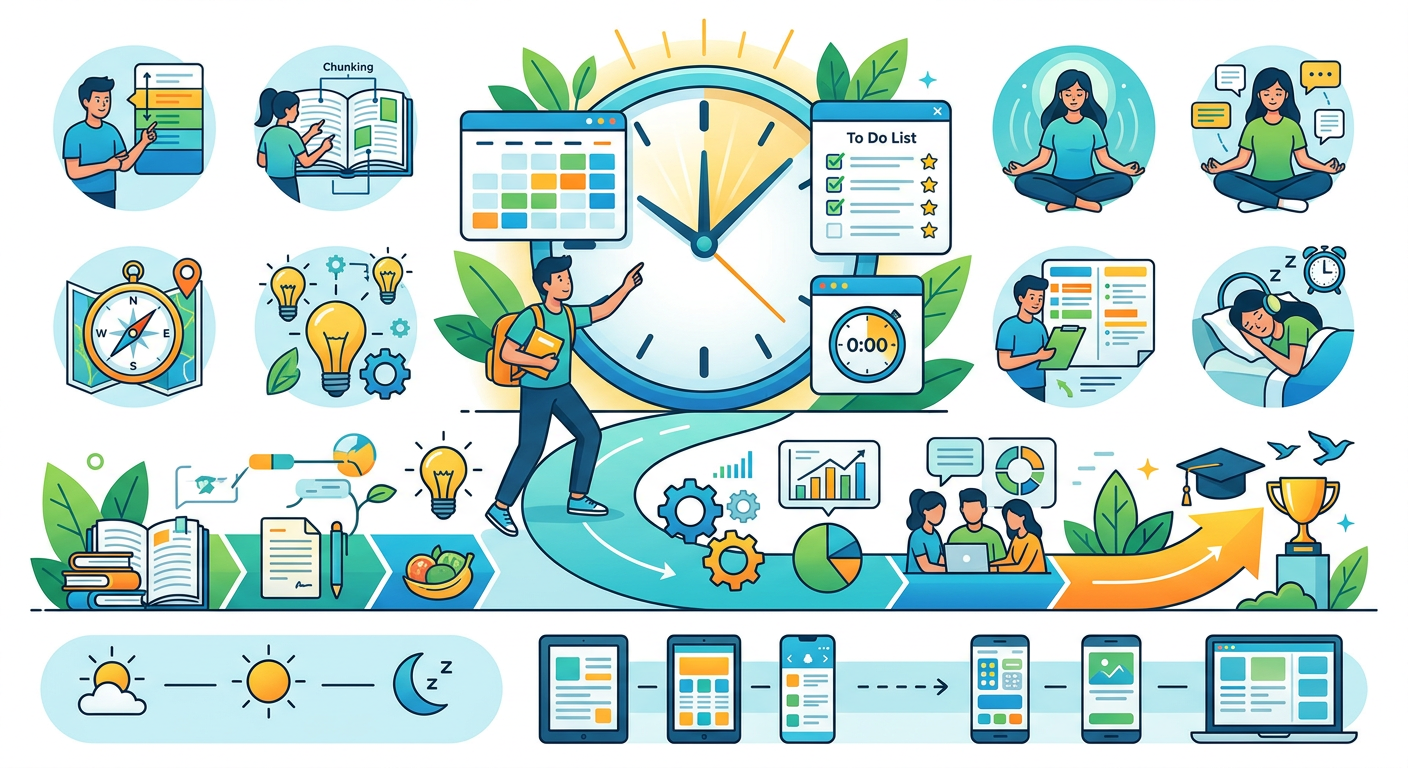
A study schedule for college students should focus on energy management rather than just counting hours. Research from Harvard Business Review suggests that high performance requires managing physical and mental energy in rhythmic cycles. Staring at a book for six straight hours leads to diminishing returns and cognitive fatigue.
The Pomodoro technique for studying is the most popular way to manage these cycles. You work for 25 minutes of total focus, followed by a 5-minute break. After four sessions, take a longer 20-30 minute break. This keeps your brain fresh and provides frequent "deadlines" that prevent your mind from wandering. It turns a daunting 4-hour study block into manageable, high-intensity sprints.
Traditional fixed schedules often fail because they are too rigid. Instead, consider a "Retroactive Study Timetable." Instead of planning what you will do, record what you actually did. Use a color-coding system (Green for "Mastered," Yellow for "Needs Review," Red for "Help!") to track different topics. If you just finished medium enthalpy change practice questions and felt confident, mark it green. This visual data tells you exactly where to spend your time tomorrow.
Beat procrastination with the 5-Minute Rule. If you feel overwhelmed, tell yourself you will only study for five minutes. The hardest part of studying is the "activation energy" required to start. Once the brain is engaged and the "Zeigarnik Effect" (the tendency to remember uncompleted tasks) kicks in, you will likely find it easier to keep going for an hour or more.
Use our AI-powered practice tools to implement active recall and spaced repetition effortlessly. Start practicing with thousands of real-world exam questions today.
Get Started FreeDeveloping the Ideal Study Environment
Your environment acts as a silent coach or a relentless distractor. The "Context-Dependent Memory" theory suggests that you perform better when the environment where you learn matches the environment where you are tested. Since exam rooms are quiet and organized, your study space should be too. Clear your desk of everything except the specific subject you are working on to reduce cognitive load.
Is music helpful? It depends. While some students swear by lo-fi beats, the best way to improve memory for exams is often through "brown noise" or silence. Lyrics can interfere with the phonological loop in your brain, making it harder to process language-based information. Save the upbeat playlists for low-intensity tasks and switch to neutral ambient sounds when tackling ICE table practice questions with answers.
Digital minimalism is non-negotiable for deep work. Your smartphone is a slot machine designed to steal your attention. Use apps like Forest or Freedom to lock your devices, or simply leave your phone in another room. Research indicates that even the mere presence of a smartphone on a desk—even if it's turned off—reduces cognitive capacity because part of your brain is actively working to ignore it.
Note-Taking Systems for Long-Term Retention
Effective note-taking is about synthesis, not transcription. If you are just copying what the professor says, you aren't learning. The Cornell Note-Taking System forces you to engage with the material by dividing your page into three sections: Cues (questions/keywords), Notes (the main content), and Summary (a 2-sentence wrap-up). This structure naturally encourages active recall during your review sessions.
Should you type or write your notes? The science mostly favors handwriting. A study by Princeton and UCLA researchers found that students who took longhand notes performed better on conceptual questions. Handwriting is slower, which forces you to be selective and summarize information in your own words, a process known as encoding. Typing often leads to mindless verbatim transcription.
For visual learners, mind mapping or the "Boxing Method" is superior for understanding hierarchies. If you are studying thermodynamics, you might have a central box for "Enthalpy," with branches leading to Hess’s Law practice questions and "Calorimetry." This allows you to visualize how different topics interconnect rather than seeing them as a series of isolated facts.
Physical and Mental Wellness During Exam Season
Sleep is not a luxury; it is a biological necessity for memory consolidation. During REM sleep, your brain replays the day’s learning, strengthening the neural connections you built during your study sessions. Pulling an all-nighter is counterproductive because it prevents this "saving" process. You are better off getting 7 hours of sleep and knowing 80% of the material deeply than staying up and having a surface-level grasp of 100%.
Nutrition plays a massive role in maintaining focus. The brain consumes about 20% of your body's daily calories. Focus on complex carbohydrates and healthy fats like walnuts, blueberries, and fatty fish to provide steady energy. Avoid high-sugar snacks that cause "insulin spikes" and subsequent crashes. Staying hydrated is equally vital, as even mild dehydration can impair concentration and executive function.
Stress management is about physiological regulation. If you feel panic rising, use the 4-7-8 breathing technique: breathe in for 4 seconds, hold for 7, and exhale for 8. This signals your parasympathetic nervous system to calm down. Remember that a little bit of stress is actually beneficial for performance, it’s called "eustress", but it must be managed so it doesn't cross into "distress."
Exam Day Strategies: Turning Preparation into Performance
Preparation ends when you enter the testing hall, but strategy begins. Start by doing a "brain dump" on the back of your exam paper or scrap sheet. Immediately write down any complex formulas, like those for hard pH calculation practice questions, or mnemonics you’ve memorized. This clears your working memory and reduces the fear of "blanking out" mid-exam.
Use the "First Pass" strategy for multiple-choice tests. Go through the entire exam and answer only the questions you can solve in under 30 seconds. This builds momentum and ensures you don't miss easy points because you got stuck on a difficult problem early on. On the second pass, tackle the more time-consuming calculations or essay prompts.
Finally, always analyze your performance after the results come in. Did you lose points because of silly mistakes, poor time management, or a genuine lack of understanding? If you struggled with specific concepts, like the forgetting curve predicts you might, go back and adjust your study methods for the next unit. Continuous improvement is the hallmark of a high-achieving student.
Stop guessing and start knowing. Bevinzey’s interactive practice questions and progress tracking help you apply science-backed study methods to every subject.
Get Started FreeFrequently Asked Questions
What is the SQ3R method for studying?
The SQ3R method stands for Survey, Question, Read, Recite, and Review. It is a reading comprehension strategy that helps students think about the text they are reading while they are reading it to improve retention.
How many hours a day should I study for exams?
Quality matters more than quantity, but most experts suggest 3-5 hours of focused, Pomodoro-style study per day. Beyond this, cognitive fatigue usually sets in, making additional hours less productive.
Is it better to study at night or in the morning?
It depends on your circadian rhythm. Morning people (lions) possess higher alertness in the early hours, while night-owls (wolves) may find their "flow state" late in the evening; however, avoid studying late enough to interfere with essential REM sleep.
What are the best foods to eat while studying?
Focus on "brain foods" like blueberries (high in antioxidants), fatty fish (omega-3s), pumpkin seeds (magnesium), and dark chocolate (flavonoids). These support blood flow to the brain and improve focus.
How do I stop procrastinating and start studying?
Use the 5-Minute Rule: commit to studying for just five minutes. Once you overcome the initial resistance to starting, the brain find it much easier to maintain the momentum and finish the task.
Does listening to music help with studying?
Music can help block out distracting background noise, but it generally should be instrumental. Music with lyrics competes for the same part of the brain that processes language, which can hinder your reading and writing ability.
Enjoyed this article?
Share it with others who might find it helpful.
Related Articles

How to Solve Molarity Problems: Step-by-Step Mastery
Learn how to solve molarity problems step-by-step with formulas, unit tips, and worked examples so you can calculate concentration with confidence.
Mar 26, 2026
Avoid These 7 Common Molarity Mistakes in Chemistry
Master chemistry calculations! Avoid common molarity mistakes with our expert guide on unit conversions, dilution errors, and proper lab techniques.
Mar 26, 2026

What Is Molarity? The Complete Guide to Molar Concentration
Master molarity with our complete guide. Learn the formula, step-by-step calculations, and the critical differences between molarity and molality.
Mar 26, 2026
Why Molarity Matters: Converting Mass to Moles for Lab Solutions
Master chemistry with our guide to the molarity formula. Learn how to calculate concentration with step-by-step examples, units, and practical lab tips.
Mar 26, 2026
Molarity vs Molality: The Essential Difference Explained
Master the difference between molarity vs molality. Learn the formulas, key differences, and when to use each in this comprehensive chemistry guide.
Mar 26, 2026