Can't Remember What You Studied? The Science-Backed Fix

You stare at the exam paper. The question is about a concept you spent hours reviewing just last night. You can almost see the page in your textbook, you remember highlighting the exact paragraph, but the answer itself is a complete blank. It's a deeply frustrating experience, and if you’ve ever cried out, “Why I forget what I study for exams?!”, you are far from alone. This phenomenon isn't a personal failure; it’s a standard feature of how the human brain works. Forgetting is not the enemy of learning, it’s a part of the process. Your brain is an efficiency machine, constantly clearing out information it deems non-essential to make room for new input. The real challenge isn't to stop forgetting, but to learn how to signal to your brain what information is crucial and must be retained. This means shifting your study habits from passive exposure to active engagement.
The Science of Forgetting: Why Your Brain Discards Information
Your brain discards information primarily because of a natural memory decay process, which is accelerated by passive study methods and cognitive overload. Without deliberate effort to reinforce a memory, your brain will efficiently prune it away to save resources. This isn't a flaw; it's a feature for survival.
This process was famously mapped by psychologist Hermann Ebbinghaus in the 1880s. He discovered what is now called "the forgetting curve," a graph showing that we lose a dramatic amount of newly learned information within the first 24 hours, often over 50%, if we don't take specific steps to retain it. The curve demonstrates that forgetting is rapid at first and then slows over time.
The main culprit behind this rapid memory decay is passive review. Simply rereading your notes, watching a lecture video again, or highlighting text feels productive, but it's a low-effort activity for your brain. It doesn't force your mind to retrieve the information, which is the key action that strengthens the neural pathways for a memory. This is a central reason why so much forgetting while studying occurs.
Why I Forget What I Study for Exams: Are You Studying Wrong?

You may forget what you study for exams because your study habits create an "illusion of competence" without building real, lasting knowledge. Common but ineffective methods like cramming, rereading, and studying in distracting environments actively work against your brain's natural memory-encoding process.
Rereading and highlighting are particularly deceptive. As you review the material, it becomes familiar, and your brain mistakes this fluency for mastery. You think, “Oh yeah, I know this.” But when the exam question asks you to recall that information without the textbook in front of you, you find you can’t. You've trained yourself to recognize the information, not to recall it from scratch. To truly learn, you have to master effective study without rereading.
Marathon cramming sessions are another classic mistake. Trying to force twelve hours of information into your brain the night before a test leads to cognitive saturation. Your short-term memory gets overwhelmed and doesn't have the time or resources to move key concepts into long-term storage. Furthermore, studying with your phone buzzing, a TV show on, or in a noisy café splits your focus, preventing the state of deep concentration required for memory to form effectively.
Tired of Ineffective Study Habits?
Stop the cycle of forgetting. Our tools integrate science-backed methods to help you study smarter, not harder.
Get Started FreeThe Fix, Part 1: Using Active Recall to Solidify Knowledge
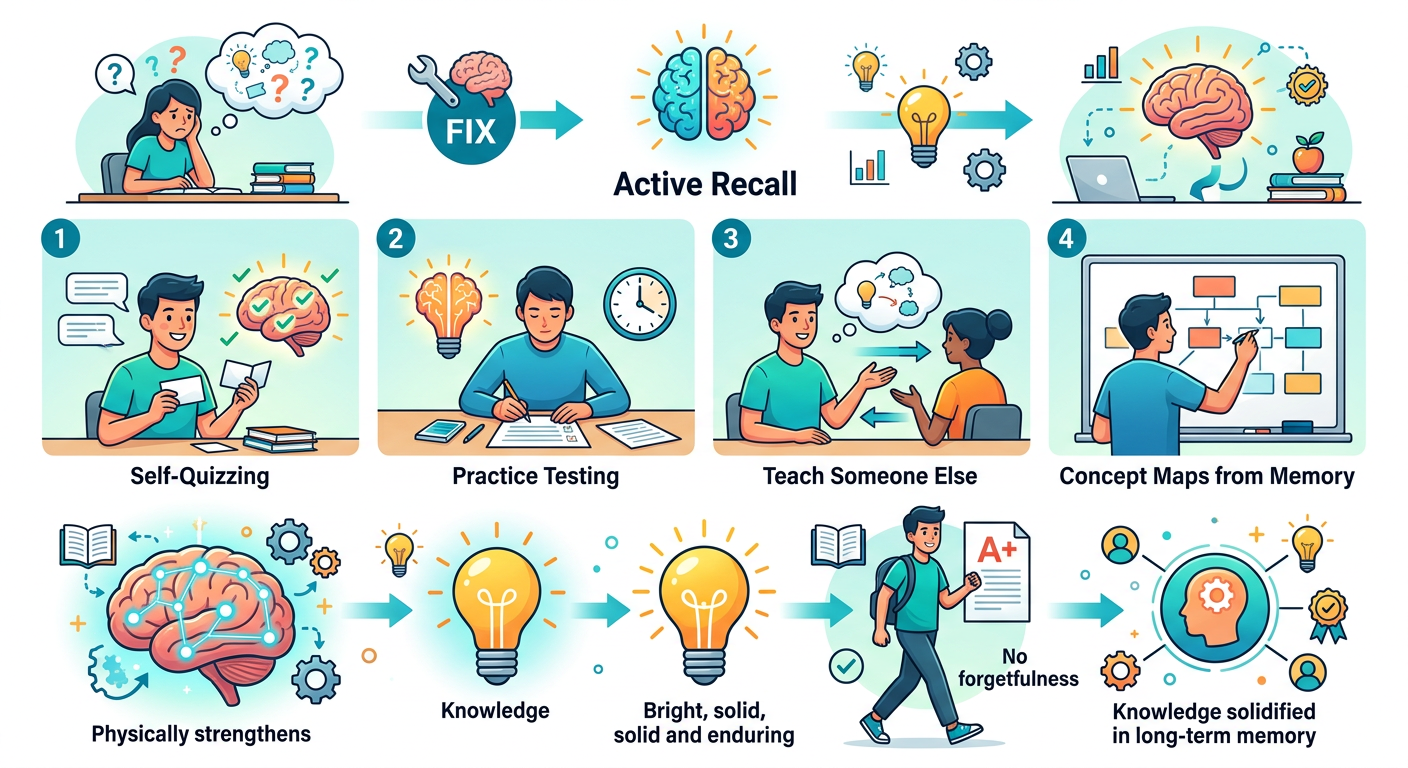
The most effective way to strengthen your memory is through active recall, which is the process of deliberately retrieving information from your brain. Instead of passively looking at the answer, you force your mind to find it. This act of retrieval tells your brain, "This is important!" and reinforces the memory each time you do it.
You can start using active recall techniques today. Instead of just rereading a chapter, close the book and summarize the key points out loud or on a blank sheet of paper. Turn chapter headings into questions and try to answer them without looking. A powerful approach is using practice testing. This doesn't just mean a final mock exam; it means constantly quizzing yourself. Whether you're reviewing concepts or tackling hard ICE table practice questions for chemistry, the struggle to find the answer is what builds the memory.
One of the best frameworks for this is the Feynman Technique. Take a concept you're studying and try to explain it in simple terms, as if you were teaching it to a child. When you get stuck or have to use complex jargon, you've pinpointed a gap in your own understanding. Go back to your source material, shore up that weak spot, and then try explaining it again. When you can explain it simply, you truly know it. This is a core tenet of how to study for exams using active recall.
The Fix, Part 2: Beating the Forgetting Curve with Spaced Repetition

To ensure information moves into long-term memory, you must review it strategically over time using a method called spaced repetition. This involves revisiting information at increasing intervals, which directly counters the brain’s forgetting curve. Reviewing something just as you are about to forget it is far more powerful than cramming it repeatedly in a short period.
You can create a simple spaced repetition schedule without any special tools. Let's say you learn a new concept in your history class on Monday. Your review schedule could look like this:
Review 1: Tuesday (1 day later)
Review 2: Thursday (3 days later)
Review 3: The following Monday (1 week later)
Review 4: Two weeks after that.
This kind of structured review feels less overwhelming than a single massive study session and is scientifically proven to improve long-term memory retention. These are just some of the many evidence-based study methods you can use.
For those who prefer a digital approach, several apps automate this process. Tools like Anki and Quizlet (with its "Long-Term Learning" mode) use algorithms to track your performance on flashcards. They automatically schedule cards you find difficult for more frequent review and push back the ones you know well, optimizing your study time for maximum efficiency.
Beyond Study Habits: How Sleep, Stress, and Diet Affect Your Memory
Your ability to remember what you study is profoundly affected by your physical and mental state, especially your sleep, stress levels, and nutrition. You can have the best study techniques in the world, but they will fail if your brain isn't biologically prepared to learn. How to remember what you study is as much about biology as it is about strategy.
Sleep plays a critical role in memory consolidation. During deep sleep stages, your brain processes the day's events and transfers information from the fragile short-term memory to more robust long-term storage. According to researchers at Harvard Medical School, a full night’s sleep after learning can boost retention significantly. Pulling an all-nighter is one of the worst things you can do for your memory.
Similarly, high stress levels sabotage recall. When you're anxious about an exam, your body produces cortisol, a stress hormone. While useful in true fight-or-flight situations, excess cortisol can interfere with the function of your prefrontal cortex and hippocampus, brain regions vital for memory retrieval. This is why you might "go blank" during a test only to have the answers come flooding back the moment you walk out. Managing stress through exercise, mindfulness, or even just taking strategic breaks is crucial for exam performance.
Finally, what you eat impacts your brain's ability to function. A diet high in sugar and processed foods can lead to inflammation and oxidative stress, impairing cognitive function. Conversely, a balanced diet rich in omega-3 fatty acids (found in fish), antioxidants (found in berries and leafy greens), and complex carbohydrates provides the fuel your brain needs for optimal performance. You can't run a supercomputer on junk fuel.
Stop Forgetting. Start Remembering.
Transform your study sessions from frustrating to effective. Bevinzey's suite of tools uses proven memory techniques like active recall and spaced repetition to help you master any subject and ace your exams.
Get Started FreeFrequently Asked Questions
Is it normal to forget everything before an exam?
Yes, it's surprisingly normal and common to feel like you've forgotten everything right before an exam. This is often caused by a combination of performance anxiety, stress-induced "blanking," and using ineffective, passive study methods that didn't create strong long-term memories in the first place.
Why do I go blank during the test but remember the answers afterward?
This happens because high stress during a test releases the hormone cortisol, which can temporarily block the brain's memory recall pathways. Once the stressful situation is over (when you leave the exam room), your cortisol levels drop, and your brain can access the information again. This is a classic sign of test anxiety interfering with performance.
How much information do you forget after 24 hours?
According to Hermann Ebbinghaus's "forgetting curve," you can forget over 50-80% of new information within just 24 hours if you don't make a conscious effort to review or recall it. The rate of forgetting is steepest right after learning.
What is the single most effective study method for memory?
Active recall is widely considered the single most effective study method for memory retention. The act of forcing your brain to retrieve information, through practice tests, flashcards, or explaining a concept from scratch, strengthens neural pathways far more effectively than passively rereading or highlighting material.
Is it better to study the night before an exam or get a full night’s sleep?
It is almost always better to get a full night's sleep. Sleep is essential for memory consolidation, the process where your brain firms up what you've learned and moves it to long-term storage. An all-nighter sacrifices this critical process and leads to fatigue, which severely impairs your ability to think clearly and recall information during the exam.
Enjoyed this article?
Share it with others who might find it helpful.
Related Articles

How to Solve Molarity Problems: Step-by-Step Mastery
Learn how to solve molarity problems step-by-step with formulas, unit tips, and worked examples so you can calculate concentration with confidence.
Mar 26, 2026

Avoid These 7 Common Molarity Mistakes in Chemistry
Master chemistry calculations! Avoid common molarity mistakes with our expert guide on unit conversions, dilution errors, and proper lab techniques.
Mar 26, 2026

What Is Molarity? The Complete Guide to Molar Concentration
Master molarity with our complete guide. Learn the formula, step-by-step calculations, and the critical differences between molarity and molality.
Mar 26, 2026
Why Molarity Matters: Converting Mass to Moles for Lab Solutions
Master chemistry with our guide to the molarity formula. Learn how to calculate concentration with step-by-step examples, units, and practical lab tips.
Mar 26, 2026

Molarity vs Molality: The Essential Difference Explained
Master the difference between molarity vs molality. Learn the formulas, key differences, and when to use each in this comprehensive chemistry guide.
Mar 26, 2026