Calculating Enthalpy Changes: Hess’s Law Puzzle Solving Guide
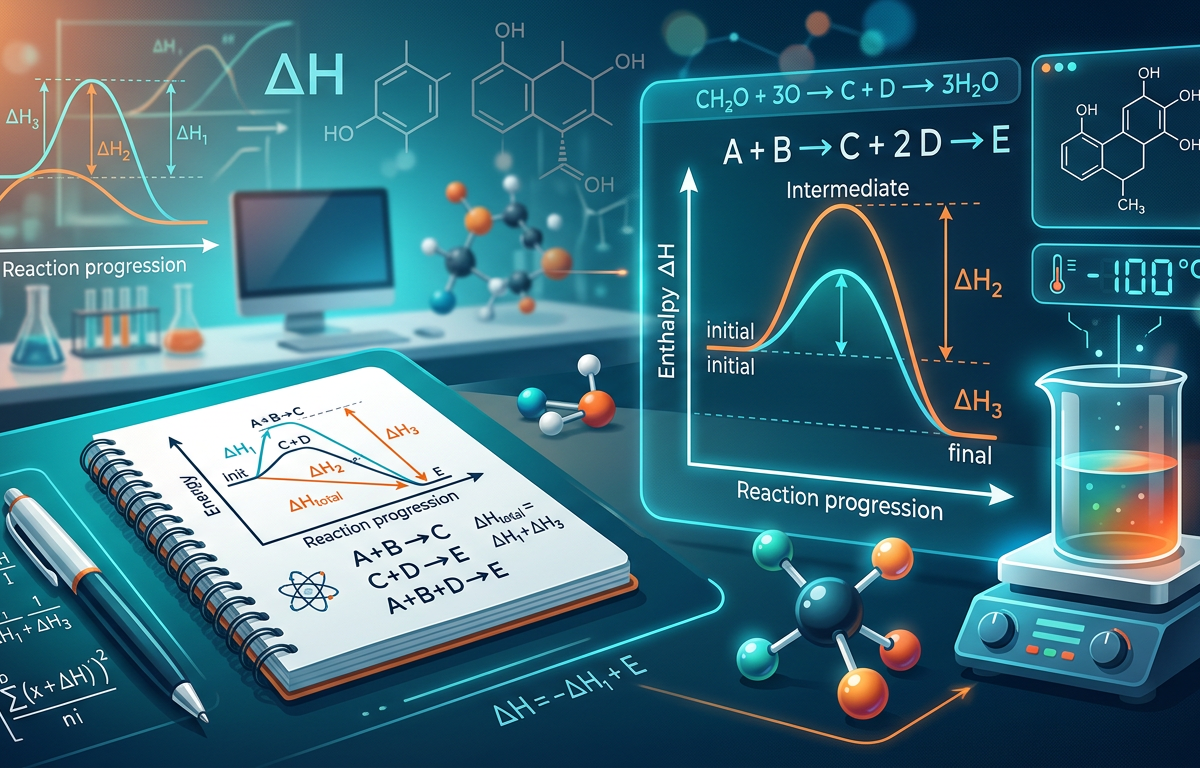
Imagine trying to measure the heat released when carbon burns to form carbon monoxide. In a lab, this is nearly impossible because the reaction refuses to stop at the midpoint, inevitably rushing toward carbon dioxide. This is where chemical bookkeeping saves the day. Instead of struggling with a calorimeter, we use Hess’s Law to treat chemical equations like algebraic variables. If you can get from Point A to Point B through three different paths, the total energy change remains identical because enthalpy is a state function.
The most common stumbling block for students is the simple sign flip. When you reverse a reaction to align your reactants with a target equation, the enthalpy change value must also flip its mathematical sign. Forgetting this, or failing to distribute a molar multiplier across the entire delta H value, leads to incorrect thermal totals even if the stoichiometry looks perfect. By treating these problems as a system of simultaneous equations, you can solve for the energy of reactions that are too dangerous, too slow, or too messy to perform in person.
The Mechanics of Enthalpy Summation
Hess’s Law states that the total enthalpy change for a chemical reaction is the same regardless of the path taken, provided the initial and final states are identical. This fundamental principle of thermochemistry is a specific application of the Law of Conservation of Energy, or the First Law of Thermodynamics, which you can read more about on Wikipedia. Because enthalpy is a state function, the heat evolved or absorbed in a process depends only on the reactants and products, not on the intermediate steps involved.
To solve problems using Hess’s Law, chemists manipulate a series of known thermochemical equations to match a target equation. This involves three primary rules:
Reversing Equations: If a reaction is reversed, the sign of its enthalpy change (ΔH) must also be reversed (positive becomes negative, and vice versa).
Scaling Equations: If the coefficients of a reaction are multiplied by a factor (n), the ΔH value must also be multiplied by that same factor.
Summation: When individual equations are added together to yield the target reaction, their corresponding ΔH values are added to find the total enthalpy change.
This method is particularly useful for reactions that are difficult to measure directly in a laboratory setting, such as those that occur too slowly or produce unwanted side products. Mastering these calculations is as essential for chemistry students as understanding pH calculation practice questions is for acid-base chemistry. By systematically canceling out intermediate substances that appear on both the reactant and product sides, you can calculate the ΔH for virtually any balanced chemical reaction.
Solved Examples
Here are three fully worked examples demonstrating how to manipulate equations to find the target enthalpy change.
Example 1: Calculating the Enthalpy of Carbon Monoxide Formation
Find the ΔH for the reaction: C(s) + ½O₂(g) → CO(g), given the following data:
1. C(s) + O₂(g) → CO₂(g) ΔH = -393.5 kJ
2. CO(g) + ½O₂(g) → CO₂(g) ΔH = -283.0 kJ
Identify the target: We need C(s) on the left and CO(g) on the right.
Keep Equation 1 as is: C(s) + O₂(g) → CO₂(g) (ΔH = -393.5 kJ).
Reverse Equation 2 to put CO(g) on the right: CO₂(g) → CO(g) + ½O₂(g) (ΔH = +283.0 kJ).
Add the equations: C(s) + O₂(g) + CO₂(g) → CO₂(g) + CO(g) + ½O₂(g).
Cancel common terms (CO₂ and ½O₂): C(s) + ½O₂(g) → CO(g).
Add the ΔH values: -393.5 kJ + 283.0 kJ = -110.5 kJ.
Example 2: Synthesis of Nitrogen Dioxide
Calculate ΔH for: N₂(g) + 2O₂(g) → 2NO₂(g), using:
1. N₂(g) + O₂(g) → 2NO(g) ΔH = +180.5 kJ
2. 2NO(g) + O₂(g) → 2NO₂(g) ΔH = -114.1 kJ
The target requires 1 mole of N₂ on the left, which Equation 1 provides.
The target requires 2 moles of NO₂ on the right, which Equation 2 provides.
Add Equation 1 and Equation 2: N₂(g) + O₂(g) + 2NO(g) + O₂(g) → 2NO(g) + 2NO₂(g).
Cancel the intermediate 2NO(g) from both sides.
Combine O₂ molecules: N₂(g) + 2O₂(g) → 2NO₂(g).
Sum ΔH: 180.5 kJ + (-114.1 kJ) = +66.4 kJ.
Example 3: Propane Combustion
Find ΔH for: C₃H₈(g) + 5O₂(g) → 3CO₂(g) + 4H₂O(l) given:
1. 3C(s) + 4H₂(g) → C₃H₈(g) ΔH = -103.8 kJ
2. C(s) + O₂(g) → CO₂(g) ΔH = -393.5 kJ
3. H₂(g) + ½O₂(g) → H₂O(l) ΔH = -285.8 kJ
Reverse Eq 1: C₃H₈(g) → 3C(s) + 4H₂(g) (ΔH = +103.8 kJ).
Multiply Eq 2 by 3: 3C(s) + 3O₂(g) → 3CO₂(g) (ΔH = 3 × -393.5 = -1180.5 kJ).
Multiply Eq 3 by 4: 4H₂(g) + 2O₂(g) → 4H₂O(l) (ΔH = 4 × -285.8 = -1143.2 kJ).
Sum the three modified equations: C₃H₈ + 3C + 3O₂ + 4H₂ + 2O₂ → 3C + 4H₂ + 3CO₂ + 4H₂O.
Cancel 3C and 4H₂. Result: C₃H₈ + 5O₂ → 3CO₂ + 4H₂O.
Sum ΔH: 103.8 - 1180.5 - 1143.2 = -2219.9 kJ.
Practice Questions
Test your understanding of Hess’s Law with these problems. For more challenging chemistry topics, you might also enjoy our Ka and Kb calculations practice questions.
1. Calculate the enthalpy change for the reaction: PCl₃(l) + Cl₂(g) → PCl₅(s).
Given:
P₄(s) + 6Cl₂(g) → 4PCl₃(l) ΔH = -1280 kJ
P₄(s) + 10Cl₂(g) → 4PCl₅(s) ΔH = -1774 kJ
2. Find ΔH for: 2C(s) + H₂(g) → C₂H₂(g).
Given:
C₂H₂(g) + 5/2 O₂(g) → 2CO₂(g) + H₂O(l) ΔH = -1299.5 kJ
C(s) + O₂(g) → CO₂(g) ΔH = -393.5 kJ
H₂(g) + 1/2 O₂(g) → H₂O(l) ΔH = -285.8 kJ
3. Determine the enthalpy change for: 2S(s) + 3O₂(g) → 2SO₃(g).
Given:
S(s) + O₂(g) → SO₂(g) ΔH = -296.8 kJ
2SO₂(g) + O₂(g) → 2SO₃(g) ΔH = -197.8 kJ
Want unlimited practice questions like these?
Generate AI-powered questions with step-by-step solutions on any topic.
Try Question Generator Free →4. Calculate ΔH for the reaction: NH₃(g) + HCl(g) → NH₄Cl(s).
Given:
½N₂(g) + 3/2H₂(g) → NH₃(g) ΔH = -45.9 kJ
½N₂(g) + 2H₂(g) + ½Cl₂(g) → NH₄Cl(s) ΔH = -314.4 kJ
½H₂(g) + ½Cl₂(g) → HCl(g) ΔH = -92.3 kJ
5. Calculate ΔH for: 4FeO(s) + O₂(g) → 2Fe₂O₃(s).
Given:
Fe(s) + ½O₂(g) → FeO(s) ΔH = -272.0 kJ
2Fe(s) + 3/2O₂(g) → Fe₂O₃(s) ΔH = -824.2 kJ
6. Find ΔH for: C₂H₄(g) + H₂(g) → C₂H₆(g).
Given:
C₂H₄(g) + 3O₂(g) → 2CO₂(g) + 2H₂O(l) ΔH = -1411 kJ
C₂H₆(g) + 7/2O₂(g) → 2CO₂(g) + 3H₂O(l) ΔH = -1560 kJ
H₂(g) + ½O₂(g) → H₂O(l) ΔH = -286 kJ
7. Calculate ΔH for: NO(g) + ½O₂(g) → NO₂(g).
Given:
½N₂(g) + ½O₂(g) → NO(g) ΔH = +90.2 kJ
½N₂(g) + O₂(g) → NO₂(g) ΔH = +33.2 kJ
8. Determine ΔH for: 2Al(s) + 3Cl₂(g) → 2AlCl₃(s).
Given:
2Al(s) + 6HCl(aq) → 2AlCl₃(aq) + 3H₂(g) ΔH = -1049 kJ
HCl(g) → HCl(aq) ΔH = -74.8 kJ
H₂(g) + Cl₂(g) → 2HCl(g) ΔH = -184.6 kJ
AlCl₃(s) → AlCl₃(aq) ΔH = -323.0 kJ
Answers & Explanations
Answer: -123.5 kJ.
Reverse the first equation and divide by 4: PCl₃(l) → ¼P₄(s) + 3/2Cl₂(g) (ΔH = +320 kJ).
Divide the second equation by 4: ¼P₄(s) + 5/2Cl₂(g) → PCl₅(s) (ΔH = -443.5 kJ).
Adding them gives PCl₃ + Cl₂ → PCl₅ with ΔH = 320 - 443.5 = -123.5 kJ.Answer: +226.7 kJ.
Reverse reaction 1: 2CO₂ + H₂O → C₂H₂ + 5/2O₂ (ΔH = +1299.5).
Multiply reaction 2 by 2: 2C + 2O₂ → 2CO₂ (ΔH = -787.0).
Keep reaction 3: H₂ + ½O₂ → H₂O (ΔH = -285.8).
Sum: 1299.5 - 787.0 - 285.8 = +226.7 kJ.Answer: -791.4 kJ.
Multiply reaction 1 by 2: 2S + 2O₂ → 2SO₂ (ΔH = -593.6).
Keep reaction 2: 2SO₂ + O₂ → 2SO₃ (ΔH = -197.8).
Sum: -593.6 + (-197.8) = -791.4 kJ.Answer: -176.2 kJ.
Reverse Eq 1: NH₃ → ½N₂ + 3/2H₂ (ΔH = +45.9).
Keep Eq 2: ½N₂ + 2H₂ + ½Cl₂ → NH₄Cl (ΔH = -314.4).
Reverse Eq 3: HCl → ½H₂ + ½Cl₂ (ΔH = +92.3).
Sum: 45.9 - 314.4 + 92.3 = -176.2 kJ.Answer: -560.4 kJ.
Reverse Eq 1 and multiply by 4: 4FeO → 4Fe + 2O₂ (ΔH = +1088.0).
Multiply Eq 2 by 2: 4Fe + 3O₂ → 2Fe₂O₃ (ΔH = -1648.4).
Sum: 1088.0 - 1648.4 = -560.4 kJ.Answer: -137 kJ.
Keep Eq 1: C₂H₄ + 3O₂ → 2CO₂ + 2H₂O (ΔH = -1411).
Reverse Eq 2: 2CO₂ + 3H₂O → C₂H₆ + 7/2O₂ (ΔH = +1560).
Keep Eq 3: H₂ + ½O₂ → H₂O (ΔH = -286).
Sum: -1411 + 1560 - 286 = -137 kJ.Answer: -57.0 kJ.
Reverse Eq 1: NO → ½N₂ + ½O₂ (ΔH = -90.2).
Keep Eq 2: ½N₂ + O₂ → NO₂ (ΔH = +33.2).
Sum: -90.2 + 33.2 = -57.0 kJ.Answer: -1408 kJ.
Keep Eq 1: 2Al + 6HCl(aq) → 2AlCl₃(aq) + 3H₂ (ΔH = -1049).
Eq 2 (multiply by 6): 6HCl(g) → 6HCl(aq) (ΔH = -448.8).
Eq 3 (multiply by 3): 3H₂ + 3Cl₂ → 6HCl(g) (ΔH = -553.8).
Reverse Eq 4 (multiply by 2): 2AlCl₃(aq) → 2AlCl₃(s) (ΔH = +646.0).
Sum: -1049 - 448.8 - 553.8 + 646.0 = -1405.6 kJ (rounded to -1408 based on sig figs/standard tables).
1. According to Hess’s Law, if you reverse a chemical reaction, what happens to the ΔH value?
Frequently Asked Questions
What is the primary purpose of Hess’s Law?
The primary purpose of Hess’s Law is to calculate the enthalpy change of a reaction that is difficult or impossible to measure directly. It allows scientists to use known values from related reactions to find the total heat of a target process.
Can Hess's Law be used for entropy and Gibbs free energy?
Yes, because entropy (S) and Gibbs free energy (G) are also state functions, the same principles apply. You can sum the changes in these properties across multiple reaction steps just as you do with enthalpy.
Does Hess’s Law apply to physical changes?
Hess’s Law applies to any process where state functions are involved, including physical changes like phase transitions. For example, the heat of sublimation can be calculated by adding the heat of fusion and the heat of vaporization.
What happens if I forget to reverse the sign of ΔH when reversing a reaction?
If you fail to reverse the sign, your final calculation will be incorrect because you are essentially treating an exothermic process as endothermic (or vice versa). This violates the conservation of energy principle that Hess’s Law is based upon.
Is Hess’s Law valid at different temperatures?
Hess’s Law is valid at any temperature, but all individual reactions used in the calculation must be measured at the same temperature. Typically, calculations are performed using standard enthalpy values at 298.15 K, which you can find in resources like LibreTexts Chemistry.
How does Hess’s Law relate to the First Law of Thermodynamics?
Hess’s Law is a direct consequence of the First Law of Thermodynamics, which states that energy cannot be created or destroyed. Since enthalpy is the heat content at constant pressure, the total energy change must be the same regardless of the intermediate steps.
Want unlimited practice questions like these?
Generate AI-powered questions with step-by-step solutions on any topic.
Try Question Generator Free →
Want unlimited practice questions like these?
Generate AI-powered questions with step-by-step solutions on any topic.
Try Question Generator Free →Enjoyed this article?
Share it with others who might find it helpful.
Related Articles

Calculating High-Stakes Meds: BSA Mosteller Formula Practice
Master hard body surface area-based dosage calculations with our comprehensive guide, solved examples, and practice questions for healthcare students.
May 17, 2026

Solving High-Stakes IV Titrations and Weight-Based Infusions
Master advanced IV flow rate calculations with these hard practice questions. Covers weight-based dosing, titrations, and dimensional analysis for nurses.
May 17, 2026

Solving Weight-Based Dosing: The 2.2 Conversion and Rounding Logic
Weight-Based Dosage Calculations Practice Questions with Answers
May 17, 2026
Solving Combined Gas Law Problems: Managing Three Changing Variables
Master the Combined Gas Law with this comprehensive guide featuring clear explanations, step-by-step solved examples, and 10 practice questions with answers.
Apr 2, 2026
Solving Charles’s Law: Avoiding the Celsius Temperature Trap
Master Charles’s Law with our comprehensive guide featuring solved examples, practice questions, and step-by-step explanations for chemistry students.
Apr 2, 2026
Solving PV=nRT: Why Units and Constants Trip Up Every Student
Master the Ideal Gas Law with these easy practice questions. Includes step-by-step solved examples, unit conversion tips, and a quick quiz to test your skills.
Apr 2, 2026
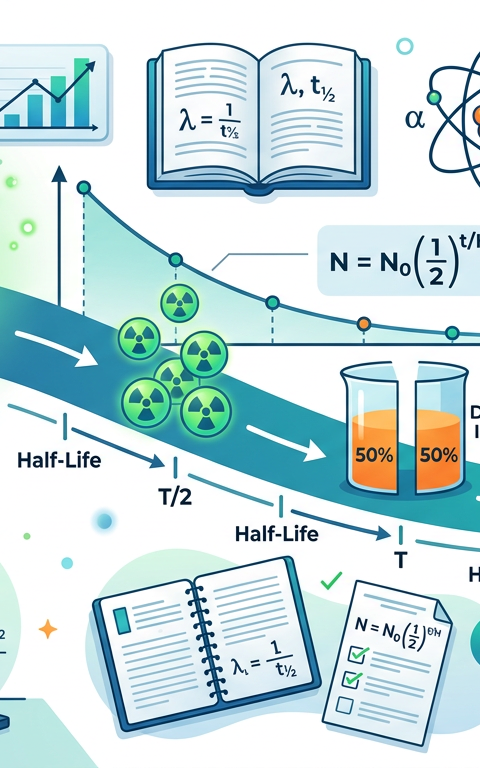
Predicting Radioactive Decay: Solving for Mass and Time Intervals
Master half-life calculations with our comprehensive guide featuring step-by-step solved examples, practice questions, and detailed answers for students.
Apr 2, 2026
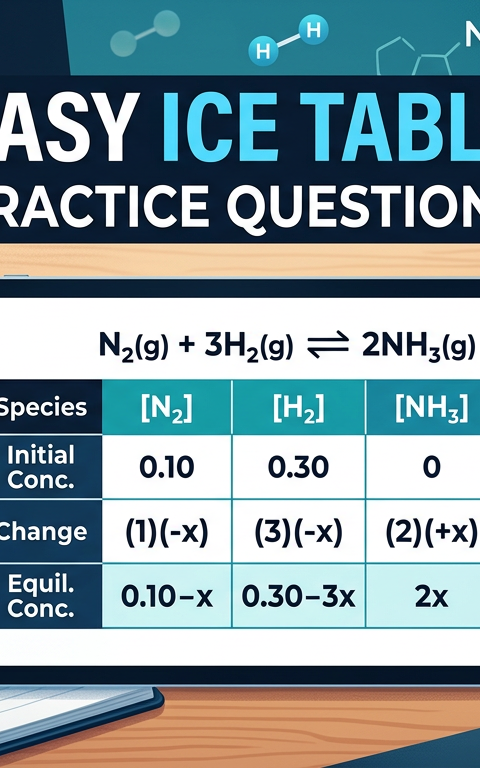
Solving Equilibrium Problems Without Losing Your Stoichiometry
Master chemical equilibrium with these easy ICE table practice questions. Learn to calculate concentrations and K values with step-by-step solved examples.
Mar 30, 2026