Predicting Equilibrium Shifts: Solving Le Chatelier's Challenges
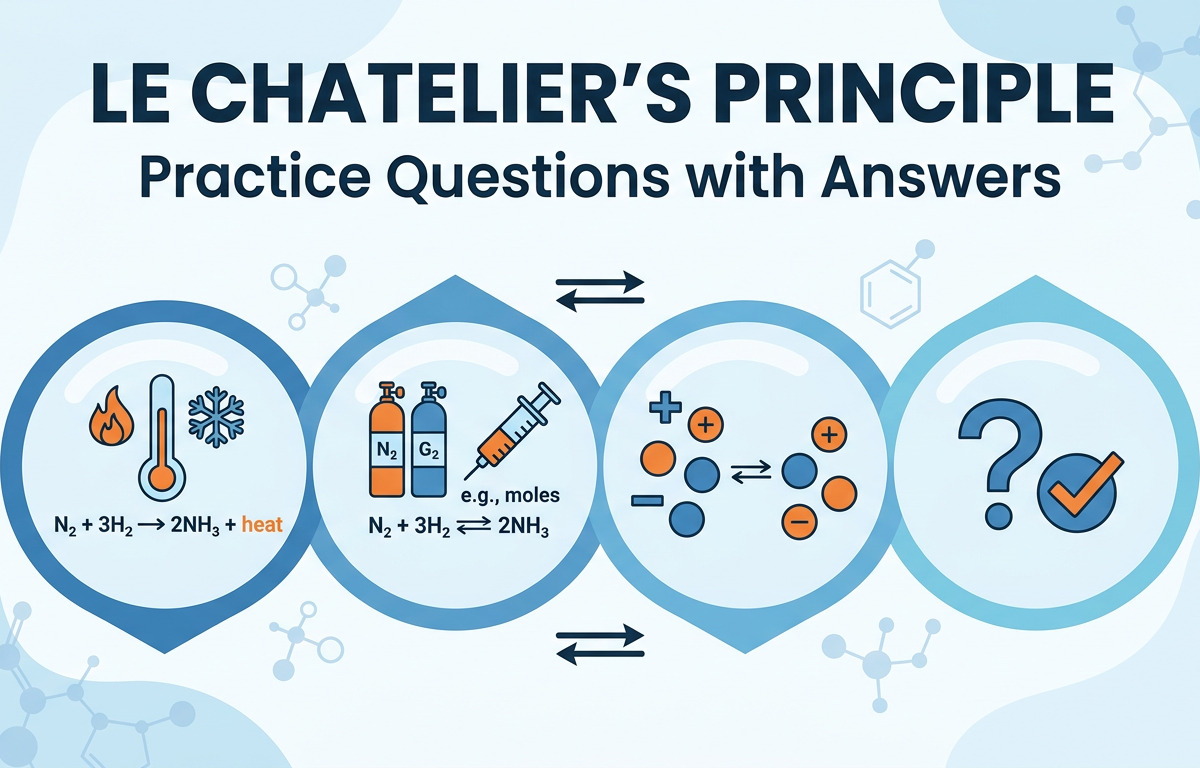
When a student looks at the synthesis of ammonia, N2(g) + 3H2(g) ⇌ 2NH3(g), the most frequent error is assuming that adding an inert gas at constant volume will force a shift because the total pressure rises. In reality, because the partial pressures of the reacting species remain unchanged, the equilibrium does not budge. Understanding Le Chatelier's Principle requires moving past simple memorization of left and right shifts to grasp how a system mathematically compensates for specific stresses in concentration, volume, and thermal energy.
This guide moves beyond the basics to address the nuances that often trip up learners during exams. You will practice identifying whether a reaction is exothermic or endothermic before predicting temperature effects and learn why catalysts only affect the rate of reaching equilibrium rather than the final yield. By working through these specific scenarios, you will develop the intuition needed to handle gaseous systems where molar ratios dictate the response to pressure changes.
Mechanics of Chemical System Responses
Le Chatelier’s Principle states that if a dynamic equilibrium is disturbed by changing the conditions, the position of equilibrium shifts to counteract the change to re-establish a new equilibrium. This qualitative rule allows chemists to predict how a chemical system will react to changes in concentration, temperature, or pressure. When a system at equilibrium is subjected to a stress, it does not simply break; instead, it adjusts the rates of the forward and reverse reactions to minimize that stress. According to Wikipedia, this principle is foundational for industrial processes like the Haber-Bosch process for ammonia synthesis.
There are four primary factors that influence equilibrium shifts:
Concentration: Adding a reactant or removing a product shifts the equilibrium toward the product side (right). Conversely, adding a product or removing a reactant shifts it toward the reactant side (left).
Pressure/Volume: For gaseous systems, increasing pressure (by decreasing volume) shifts the equilibrium toward the side with fewer moles of gas. Decreasing pressure shifts it toward the side with more moles of gas.
Temperature: This depends on whether the reaction is exothermic or endothermic. Increasing temperature favors the endothermic direction, while decreasing temperature favors the exothermic direction. You can explore more about energy changes in our Enthalpy Change Practice Questions with Answers.
Catalysts: A catalyst increases the rate of both the forward and reverse reactions equally. Therefore, it does not change the position of equilibrium, only the speed at which equilibrium is reached.
Solved Examples
Study these worked examples to understand how to apply the principle to specific chemical equations.
Example 1: Concentration Changes
Consider the reaction: N2(g) + 3H2(g) ⇌ 2NH3(g). What happens if more H2 is added?Identify the stress: Increase in reactant concentration.
Determine the response: The system must consume the excess H2.
Predict the shift: The equilibrium shifts to the right (toward products) to use up the H2.
Example 2: Pressure Changes
Consider the reaction: PCl5(g) ⇌ PCl3(g) + Cl2(g). What happens if the volume of the container is decreased?Identify the stress: Decreasing volume increases the total pressure.
Analyze gas moles: Reactants have 1 mole of gas; products have 2 moles of gas.
Predict the shift: The system shifts to the side with fewer moles to reduce pressure. The equilibrium shifts to the left.
Example 3: Temperature Changes
Consider the exothermic reaction: 2SO2(g) + O2(g) ⇌ 2SO3(g) + heat. What happens if the system is cooled?Identify the stress: Removal of heat (lowering temperature).
Determine the response: The system acts to replace the lost heat.
Predict the shift: Since the forward reaction is exothermic (releases heat), the equilibrium shifts to the right. This is closely related to the Heat of Reaction Practice Questions with Answers.
Practice Questions
Test your knowledge with these Le Chatelier’s Principle practice questions ranging from basic shifts to complex industrial scenarios.
1. In the reaction CO(g) + 2H2(g) ⇌ CH3OH(g), what is the effect of removing CH3OH as it is formed?
2. For the endothermic reaction CaCO3(s) ⇌ CaO(s) + CO2(g), how will increasing the temperature affect the yield of CO2?
3. In the gaseous system 2NO2(g) ⇌ N2O4(g), how does doubling the volume of the reaction vessel affect the concentration of NO2?
Want unlimited practice questions like these?
Generate AI-powered questions with step-by-step solutions on any topic.
Try Question Generator Free →4. Consider the reaction H2(g) + I2(g) ⇌ 2HI(g). If the pressure is increased by injecting an inert gas like Argon at constant volume, what happens to the equilibrium position?
5. The reaction 2NO(g) + O2(g) ⇌ 2NO2(g) is exothermic. If you want to maximize the production of NO2, should you use high or low temperatures?
6. In the equilibrium Fe3+(aq) + SCN-(aq) ⇌ [FeSCN]2+(aq), the solution turns a deeper red (the color of the complex) when more SCN- is added. Explain this using Le Chatelier’s Principle.
7. For the decomposition of water vapor: 2H2O(g) ⇌ 2H2(g) + O2(g) (ΔH > 0). What two changes could you make to increase the amount of H2 produced?
8. How does adding a platinum catalyst affect the equilibrium constant (K) and the position of equilibrium for the oxidation of sulfur dioxide?
9. In the reaction C(s) + CO2(g) ⇌ 2CO(g), what happens to the amount of CO2 if the pressure is decreased?
10. Explain why the addition of a solid reactant, like C(s) in the previous question, generally does not shift the equilibrium position.
Answers & Explanations
Answer: Shift to the right. Removing a product decreases its concentration. The system responds by producing more of that product to restore equilibrium, thus shifting the reaction forward.
Answer: Increase yield. Since the reaction is endothermic, heat can be treated as a reactant. Adding heat (increasing temperature) drives the reaction toward the products, increasing the amount of CO2 gas produced.
Answer: Shift to the left. Doubling the volume decreases the total pressure. The system shifts toward the side with more moles of gas (the reactant side, which has 2 moles compared to 1 mole of product) to increase the pressure.
Answer: No change. Adding an inert gas at constant volume increases total pressure but does not change the partial pressures of the reacting gases. Therefore, the equilibrium position remains unchanged. This is a common point of confusion in equilibrium studies.
Answer: Low temperatures. Because the reaction is exothermic, it releases heat. According to Le Chatelier's Principle, lowering the temperature (removing heat) will shift the equilibrium toward the product side to generate more heat.
Answer: Shift to the right. Adding SCN- increases the concentration of a reactant. The system counteracts this by consuming the extra SCN-, reacting it with Fe3+ to produce more [FeSCN]2+, which intensifies the red color.
Answer: Increase temperature and decrease pressure. Increasing temperature favors the endothermic forward reaction. Decreasing pressure shifts the equilibrium toward the side with more moles of gas (3 moles of product vs 2 moles of reactant).
Answer: No effect on either. A catalyst lowers the activation energy for both forward and reverse reactions equally. It speeds up the time to reach equilibrium but does not change the ratio of products to reactants (K) or the final position.
Answer: CO2 decreases. Decreasing pressure shifts the equilibrium toward the side with more moles of gas. The product side has 2 moles of gas (CO), while the reactant side has only 1 mole of gas (CO2). The shift to the right consumes CO2.
Answer: Pure solids have constant concentrations. The concentration (density) of a pure solid does not change regardless of how much is present. Since equilibrium depends on concentration changes, adding more solid does not exert "stress" on the system in the same way gases or solutes do.
1. Which of the following changes will shift the equilibrium of an exothermic reaction toward the products?
Frequently Asked Questions
What is the main purpose of Le Chatelier's Principle?
The main purpose is to predict how changes in physical or chemical conditions will affect the position of a chemical equilibrium. It helps scientists and engineers manipulate reactions to maximize the yield of desired products in industrial processes.
Does adding an inert gas always shift the equilibrium?
No, adding an inert gas only affects equilibrium if it changes the partial pressures of the reacting species. If added at constant volume, it has no effect; if added at constant pressure, it increases volume and may cause a shift.
How does temperature affect the equilibrium constant K?
Temperature is the only factor that actually changes the numerical value of the equilibrium constant K. For endothermic reactions, K increases with temperature, while for exothermic reactions, K decreases as temperature rises.
Why don't catalysts shift the equilibrium position?
Catalysts provide an alternative reaction pathway with a lower activation energy for both the forward and reverse reactions. Because both rates are increased by the same factor, the relative concentrations at equilibrium remain exactly the same.
Can Le Chatelier's Principle be applied to physical changes?
Yes, it applies to physical equilibria such as phase changes. For example, increasing pressure on ice shifts the equilibrium toward liquid water because water is denser than ice, occupying less volume. You can see similar logic applied in Easy Enthalpy Change Practice Questions regarding phase transitions.
Want unlimited practice questions like these?
Generate AI-powered questions with step-by-step solutions on any topic.
Try Question Generator Free →
Want unlimited practice questions like these?
Generate AI-powered questions with step-by-step solutions on any topic.
Try Question Generator Free →Enjoyed this article?
Share it with others who might find it helpful.
Related Articles
Hard Le Chatelier’s Principle Practice Questions
Master Hard Le Chatelier’s Principle Practice Questions with our comprehensive guide featuring solved examples, practice problems, and detailed explanations.
Mar 30, 2026
Hard Reaction Quotient (Q) Practice Questions
Hard Reaction Quotient (Q) Practice Questions
Mar 30, 2026
Grams to Moles Practice Questions with Answers
Master grams to moles conversions with our comprehensive guide. Includes step-by-step examples, practice questions, and detailed answers for chemistry students.
Mar 26, 2026
Avogadro’s Number Practice Questions with Answers
Master the mole concept with our Avogadro’s Number practice questions. Includes step-by-step solved examples, a quick quiz, and detailed explanations.
Mar 26, 2026
Empirical Formulas: Solving Ratios from Mass and Percent Data
Master empirical formula calculations with 10 practice questions, worked answers, and a free step-by-step calculator for mass, percentage, and combustion problems.
Mar 26, 2026