Kp Calculations Practice Questions with Answers
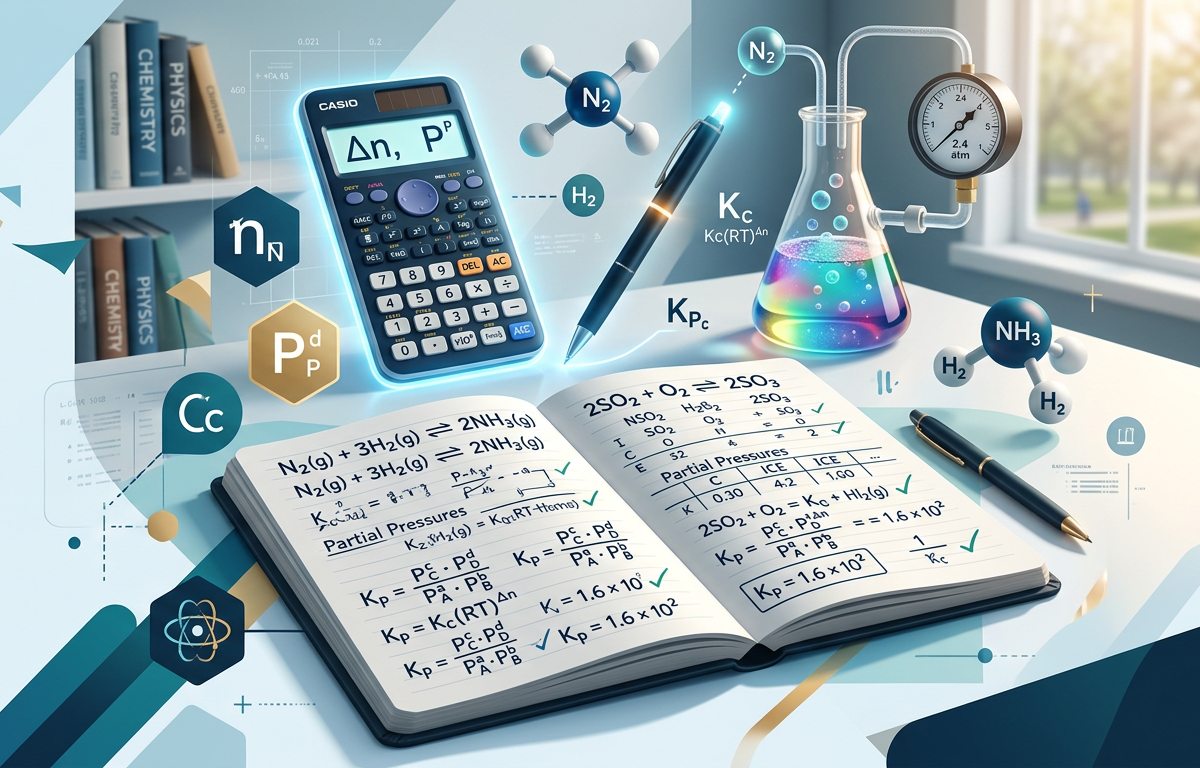
Kp Calculations Practice Questions with Answers
Mastering Kp calculations is essential for any student of chemical thermodynamics and equilibrium. While concentration-based equilibrium constants (Kc) are common, gaseous systems often require the use of partial pressures to describe the state of a reaction at equilibrium. This guide provides a deep dive into the theory, formulas, and practical application of pressure-based equilibrium constants to help you excel in your chemistry studies.
Concept Explanation
The equilibrium constant Kp is a numerical value that describes the ratio of product partial pressures to reactant partial pressures for a reversible chemical reaction at a specific temperature. Unlike Kc, which uses molar concentrations, Kp is specifically designed for reactions involving gases. According to Dalton's Law of Partial Pressures, the total pressure of a gas mixture is the sum of the individual partial pressures of each component gas.
For a general gas-phase reaction: aA(g) + bB(g) ⇌ cC(g) + dD(g), the expression for Kp is written as:
Kp = (PCc × PDd) / (PAa × PBb)
Key points to remember about Kp include:
Units: Kp is technically dimensionless when calculated using activities, but in many introductory courses, it may carry units of pressure (atm, kPa, bar) depending on the change in moles of gas (Δn).
Exclusions: Only gaseous species are included in the Kp expression. Pure solids and liquids are omitted because their concentrations and effective pressures do not change significantly during the reaction.
Temperature Dependence: The value of Kp changes only with temperature, as described by the van 't Hoff equation.
Relationship to Kc: Kp and Kc are related by the equation Kp = Kc(RT)Δn, where R is the ideal gas constant (0.0821 L·atm/mol·K), T is the absolute temperature in Kelvin, and Δn is the change in moles of gas (moles of gaseous products - moles of gaseous reactants).
When solving these problems, you might also need to apply concepts from Ka and Kb calculations if you are dealing with acid-base equilibria in different phases, or relate energy changes using enthalpy change practice questions to understand how temperature shifts the equilibrium position.
Solved Examples
The following examples demonstrate how to set up and solve Kp problems using stoichiometric ratios and the equilibrium constant expression.
Example 1: Calculating Kp from Equilibrium Pressures
Consider the reaction: N2(g) + 3H2(g) ⇌ 2NH3(g). At equilibrium and a specific temperature, the partial pressures are P(N2) = 0.50 atm, P(H2) = 0.20 atm, and P(NH3) = 0.15 atm. Calculate Kp.
Write the Kp expression: Kp = (PNH3)2 / [(PN2) × (PH2)3].
Substitute the given values: Kp = (0.15)2 / [(0.50) × (0.20)3].
Perform the calculation: Kp = 0.0225 / (0.50 × 0.008) = 0.0225 / 0.004.
Final Answer: Kp = 5.625.
Example 2: Finding Equilibrium Pressure using Kp
For the reaction PCl5(g) ⇌ PCl3(g) + Cl2(g), Kp = 1.05 at 250°C. If the equilibrium partial pressures of PCl5 and PCl3 are 0.875 atm and 0.450 atm respectively, find the partial pressure of Cl2.
Write the Kp expression: Kp = (PPCl3 × PCl2) / PPCl5.
Rearrange for PCl2: PCl2 = (Kp × PPCl5) / PPCl3.
Substitute values: PCl2 = (1.05 × 0.875) / 0.450.
Calculate: PCl2 = 0.91875 / 0.450 = 2.04 atm.
Example 3: Converting Kc to Kp
The reaction 2SO2(g) + O2(g) ⇌ 2SO3(g) has a Kc of 280 at 1000 K. Calculate Kp at this temperature.
Identify Δn: Δn = (moles of gaseous products) - (moles of gaseous reactants) = 2 - (2 + 1) = -1.
Use the conversion formula: Kp = Kc(RT)Δn.
Substitute values (R = 0.0821 L·atm/mol·K): Kp = 280 × (0.0821 × 1000)-1.
Calculate: Kp = 280 × (82.1)-1 = 280 / 82.1 = 3.41.
Practice Questions
Test your understanding with these Kp calculations practice questions. They range from simple plug-and-chug problems to more complex ICE table scenarios.
The reaction H2(g) + I2(g) ⇌ 2HI(g) reaches equilibrium with partial pressures of P(H2) = 0.25 atm, P(I2) = 0.15 atm, and P(HI) = 1.20 atm. Calculate Kp.
For the decomposition of calcium carbonate: CaCO3(s) ⇌ CaO(s) + CO2(g), the equilibrium pressure of CO2 is 0.236 atm at 800°C. What is the Kp for this reaction?
In the reaction 2NO(g) + Cl2(g) ⇌ 2NOCl(g), the equilibrium pressures are P(NO) = 0.10 atm, P(Cl2) = 0.30 atm, and P(NOCl) = 1.5 atm. Calculate Kp.
Want unlimited practice questions like these?
Generate AI-powered questions with step-by-step solutions on any topic.
Try Question Generator Free →At 500 K, the reaction N2O4(g) ⇌ 2NO2(g) has Kp = 0.48. If the equilibrium pressure of N2O4 is 0.12 atm, what is the equilibrium pressure of NO2?
The Kc for the reaction CO(g) + H2O(g) ⇌ CO2(g) + H2(g) is 5.10 at 800 K. What is the value of Kp at this temperature?
A flask is filled with HI at a pressure of 1.00 atm. At equilibrium, the pressure of HI has decreased to 0.78 atm due to the reaction 2HI(g) ⇌ H2(g) + I2(g). Calculate Kp.
For the reaction 2C(s) + O2(g) ⇌ 2CO(g), the Kp is 1.45 × 10⁵ at a certain temperature. If the partial pressure of CO is 2.0 atm, what is the partial pressure of O2?
Calculate the Kc for the reaction N2(g) + 3H2(g) ⇌ 2NH3(g) at 400 K if Kp = 4.3 × 10⁻⁴.
In a 10.0 L container at 1000 K, the reaction C(s) + H2O(g) ⇌ CO(g) + H2(g) reaches equilibrium. If the total pressure is 5.0 atm and the partial pressure of H2O is 1.5 atm, calculate Kp.
At a high temperature, Kp = 64 for the reaction H2(g) + I2(g) ⇌ 2HI(g). If a mixture starts with 2.0 atm of H2 and 2.0 atm of I2, what is the equilibrium partial pressure of HI?
Answers & Explanations
Answer: 38.4
Kp = (PHI)2 / (PH2 × PI2) = (1.20)2 / (0.25 × 0.15) = 1.44 / 0.0375 = 38.4.Answer: 0.236
For heterogeneous equilibria, solids are excluded. Kp = PCO2. Therefore, Kp = 0.236.Answer: 750
Kp = (PNOCl)2 / [(PNO)2 × PCl2] = (1.5)2 / [(0.10)2 × 0.30] = 2.25 / (0.01 × 0.30) = 2.25 / 0.003 = 750.Answer: 0.24 atm
Kp = (PNO2)2 / PN2O4 → 0.48 = (PNO2)2 / 0.12. (PNO2)2 = 0.0576. Taking the square root gives PNO2 = 0.24 atm.Answer: 5.10
In this reaction, Δn = (1+1) - (1+1) = 0. Since Kp = Kc(RT)0 and anything to the power of 0 is 1, Kp = Kc.Answer: 0.0198
Initial P(HI) = 1.00. Equilibrium P(HI) = 0.78. Change = -0.22. Based on stoichiometry, P(H2) and P(I2) each increase by 0.11 (half of 0.22). Kp = (0.11 × 0.11) / (0.78)2 = 0.0121 / 0.6084 ≈ 0.0198.Answer: 2.76 × 10⁻⁵ atm
Kp = (PCO)2 / PO2. Rearranging: PO2 = (PCO)2 / Kp = (2.0)2 / (1.45 × 10⁵) = 4 / 145000 = 2.76 × 10⁻⁵.Answer: 0.46
Kp = Kc(RT)Δn. Here Δn = 2 - 4 = -2. 4.3 × 10-4 = Kc(0.0821 × 400)-2. Kc = 4.3 × 10-4 × (32.84)2 = 4.3 × 10-4 × 1078.46 ≈ 0.46.Answer: 4.08
Total Pressure = P(H2O) + P(CO) + P(H2). 5.0 = 1.5 + P(CO) + P(H2). Since stoichiometry is 1:1 for products, P(CO) = P(H2) = (5.0 - 1.5)/2 = 1.75 atm. Kp = (1.75 × 1.75) / 1.5 = 2.04. (Correction: Check stoichiometry, 1.75*1.75/1.5 = 2.04).Answer: 3.2 atm
Let change be x. Kp = (2x)2 / (2.0-x)2 = 64. Take square root: 2x / (2.0-x) = 8. Solve for x: 2x = 16 - 8x → 10x = 16 → x = 1.6. Equilibrium P(HI) = 2x = 3.2 atm.
1. Which of the following states of matter is NEVER included in a Kp expression?
Frequently Asked Questions
What is the difference between Kc and Kp?
Kc is the equilibrium constant expressed in terms of molar concentrations (mol/L), while Kp is expressed in terms of the partial pressures of gaseous reactants and products. They are related through the ideal gas law and depend on the change in the number of moles of gas in the reaction.
Can Kp be used for reactions involving liquids?
No, Kp is specifically defined for gaseous species because it uses partial pressures. If a reaction involves liquids or solids along with gases, only the gaseous species are included in the Kp expression, while others are omitted.
Why does Kp only change with temperature?
Kp is a thermodynamic constant linked to the standard Gibbs free energy change of a reaction. Since the standard state is defined at a specific pressure, only a change in temperature can alter the ratio of products to reactants at equilibrium for a given system.
What does a very large Kp value indicate?
A very large Kp value (much greater than 1) indicates that at equilibrium, the partial pressures of the products are much higher than those of the reactants. This means the reaction proceeds nearly to completion under the given conditions.
How do you calculate Δn for the Kp/Kc conversion?
To calculate Δn, subtract the sum of the stoichiometric coefficients of the gaseous reactants from the sum of the stoichiometric coefficients of the gaseous products. Make sure to ignore any species that are in the solid or liquid phase.
Is Kp affected by a change in total pressure?
According to Le Chatelier's Principle, a change in total pressure may shift the equilibrium position, but the value of the Kp constant itself remains unchanged as long as the temperature is constant. The system adjusts the partial pressures of individual gases to maintain the same Kp ratio.
Want unlimited practice questions like these?
Generate AI-powered questions with step-by-step solutions on any topic.
Try Question Generator Free →
Want unlimited practice questions like these?
Generate AI-powered questions with step-by-step solutions on any topic.
Try Question Generator Free →Enjoyed this article?
Share it with others who might find it helpful.
Related Articles
Hard Le Chatelier’s Principle Practice Questions
Master Hard Le Chatelier’s Principle Practice Questions with our comprehensive guide featuring solved examples, practice problems, and detailed explanations.
Mar 30, 2026

Hard Reaction Quotient (Q) Practice Questions
Hard Reaction Quotient (Q) Practice Questions
Mar 30, 2026
Grams to Moles Practice Questions with Answers
Master grams to moles conversions with our comprehensive guide. Includes step-by-step examples, practice questions, and detailed answers for chemistry students.
Mar 26, 2026
Avogadro’s Number Practice Questions with Answers
Master the mole concept with our Avogadro’s Number practice questions. Includes step-by-step solved examples, a quick quiz, and detailed explanations.
Mar 26, 2026

Empirical Formulas: Solving Ratios from Mass and Percent Data
Master empirical formula calculations with 10 practice questions, worked answers, and a free step-by-step calculator for mass, percentage, and combustion problems.
Mar 26, 2026