Why Your Brain Deletes Data and How to Fix the Ebbinghaus Decay

Imagine spending four hours Sunday night memorizing the anatomy of the heart, only to stare at a blank diagram on Tuesday morning unable to recall the difference between the mitral and tricuspid valves. This frustrating vacuum is not a sign of low intelligence but a result of the Ebbinghaus R = e^(-t/S) formula in action. Within just twenty-four hours, the average human brain discards up to 70 percent of new, unreinforced data. This aggressive biological pruning happens because your hippocampus treats isolated facts like temporary browser cache rather than permanent hard drive storage.
The mistake most students make is treating memory like a bucket that stays full once poured. In reality, memory is a leaky sieve by design. Hermann Ebbinghaus proved this by testing his recall of thousands of nonsense syllables, discovering that retention drops exponentially almost the moment learning stops. To bypass this, you must move beyond simple re-reading and focus on strengthening the stability of the memory trace. By understanding the specific math of decay, you can time your reviews to hit right before the cliff-edge of total loss, effectively tricking your brain into marking academic data as essential for survival.
What Is the Forgetting Curve? Definition and Origin
The forgetting curve is a visual representation of how information slips out of the human mind over time if there is no attempt to retain it. It demonstrates that memory retention declines most sharply immediately after a learning event. Within the first 24 hours, humans typically lose up to 70% of new information unless they actively engage with the material.
This concept originated with Hermann Ebbinghaus, a German psychologist who pioneered the experimental study of memory in 1885. Ebbinghaus didn't just speculate; he turned himself into a laboratory. He memorized thousands of "nonsense syllables"—three-letter combinations like "WID" or "ZOF"—to ensure his existing knowledge didn't bias the results. His findings revealed a consistent, exponential decay in retention.
Why do our brains do this? From an evolutionary perspective, forgetting is a survival mechanism. Our ancestors didn't need to remember every leaf they saw on a tree; they needed to remember which berries were poisonous. The brain "prunes" data that seems irrelevant to keep our processing power focused on what matters for survival. Forgetting is essentially a form of biological disk cleanup.
The Math Behind the Curve
Ebbinghaus expressed the relationship between memory and time through a formula: R = e^(-t/S). In this equation, R represents retention, S is the strength of the memory, and t is time. The takeaway is simple but devastating: without intervention, the "half-life" of a new memory is incredibly short. This is why following the ultimate evidence-based guide to effective studying is critical for anyone trying to bypass these natural limitations.
The Mechanics of Memory: How We Encode and Lose Information
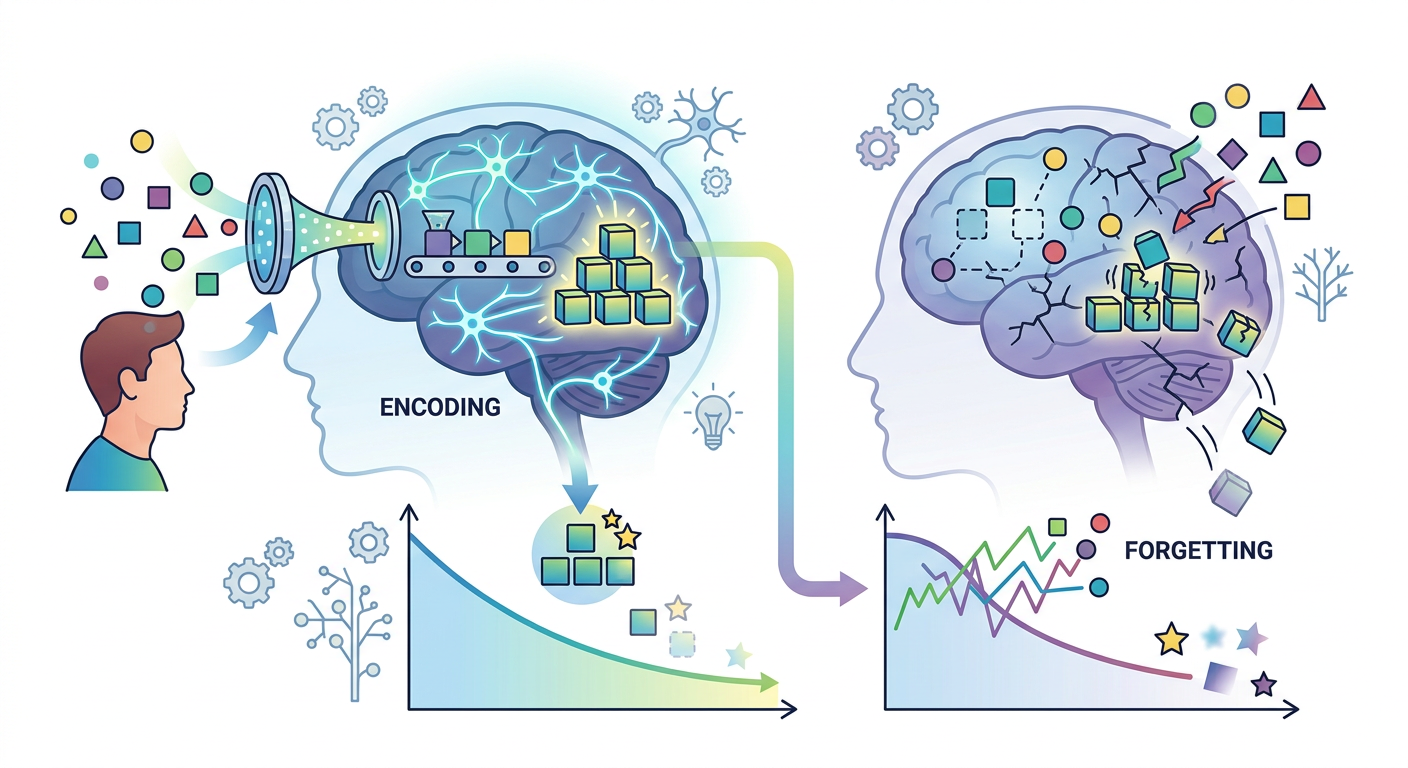
The Mechanics of Memory: How We Encode and Lose Information
Memory loss occurs because the brain is a dynamic organ that prioritizes efficiency over total recall. When you encounter new information, your hippocampus processes it before eventually "uploading" it to the cerebral cortex for long-term storage. However, this transfer process is fragile. If the neural pathways aren't reinforced, the physical traces of that memory, known as engrams, simply fade away.
Information decay often happens through Interference Theory. Proactive interference occurs when your old memories prevent you from learning new things, while retroactive interference happens when new information wipes out old data. Think of it like a crowded whiteboard; if you keep writing without erasing, the messages eventually overlap until nothing is legible. This is a common hurdle mentioned in the ultimate study guide for college students, where heavy workloads often lead to information overlap.
The "Use It or Lose It" principle of neuroplasticity dictates that neurons that fire together, wire together. When you stop using a specific piece of information, the synaptic connections weaken. Your brain assumes the data is no longer useful for your environment and reallocates those resources. This biological pruning ensures that you don't suffer from "system lag" caused by storing every meaningless detail of your commute or grocery list.
Factors That Influence the Rate of Forgetting
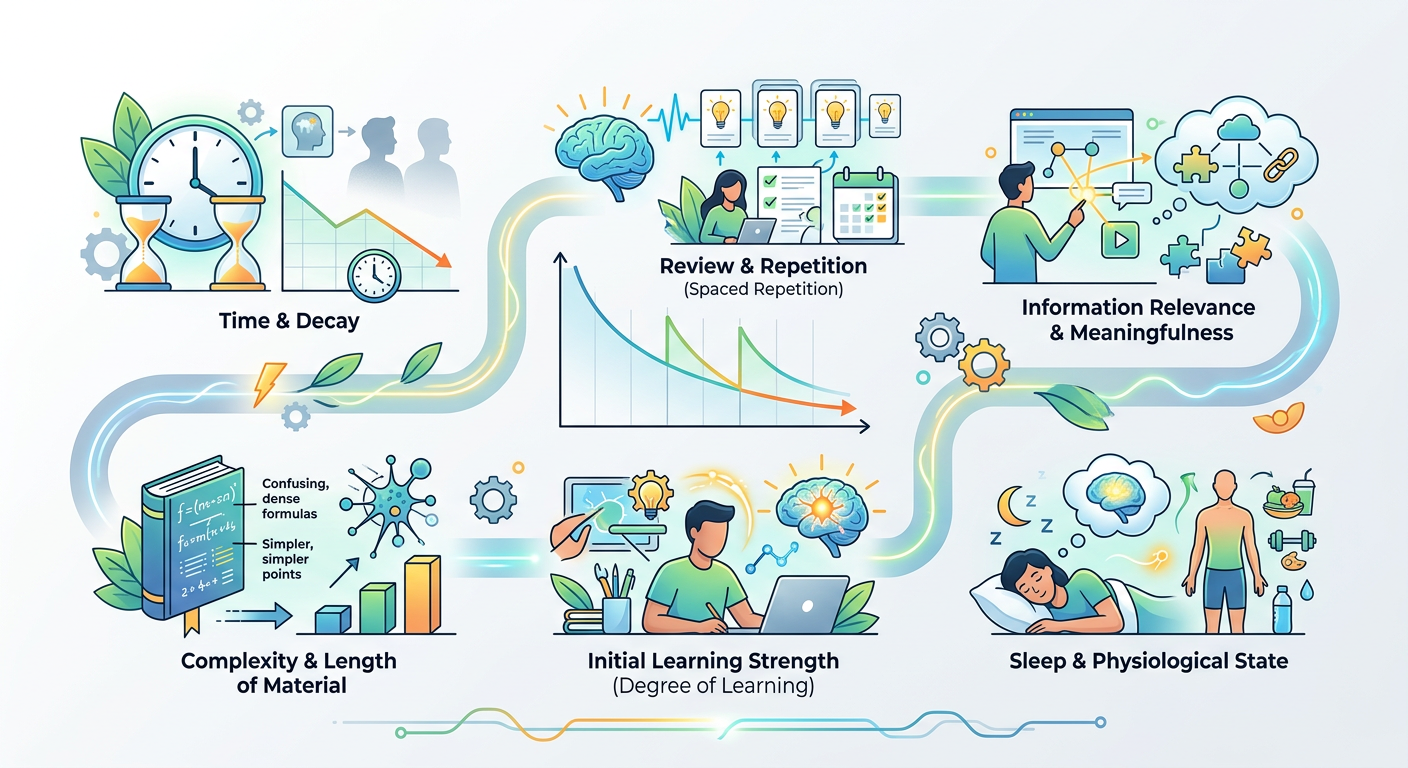
Factors That Influence the Rate of Forgetting
Retention is not a fixed constant; it varies based on the quality of the information and your physical state. Meaningfulness is the most significant factor. You will remember a complex medical procedure much better if you understand the underlying anatomy than if you merely try to memorize a list of 20 abstract steps. Context provides the "hooks" that help a memory stick to the walls of your mind.
Clarity also dictates how fast the forgetting curve takes its toll. Material that is presented poorly or lacks logical structure is discarded faster by the brain. This is why AI in education is becoming so transformative; it allows for the personalization of content clarity to match an individual's specific learning level.
Psychological factors like stress and fatigue play a massive role in information decay. When you are stressed, your body releases cortisol, which can physically shrink the hippocampus over time and disrupt memory encoding. Furthermore, sleep is the period when memory consolidation happens. If you skip sleep to study, you are essentially pouring water into a bucket with a massive hole in the bottom.
The Power of Spaced Repetition: Flattening the Curve
Spaced repetition is the most effective tactical antidote to the forgetting curve. Instead of reviewing information once or twice in a short window (cramming), you review it at increasing intervals. You might review a concept 10 minutes after learning it, then 24 hours later, then a week later, and eventually a month later. Each review "resets" the curve, making the subsequent rate of decay much shallower.
The Leitner System is a classic physical application of this theory. You use five boxes for your flashcards. Every time you get a card right, it moves to the next box (and is reviewed less frequently). Every time you get one wrong, it goes back to Box 1. This forces you to spend more time on the difficult material and less on what you already know, maximizing efficiency.
Why does this work? It exploits the "Spacing Effect." Research documented by the American Psychological Association shows that the brain learns more effectively when it has to work to retrieve a memory just as it is about to be forgotten. This "desirable difficulty" signals to the brain that the information is high priority, prompting it to build more durable neural connections.
Active Recall vs. Passive Review: Which Wins?
Passive review such as reading your notes, highlighting textbooks, or re-watching lectures is largely a waste of time. It creates an "illusion of competence." You feel like you know the material because it looks familiar, but your brain hasn't actually practiced the act of retrieving that information from scratch. Passive review does almost nothing to stop the forgetting curve.
Active recall is the process of forcing your brain to retrieve information without looking at the source. This could involve flashcards, taking a practice quiz, or using the "Feynman Technique" (explaining a concept to someone else in simple terms). When you struggle to remember a fact, you are literally strengthening the path to that memory. This is a core pillar of the complete test preparation guide for high-performing students.
The "Testing Effect" proves that taking a test is actually a more powerful learning tool than studying for the same amount of time. Every time you use active recall, you "update" the memory and make it more resistant to future decay. If you want to master a topic, stop reading and start quizzing yourself.
Practical Strategies to Improve Memory Retention
Beyond spaced repetition, you can use mnemonic devices to make abstract data more memorable. The "Method of Loci" (or Memory Palace) involves visualizing a familiar building and "placing" pieces of information in specific rooms. Because humans have excellent spatial memory, "walking" through this mental house makes it nearly impossible to forget the items you've stored there.
In a professional setting, microlearning is the best way to combat information overload. Instead of attending an eight-hour seminar once a year, employees should engage in five-minute learning bursts daily. This keeps the forgetting curve flat and ensures that training actually translates into long-term skill development. Mastering these habits is a key component of the complete student productivity blueprint.
Finally, never underestimate the power of sleep. During the REM and deep sleep cycles, your brain "replays" the events of the day and moves them into permanent storage. Without adequate rest, your brain simply cannot perform the physical maintenance required to keep memories intact. High-quality retention is as much about what you do in bed as what you do at your desk.
The Future of Memory Science: Digital Brains and AI
Artificial Intelligence is fundamentally changing how we interact with the forgetting curve. Modern learning platforms now use customized algorithms to track exactly when an individual student is likely to forget a specific fact. This allows for "just-in-time" learning, where the system prompts you to review a concept at the precise moment of maximum cognitive benefit. Universities are already seeing results from this as detailed in our guide to AI for higher education.
However, we are also entering an era of "Digital Amnesia." Because we know Google can provide any fact in seconds, our brains are becoming less likely to store the information itself and more likely to store the location of the information. This is known as the "Google Effect." While this makes us efficient researchers, it can weaken our baseline knowledge and ability to think critically without an internet connection.
In the coming years, the goal won't be to memorize everything, but to use AI to curate what is truly worth internalizing. By combining human neurobiology with machine-learning precision, we can finally stop fighting against our brain's tendency to forget and start working with it.
Frequently Asked Questions
What is the average rate of forgetting?
Most people forget approximately 50% of new information within one hour of learning it. By the end of 24 hours, that number often jumps to 70%, and after a week, retention can drop as low as 10-20% without review.
Can the forgetting curve be reversed?
While you cannot "stop" the biological process of forgetting, you can "reset" the curve. Every time you review material using active recall, the retention percentage jumps back to 100%, and the subsequent slope of the curve becomes flatter.
How does spaced repetition impact the forgetting curve?
Spaced repetition systematically interrupts the forgetting process. By reviewing material just as you are about to forget it, you strengthen the neural pathway, making the memory more stable and significantly slowing down the decay rate over time.
Does the forgetting curve apply to all types of memory?
The curve primarily applies to declarative memory (facts and figures). It is less aggressive for procedural memory (skills like riding a bike) or highly emotional memories, which are encoded more deeply in the brain from the start.
Who discovered the forgetting curve?
Hermann Ebbinghaus, a German psychologist, discovered the curve in 1885. He published his findings in a landmark book titled Memory: A Contribution to Experimental Psychology, which remains a cornerstone of learning science.
How do emotions affect the forgetting curve?
Strong emotions trigger the release of adrenaline and dopamine, which act as "save buttons" for the brain. This is why you can remember a traumatic event or a joyful wedding in vivid detail decades later, while you forget a grocery list in minutes.
Start Learning Smarter Today
Join thousands of students using AI-powered study tools to achieve better results.
Get Started FreeEnjoyed this article?
Share it with others who might find it helpful.
Related Articles

How to Solve Molarity Problems: Step-by-Step Mastery
Learn how to solve molarity problems step-by-step with formulas, unit tips, and worked examples so you can calculate concentration with confidence.
Mar 26, 2026
Avoid These 7 Common Molarity Mistakes in Chemistry
Master chemistry calculations! Avoid common molarity mistakes with our expert guide on unit conversions, dilution errors, and proper lab techniques.
Mar 26, 2026
What Is Molarity? The Complete Guide to Molar Concentration
Master molarity with our complete guide. Learn the formula, step-by-step calculations, and the critical differences between molarity and molality.
Mar 26, 2026
Why Molarity Matters: Converting Mass to Moles for Lab Solutions
Master chemistry with our guide to the molarity formula. Learn how to calculate concentration with step-by-step examples, units, and practical lab tips.
Mar 26, 2026
Molarity vs Molality: The Essential Difference Explained
Master the difference between molarity vs molality. Learn the formulas, key differences, and when to use each in this comprehensive chemistry guide.
Mar 26, 2026