Medium Kp Calculations Practice Questions

Concept Explanation
Kp is the equilibrium constant for a chemical reaction involving gases, expressed in terms of the partial pressures of the reactants and products rather than their molar concentrations. While Kc relies on molarity, Kp uses the pressure exerted by each gas species, which is directly proportional to its concentration according to the Ideal Gas Law (PV = nRT). For a general reaction aA(g) + bB(g) ⇌ cC(g) + dD(g), the expression is Kp = (PCc × PDd) / (PAa × PBb).
To master Kp calculations, you must understand Dalton’s Law of Partial Pressures, which states that the total pressure of a mixture is the sum of the individual partial pressures. You also need to be comfortable with mole fractions, where the partial pressure of a gas (Pi) equals the mole fraction of that gas (Xi) multiplied by the total pressure (Ptotal). Just as in Ka and Kb calculations, setting up an ICE (Initial, Change, Equilibrium) table is the standard method for solving these problems. Remember that Kp is temperature-dependent and only includes species in the gaseous state; solids and liquids are omitted from the expression.
Solved Examples
Below are fully worked examples demonstrating how to navigate common Kp problems involving stoichiometry and partial pressures.
Calculating Kp from Equilibrium Pressures: Consider the reaction 2SO2(g) + O2(g) ⇌ 2SO3(g). At equilibrium, the partial pressures are P(SO2) = 0.20 atm, P(O2) = 0.15 atm, and P(SO3) = 0.45 atm. Calculate Kp.
Write the Kp expression: Kp = (PSO3)2 / [(PSO2)2 × (PO2)].
Substitute the values: Kp = (0.45)2 / [(0.20)2 × 0.15].
Calculate the numerator: 0.2025.
Calculate the denominator: 0.04 × 0.15 = 0.006.
Final result: Kp = 33.75.
Finding Equilibrium Pressure from Kp: For the reaction N2O4(g) ⇌ 2NO2(g), Kp = 0.113 at 298 K. If the initial pressure of N2O4 is 0.500 atm, find the equilibrium pressure of NO2.
Set up ICE table: Initial [N2O4] = 0.500; Initial [NO2] = 0. Change: -x for N2O4, +2x for NO2.
Equilibrium: P(N2O4) = 0.500 - x; P(NO2) = 2x.
Kp expression: 0.113 = (2x)2 / (0.500 - x).
Rearrange to quadratic: 4x2 + 0.113x - 0.0565 = 0.
Solve for x using the quadratic formula: x ≈ 0.106.
Equilibrium P(NO2) = 2(0.106) = 0.212 atm.
Converting Kc to Kp: The reaction H2(g) + I2(g) ⇌ 2HI(g) has a Kc of 54.3 at 430 °C. Calculate Kp.
Use the formula Kp = Kc(RT)Δn.
Calculate Δn: (moles of gas products) - (moles of gas reactants) = 2 - (1 + 1) = 0.
Since Δn = 0, Kp = Kc(RT)0.
Kp = 54.3 × 1 = 54.3.
Practice Questions
1. For the reaction PCl5(g) ⇌ PCl3(g) + Cl2(g), the Kp is 1.05 at 250 °C. If a vessel starts with 2.00 atm of PCl5, what is the equilibrium partial pressure of Cl2?
2. Ammonia is synthesized via N2(g) + 3H2(g) ⇌ 2NH3(g). At a specific temperature, the equilibrium partial pressures are P(N2) = 0.35 atm, P(H2) = 0.55 atm, and P(NH3) = 0.15 atm. Calculate Kp.
3. In the reaction C(s) + CO2(g) ⇌ 2CO(g), the total pressure at equilibrium is 4.50 atm. If the partial pressure of CO2 is 1.25 atm, calculate Kp. (Hint: Solids are excluded).
Want unlimited practice questions like these?
Generate AI-powered questions with step-by-step solutions on any topic.
Try Question Generator Free →4. The decomposition of phosgene, COCl2(g) ⇌ CO(g) + Cl2(g), has Kp = 0.041 at 450 K. If the initial pressure of COCl2 is 1.50 atm, find the fraction of COCl2 that decomposes.
5. If Kc for 2NO(g) + O2(g) ⇌ 2NO2(g) is 1.5 × 10³ at 400 K, calculate Kp using R = 0.0821 L·atm/(mol·K).
6. Consider 2HBr(g) ⇌ H2(g) + Br2(g). If you start with 5.0 atm of HBr and at equilibrium the partial pressure of H2 is 0.45 atm, what is the Kp value?
7. A mixture of 1.00 atm of NO and 1.00 atm of Cl2 reacts to form NOCl according to 2NO(g) + Cl2(g) ⇌ 2NOCl(g). At equilibrium, the partial pressure of NOCl is 0.64 atm. Calculate Kp.
8. For the reaction NH4HS(s) ⇌ NH3(g) + H2S(g), the total pressure at equilibrium is 0.660 atm at 25 °C. Calculate Kp.
9. At 500 K, the Kp for the reaction N2(g) + 3H2(g) ⇌ 2NH3(g) is 1.45 × 10⁻⁵. If the equilibrium pressures of H2 and NH3 are 0.928 atm and 0.012 atm respectively, find the equilibrium pressure of N2.
10. The reaction 2A(g) ⇌ B(g) + 3C(g) starts with A at 2.0 atm. At equilibrium, the total pressure is 3.2 atm. Calculate Kp.
Answers & Explanations
Answer: 1.02 atm. Setup: Kp = x2 / (2.00 - x) = 1.05. Using quadratic: x2 + 1.05x - 2.10 = 0. Solving for x (Cl2 pressure) gives 1.02 atm.
Answer: 0.387. Kp = (0.15)2 / [(0.35) × (0.55)3] = 0.0225 / [0.35 × 0.166] = 0.0225 / 0.0581 = 0.387.
Answer: 8.45. P(CO) = Ptotal - P(CO2) = 4.50 - 1.25 = 3.25 atm. Kp = (PCO)2 / PCO2 = (3.25)2 / 1.25 = 10.56 / 1.25 = 8.45.
Answer: 0.11 (or 11%). Kp = x2 / (1.50 - x) = 0.041. x2 + 0.041x - 0.0615 = 0. x ≈ 0.228. Fraction = 0.228 / 1.50 = 0.15. (Note: Calculation check: 0.2282/1.272 ≈ 0.041).
Answer: 45.7. Δn = 2 - (2+1) = -1. Kp = Kc(RT)-1 = 1500 / (0.0821 × 400) = 1500 / 32.84 = 45.7.
Answer: 0.012. ICE: HBr = 5.0 - 2x; H2 = x; Br2 = x. Since x = 0.45, HBr = 5.0 - 0.9 = 4.1. Kp = (0.45 × 0.45) / (4.1)2 = 0.2025 / 16.81 = 0.012.
Answer: 1.76. NO = 1.00 - 0.64 = 0.36; Cl2 = 1.00 - 0.32 = 0.68. Kp = (0.64)2 / [(0.36)2 × 0.68] = 0.4096 / [0.1296 × 0.68] = 0.4096 / 0.088 = 4.65.
Answer: 0.109. Since NH3 and H2S are produced in a 1:1 ratio, P(NH3) = P(H2S) = 0.660 / 2 = 0.330 atm. Kp = 0.330 × 0.330 = 0.1089.
Answer: 12.4 atm. 1.45 × 10-5 = (0.012)2 / [P(N2) × (0.928)3]. P(N2) = 0.000144 / [1.45 × 10-5 × 0.799] = 12.4.
Answer: 1.08. Let 2x be the change in A. Ptotal = (2.0 - 2x) + x + 3x = 2.0 + 2x = 3.2. So 2x = 1.2, x = 0.6. P(A) = 0.8, P(B) = 0.6, P(C) = 1.8. Kp = (0.6 × 1.83) / 0.82 = 3.4992 / 0.64 = 5.47.
1. Which of the following is NOT included in a Kp expression?
Frequently Asked Questions
What is the difference between Kp and Kc?
Kp is the equilibrium constant calculated using the partial pressures of gases, whereas Kc is calculated using molar concentrations. They are related by the equation Kp = Kc(RT)Δn, where Δn is the change in moles of gas.
Can Kp be used for aqueous solutions?
No, Kp is specifically designed for reactions involving gases because it relies on partial pressures. For aqueous reactions, you should use Kc or other equilibrium constants like those found in pKa and pKb calculations.
Why are solids and liquids excluded from Kp?
The activity of pure solids and liquids is considered to be 1 because their concentrations and "pressures" do not change significantly during a reaction. Including them would not affect the ratio of products to reactants in the equilibrium expression.
Does Kp change with temperature?
Yes, Kp is a temperature-dependent constant. According to Le Chatelier's Principle and the van 't Hoff equation, the value of Kp will shift as temperature changes depending on whether the reaction is endothermic or exothermic.
What does a very large Kp value indicate?
A very large Kp (much greater than 1) indicates that at equilibrium, the partial pressures of the products are much higher than those of the reactants. This means the reaction proceeds nearly to completion, favoring product formation.
Want unlimited practice questions like these?
Generate AI-powered questions with step-by-step solutions on any topic.
Try Question Generator Free →
Want unlimited practice questions like these?
Generate AI-powered questions with step-by-step solutions on any topic.
Try Question Generator Free →Enjoyed this article?
Share it with others who might find it helpful.
Related Articles
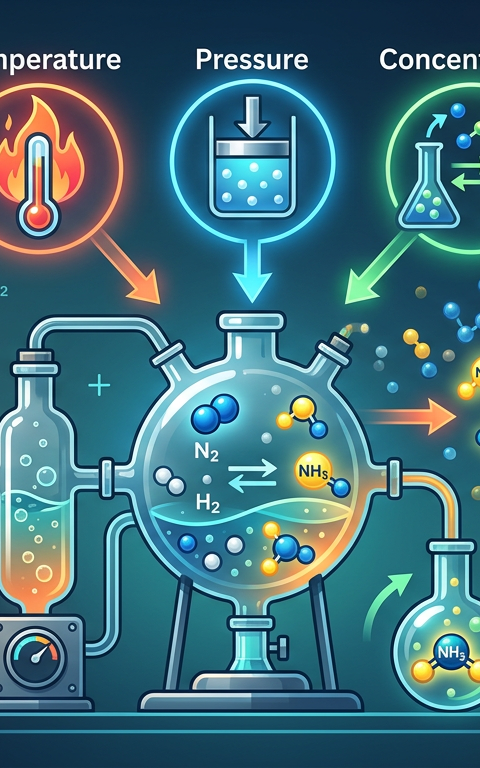
Hard Le Chatelier’s Principle Practice Questions
Master Hard Le Chatelier’s Principle Practice Questions with our comprehensive guide featuring solved examples, practice problems, and detailed explanations.
Mar 30, 2026

Hard Reaction Quotient (Q) Practice Questions
Hard Reaction Quotient (Q) Practice Questions
Mar 30, 2026
Grams to Moles Practice Questions with Answers
Master grams to moles conversions with our comprehensive guide. Includes step-by-step examples, practice questions, and detailed answers for chemistry students.
Mar 26, 2026
Avogadro’s Number Practice Questions with Answers
Master the mole concept with our Avogadro’s Number practice questions. Includes step-by-step solved examples, a quick quiz, and detailed explanations.
Mar 26, 2026

Empirical Formulas: Solving Ratios from Mass and Percent Data
Master empirical formula calculations with 10 practice questions, worked answers, and a free step-by-step calculator for mass, percentage, and combustion problems.
Mar 26, 2026