Easy Enthalpy Change Practice Questions
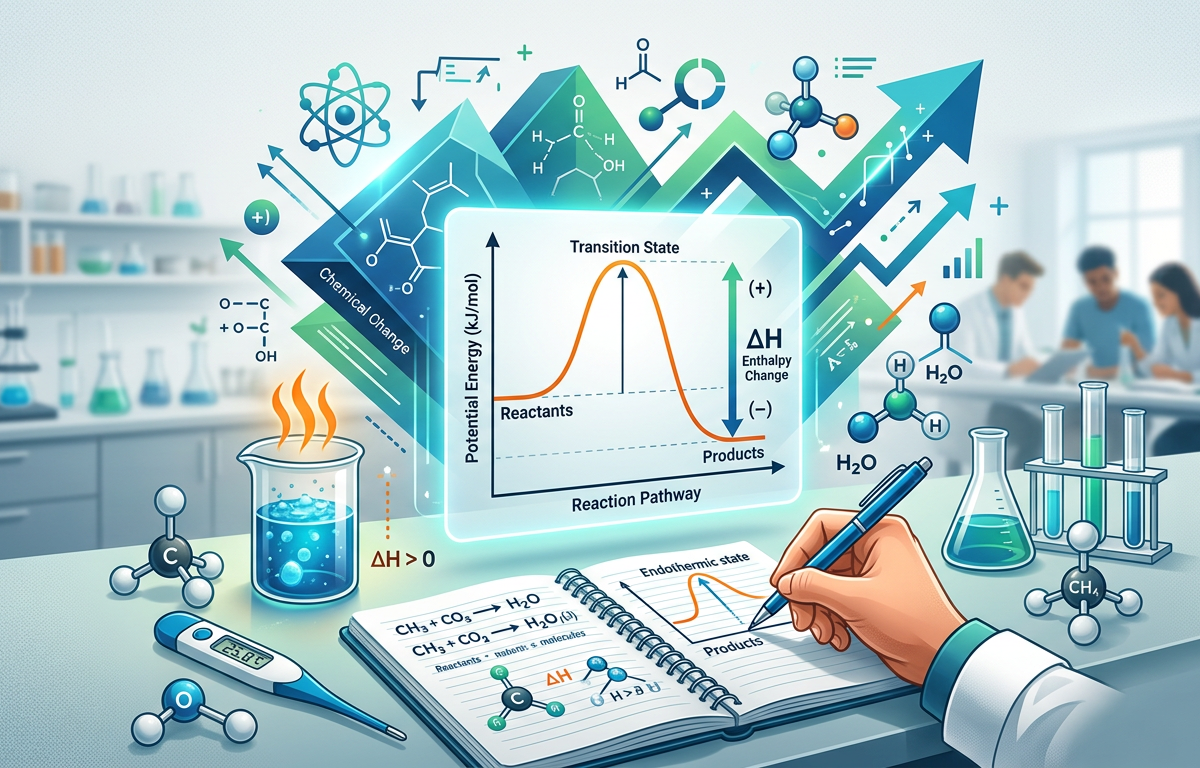
Understanding thermodynamics starts with mastering the concept of energy flow during chemical reactions. These Easy Enthalpy Change Practice Questions are designed to help you grasp how heat is absorbed or released when substances interact. Whether you are prepping for a high school chemistry quiz or a college introductory course, getting comfortable with the fundamental calculations of enthalpy is a critical first step.
Concept Explanation
Enthalpy change (ΔH) is the amount of heat energy absorbed or released by a system during a chemical reaction at constant pressure. This thermodynamic property is a state function, meaning it depends only on the initial and final states of the system, not the path taken to get there. Physically, it represents the difference between the energy required to break bonds in the reactants and the energy released when new bonds form in the products. You can find more detailed examples in our Bond Energy Practice Questions guide.
When a reaction occurs, the enthalpy change can be categorized into two main types:
Exothermic Reactions: These reactions release heat to the surroundings. In these cases, the products have less chemical potential energy than the reactants, resulting in a negative ΔH value (ΔH < 0). A common example is the combustion of methane in a kitchen stove.
Endothermic Reactions: These reactions absorb heat from the surroundings. The products possess more chemical potential energy than the reactants, resulting in a positive ΔH value (ΔH > 0). An example is the process of photosynthesis or the melting of ice.
Standard enthalpy changes are typically measured under standard conditions: a pressure of 100 kPa (1 bar) and a temperature of 298 K (25°C). According to the International Union of Pure and Applied Chemistry (IUPAC), these standard states ensure consistency across scientific data. To calculate the total heat change in a laboratory setting, scientists often use calorimetry practice questions to relate temperature changes to energy units (Joules).
Solved Examples
Below are three fully worked examples to demonstrate how to identify and calculate basic enthalpy changes.
Identifying Reaction Type: A reaction has an enthalpy of reactants equal to 150 kJ and an enthalpy of products equal to 90 kJ. Calculate the ΔH and determine if it is exothermic or endothermic.
Use the formula: ΔH = H(products) - H(reactants).
Substitute the values: ΔH = 90 kJ - 150 kJ.
ΔH = -60 kJ. Since the value is negative, the reaction is exothermic.
Calculating Energy Released: The combustion of 1 mole of propane releases 2220 kJ of heat. How much heat is released when 0.5 moles of propane are burned?
Identify the molar enthalpy: ΔH = -2220 kJ/mol.
Multiply by the number of moles: Heat = 0.5 mol × (-2220 kJ/mol).
Result: 1110 kJ of heat is released.
Using Standard Enthalpies of Formation: Calculate the ΔH for a reaction where the sum of ΔHf of products is -400 kJ and the sum of ΔHf of reactants is -250 kJ.
Apply the equation: ΔH = ΣΔHf(products) - ΣΔHf(reactants).
Substitute: ΔH = (-400 kJ) - (-250 kJ).
Calculate: ΔH = -400 + 250 = -150 kJ.
Practice Questions
Test your understanding with these introductory problems. Refer back to the Heat of Reaction Practice Questions if you need a refresher on the terminology.
1. If a chemical system absorbs 125 kJ of heat from the surroundings at constant pressure, what is the value of ΔH for the process?
2. A reaction has a ΔH of +45 kJ/mol. If 2 moles of reactant react completely, what is the total enthalpy change?
3. Carbon reacts with oxygen to form carbon dioxide, releasing 393.5 kJ of energy per mole of CO₂ formed. Write the ΔH value for this reaction with the correct sign.
Want unlimited practice questions like these?
Generate AI-powered questions with step-by-step solutions on any topic.
Try Question Generator Free →4. In an experiment, the temperature of the surrounding water increases when a salt dissolves. Is the enthalpy change of the salt dissolving process positive or negative?
5. Calculate the enthalpy change for a reaction where the products have an internal energy of 500 kJ and the reactants have an internal energy of 750 kJ.
6. Define the term "standard state" as used in enthalpy calculations according to Wikipedia's thermodynamic standards.
7. If the ΔH for the evaporation of water is +44 kJ/mol, how much energy is required to evaporate 3 moles of water?
8. Which has a higher enthalpy in an endothermic reaction: the reactants or the products?
9. A specific reaction releases 50 kJ of heat. Is this reaction endothermic or exothermic?
10. If the enthalpy of the reactants is -100 kJ and the enthalpy of the products is -150 kJ, what is the ΔH?
Answers & Explanations
+125 kJ: Since the system absorbs heat, the process is endothermic, and ΔH is positive.
+90 kJ: Multiply the molar enthalpy by the number of moles (45 kJ/mol × 2 mol = 90 kJ).
-393.5 kJ: Because energy is released, the reaction is exothermic, requiring a negative sign.
Negative: If the surroundings (water) get hotter, the system released heat, making it an exothermic process (ΔH < 0).
-250 kJ: ΔH = Products - Reactants = 500 kJ - 750 kJ = -250 kJ.
Standard State: This refers to a pure substance at 1 bar of pressure and a specified temperature (usually 298.15 K).
132 kJ: 44 kJ/mol × 3 mol = 132 kJ.
Products: In endothermic reactions, energy is absorbed, so the products end up with more energy than the reactants.
Exothermic: Any reaction that releases heat to the surroundings is classified as exothermic.
-50 kJ: ΔH = (-150 kJ) - (-100 kJ) = -150 + 100 = -50 kJ.
1. Which of the following indicates an exothermic reaction?
Frequently Asked Questions
What is the difference between enthalpy and heat?
Enthalpy is a property of a system that includes internal energy and the product of pressure and volume, while heat is the energy transferred between a system and its surroundings due to a temperature difference. At constant pressure, the change in enthalpy is equal to the heat exchanged.
Why is enthalpy change negative for exothermic reactions?
Enthalpy change is negative because the system loses energy to the surroundings, meaning the final energy state of the products is lower than the initial energy state of the reactants. This loss of internal chemical potential energy is expressed as a negative value in thermodynamic equations.
Can ΔH be measured directly?
No, absolute enthalpy cannot be measured directly; only the change in enthalpy (ΔH) can be determined by measuring temperature changes during a reaction. Scientists use tools like calorimeters to track these energy transfers accurately.
How does stoichiometry affect enthalpy change?
Enthalpy change is an extensive property, meaning it is directly proportional to the amount of substance reacting. If you double the coefficients in a balanced chemical equation, you must also double the value of ΔH for that reaction.
What are standard conditions for enthalpy?
Standard conditions refer to a pressure of 1 bar (100 kPa) and a specified temperature, usually 25°C (298.15 K), with substances in their most stable physical states. These conditions allow chemists to compare the energy changes of different reactions on a consistent scale.
Is melting ice endothermic or exothermic?
Melting ice is an endothermic process because the ice must absorb heat from its surroundings to break the hydrogen bonds holding the water molecules in a solid lattice. Consequently, the enthalpy change for melting (fusion) is positive.
Want unlimited practice questions like these?
Generate AI-powered questions with step-by-step solutions on any topic.
Try Question Generator Free →
Want unlimited practice questions like these?
Generate AI-powered questions with step-by-step solutions on any topic.
Try Question Generator Free →Enjoyed this article?
Share it with others who might find it helpful.
Related Articles
Hard Le Chatelier’s Principle Practice Questions
Master Hard Le Chatelier’s Principle Practice Questions with our comprehensive guide featuring solved examples, practice problems, and detailed explanations.
Mar 30, 2026

Hard Reaction Quotient (Q) Practice Questions
Hard Reaction Quotient (Q) Practice Questions
Mar 30, 2026
Grams to Moles Practice Questions with Answers
Master grams to moles conversions with our comprehensive guide. Includes step-by-step examples, practice questions, and detailed answers for chemistry students.
Mar 26, 2026
Avogadro’s Number Practice Questions with Answers
Master the mole concept with our Avogadro’s Number practice questions. Includes step-by-step solved examples, a quick quiz, and detailed explanations.
Mar 26, 2026

Empirical Formulas: Solving Ratios from Mass and Percent Data
Master empirical formula calculations with 10 practice questions, worked answers, and a free step-by-step calculator for mass, percentage, and combustion problems.
Mar 26, 2026