Why Molarity Ratios Fail: Solving the Moles per Liter Logic Gap

Imagine you weigh out 58.44 grams of sodium chloride and dissolve it in enough water to reach exactly one liter. You have created a 1.0 M solution, yet most students see this as a math problem rather than a physical reality. The breakdown usually happens the moment you are asked to pour out 250 milliliters and calculate how many particles are in that specific sample. The brain tends to treat M as a fixed unit like a gram, forgetting that it is a ratio that scales with volume. If you treat molarity as a label instead of a relationship, you will inevitably fail when the problem shifts to dilutions or titration stoichiometry.
The primary cognitive trap is the invisible conversion. A student might correctly identify the formula n = CV, but they often struggle to visualize why 0.5 moles of a substance looks identical to 2.0 moles when both are dissolved in clear liquid. This disconnect between the macroscopic volume you see in a graduated cylinder and the microscopic moles calculated on paper is where most chemistry grades begin to slip. To fix this, you must stop memorizing the triangle formula and start treating the mole as a tangible count of particles hidden within the solvent.
This struggle often stems from the transition between macroscopic measurements—like grams measured on a digital scale—and the microscopic world of moles. It is the fundamental "language" of quantitative chemistry. If you cannot speak this language, every subsequent topic, from stoichiometry to acid-base equilibrium, feels like an uphill battle. Educators often call molarity a "gateway concept" because mastering it determines whether a student survives the first semester of college-level science.
The Molarity Hurdle: Why This Concept Trips Up Chemistry Students
Molarity difficulties arise primarily because the concept requires a student to juggle three distinct variables simultaneously: moles of solute, liters of solution, and the resulting concentration. Most high school curricula rush through the definition of a mole to reach chemical reactions quickly. This speed leaves a conceptual gap where students treat M as a static number rather than a dynamic ratio.
Think of molarity as the "density" of chemical potential within a liquid. In practical settings, we don't count individual atoms; we measure volumes of liquids. The International System of Units (SI) defines the mole as a specific amount of substance, but in a beaker, that substance is dissolved and invisible. This invisibility is exactly why so many students struggle to grasp the physical reality of the numbers they calculate.
Furthermore, the jump from mass to moles requires an intermediate step involving the periodic table. If a student makes a single error in calculating molar mass, the entire molarity calculation fails. This cascading effect creates a sense of frustration that many label as a "difficulty with chemistry," when it is actually a difficulty with sequential multi-step logic. To build a stronger foundation, many students benefit from revisiting Mole Concept Practice Questions with Answers to ensure their base-level understanding is rock solid.
The Psychological and Cognitive Barriers to Learning Molarity
The human brain is not naturally wired to comprehend numbers as large as 6.022 x 10^23. When we ask a student to calculate the molarity of a solution, we are asking them to perform abstract mental gymnastics. This "scaling problem" sits at the heart of many molarity difficulties. Because the mole is a counting unit for things we cannot see, students often default to "plug-and-chug" math without understanding the underlying chemistry.
Instructional pace contributes significantly to this cognitive overload. In a typical semester, students move from basic atomic structure to complex solution chemistry in just a few weeks. When you combine the math of ratios with the requirement of scientific notation and unit conversions, the brain's working memory reaches its limit. This is especially true for those dealing with "math anxiety," where the sight of a fraction (mol/L) triggers a freeze response before the chemistry logic even starts.
To overcome this, learners must see the mole not as a mysterious scientific constant, but as a simple "chemist's dozen." Just as a dozen eggs is 12, a mole is just a very large group. When students use moles to grams practice questions, they begin to see the mole as a tangible tool rather than a theoretical obstacle. Repeated exposure through spaced repetition can help move these concepts from short-term struggle to long-term mastery.
Master Molarity with Bevinzey
Overcome chemistry hurdles with AI-powered practice tailored to your weak spots.
Get Started FreeCommon Pitfalls: Where Students Usually Go Wrong
The most frequent error in molarity calculations is the "Total Volume Trap." Molarity is defined as moles of solute per liter of solution, not per liter of solvent. If you add 100mL of salt to 1000mL of water, the final volume is not exactly 1000mL. Students who ignore the displacement caused by the solute end up with incorrect concentration values in a laboratory setting.
The "Unit Conversion Crisis" is another primary driver of molarity difficulties. Most lab glassware, like graduated cylinders and pipettes, measures in milliliters (mL). However, the molarity formula strictly requires liters (L). A student who forgets to divide by 1,000 will be off by three orders of magnitude—a mistake that results in a 1000% error. This is a common theme explored in Molarity Practice Questions with Answers, where unit consistency is constantly tested.
Distinguishing between similar terms is also a hurdle. Consider these nuances:
- Solute: The substance being dissolved (e.g., sugar).
- Solvent: The liquid doing the dissolving (e.g., water).
- Solution: The combination of both.
- Molarity (M) vs. Molality (m): Molarity uses liters of solution; molality uses kilograms of solvent.
Many students find themselves stuck on hard molarity practice questions because they fail to identify which mass belongs to the solute and which belongs to the solution. Accurate calculation of molar mass from the periodic table is the final technical hurdle. One wrong digit in the atomic mass of Oxygen can derail a complex stoichiometry problem.
The Mathematical Foundation: Algebra and Ratios
Mastering molarity requires a comfort level with basic algebraic rearrangement. The formula M = n / V (where M is molarity, n is moles, and V is volume in liters) is a three-way relationship. To solve for moles, you must use n = M x V. To solve for volume, you use V = n / M. If a student struggles with these basic shifts, the chemistry becomes secondary to the math problem.
Dimensional analysis, often called the factor-label method, is the most effective "secret weapon" for overcoming molarity difficulties. Instead of memorizing three different formulas, students can treat units like numbers that cancel out. For example, multiplying Liters by (Moles/Liter) leaves you with Moles. This logical flow prevents the common mistake of multiplying when you should be dividing.
According to the National Center for Education Statistics, students who utilize procedural frameworks like dimensional analysis perform significantly better on standardized science assessments. This technique is especially useful when transitioning into stoichiometry word practice questions, where molarity is just one step in a much longer chain of calculations.
How to Fix It: Proven Strategies for Educators and Students
To fix molarity difficulties, we must move from abstract numbers to visual models. Educators should use "Particle View" diagrams, where a 1.0 M solution is drawn with twice as many dots as a 0.5 M solution in the same sized box. Visualizing the "crowdedness" of the particles helps students realize that molarity is a measure of concentration, regardless of the container's size.
The 5-Step Method for solving any molarity problem is a reliable framework: 1. Identify the given values (Mass, Volume, Molarity). 2. Convert all units to Moles and Liters. 3. Calculate the Molar Mass of the solute. 4. Set up the dimensional analysis string. 5. Solve and check if the magnitude of the answer makes sense.
Real-world analogies also provide clarity. Ask a student: "If you have a cup of sweet tea and pour half into another cup, is the new cup less sweet?" Most will correctly answer "No." This helps them understand that molarity is an intensive property—it doesn't change based on the amount of liquid you have, provided the mixture is uniform. For those just starting, practicing with easy molarity practice questions allows them to build this intuition before adding complexity.
Advanced Concepts: Dilutions and Stoichiometry Integration
Once the basics are mastered, students encounter the dilution equation: M1V1 = M2V2. While this is a powerful tool, it often leads to a new set of molarity difficulties when students try to apply it to reaction stoichiometry where it doesn't belong. The dilution equation only applies when the number of moles remains constant while the volume changes—like adding water to concentrated orange juice.
In chemical reactions, molarity becomes a conversion factor. If you know the molarity and the volume, you can find the moles of a reactant and then use mole ratio practice questions to find the amount of product. This is the core of acid-base titration practice questions, where a solution of known concentration is used to determine an unknown one.
Advanced students must also consider ion concentration. When 1 mole of Calcium Chloride (CaCl2) dissolves, it produces 1 mole of Ca2+ ions but 2 moles of Cl- ions. Failing to account for this dissociation is a frequent error in high-level chemistry exams. Understanding these nuances is the difference between a passing grade and a deep mastery of the subject, often tested in medium molarity practice questions.
Technology and Tools to Support Learning
Modern students have access to interactive simulations that weren't available a decade ago. Tools like the PhET Interactive Simulations from the University of Colorado Boulder allow students to virtually add solute to a beaker and watch the molarity value change in real-time. This immediate feedback loop is crucial for overcoming conceptual molarity difficulties.
Furthermore, digital platforms can help students refine their problem-solving techniques. Using active recall studying techniques alongside these digital tools ensures that the information sticks. Whether it is watching a Tyler DeWitt video on YouTube or using spreadsheet modeling to graph concentration changes, the integration of visual and mathematical data is the fastest way to achieve fluency in chemistry.
Crush Your Next Chemistry Exam
Stop struggling with chemical calculations. Bevinzey uses advanced AI to create personalized study plans that turn your "molarity difficulties" into academic strengths.
Get Started FreeFrequently Asked Questions
Why is molarity harder to learn than mass percentage?
Molarity is more complex because it involves the mole concept, which requires converting between mass and the number of particles. Mass percentage only requires the masses of the individual parts, making it a simpler ratio of "like units" compared to the "unlike units" (mol/L) of molarity.
What is the easiest way to remember the molarity formula?
The "Molarity Triangle" is a popular visual aid. Draw a triangle divided into three parts: put Moles (n) at the top, and Molarity (M) and Volume (V) at the bottom. Cover the variable you need to find to see how to arrange the others.
Can you have a molarity higher than 1?
Yes. Many laboratory-grade acids are highly concentrated. For example, concentrated Hydrochloric acid (HCl) is approximately 12 M, and concentrated Sulfuric acid (H2SO4) can be as high as 18 M.
How do you convert between molarity and molality?
To convert between the two, you must know the density of the solution. This allows you to convert the volume of the solution into mass, which can then be used to isolate the mass of the solvent needed for molality calculations.
What are the most common units used in molarity calculations?
While the standard unit for molarity is moles per liter (mol/L), students often start with grams (mass) and milliliters (volume). These must consistently be converted to moles and liters respectively before finalizing the molarity calculation.
Enjoyed this article?
Share it with others who might find it helpful.
Related Articles
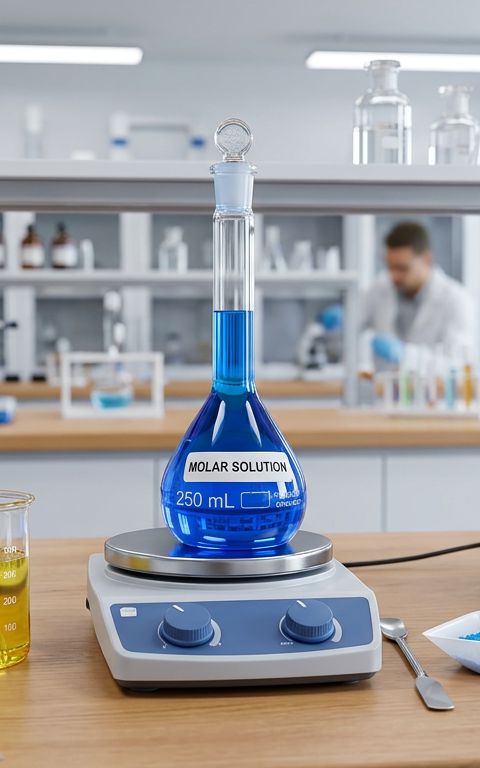
Why Molarity Matters: Converting Mass to Moles for Lab Solutions
Master chemistry with our guide to the molarity formula. Learn how to calculate concentration with step-by-step examples, units, and practical lab tips.
Mar 26, 2026

Avoid These 7 Common Molarity Mistakes in Chemistry
Master chemistry calculations! Avoid common molarity mistakes with our expert guide on unit conversions, dilution errors, and proper lab techniques.
Mar 26, 2026

Solving High-Stakes IV Titrations and Weight-Based Infusions
Master advanced IV flow rate calculations with these hard practice questions. Covers weight-based dosing, titrations, and dimensional analysis for nurses.
May 17, 2026

Solving Weight-Based Dosing: The 2.2 Conversion and Rounding Logic
Weight-Based Dosage Calculations Practice Questions with Answers
May 17, 2026
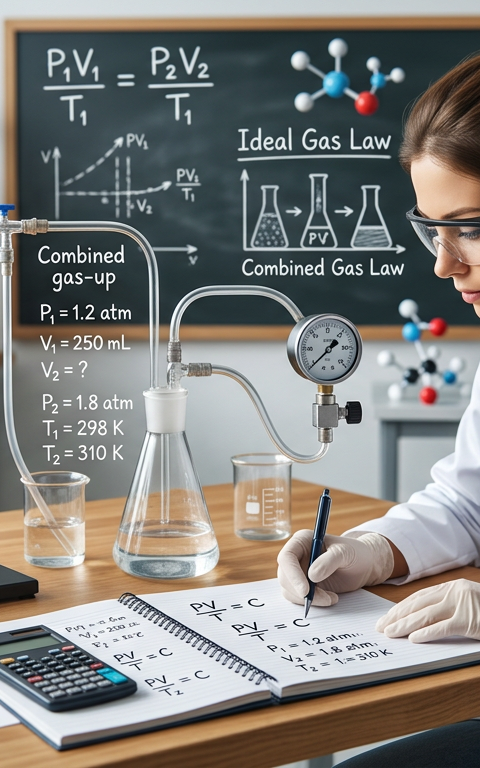
Solving Combined Gas Law Problems: Managing Three Changing Variables
Master the Combined Gas Law with this comprehensive guide featuring clear explanations, step-by-step solved examples, and 10 practice questions with answers.
Apr 2, 2026
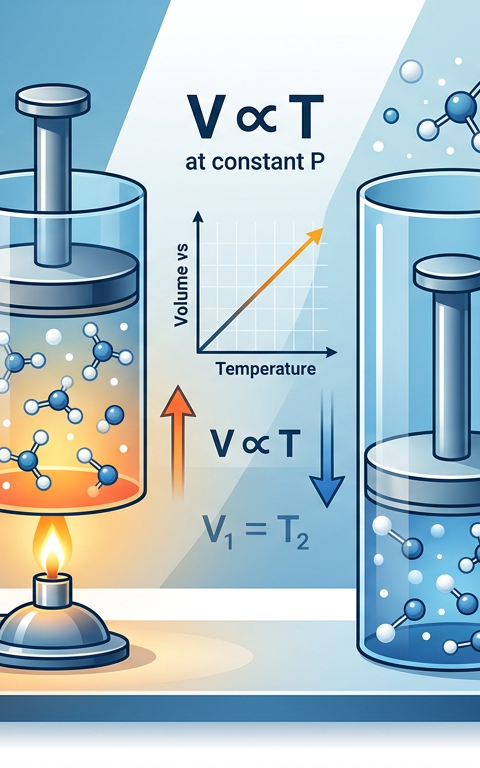
Solving Charles’s Law: Avoiding the Celsius Temperature Trap
Master Charles’s Law with our comprehensive guide featuring solved examples, practice questions, and step-by-step explanations for chemistry students.
Apr 2, 2026

Solving PV=nRT: Why Units and Constants Trip Up Every Student
Master the Ideal Gas Law with these easy practice questions. Includes step-by-step solved examples, unit conversion tips, and a quick quiz to test your skills.
Apr 2, 2026
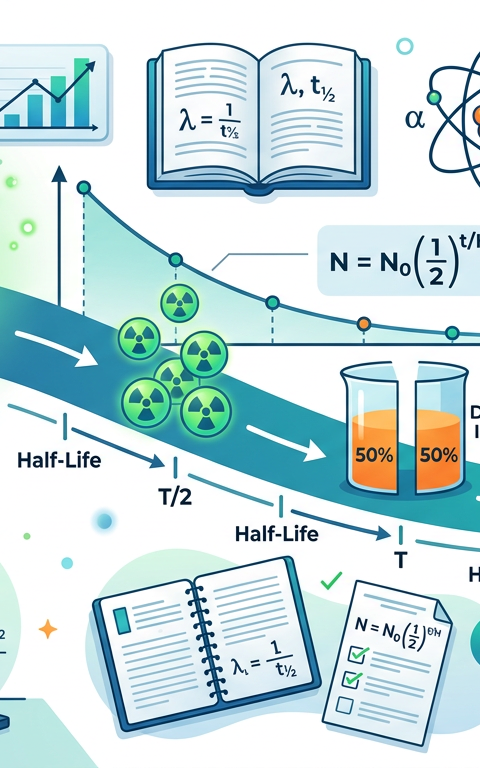
Predicting Radioactive Decay: Solving for Mass and Time Intervals
Master half-life calculations with our comprehensive guide featuring step-by-step solved examples, practice questions, and detailed answers for students.
Apr 2, 2026