Spaced Repetition: The Complete Guide (SM-2 Explained)

Spaced repetition systems represent the most significant leap in learning technology since the invention of the printing press. Instead of fighting against the natural tendency of the human brain to forget, these systems leverage mathematical algorithms to schedule reviews at the precise moment a memory is about to fade.
Most students spend hundreds of hours rereading textbooks only to forget 80% of the material within a week. This "leaky bucket" problem is the primary cause of academic burnout and exam anxiety. By using Harvard Medical School principles of cognitive load, we can identify that the issue isn't the student's intelligence, but rather the inefficiency of the study method.
If you want to move beyond short-term "cramming" and build a permanent library of knowledge, you must understand the underlying science of memory. This guide breaks down the mechanics of the SM-2 algorithm and how you can apply these evidence-based techniques to your daily academic life.
What is Spaced Repetition? The Science of Permanent Memory
Spaced repetition systems are digital or manual tools designed to increase the intervals of time between subsequent reviews of previously learned material. Rather than studying a concept five times in one night, you study it five times over the course of several months. This technique exploits the "spacing effect," a psychological phenomenon where information is better encoded into long-term memory when sessions are spread out.
The foundation of this method lies in the work of Hermann Ebbinghaus, a German psychologist who pioneered the experimental study of memory. He famously mapped the Forgetting Curve, which illustrates how rapidly information slips from our minds after an initial learning event. Without intervention, the decline is exponential; you might lose half of what you learned within twenty-four hours.
How does the spacing effect counter this? Each time you successfully recall a piece of information, the rate of forgetting slows down. The "curve" flattens. By the fourth or fifth review, the interval until the next review might be years rather than days. This is the core engine behind effective studying.
Traditional "massed practice"—commonly known as cramming—is the opposite of this approach. While it may help you pass a test tomorrow morning, the knowledge disappears almost immediately afterward. For students in high-stakes fields like medicine or law, this temporary "fluency" is a dangerous illusion that fails when the professional stakes are highest.
The Mechanics of Memory: Active Recall vs. Passive Review
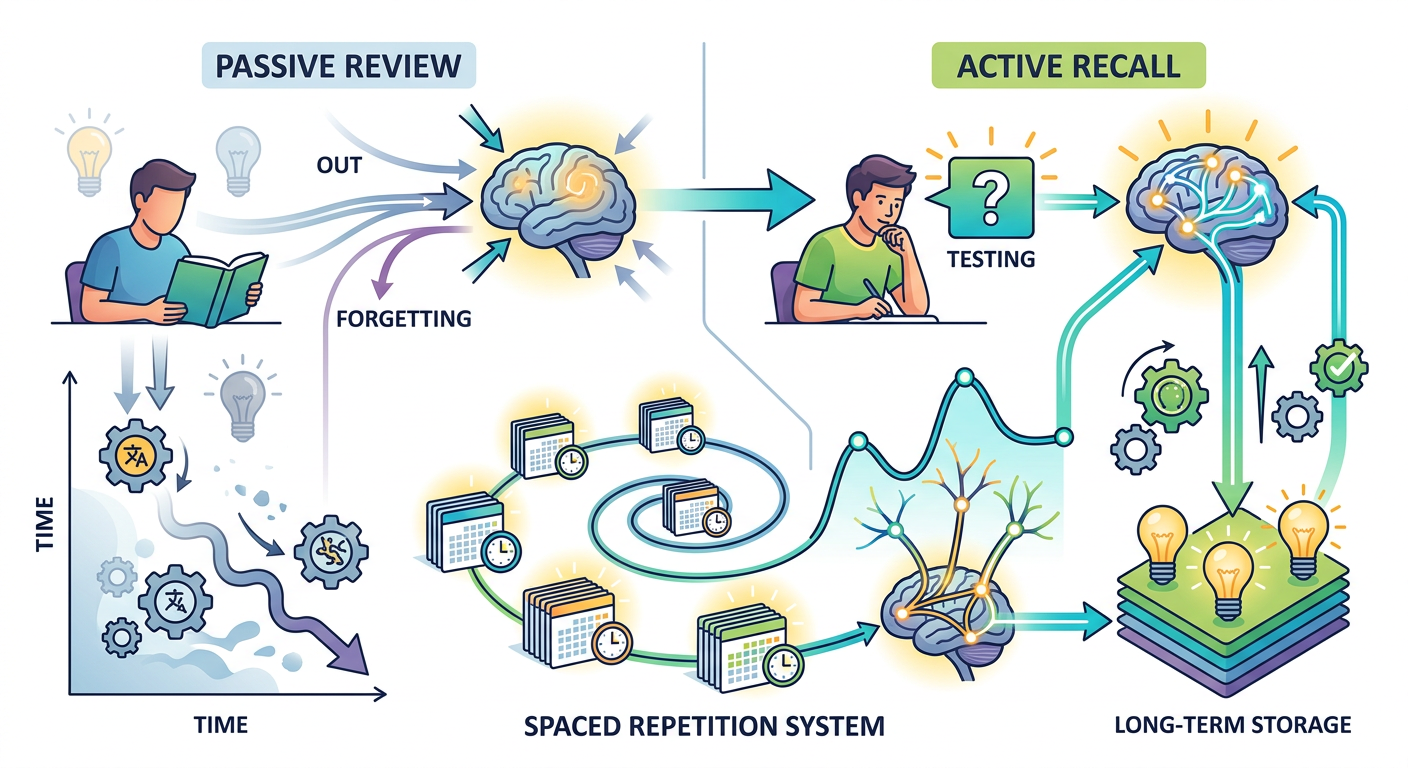
Active recall is the process of taxing your brain to retrieve a specific piece of information without looking at the answer. It is the fuel that makes spaced repetition systems function properly. Without active effort, you aren't actually strengthening neural pathways; you're simply recognizing familiar text.
Rereading, highlighting, and summarizing are often categorized as passive review. According to research cited by the American Psychological Association, these methods have low utility because they do not require "desirable difficulty." When a student rereads a chapter, they experience the "illusion of competence"—it feels easy because the information is right in front of them, not because they’ve mastered it.
Retrieval practice, on the other hand, mimics the conditions of an exam. Every time you struggle to remember a fact on a flashcard, your brain signals that this information is important. This is known as the "Testing Effect." By forcing the brain to reconstruct the memory, you are effectively "thickening" the neural connections associated with that fact.
For more on how to implement this, check out our Active Recall Studying Guide. It explains how to combine the "what" (recall) with the "when" (spaced repetition).
Master Your Exams with AI-Powered Recall
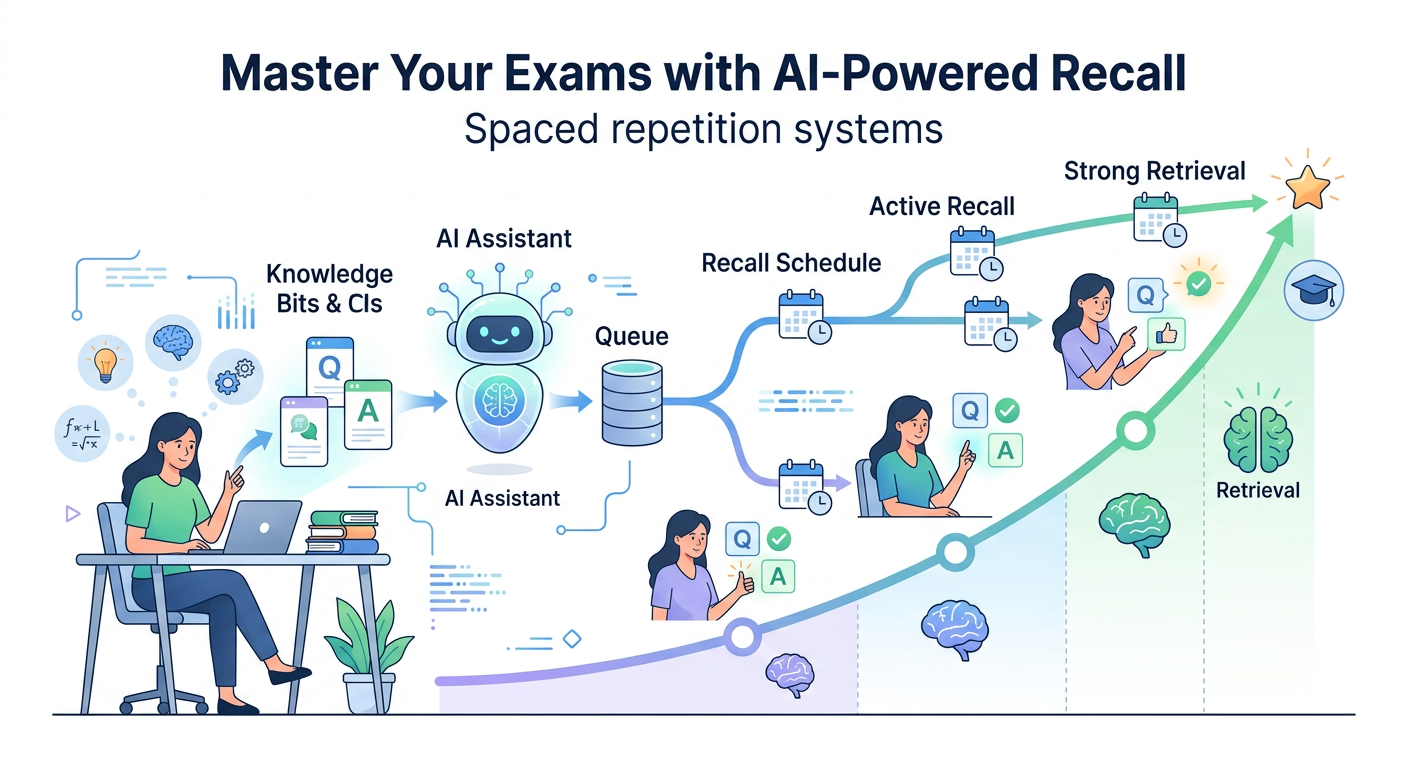
Stop wasting hours on passive reading. Use Bevinzey to generate high-quality active recall questions from your study materials in seconds.
Get Started FreeBreaking Down the SM-2 Algorithm: How It Works
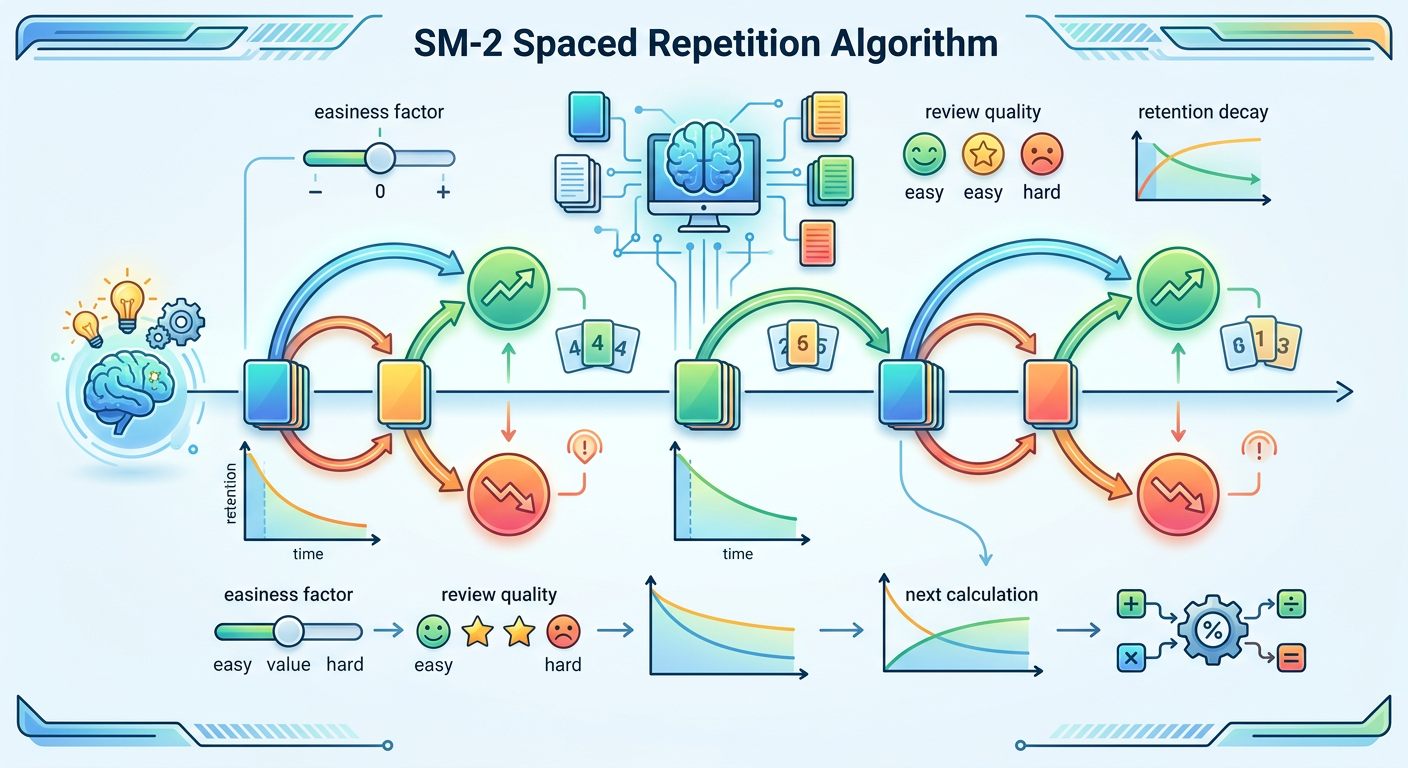
The SM-2 algorithm is the mathematical formula that powers the most popular spaced repetition systems used today. Developed by Piotr Woźniak in the late 1980s for his "SuperMemo" software, it revolutionized the way we quantify human memory. Woźniak wanted to find the exact point at which a user had a 90% chance of remembering a card.
The algorithm relies on three primary variables: the current interval, the repetition count, and the "Easiness Factor" (E-Factor). The E-Factor is a number (defaulting to 2.5) that represents how easy a card is to remember. Every time you review a card, you provide a score from 0 to 5. If you score it a "5" (perfect response), the E-Factor increases; if you struggle, it decreases.
The step-by-step logic works as follows:
- First Review (I=1): The card is seen today.
- Second Review (I=2): The card is seen 6 days later.
- Subsequent Reviews: The new interval is calculated by multiplying the previous interval by the current E-Factor.
Mathematically, the formula is I(n) = I(n-1) * EF. For example, if a card has an E-Factor of 2.5 and was last seen 10 days ago, the next review will be in 25 days. This geometric progression allows students to manage thousands of facts simultaneously without being overwhelmed by daily reviews. You can find more about the mathematical history of these systems at SuperMemo’s official documentation.
Why SM-2 is Still the Gold Standard for Modern Apps
Modern applications like Anki and RemNote still use modified versions of the SM-2 algorithm because it strikes a perfect balance between complexity and efficiency. While newer models like the Free Spaced Repetition Scheduler (FSRS) use advanced neural networks to predict forgetting, SM-2 remains highly robust for the average student. It is predictable, easy to implement, and backed by decades of data.
Anki, the powerhouse of the medical school community, popularized the SM-2 approach by allowing users to tweak the "starting ease" and "interval modifiers." This flexibility is vital because not all subjects are created equal. Memorizing Spanish vocabulary is cognitively different from memorizing complex anatomical structures or organic chemistry reactions.
Is SM-2 outdated? Not necessarily. While it might slightly over-schedule cards that are very easy, it errs on the side of caution. For a student following The Complete Test Preparation Guide, the marginal gains of a newer algorithm are often less important than the consistency of using any SRS daily.
How to Implement Spaced Repetition in Your Study Routine
To start using spaced repetition systems, you first need to select the right toolset. Anki is the most powerful and customizable, making it perfect for long-term mastery. Quizlet is more user-friendly but often relies on less sophisticated scheduling. If you prefer a "networked thought" approach, tools like RemNote or Logseq allow you to turn your notes directly into flashcards.
The "Atomic Rule" is your most important guideline: one card, one idea. If a flashcard asks for five different symptoms of a disease, you will likely remember three and forget two. If you mark that card as "correct," you are lying to the algorithm. Instead, split that information into five separate cards. This ensures that the algorithm can track your retention of each individual data point accurately.
Utilize "Cloze Deletions" for faster card creation. A cloze deletion is essentially a fill-in-the-blank card. For example: "The capital of France is {{c1::Paris}}." This is often more effective than standard front-and-back cards because it provides context. If you're feeling overwhelmed, remind yourself that the power of SRS comes from the "streak." Even reviewing 10 cards a day is better than doing 500 once a month.
Maintaining a daily review habit is the hardest part of the process. If you miss a few days, your "backlog" will grow, leading to what many call "Anki burnout." To avoid this, set a daily limit on new cards, but never limit your reviews. Reviews are the priority; they are the maintenance work that prevents your existing knowledge from decaying.
Advanced Strategies: Beyond Simple Flashcards
Can you use spaced repetition systems for subjects like math or physics? Yes, but the approach must change. Instead of memorizing a formula, you should use SRS to schedule practice problems. Create a card that presents a specific problem type on the front, and the step-by-step solution on the back. When the card appears, you must work out the problem on paper before checking the answer.
You can also blend SRS with the "Feynman Technique"—explaining a concept in simple terms. Your flashcard prompt might be: "Explain the Second Law of Thermodynamics to a five-year-old." This ensures you are testing your conceptual understanding rather than just your ability to recognize jargon. This is a key component of The Ultimate Study Guide for College Students.
Another powerful hybrid method is "Blurting." After the algorithm shows you a high-level topic, you write down everything you know about it on a blank sheet of paper. Then, you use your notes to see what you missed. This combines the "macro" view of a subject with the "micro" scheduling of spaced repetition.
In the evolving landscape of AI in education, we are seeing tools that can now automatically generate these advanced prompts. This reduces the friction of card creation, allowing you to focus entirely on the act of retrieval.
Common Pitfalls and How to Avoid Them
The most common mistake is the "Mindless Memorization Trap." If you create cards for information you don't actually understand, you are performing "rote memorization." This knowledge is brittle; it will crumble the moment a professor asks a question in a slightly different format. Always follow the rule: Understand first, memorize second.
Watch out for "Leeches." In SRS terminology, a leech is a card that you consistently get wrong. It consumes a disproportionate amount of your study time. If you’ve missed a card 10 times, the problem isn't your memory—it's the card. It's either too complex, too vague, or you lack the underlying fundamental knowledge to make it "stick." When you find a leech, delete it or rewrite it.
Finally, avoid "Card Density" issues. A card should never be a paragraph. It should be a punchy question that takes less than 10 seconds to answer. If your review sessions feel like a marathon of reading, you are doing it wrong. High-efficiency spaced repetition systems rely on rapid-fire retrieval of atomic facts.
As you scale your productivity, consider integrating these habits with a broader Student Productivity Blueprint to ensure you're balancing your health, focus, and academic goals.
Automate Your Spaced Repetition Today
Don't spend hours manual making cards. Bevinzey uses advanced AI to transform your notes into optimized spaced repetition decks instantly.
Get Started FreeFrequently Asked Questions
How does the SM-2 algorithm actually work?
The SM-2 algorithm calculates the ideal interval for your next review by multiplying the previous interval by an "Easiness Factor" (E-Factor). It starts with a 1-day interval, moves to 6 days, and then grows geometrically based on your self-reported difficulty score (0-5) for each card.
Is Anki better than Quizlet for spaced repetition?
For long-term retention, Anki is generally superior because it uses a more sophisticated SM-2-based algorithm. Quizlet is excellent for short-term familiarity and has a lower learning curve, but it lacks the deep customization and algorithmic precision required for complex subjects like medicine.
How many new cards should I study per day as a student?
A sustainable range for most students is 15 to 30 new cards per day. Remember that every new card you add today creates a series of future reviews. Adding 100 cards in a single day might feel productive now, but it will lead to an overwhelming review mountain two weeks later.
Can I use spaced repetition for subjects like math or coding?
Yes, though you should focus on "procedural" cards. Instead of memorizing definitions, use cards that prompt you to write a specific code snippet or solve a specific type of equation. This ensures you are practicing the application of the knowledge, not just the theory.
What is the 'forgetting curve' and why does it matter?
The forgetting curve is a mathematical representation of how information is lost over time when there is no attempt to retain it. It matters because it proves that memory is time-dependent; if you don't review information at specific intervals, you will inevitably lose it, regardless of how well you understood it initially.
How long does it take to see results from spaced repetition?
You will notice an increase in "fluency" within the first week, but the true power of SRS becomes apparent after 3-4 weeks. This is when the intervals begin to stretch into months, and you realize you still remember facts from the first day without having reviewed them dozens of times.
Enjoyed this article?
Share it with others who might find it helpful.
Related Articles

How to Solve Molarity Problems: Step-by-Step Mastery
Learn how to solve molarity problems step-by-step with formulas, unit tips, and worked examples so you can calculate concentration with confidence.
Mar 26, 2026

Avoid These 7 Common Molarity Mistakes in Chemistry
Master chemistry calculations! Avoid common molarity mistakes with our expert guide on unit conversions, dilution errors, and proper lab techniques.
Mar 26, 2026

What Is Molarity? The Complete Guide to Molar Concentration
Master molarity with our complete guide. Learn the formula, step-by-step calculations, and the critical differences between molarity and molality.
Mar 26, 2026

Why Molarity Matters: Converting Mass to Moles for Lab Solutions
Master chemistry with our guide to the molarity formula. Learn how to calculate concentration with step-by-step examples, units, and practical lab tips.
Mar 26, 2026

Molarity vs Molality: The Essential Difference Explained
Master the difference between molarity vs molality. Learn the formulas, key differences, and when to use each in this comprehensive chemistry guide.
Mar 26, 2026