Molarity Practice Questions with Answers
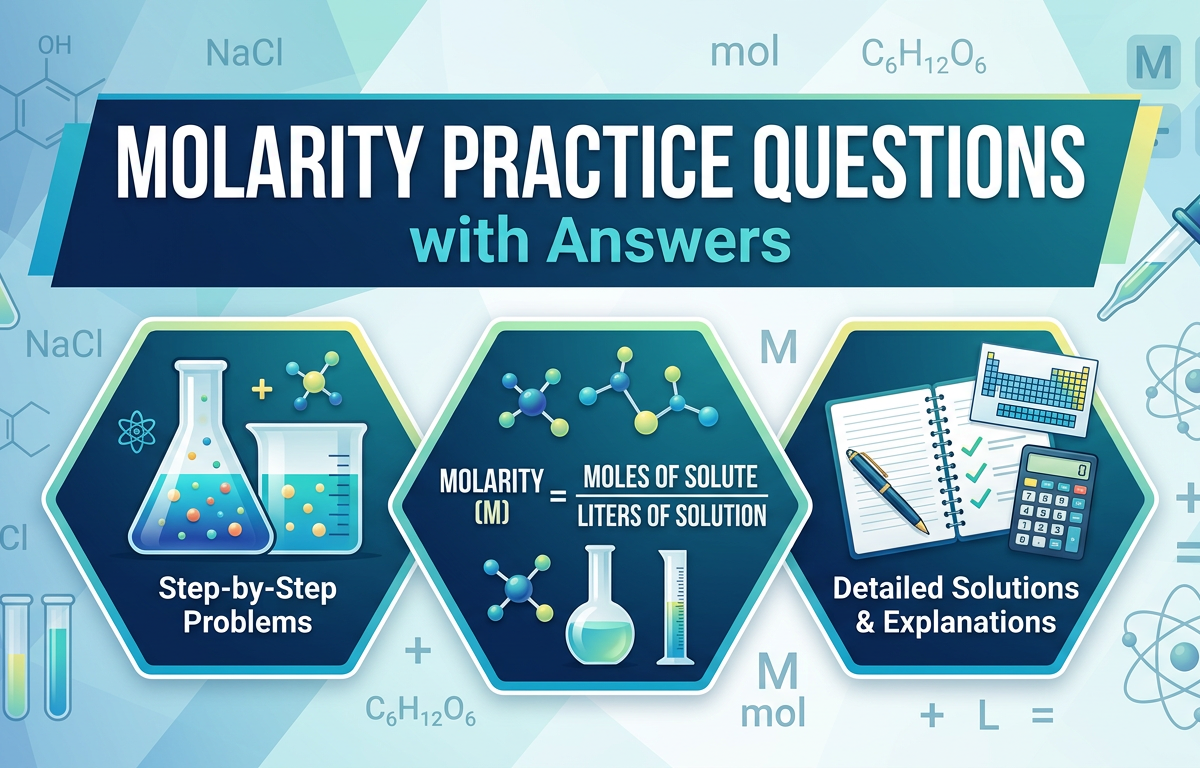
Concept Explanation
Molarity is a measure of the concentration of a solute in a solution, defined as the number of moles of solute per liter of solution. It is the most common unit of concentration used in chemistry and is represented by the capital letter 'M'. To calculate molarity, you divide the amount of substance (in moles) by the total volume of the mixture (in liters). This relationship is expressed by the formula: Molarity (M) = moles of solute / liters of solution. Understanding molarity is essential for performing quantitative analysis and is a foundational component of stoichiometry practice questions. When preparing solutions in a laboratory setting, chemists often use volumetric flasks to ensure the final volume is precise, as molarity is temperature-dependent due to the expansion or contraction of liquids. For more detailed definitions of chemical units, you can refer to the IUPAC Gold Book.
Solved Examples
The following examples demonstrate how to apply the molarity formula in various scenarios, including converting grams to moles and adjusting volumes.
Calculating Molarity from Mass: A student dissolves 58.44 grams of Sodium Chloride (NaCl) in enough water to make 2.00 liters of solution. What is the molarity?
Find the molar mass of NaCl: Na (22.99) + Cl (35.45) = 58.44 g/mol.
Convert grams to moles: 58.44 g / 58.44 g/mol = 1.00 mole.
Calculate molarity: 1.00 mole / 2.00 L = 0.500 M.
Finding Mass from Molarity: How many grams of Potassium Permanganate (KMnO₄) are needed to create 500 mL of a 0.100 M solution? (Molar mass of KMnO₄ = 158.03 g/mol)
Convert volume to liters: 500 mL = 0.500 L.
Calculate moles needed: Moles = Molarity × Volume = 0.100 M × 0.500 L = 0.050 moles.
Convert moles to grams: 0.050 moles × 158.03 g/mol = 7.90 grams.
Dilution Calculation: If you have 100 mL of a 2.0 M HCl stock solution, what is the new molarity if you dilute it to a final volume of 500 mL?
Use the dilution formula M₁V₁ = M₂V₂.
Plug in the values: (2.0 M)(0.100 L) = (M₂)(0.500 L).
Solve for M₂: M₂ = 0.200 / 0.500 = 0.40 M.
Practice Questions
Test your knowledge with these molarity practice questions. They range from basic calculations to complex problems involving limiting reagents and stoichiometry.
Calculate the molarity of a solution prepared by dissolving 15.0 g of NaOH in enough water to make 250 mL of solution.
How many moles of solute are present in 1.25 L of a 0.750 M solution?
What volume (in mL) of a 0.50 M solution can be prepared using 0.25 moles of glucose?
Want unlimited practice questions like these?
Generate AI-powered questions with step-by-step solutions on any topic.
Try Question Generator Free →A 25.0 mL sample of 12.0 M concentrated HCl is diluted to a final volume of 500.0 mL. What is the molarity of the diluted solution?
How many grams of Na₂SO₄ (molar mass = 142.04 g/mol) are required to prepare 750 mL of a 0.350 M solution?
Determine the molarity of a solution that contains 4.5 grams of Calcium Chloride (CaCl₂) in 300 mL of solution.
If you evaporate 150 mL of water from 450 mL of a 0.20 M solution, what is the final molarity? (Assume volumes are additive).
How many liters of 0.100 M AgNO₃ contain exactly 5.00 grams of solute?
Calculate the molarity of chloride ions (Cl⁻) in a 0.15 M solution of AlCl₃.
What mass of Ba(OH)₂ is needed to react completely with 50.0 mL of 0.200 M HCl? This requires applying concepts from acid-base titration practice questions.
Answers & Explanations
Review the detailed steps below to check your work and understand the logic behind each molarity calculation.
1. Answer: 1.50 M. First, find the moles of NaOH: 15.0 g / 40.00 g/mol = 0.375 mol. Then divide by volume in liters: 0.375 mol / 0.250 L = 1.50 M.
2. Answer: 0.938 mol. Use the formula Moles = Molarity × Volume. 0.750 M × 1.25 L = 0.9375 mol, rounded to 0.938 mol.
3. Answer: 500 mL. Volume = Moles / Molarity. 0.25 mol / 0.50 M = 0.50 L. Convert to mL: 0.50 L × 1000 = 500 mL.
4. Answer: 0.600 M. Use M₁V₁ = M₂V₂. (12.0 M)(25.0 mL) = (M₂)(500.0 mL). M₂ = 300 / 500 = 0.600 M.
5. Answer: 37.3 g. Moles = 0.350 M × 0.750 L = 0.2625 mol. Mass = 0.2625 mol × 142.04 g/mol = 37.2855 g, rounded to 37.3 g.
6. Answer: 0.135 M. Moles of CaCl₂ = 4.5 g / 110.98 g/mol = 0.0405 mol. Molarity = 0.0405 mol / 0.300 L = 0.135 M.
7. Answer: 0.30 M. Initial moles = 0.450 L × 0.20 M = 0.090 mol. Final volume = 450 mL - 150 mL = 300 mL (0.300 L). Final Molarity = 0.090 mol / 0.300 L = 0.30 M.
8. Answer: 0.294 L. Moles of AgNO₃ = 5.00 g / 169.87 g/mol = 0.0294 mol. Volume = 0.0294 mol / 0.100 M = 0.294 L.
9. Answer: 0.45 M. AlCl₃ dissociates into Al³⁺ and 3Cl⁻. Therefore, [Cl⁻] = 3 × [AlCl₃] = 3 × 0.15 M = 0.45 M.
10. Answer: 0.857 g. Moles HCl = 0.050 L × 0.200 M = 0.010 mol. The reaction is Ba(OH)₂ + 2HCl → BaCl₂ + 2H₂O. Moles Ba(OH)₂ = 0.010 mol HCl / 2 = 0.005 mol. Mass = 0.005 mol × 171.34 g/mol = 0.8567 g, rounded to 0.857 g.
Frequently Asked Questions
What is the difference between molarity and molality?
Molarity is the number of moles of solute per liter of solution, whereas molality is the number of moles of solute per kilogram of solvent. Molarity depends on the volume of the entire solution and can change with temperature, while molality is based on mass and remains constant regardless of temperature changes. For more on temperature effects, visit LibreTexts Chemistry.
How does temperature affect molarity?
Molarity is temperature-dependent because the volume of a liquid expands or contracts as temperature changes. Since molarity is calculated using the volume of the solution, an increase in temperature usually causes the volume to increase, which subsequently decreases the molarity.
Can molarity be used for gases?
While molarity is typically used for liquid solutions, it can technically be applied to gases by calculating moles per liter of the gas container. However, in gas chemistry, partial pressure or mole fractions are more commonly used units of concentration. You can explore this further in Khan Academy's chemistry modules.
Why must the volume be in liters when calculating molarity?
The standard definition of molarity is specifically moles per liter (mol/L). If you use milliliters or other units without converting to liters, the numerical value will not represent the standard molar concentration, leading to errors in chemical calculations and stoichiometry.
What is a stock solution?
A stock solution is a concentrated solution that is prepared for long-term storage and intended to be diluted to a lower concentration for actual use. Using stock solutions saves time, reduces storage space, and improves accuracy when preparing very dilute solutions.
Enjoyed this article?
Share it with others who might find it helpful.
Related Articles
Hard Molarity Practice Questions
Master advanced chemistry with these hard molarity practice questions. Includes step-by-step solutions for density, mass percent, and titration problems.
Mar 26, 2026
Easy Molarity Practice Questions
Master molarity with these easy practice questions. Learn the M=n/V formula, volume conversions, and step-by-step solutions for chemistry students.
Mar 26, 2026
Medium Molarity Practice Questions
Master medium-level molarity problems with our comprehensive guide. Includes step-by-step solved examples, practice questions, and a quick quiz to test your skills.
Mar 26, 2026
Molarity vs Molality: The Essential Difference Explained
Master the difference between molarity vs molality. Learn the formulas, key differences, and when to use each in this comprehensive chemistry guide.
Mar 26, 2026
Why Molarity Matters: Converting Mass to Moles for Lab Solutions
Master chemistry with our guide to the molarity formula. Learn how to calculate concentration with step-by-step examples, units, and practical lab tips.
Mar 26, 2026

Avoid These 7 Common Molarity Mistakes in Chemistry
Master chemistry calculations! Avoid common molarity mistakes with our expert guide on unit conversions, dilution errors, and proper lab techniques.
Mar 26, 2026

How to Solve Molarity Problems: Step-by-Step Mastery
Learn how to solve molarity problems step-by-step with formulas, unit tips, and worked examples so you can calculate concentration with confidence.
Mar 26, 2026

Why Molarity Ratios Fail: Solving the Moles per Liter Logic Gap
Master molarity with ease. Discover why chemistry students struggle with concentration units and learn proven strategies to solve molarity problems fast.
Mar 26, 2026