Stop the Illusion of Competence: Using Retrieval to Pass Exams

Consider the last time you spent two hours underlining a textbook chapter only to stare at a blank exam page the next morning. When you highlight a sentence like synaptic plasticity is the strengthening of neural connections, your eyes register the words, but your brain marks the information as external. This creates a psychological trap called the illusion of competence. You recognize the text because it is physically in front of you, but you have not yet built the internal circuitry required to generate that definition from a cold start. Recognition is a passive reflex; retrieval is a metabolic effort.
Effective study sessions are measured by the frequency of the mental reach. If you spend sixty minutes reading, your return on investment is statistically near zero because you are merely confirming what you already see. Active recall flips this by forcing the brain to bridge the gap between a question and a hidden memory without the safety net of your notes. This process relies on desirable difficulty, the specific level of strain that signals to your neurons that a piece of data is worth keeping. By switching from input to output, you stop practicing how to read and start practicing how to perform.
When you practice active recall, you aren't just putting information into your head; you are practicing the act of taking it out. This shift in perspective is the difference between a student who survives finals week and one who thrives. By engaging in evidence-based learning strategies, you can cut your study time in half while significantly increasing your retention rates. If you want to stop the cycle of forgetting, you need to master the art of the "mental reach."
What is Active Recall? The Science of Efficient Learning
Active recall studying is the practice of deliberately challenging your mind to retrieve information without looking at your notes. Think of your brain like a forest. Passive learning is like looking at a map of a trail; active recall is the act of actually walking that trail. Every time you retrieve a fact, you "trample" the path, making it wider, clearer, and easier to navigate the next time you need it. This process is deeply rooted in the neurobiology of memory and synaptic plasticity.
The core difference between recognition and recall is the presence of a cue. Recognition occurs when you see information (like a multiple-choice answer) and think, "I know that." Recall occurs when you generate the answer from scratch. Research by Roediger and Karpicke (2006) demonstrated that students who were tested frequently outperformed those who spent that same time rereading material, even if the "testers" felt less confident initially.
The concept of "Desirable Difficulty" is central to this success. Learning shouldn't feel easy; if it does, you probably aren't learning. When your brain struggles to remember a concept, it signals to your neurons that this information is vital for survival, triggering stronger long-term storage. To better understand how your brain handles this information over time, you should explore The Forgetting Curve: Why We Forget and 5 Secrets to Stop It.
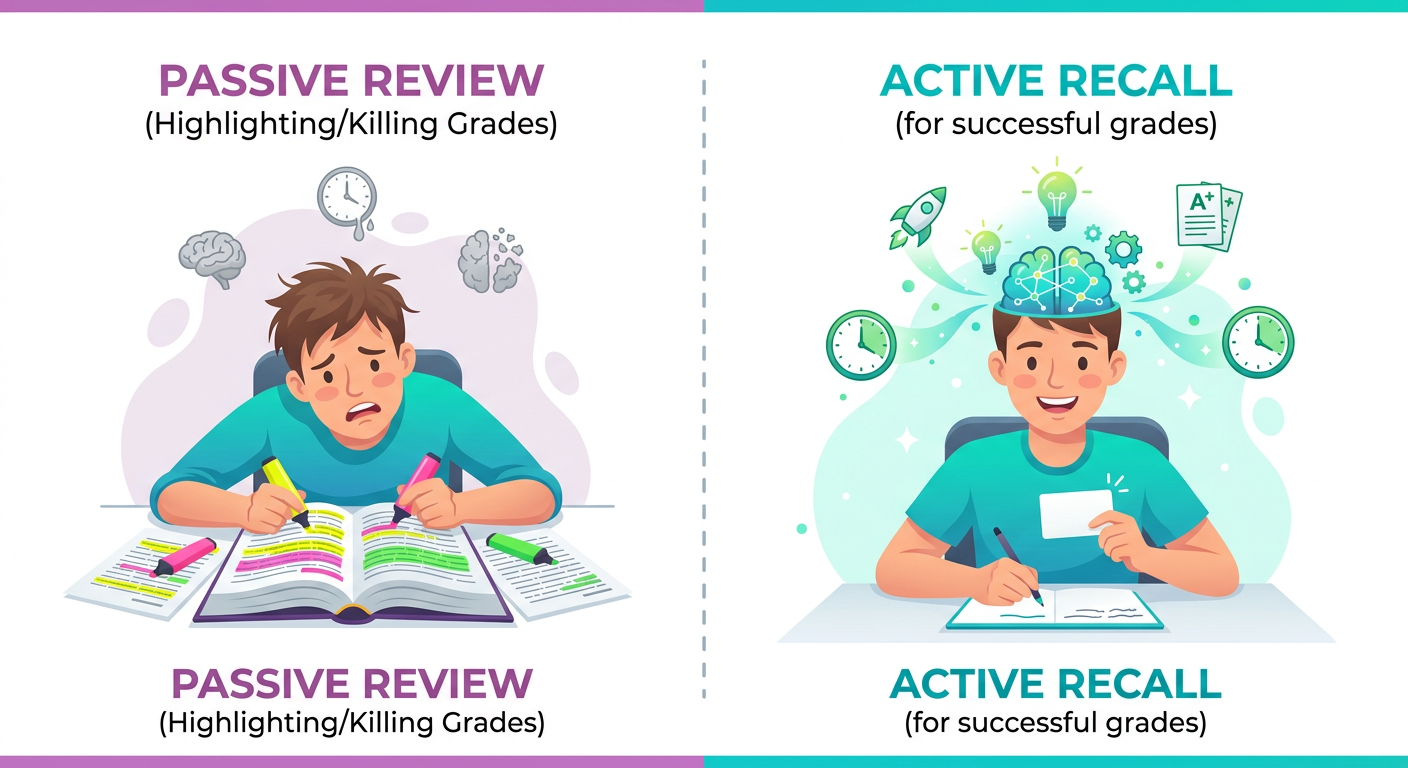
Active Recall vs. Passive Review: Why Highlighting is Killing Your Grades
Active Recall vs. Passive Review: Why Highlighting is Killing Your Grades
Highlighting is often a form of "productive procrastination" that provides an illusion of competence. When you highlight a sentence, your brain registers the information as "important," but it doesn't actually store it. You are simply marking where the information lives so you can find it later. This creates a dangerous familiarity where you recognize the text on the page but lack the neural pathways to explain it in your own words.
Passive review techniques, like rereading or underlining, have a remarkably low Return on Investment (ROI). While they feel comfortable because they don't challenge your ego, they lead to rapid decay of knowledge. In contrast, active recall studying yields high retention because it mimics the environment of the exam itself. If you want to optimize your performance, check out The Ultimate Evidence-Based Guide to Effective Studying for a deeper dive into high-utility methods.
Measuring the ROI of your study session is simple: ask yourself how many times you were forced to produce an answer during the hour. If you spent 60 minutes reading, your ROI is near zero. If you spent 20 minutes reading and 40 minutes answering practice questions, you’ve hit the gold standard of The Ultimate Study Guide For College Students.
How to Implement Active Recall: 5 Core Strategies for Students

How to Implement Active Recall: 5 Core Strategies for Students
Effective retrieval practice examples range from low-tech paper methods to high-tech AI integrations. The goal is always the same: keep the book closed as much as possible. Here are five strategies to transform your study routine immediately:
The Pre-Test Method: Before you even start a new chapter, try to answer the practice questions at the end. You will likely fail, but that failure primes your brain to look for those specific answers as you read.
The "Blurting" Technique: After reading a section of text, close the book and write down everything you can remember on a blank sheet of paper. Once you're finished, open the book and use a different colored pen to add the details you missed.
Question-Based Note Taking: Instead of writing "Mitochondria is the powerhouse of the cell," write "What is the function of the mitochondria?" During your review, cover the answers and only look at the questions.
Flashcards on Steroids: Digital tools allow you to use a spaced repetition system to ensure you are only seeing difficult cards frequently. Understanding how to use AIflashcard.net for school is perhaps the most powerful skill a modern student can develop.
The Feynman Technique: Explain a complex concept to an imaginary six-year-old. If you can’t explain it simply, you don’t understand it well enough to recall it under stress.
Many students now use AI In Education to generate these questions automatically. Instead of spending hours writing flashcards, you can feed your lecture notes into an AI tool to create a custom quiz, allowing you to spend more time on actual retrieval practice examples rather than content creation.
The Ultimate Duo: Combining Active Recall with Spaced Repetition
The Ultimate Duo: Combining Active Recall with Spaced Repetition
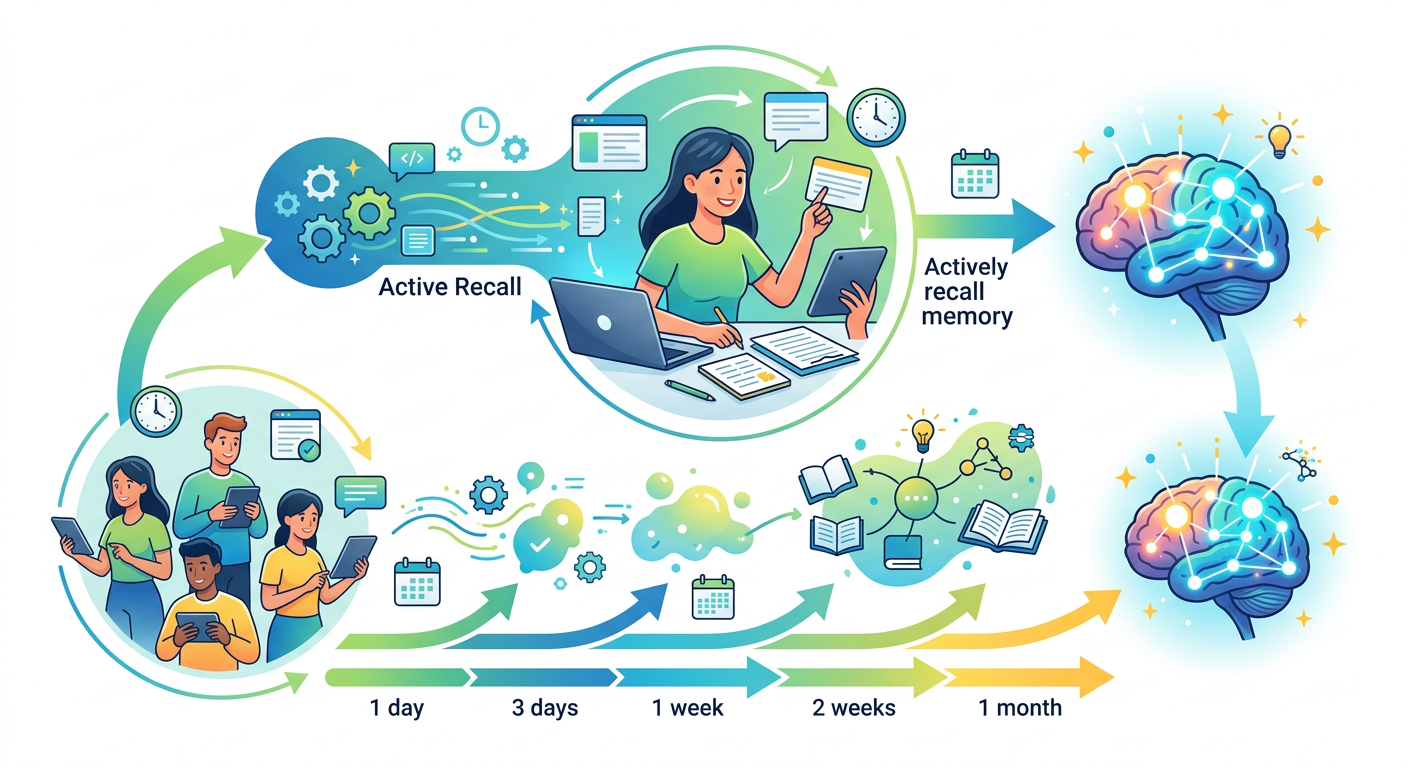
Active recall is the "how" of studying, but spaced repetition is the "when." Hermann Ebbinghaus, a pioneer in memory research, discovered that we lose nearly 70% of new information within 24 hours if we don't review it. To combat this, you must revisit the material at increasing intervals such as 1 day, 3 days, 7 days, and 30 days later. This "spaced" approach resets the forgetting curve, eventually moving information into your permanent long-term memory.
You can automate this using software like Bevinzey, AIflashcard.net, Anki, RemNote, or Quizlet. These platforms use algorithms to show you the "hard" cards more often and hide the "easy" cards for weeks at a time. This prevents the common mistake of over-studying material you already know. For those who prefer analog methods, the "Leitner System" uses physical boxes to achieve the same result. For more ways to organize your time effectively, see The Complete Student Productivity Blueprint.
Active Recall for Different Subjects: A Custom Approach
Active recall studying looks different depending on whether you are studying Organic Chemistry or Victorian Literature. In STEM fields, retrieval should focus on problem-solving. Don't look at the solution manual; keep the book closed and struggle with the math problem until you've explored every possible route. You are retrieving the process, not just the answer.
In the Humanities, active recall focuses on argumentation and themes. Instead of memorizing dates, ask yourself "Why did this event happen?" and try to recite the connections between different historical figures aloud. If you are a medical or law student, you might find AI For Higher Education particularly helpful for generating complex case-study scenarios to test your application of theory.
For language learning, stop using translation lists. Use flashcards with an image on one side and the foreign word on the other. This forces your brain to retrieve the concept directly in the target language, bypassing the "English translation" step that slows down fluency. Whether you are prepping for a mid-term or a bar exam, following The Complete Test Preparation Guide For Students will ensure you use the right retrieval method for the right task.
Common Pitfalls and How to Avoid Them
The biggest pitfall in active recall studying is the "Leaky Bucket" problem: creating flashcards that are far too long. If a card contains three sentences, you might recognize the first few words and assume you knew the rest. This is cheating. Keep your questions and answers "atomic"—one specific concept per card. If a concept is too large, break it down into five smaller questions.
Another issue is mental burnout. Because active recall is cognitively demanding, you cannot do it for's hours on end. Aim for 25-50 minute sessions followed by a true break. Finally, beware of the "ten-second rule." If you can't recall an answer within ten seconds, stop guessing and look at the answer. Prolonged struggling with zero retrieval can lead to frustration and cognitive fatigue, which is counterproductive to improving long-term memory for exams.
The 'Perfect' Study Routine: A Step-by-Step Template
A high-performance study routine begins the moment a lecture ends. Within the first 24 hours, do a "brain dump" or a blurting session to see what stuck. This immediate retrieval is the most critical step in preventing the initial drop-off on the forgetting curve. On day three, convert your notes into active questions or Anki cards.
By day seven, you should be moving into your second round of spaced repetition. At this stage, you should combine active recall with "Interleaving"—mixing up different topics in one session. Instead of doing two hours of Biology, do 30 minutes of Bio, 30 minutes of Calculus, and 30 minutes of History. This forces your brain to work even harder to switch contexts, which studies show leads to better mastery of the material.
Frequently Asked Questions
Is active recall better than rereading?
Yes, significantly. Research consistently shows that retrieving information from memory strengthens neural pathways far more effectively than repeatedly looking at the same information. Rereading creates familiarity, while active recall creates true mastery.
Can I use active recall for subjects like math or art?
Absolutely. For math, active recall involves solving problems from scratch without looking at the steps. For art, it involves retrieving the names of techniques, identifying art movements by sight, or explaining the historical context of a piece from memory.
How often should I practice active recall for a single topic?
Frequency should follow a spaced repetition schedule. Review 24 hours after learning, then at 3 days, 7 days, and 14 days. If you find the material easy, increase the intervals; if it's difficult, shorten them.
Is active recall effective for students with ADHD?
Many students with ADHD find active recall more engaging because it is "active" and gamified, especially when using digital tools like flashcard apps that provide immediate feedback and progress bars.
How do I start using active recall if I have no notes?
You can start by using the practice questions at the end of textbook chapters or using a "blurting" session where you write everything you remember from a lecture before looking at any external resources to see where your gaps are.
Enjoyed this article?
Share it with others who might find it helpful.
Related Articles

How to Solve Molarity Problems: Step-by-Step Mastery
Learn how to solve molarity problems step-by-step with formulas, unit tips, and worked examples so you can calculate concentration with confidence.
Mar 26, 2026
Avoid These 7 Common Molarity Mistakes in Chemistry
Master chemistry calculations! Avoid common molarity mistakes with our expert guide on unit conversions, dilution errors, and proper lab techniques.
Mar 26, 2026
What Is Molarity? The Complete Guide to Molar Concentration
Master molarity with our complete guide. Learn the formula, step-by-step calculations, and the critical differences between molarity and molality.
Mar 26, 2026
Why Molarity Matters: Converting Mass to Moles for Lab Solutions
Master chemistry with our guide to the molarity formula. Learn how to calculate concentration with step-by-step examples, units, and practical lab tips.
Mar 26, 2026
Molarity vs Molality: The Essential Difference Explained
Master the difference between molarity vs molality. Learn the formulas, key differences, and when to use each in this comprehensive chemistry guide.
Mar 26, 2026