Stoichiometry: Using Molar Ratios to Bridge Reactants and Products
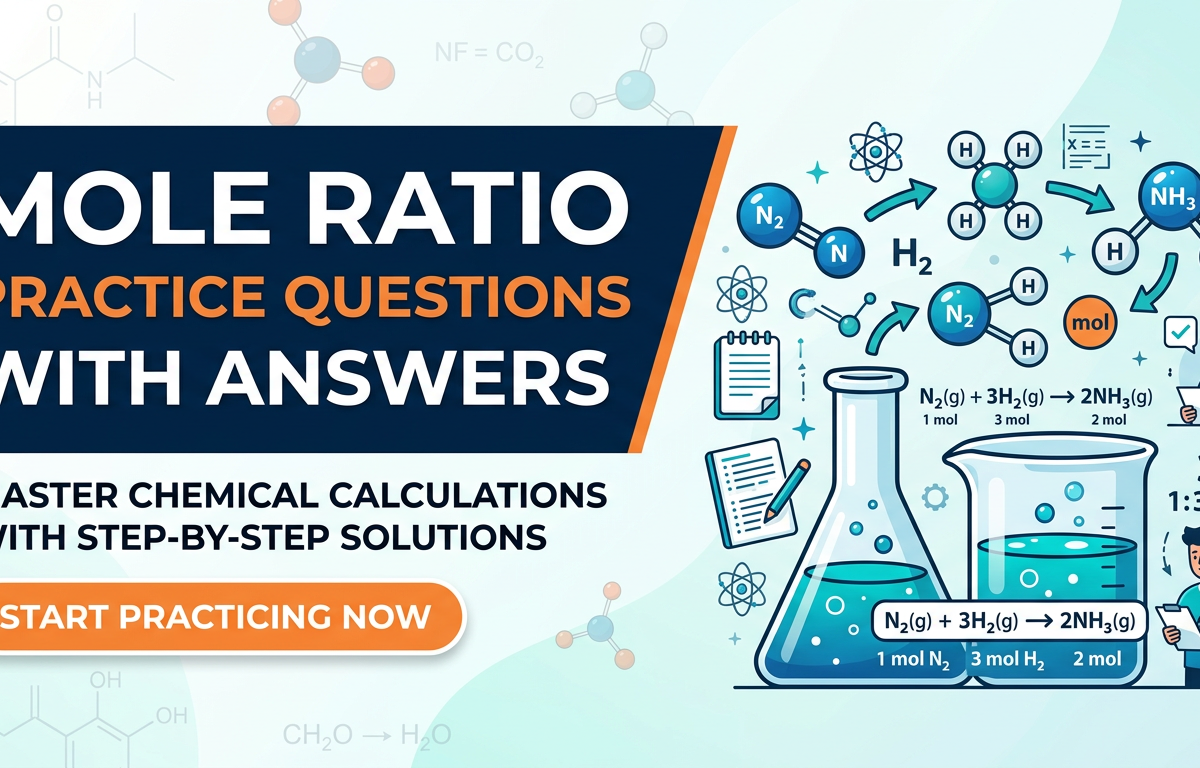
If you attempt to calculate the output of the Haber process using N2 + H2 → NH3, your results will be fundamentally wrong before you even touch a calculator. The chemical equation acts as a recipe, but only when it is balanced. Without the specific 1:3:2 ratio of nitrogen to hydrogen to ammonia, you cannot determine how much gas is consumed or produced. A mole ratio is the mathematical bridge that allows you to jump from one substance to another, and it is derived solely from these numerical coefficients.
Students often struggle by placing the wrong value in the numerator or forgetting to check if the equation is balanced first. In the combustion of propane, for instance, a 1:5 ratio exists between the fuel and oxygen. If you flip this fraction during dimensional analysis, your final answer will be off by a factor of 25. This guide provides specific practice problems to help you identify the known and unknown variables, ensuring your units cancel out correctly every time you perform a stoichiometric conversion.
The Logic of Stoichiometric Conversion
A mole ratio is a conversion factor that relates the amounts in moles of any two substances involved in a chemical reaction, derived directly from the coefficients of a balanced chemical equation. These ratios serve as the essential bridge in stoichiometry, allowing chemists to calculate how much reactant is needed to produce a specific amount of product, or how much product can be formed from a given amount of starting material. Because the law of conservation of mass dictates that atoms are neither created nor destroyed, the coefficients in a balanced equation represent the fixed proportions in which substances react on a molecular level.
To determine a mole ratio, you must first ensure the chemical equation is balanced. For example, in the synthesis of water: 2H₂ + O₂ → 2H₂O. The coefficients tell us that 2 moles of hydrogen react with 1 mole of oxygen to produce 2 moles of water. From this single equation, we can derive several ratios:
H₂ to O₂: 2:1
O₂ to H₂O: 1:2
H₂ to H₂O: 2:2 (which simplifies to 1:1)
When solving stoichiometry problems, the mole ratio is used as a fraction. You place the moles of the "unknown" substance (what you are looking for) in the numerator and the moles of the "known" substance (what you are given) in the denominator. This mathematical approach ensures that units cancel out correctly during dimensional analysis. Understanding stoichiometry basics is vital for mastering these calculations in laboratory settings.
Solved Examples
These examples demonstrate how to extract and apply mole ratios from balanced chemical equations to solve quantitative chemistry problems.
Example 1: Ammonia Synthesis
Equation: N₂ + 3H₂ → 2NH₃
How many moles of H₂ are required to react completely with 4.5 moles of N₂?
Identify the known: 4.5 mol N₂.
Identify the desired unit: mol H₂.
Determine the mole ratio from the balanced equation: 3 moles H₂ / 1 mole N₂.
Multiply the known value by the ratio: 4.5 mol N₂ × (3 mol H₂ / 1 mol N₂) = 13.5 mol H₂.
Example 2: Combustion of Propane
Equation: C₃H₈ + 5O₂ → 3CO₂ + 4H₂O
If 12 moles of CO₂ are produced, how many moles of C₃H₈ were consumed?
Identify the known: 12 mol CO₂.
Identify the desired unit: mol C₃H₈.
Determine the mole ratio: 1 mole C₃H₈ / 3 moles CO₂.
Multiply: 12 mol CO₂ × (1 mol C₃H₈ / 3 mol CO₂) = 4 moles C₃H₈.
Example 3: Aluminum Oxide Formation
Equation: 4Al + 3O₂ → 2Al₂O₃
How many moles of Al₂O₃ are produced from 0.60 moles of O₂?
Identify the known: 0.60 mol O₂.
Identify the desired unit: mol Al₂O₃.
Determine the mole ratio: 2 moles Al₂O₃ / 3 moles O₂.
Multiply: 0.60 mol O₂ × (2/3) = 0.40 moles Al₂O₃.
Practice Questions
Test your understanding of mole ratios with the following problems. The difficulty increases as you progress through the list.
1. (Easy) Given the equation 2Mg + O₂ → 2MgO, what is the mole ratio of Mg to MgO?
2. (Easy) In the reaction 2H₂ + O₂ → 2H₂O, how many moles of oxygen are needed to react with 6 moles of hydrogen?
3. (Easy) For the reaction CH₄ + 2O₂ → CO₂ + 2H₂O, what is the mole ratio of O₂ to H₂O?
4. (Medium) Using the equation 2KClO₃ → 2KCl + 3O₂, calculate the moles of O₂ produced from 1.5 moles of KClO₃.
5. (Medium) In the synthesis of iron(III) oxide (4Fe + 3O₂ → 2Fe₂O₃), how many moles of iron are needed to produce 5.0 moles of Fe₂O₃?
6. (Medium) If 0.75 moles of CO₂ are produced in the reaction C + O₂ → CO₂, how many moles of O₂ were consumed?
7. (Medium) Consider 2Al + 6HCl → 2AlCl₃ + 3H₂. How many moles of HCl are required to react with 2.4 moles of Al?
8. (Hard) In the reaction 3Cu + 8HNO₃ → 3Cu(NO₃)₂ + 2NO + 4H₂O, what is the mole ratio of HNO₃ to NO? How many moles of NO are produced from 1.2 moles of HNO₃?
9. (Hard) 2C₂H₆ + 7O₂ → 4CO₂ + 6H₂O. If you have 10.5 moles of O₂, how many moles of CO₂ can be produced?
10. (Hard) For the reaction P₄ + 5O₂ → P₄O₁₀, calculate the moles of phosphorus (P₄) needed to react with 0.85 moles of oxygen gas.
Answers & Explanations
Question Answer Explanation
1. 1:1 (or 2:2) The coefficients for Mg and MgO are both simplified, the ratio is 1:1.
2. 3 moles O₂ Ratio is 1 O₂ : 2 H₂. Calculation: 6 mol H₂ × (1/2) = 3 mol O₂.
3. 1:1 (or 2:2) The coefficient for O₂ is 2 and for H₂O is 2. The ratio is 2/2, which is 1.
4. 2.25 moles O₂ Ratio is 3 O₂ : 2 KClO₃. Calculation: 1.5 mol KClO₃ × (3/2) = 2.25 mol O₂.
5. 10 moles Fe Ratio is 4 Fe : 2 Fe₂O₃. Calculation: 5.0 mol Fe₂O₃ × (4/2) = 10 mol Fe.
6. 0.75 moles O₂ The ratio of O₂ to CO₂ is 1:1. Therefore, the amount of moles remains the same.
7. 7.2 moles HCl Ratio is 6 HCl : 2 Al. Calculation: 2.4 mol Al × (6/2) = 7.2 mol HCl.
8. 4:1 ratio; 0.3 mol NO Ratio is 8 HNO₃ : 2 NO (simplifies to 4:1). Calculation: 1.2 mol HNO₃ × (2/8) = 0.3 mol NO.
9. 6 moles CO₂ Ratio is 4 CO₂ : 7 O₂. Calculation: 10.5 mol O₂ × (4/7) = 6.0 mol CO₂.
10. 0.17 moles P₄ Ratio is 1 P₄ : 5 O₂. Calculation: 0.85 mol O₂ × (1/5) = 0.17 mol P₄.
1. What is the mole ratio of H₂ to NH₃ in the reaction N₂ + 3H₂ → 2NH₃?
Frequently Asked Questions
What is a mole ratio in chemistry?
A mole ratio is a conversion factor that relates the amounts in moles of any two substances involved in a chemical reaction. It is derived from the coefficients of a balanced chemical equation.
How do you find the mole ratio of a balanced equation?
To find the mole ratio, look at the coefficients in front of the chemical formulas in a balanced equation. Create a fraction using the coefficient of the substance you are solving for as the numerator and the coefficient of the known substance as the denominator.
Why is the mole ratio important in stoichiometry?
Mole ratios are important because they allow for the quantitative comparison of reactants and products. They provide the necessary link to convert the amount of one substance into the amount of another within a chemical system.
Can mole ratios be fractions?
While the coefficients in a balanced equation are usually whole numbers, the mole ratio itself is used as a mathematical operator. In calculations, it functions as a bridge that can result in non-integer values for the final number of moles.
Does the mole ratio change if the amount of reactant changes?
No, the mole ratio remains constant regardless of the actual quantities used because it is defined by the stoichiometry of the reaction. The ratio represents the fixed proportion required for the reaction to occur according to the law of conservation of mass.
Ready to ace your exams?
Try Bevinzey's AI-powered study tools for free.
Enjoyed this article?
Share it with others who might find it helpful.
Related Articles
Calculating Enthalpy Changes Using Bond Enthalpy Data
Master bond energy calculations with our comprehensive guide. Includes solved examples, practice questions, and detailed explanations for chemistry students.
Mar 29, 2026
Empirical Formulas: Solving Ratios from Mass and Percent Data
Master empirical formula calculations with 10 practice questions, worked answers, and a free step-by-step calculator for mass, percentage, and combustion problems.
Mar 26, 2026
Scaling Up: Using Molar Mass to Predict Lab Quantities
Learn how to convert moles to grams with our comprehensive guide, featuring step-by-step solved examples and 10 practice questions with detailed answers.
Mar 26, 2026
Stoichiometry: Calculating Yields and Finding Limiting Reactants
Master stoichiometry with our comprehensive guide featuring detailed explanations, solved examples, and practice questions with answers for chemistry students.
Mar 21, 2026
Stoichiometry: Finding the Reactant That Runs Out First
Master stoichiometry with our limiting reagent practice questions and step-by-step answers. Learn how to identify the limiting reactant and calculate yield.
Mar 21, 2026
What Is Molarity? The Complete Guide to Molar Concentration
Master molarity with our complete guide. Learn the formula, step-by-step calculations, and the critical differences between molarity and molality.
Mar 26, 2026

Why Molarity Ratios Fail: Solving the Moles per Liter Logic Gap
Master molarity with ease. Discover why chemistry students struggle with concentration units and learn proven strategies to solve molarity problems fast.
Mar 26, 2026

Calculating High-Stakes Meds: BSA Mosteller Formula Practice
Master hard body surface area-based dosage calculations with our comprehensive guide, solved examples, and practice questions for healthcare students.
May 17, 2026