Scaling Up: Using Molar Mass to Predict Lab Quantities
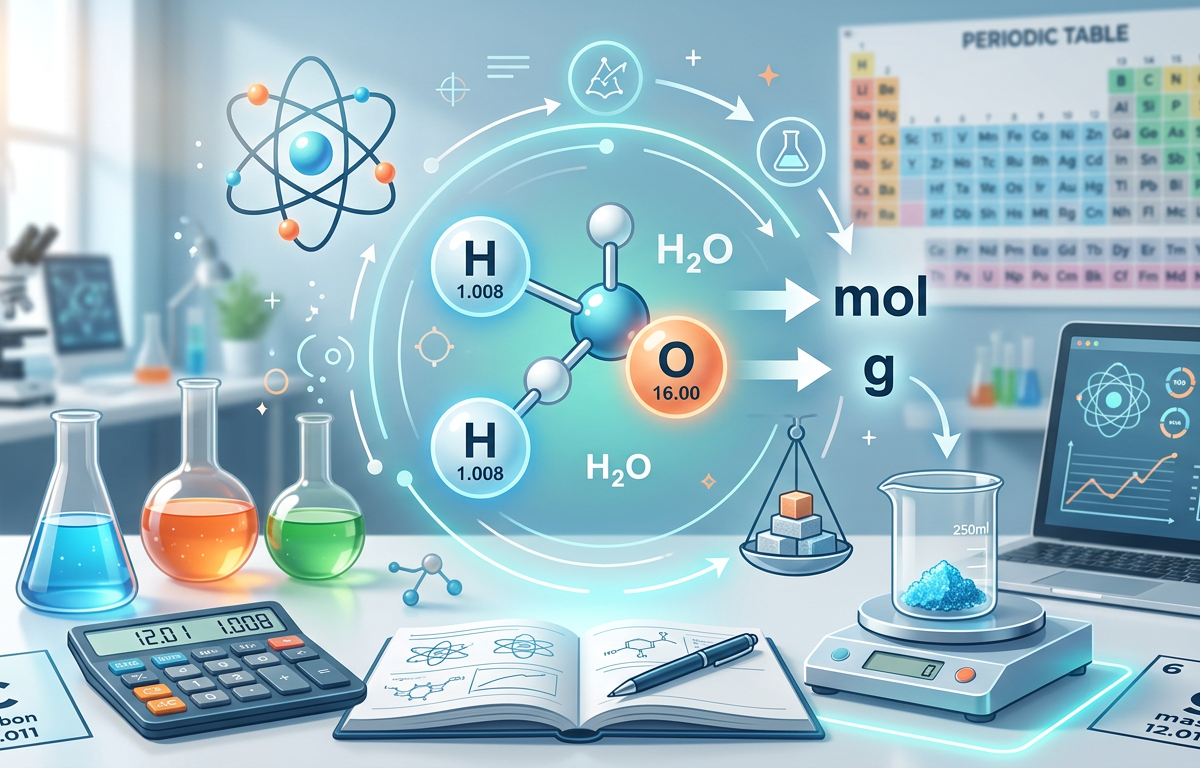
When you look at a chemical equation, you see ratios of individual atoms, but your laboratory balance only understands grams. A student might correctly identify that they need 0.50 moles of Sodium Chloride for a reaction, but they cannot simply pour 0.50 units of a substance onto a scale. This gap between the invisible count of particles and the physical weight of a sample is the most frequent source of error in introductory chemistry. If you forget to account for the specific molar mass of each element, your yield will be off by a factor of thousands.
To move from the theoretical mole to a measurable mass, you must treat the periodic table as a conversion directory. The critical step often missed is the precise summation of atomic weights for compounds like Calcium Carbonate or Sulfuric Acid before multiplying. This guide focuses on the Mass = n × M calculation, ensuring you apply significant figure rules correctly so your lab results match your theoretical predictions. By the end of these exercises, you will be able to translate any molar quantity into its corresponding weight in grams with absolute precision.
Moles to Grams Practice Questions with Answers
Mastering the conversion from moles to grams is a fundamental skill in chemistry that allows scientists to bridge the gap between the microscopic world of atoms and the macroscopic world of the laboratory. Whether you are balancing chemical equations or preparing a solution, understanding how to calculate mass from a given amount of substance is essential for success in any introductory or advanced chemistry course. This guide provides a deep dive into the moles to grams conversion process, offering clear explanations and a variety of practice problems to sharpen your skills.
The Mathematics of Atomic Weight
A moles to grams conversion is a calculation used to determine the mass of a substance by multiplying the number of moles by its molar mass. The mole is the SI unit for the amount of substance, representing 6.022 × 10²³ particles. To convert this quantity into a measurable mass (grams), you must use the molar mass, which is the mass of one mole of that specific substance, typically expressed in grams per mole (g/mol).
The relationship is defined by a simple mathematical formula:
Mass (g) = Number of Moles (mol) × Molar Mass (g/mol)
To perform this calculation accurately, follow these steps:
Identify the chemical formula of the substance.
Calculate the molar mass by summing the atomic masses of all atoms in the formula using the Periodic Table of Elements.
Multiply the given number of moles by the calculated molar mass.
Ensure your final answer reflects the correct number of significant figures.
This process is a core component of the broader mole concept practice questions that students encounter early in their studies. Understanding this conversion is also a prerequisite for more complex topics like mass-to-mass stoichiometry.
Solved Examples
Review these step-by-step examples to understand how to apply the conversion formula in different scenarios.
Example 1: Converting Moles of an Element
Calculate the mass of 2.50 moles of Iron (Fe).
Find the atomic mass of Iron (Fe) on the periodic table: 55.85 g/mol.
Set up the calculation: Mass = 2.50 mol × 55.85 g/mol.
Calculate the result: 139.625 g.
Round to three significant figures: 140 g (or 1.40 × 10² g).
Example 2: Converting Moles of a Compound
What is the mass of 0.75 moles of Carbon Dioxide (CO2)?
Calculate the molar mass of CO2: (1 × 12.01) + (2 × 16.00) = 44.01 g/mol.
Set up the calculation: Mass = 0.75 mol × 44.01 g/mol.
Calculate the result: 33.0075 g.
Round to two significant figures: 33 g.
Example 3: Working with Large Quantities
Determine the mass of 15.0 moles of Sodium Chloride (NaCl).
Calculate the molar mass of NaCl: (1 × 22.99) + (1 × 35.45) = 58.44 g/mol.
Set up the calculation: Mass = 15.0 mol × 58.44 g/mol.
Calculate the result: 876.6 g.
Round to three significant figures: 877 g.
Practice Questions
Test your knowledge with these moles to grams practice problems. You will need a periodic table to find atomic masses.
1. How many grams are in 3.00 moles of Helium (He)?
2. Calculate the mass of 0.500 moles of Water (H2O).
3. Determine the mass of 1.25 moles of Calcium Carbonate (CaCO3).
Want unlimited practice questions like these?
Generate AI-powered questions with step-by-step solutions on any topic.
Try Question Generator Free →4. What is the mass of 4.20 moles of Magnesium Oxide (MgO)?
5. Find the mass of 0.025 moles of Silver Nitrate (AgNO3).
6. Calculate the mass of 10.0 moles of Glucose (C6H12O6).
7. How many grams are in 0.85 moles of Sulfuric Acid (H2SO4)?
8. Determine the mass of 2.15 moles of Copper(II) Sulfate (CuSO4).
9. A sample contains 0.0045 moles of Gold (Au). What is its mass in grams?
10. Calculate the mass of 6.50 moles of Methane (CH4).
Answers & Explanations
Below are the detailed solutions for the practice questions provided above.
1. Answer: 12.0 g
Explanation: The atomic mass of Helium is 4.00 g/mol. Mass = 3.00 mol × 4.00 g/mol = 12.0 g.
2. Answer: 9.01 g
Explanation: Molar mass of H2O = (2 × 1.01) + 16.00 = 18.02 g/mol. Mass = 0.500 mol × 18.02 g/mol = 9.01 g.
3. Answer: 125 g
Explanation: Molar mass of CaCO3 = 40.08 + 12.01 + (3 × 16.00) = 100.09 g/mol. Mass = 1.25 mol × 100.09 g/mol = 125.11 g, rounded to 125 g.
4. Answer: 169 g
Explanation: Molar mass of MgO = 24.31 + 16.00 = 40.31 g/mol. Mass = 4.20 mol × 40.31 g/mol = 169.302 g, rounded to 169 g.
5. Answer: 4.2 g
Explanation: Molar mass of AgNO3 = 107.87 + 14.01 + (3 × 16.00) = 169.88 g/mol. Mass = 0.025 mol × 169.88 g/mol = 4.247 g, rounded to 4.2 g.
6. Answer: 1,800 g
Explanation: Molar mass of Glucose = (6 × 12.01) + (12 × 1.01) + (6 × 16.00) = 180.18 g/mol. Mass = 10.0 mol × 180.18 g/mol = 1801.8 g, rounded to 1800 g (3 sig figs).
7. Answer: 83 g
Explanation: Molar mass of H2SO4 = (2 × 1.01) + 32.06 + (4 × 16.00) = 98.08 g/mol. Mass = 0.85 mol × 98.08 g/mol = 83.368 g, rounded to 83 g.
8. Answer: 343 g
Explanation: Molar mass of CuSO4 = 63.55 + 32.06 + (4 × 16.00) = 159.61 g/mol. Mass = 2.15 mol × 159.61 g/mol = 343.16 g, rounded to 343 g.
9. Answer: 0.89 g
Explanation: Atomic mass of Gold is 196.97 g/mol. Mass = 0.0045 mol × 196.97 g/mol = 0.886365 g, rounded to 0.89 g.
10. Answer: 104 g
Explanation: Molar mass of CH4 = 12.01 + (4 × 1.01) = 16.05 g/mol. Mass = 6.50 mol × 16.05 g/mol = 104.325 g, rounded to 104 g.
Once you are comfortable with these calculations, you can move on to applying them in chemical reactions using stoichiometry practice questions.
1. Which formula is used to convert moles to grams?
Frequently Asked Questions
What is the difference between atomic mass and molar mass?
Atomic mass is the mass of a single atom measured in atomic mass units (amu), while molar mass is the mass of one mole of those atoms measured in grams per mole (g/mol). Numerically, they are the same value, but they represent different scales of measurement.
Can I use the same formula for gases and solids?
Yes, the moles to grams conversion formula applies to all states of matter, including solids, liquids, and gases. As long as you know the chemical formula and the number of moles, the state of the substance does not change the mathematical approach.
Why do I need to round my answer to significant figures?
Rounding to significant figures ensures that your final answer reflects the precision of the measurements provided in the problem. In chemistry, overstating precision can lead to errors in experimental results and lab safety.
How do I find the molar mass of a hydrate?
To find the molar mass of a hydrate, calculate the mass of the anhydrous salt and add the mass of the water molecules attached to it. For example, in CuSO4·5H2O, you would add the mass of one CuSO4 unit to the mass of five H2O molecules.
What happens if I divide moles by molar mass instead of multiplying?
If you divide moles by molar mass, the units will not cancel correctly, resulting in mol²/g instead of grams. Always use dimensional analysis to verify that your units cancel out to leave only the desired unit, grams.
Is the molar mass of an element always its atomic weight?
For most elements, the molar mass is equal to the atomic weight in g/mol. However, for diatomic elements like Oxygen (O2) or Nitrogen (N2), you must multiply the atomic weight by two.
Enjoyed this article?
Share it with others who might find it helpful.
Related Articles
Predicting Radioactive Decay: Solving for Mass and Time Intervals
Master half-life calculations with our comprehensive guide featuring step-by-step solved examples, practice questions, and detailed answers for students.
Apr 2, 2026
Calculating Enthalpy Changes Using Bond Enthalpy Data
Master bond energy calculations with our comprehensive guide. Includes solved examples, practice questions, and detailed explanations for chemistry students.
Mar 29, 2026

Stoichiometry of the Flask: Calculating Solute Mass and Dilutions
Master solution preparation with these easy practice questions. Learn to calculate molarity, mass, and dilutions with step-by-step examples and a quick quiz.
Mar 27, 2026

Calculating Mass Ratios: Percent Composition Mastery and Problems
Master percentage composition with our comprehensive guide featuring step-by-step solved examples, practice questions, and a quick quiz to test your knowledge.
Mar 26, 2026
Empirical Formulas: Solving Ratios from Mass and Percent Data
Master empirical formula calculations with 10 practice questions, worked answers, and a free step-by-step calculator for mass, percentage, and combustion problems.
Mar 26, 2026
Stoichiometry: Using Molar Ratios to Bridge Reactants and Products
Master mole ratio calculations with our comprehensive guide, featuring solved examples, practice questions, and a quick quiz to test your stoichiometry skills.
Mar 21, 2026
Why Molarity Matters: Converting Mass to Moles for Lab Solutions
Master chemistry with our guide to the molarity formula. Learn how to calculate concentration with step-by-step examples, units, and practical lab tips.
Mar 26, 2026
What Is Molarity? The Complete Guide to Molar Concentration
Master molarity with our complete guide. Learn the formula, step-by-step calculations, and the critical differences between molarity and molality.
Mar 26, 2026