Stoichiometry Word Practice Questions with Answers
Concept Explanation
Stoichiometry Word problems are mathematical applications of chemistry that use the quantitative relationships between reactants and products in a balanced chemical equation to calculate masses, volumes, and concentrations.
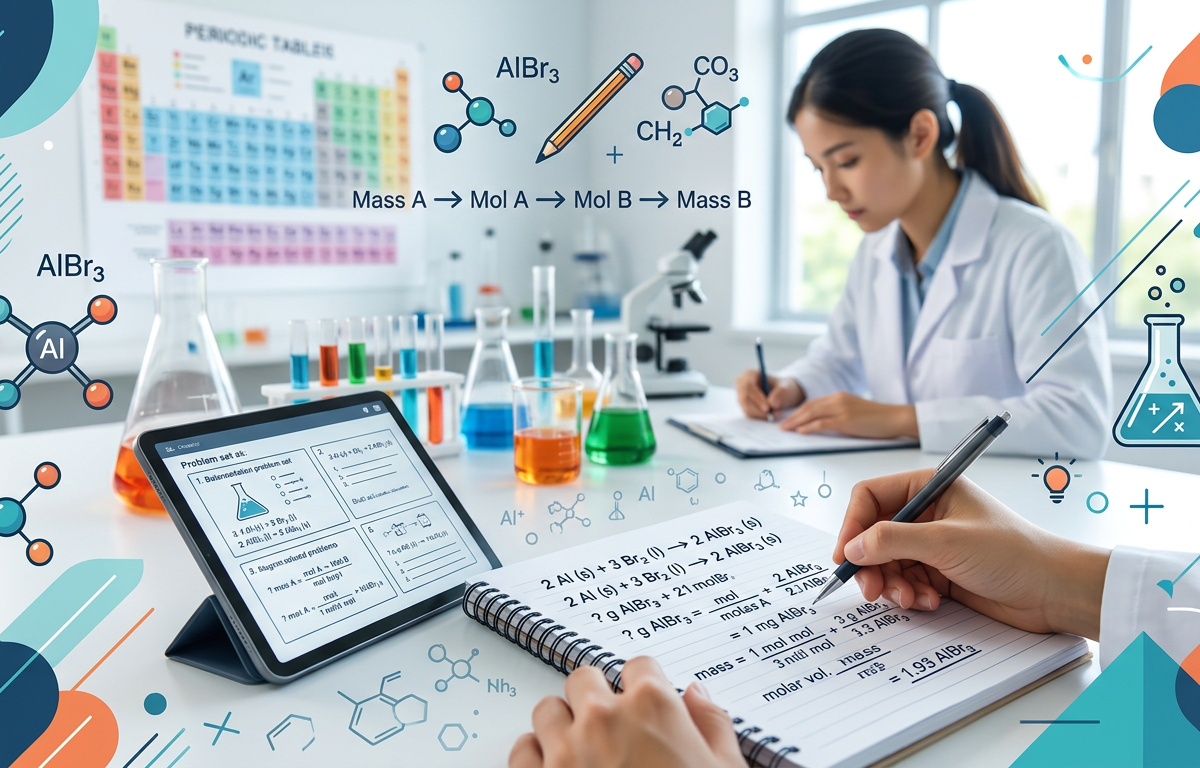
To master stoichiometry, you must understand the law of conservation of mass, which states that matter is neither created nor destroyed during a chemical reaction. This principle allows us to predict exactly how much of a substance is needed to react with another or how much product will form. The process typically follows a specific sequence of steps: converting given units (like grams or liters) into moles, using the mole ratio from the balanced equation to switch between substances, and then converting those moles back into the desired final unit.
Key components of these problems include:
Balanced Equations: The coefficients represent the molar proportions of the substances involved.
Molar Mass: The sum of the atomic weights of the atoms in a molecule, expressed in grams per mole (g/mol).
Avogadro's Number: $6.022 \times 10^{23}$ particles per mole, used for particle-to-mole conversions.
Molar Volume: At Standard Temperature and Pressure (STP), one mole of any gas occupies 22.4 liters.
By applying these concepts, students can solve complex problems involving limiting reagents and theoretical yields. Understanding these relationships is vital for fields ranging from pharmaceutical manufacturing to environmental engineering. For more foundational help, you might explore Khan Academy's guide to stoichiometry.
Solved Examples
Here are three fully worked examples to demonstrate the step-by-step logic required for solving stoichiometry word problems.
Example 1: Mass-to-Mass Calculation
Problem: How many grams of water () are produced when 4.0 grams of hydrogen gas () react completely with excess oxygen gas ()? The balanced equation is: $2H_2 + O_2 \rightarrow 2H_2O$.
Identify the molar masses: g/mol; g/mol.
Convert grams of to moles: $4.0 \text{ g } H_2 \div 2.02 \text{ g/mol} = 1.98 \text{ moles } H_2$.
Use the mole ratio from the equation ($2:2$ or $1:1$): $1.98 \text{ moles } H_2 \times (2 \text{ moles } H_2O / 2 \text{ moles } H_2) = 1.98 \text{ moles } H_2O$.
Convert moles of to grams: $1.98 \text{ moles } \times 18.02 \text{ g/mol} = 35.68 \text{ grams}$.
Final Answer: 35.7 grams of .
Example 2: Volume-to-Mole Calculation
Problem: If 44.8 liters of Nitrogen gas () react with hydrogen at STP, how many moles of Ammonia () are produced? Equation: .
Convert volume to moles using the STP constant (22.4 L/mol): $44.8 \text{ L } \div 22.4 \text{ L/mol} = 2.0 \text{ moles } N_2$.
Use the mole ratio from the balanced equation ($1 \text{ mole } N_2 : 2 \text{ moles } NH_3$): $2.0 \text{ moles } N_2 \times (2 \text{ moles } NH_3 / 1 \text{ mole } N_2) = 4.0 \text{ moles } NH_3$.
Final Answer: 4.0 moles of .
Example 3: Finding Theoretical Yield
Problem: 10.0 grams of Magnesium (Mg) reacts with excess HCl. What is the theoretical yield of in grams? Equation: .
Find molar masses: g/mol; g/mol.
Convert Mg mass to moles: $10.0 \text{ g } / 24.31 \text{ g/mol} = 0.411 \text{ moles } Mg$.
Use the $1:1$ mole ratio: $0.411 \text{ moles } Mg = 0.411 \text{ moles } MgCl_2$.
Convert to mass: $0.411 \text{ mol } \times 95.21 \text{ g/mol} = 39.13 \text{ g}$.
Final Answer: 39.1 grams of .
Practice Questions
Propane () burns in oxygen to produce and . How many grams of are produced from 22.0 grams of propane? ()
How many moles of Oxygen () are required to react with 6.0 moles of Aluminum (Al) to produce Aluminum Oxide ()? ($4Al + 3O_2 \rightarrow 2Al_2O_3$)
If 50.0 grams of Silicon Dioxide () reacts with excess Carbon, how many grams of Carbon Monoxide (CO) are formed? ()
Want unlimited practice questions like these?
Generate AI-powered questions with step-by-step solutions on any topic.
Try Question Generator Free →Iron (III) Oxide reacts with Carbon Monoxide to produce Iron and Carbon Dioxide. How many grams of Iron are produced from 160 grams of ? ()
What volume (in Liters) of Hydrogen gas is produced at STP when 2.5 moles of Zinc react with excess HCl? ()
If a reaction starts with 10.0 grams of Lithium and produces 12.0 grams of Lithium Chloride, what is the percent yield? ($2Li + Cl_2 \rightarrow 2LiCl$)
How many molecules of are needed to react with 2.0 moles of in a combustion reaction? ()
If 100 grams of decomposes, how many grams of CaO are formed? ()
How many moles of are needed to produce 10.0 moles of according to the Haber process? ()
Determine the mass of Silver Chloride (AgCl) produced when 0.5 moles of Silver Nitrate () reacts with excess Sodium Chloride. ()
Answers & Explanations
66.0 grams: Molar mass of g/mol. $22.0 / 44.1 = 0.5$ mol . Ratio is $1:3$, so $1.5$ mol is produced. $1.5 \times 44.01$ (molar mass ) = $66.0$ g.
4.5 moles: Using the ratio from the equation, $6.0 \text{ moles Al } \times (3 \text{ moles } O_2 / 4 \text{ moles Al}) = 4.5 \text{ moles } O_2$.
46.6 grams: Molar mass g/mol. $50.0 / 60.08 = 0.832$ mol . Ratio is $1:2$, so $1.664$ mol CO. $1.664 \times 28.01$ g/mol = $46.6$ g.
111.7 grams: Molar mass g/mol. $160 / 159.7 \approx 1$ mol. Ratio is $1:2$, so 2 moles of Fe are produced. $2 \times 55.85$ g/mol = $111.7$ g.
56.0 Liters: Ratio is $1:1$. $2.5$ mol L/mol = $56.0$ L.
19.7%: Molar mass Li = 6.94 g/mol. $10.0 / 6.94 = 1.44$ mol Li. Ratio $1:1$ means $1.44$ mol LiCl expected. $1.44 \times 42.39$ g/mol = $61.0$ g theoretical. .
$2.41 \times 10^{24}$ molecules: $2.0$ moles requires $4.0$ moles (ratio $1:2$). $4.0 \times (6.022 \times 10^{23}) = 2.41 \times 10^{24}$.
56.1 grams: Molar mass g/mol. $100 / 100.1 \approx 1$ mol. Ratio $1:1$ gives 1 mol CaO. Molar mass CaO = $56.08$ g/mol.
15.0 moles: $10.0$ moles moles .
71.7 grams: 0.5 moles produces 0.5 moles AgCl ($1:1$ ratio). $0.5 \times 143.32$ g/mol = $71.66$ g.
Frequently Asked Questions
What is the difference between stoichiometry and a mole ratio?
Stoichiometry is the broad study of quantitative relationships in chemistry, while a mole ratio is a specific conversion factor derived from the coefficients of a balanced equation. You use mole ratios as a tool within the larger framework of a stoichiometry calculation.
Can I do stoichiometry without balancing the equation?
No, you cannot perform accurate stoichiometry without a balanced equation because the ratios of reactants to products would be incorrect. An unbalanced equation violates the law of conservation of mass and leads to wrong numerical results.
What is a limiting reactant in word problems?
The limiting reactant is the substance that is completely consumed first in a chemical reaction, thereby limiting the amount of product that can be formed. In word problems, you identify it by calculating which reactant produces the least amount of product.
How do I convert grams to moles?
To convert grams to moles, you divide the given mass of the substance by its molar mass, which is found on the periodic table of elements. This step is essential for using the mole ratios found in chemical equations.
Why is percent yield usually less than 100%?
Percent yield is often less than 100% due to incomplete reactions, side reactions that form different products, or loss of material during the collection and purification process. It represents the efficiency of a real-world chemical process compared to the theoretical ideal.
How does STP affect stoichiometry calculations?
Standard Temperature and Pressure (STP) provides a constant molar volume of 22.4 L/mol for gases, allowing for easy conversion between gas volume and moles. Without these standard conditions, you would need to use the Ideal Gas Law () to find the number of moles.
Enjoyed this article?
Share it with others who might find it helpful.
Related Articles
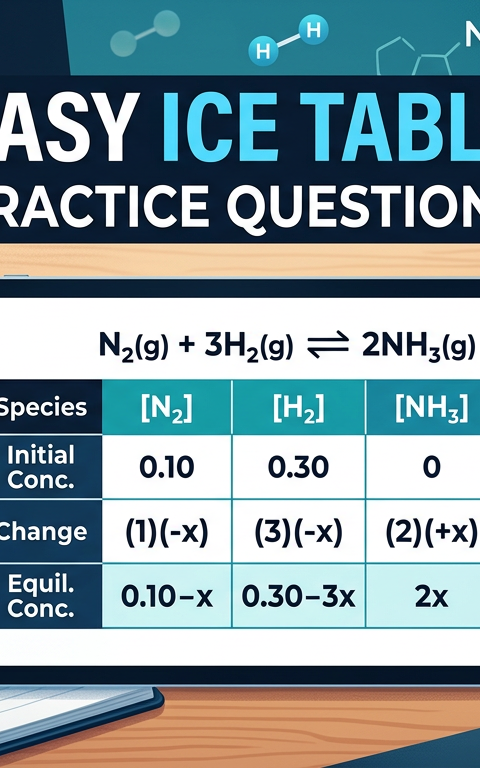
Solving Equilibrium Problems Without Losing Your Stoichiometry
Master chemical equilibrium with these easy ICE table practice questions. Learn to calculate concentrations and K values with step-by-step solved examples.
Mar 30, 2026
Solving Titration Math: From M1V1 to Polyprotic Stoichiometry
Master the basics of neutralization with our easy acid-base titration practice questions. Includes step-by-step solved examples and a quick quiz.
Mar 29, 2026
Stoichiometry of the Flask: Calculating Solute Mass and Dilutions
Master solution preparation with these easy practice questions. Learn to calculate molarity, mass, and dilutions with step-by-step examples and a quick quiz.
Mar 27, 2026
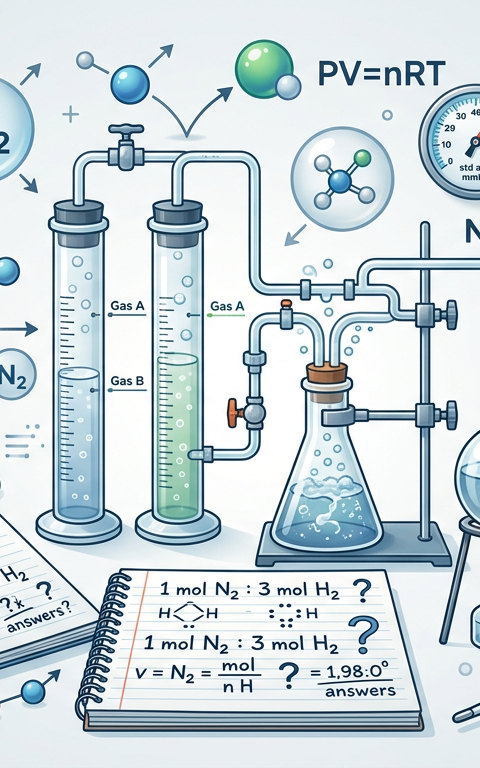
Gas Stoichiometry Practice Questions with Answers
Master gas stoichiometry with our comprehensive guide. Includes solved examples, PV=nRT practice questions, and detailed answers for chemistry students.
Mar 23, 2026
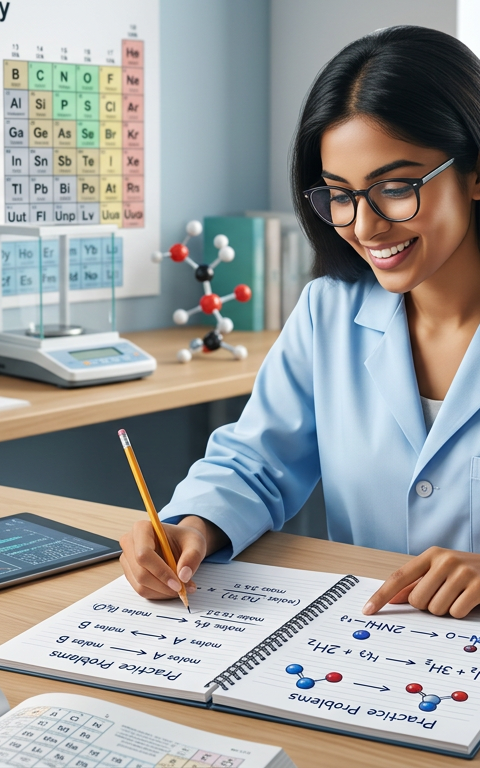
Mole-to-Mole Stoichiometry Practice Questions with Answers
Master mole-to-mole stoichiometry with our comprehensive guide featuring solved examples, practice questions, and detailed explanations for chemistry students.
Mar 23, 2026
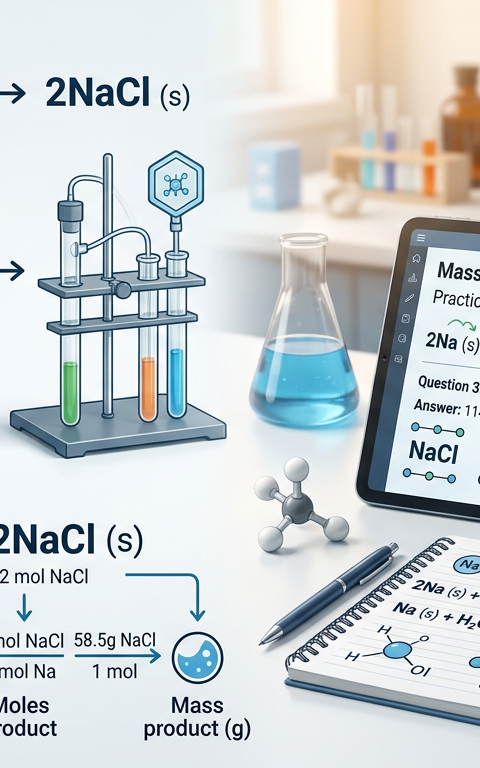
Predicting Reaction Yields: Grams-to-Grams Stoichiometry Guide
Master mass-to-mass stoichiometry with our comprehensive guide. Includes step-by-step solved examples, practice questions, and a quick quiz to test your knowledge.
Mar 21, 2026
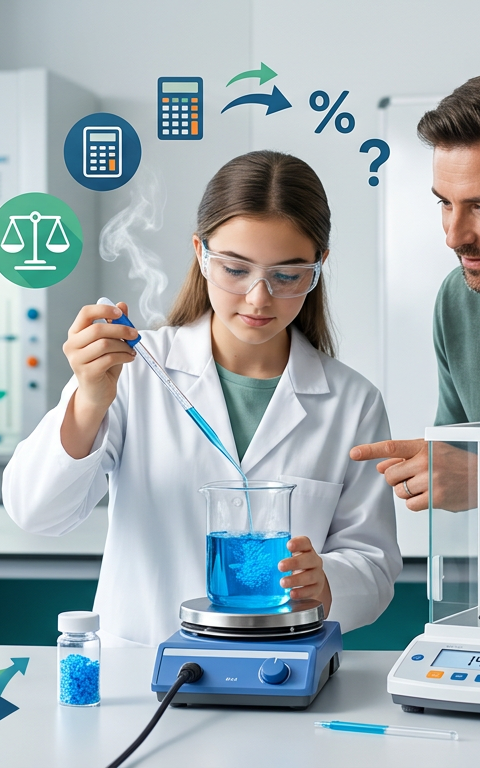
Stoichiometry vs. Reality: Calculating Percent Yield in Chemistry
Master percent yield calculations with our guide. Includes step-by-step solved examples, practice questions, and a quiz to test your chemistry skills.
Mar 21, 2026

Calculating High-Stakes Meds: BSA Mosteller Formula Practice
Master hard body surface area-based dosage calculations with our comprehensive guide, solved examples, and practice questions for healthcare students.
May 17, 2026