Hard Molarity Practice Questions
Concept Explanation
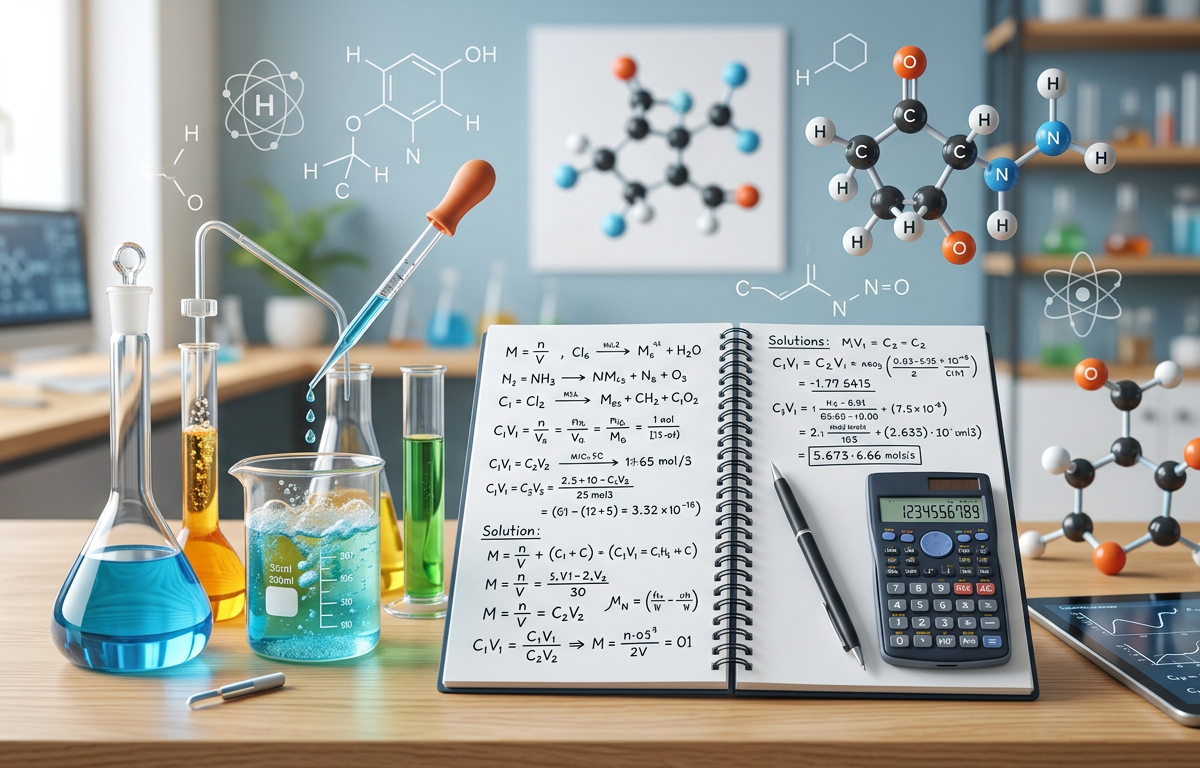
Molarity is the measure of solute concentration in a solution, specifically defined as the number of moles of solute dissolved per liter of solution (mol/L).
While basic molarity involves simple division of moles by volume, hard molarity practice questions require a deep understanding of multi-step conversions, including density, mass percent, and complex stoichiometry. To calculate molarity in advanced scenarios, one must often navigate between units of mass, volume, and particle count. The fundamental formula is M = n / V, where 'M' represents molarity, 'n' is the number of moles of solute, and 'V' is the total volume of the solution in liters. When solving high-level problems, you will frequently need to incorporate the mole concept to convert mass to moles using molar mass.
In analytical chemistry, molarity is critical for preparing reagents and performing titrations. Advanced problems often involve "dilution" (M1V1 = M2V2) or mixing two solutions of different concentrations. It is vital to remember that volumes are not always additive in the real world due to molecular interactions, though most academic problems assume additivity unless density changes are specified. For those looking to master these calculations, understanding stoichiometry practice questions is a prerequisite, as molarity serves as the bridge between volume and reaction stoichiometry.
Solved Examples
Review these detailed solutions to understand the logic required for complex concentration problems.
Example 1: Density and Mass Percent. A concentrated solution of sulfuric acid (H₂SO₄) has a density of 1.84 g/mL and is 98.0% H₂SO₄ by mass. Calculate the molarity.
Assume a volume of 1.00 L (1000 mL) of solution.
Calculate the total mass of the solution: 1000 mL × 1.84 g/mL = 1840 g.
Find the mass of the pure solute: 1840 g × 0.98 = 1803.2 g of H₂SO₄.
Convert mass to moles: 1803.2 g / 98.08 g/mol = 18.38 moles.
Since the volume is 1 L, the Molarity is 18.4 M.
Example 2: Mixing Solutions. If 250 mL of 0.50 M HCl is mixed with 450 mL of 1.2 M HCl, what is the final molarity? (Assume volumes are additive).
Calculate moles in the first solution: 0.250 L × 0.50 mol/L = 0.125 mol.
Calculate moles in the second solution: 0.450 L × 1.2 mol/L = 0.540 mol.
Sum the total moles: 0.125 + 0.540 = 0.665 mol.
Sum the total volume: 0.250 L + 0.450 L = 0.700 L.
Divide total moles by total volume: 0.665 mol / 0.700 L = 0.95 M.
Example 3: Precipitation Stoichiometry. How many milliliters of 0.250 M BaCl₂ are required to react completely with 50.0 mL of 0.150 M Na₂SO₄?
Write the balanced equation: BaCl₂ + Na₂SO₄ → BaSO₄ + 2NaCl.
Calculate moles of Na₂SO₄: 0.050 L × 0.150 M = 0.0075 mol.
Use the 1:1 mole ratio: 0.0075 mol Na₂SO₄ requires 0.0075 mol BaCl₂.
Calculate volume of BaCl₂: 0.0075 mol / 0.250 M = 0.030 L.
Convert to mL: 30.0 mL.
Practice Questions
Test your skills with these hard molarity practice questions. Ensure you have a periodic table and calculator ready.
A solution of phosphoric acid (H₃PO₄) is 35.0% by mass and has a density of 1.209 g/mL. What is the molarity of this solution?
Calculate the final concentration of chloride ions (Cl⁻) when 150 mL of 0.20 M AlCl₃ is mixed with 250 mL of 0.50 M MgCl₂.
How many grams of solid NaOH (97% purity) are needed to prepare 500 mL of a 0.125 M solution?
Want unlimited practice questions like these?
Generate AI-powered questions with step-by-step solutions on any topic.
Try Question Generator Free →A 25.00 mL sample of an unknown HBr solution is titrated with 0.150 M KOH. If 18.45 mL of the base is required to reach the equivalence point, what is the molarity of the HBr?
What volume of water must be added to 150 mL of 6.0 M HCl to dilute it to a concentration of 0.50 M?
A solution is prepared by dissolving 12.5 g of Na₂SO₄ in enough water to make 750 mL of solution. If the density of the final solution is 1.08 g/mL, calculate the molality (m) and then the molarity (M).
How many milliliters of 0.100 M AgNO₃ are needed to react with 25.0 mL of 0.0500 M CaCl₂ to precipitate all the chloride ions?
If a solution of glucose (C₆H₁₂O₆) has a molarity of 1.50 M and a density of 1.12 g/mL, what is the mass percent of glucose in the solution?
You mix 100 mL of 2.0 M HCl with 200 mL of 0.5 M HCl and then boil the solution until the volume is reduced to 150 mL. What is the new molarity?
A sample of 0.842 g of an unknown dicarboxylic acid (H₂A) requires 35.62 mL of 0.250 M NaOH for complete neutralization. Calculate the molar mass of the acid.
Answers & Explanations
Compare your results with the step-by-step logic below to identify any errors in your calculation process.
1. Answer: 4.32 M. Assume 1 L of solution. Mass = 1000 mL × 1.209 g/mL = 1209 g. Mass of solute = 1209 g × 0.35 = 423.15 g. Moles = 423.15 g / 97.99 g/mol = 4.318 mol. Molarity = 4.32 M.
2. Answer: 1.15 M Cl⁻. Moles Cl⁻ from AlCl₃ = 0.150 L × 0.20 M × 3 = 0.090 mol. Moles Cl⁻ from MgCl₂ = 0.250 L × 0.50 M × 2 = 0.250 mol. Total moles = 0.340 mol. Total volume = 0.400 L. Molarity = 0.340 / 0.400 = 0.85 M. Correction: Sum is 0.340/0.4 = 0.85M. (Wait, let's re-calculate: 0.15*0.2*3 = 0.09; 0.25*0.5*2 = 0.25; 0.09+0.25=0.34. 0.34/0.4 = 0.85 M).
3. Answer: 2.58 g. Required moles = 0.500 L × 0.125 M = 0.0625 mol. Mass pure NaOH = 0.0625 × 39.997 = 2.50 g. Since it is 97% pure, mass needed = 2.50 / 0.97 = 2.58 g.
4. Answer: 0.111 M. Moles KOH = 0.01845 L × 0.150 M = 0.0027675 mol. Mole ratio is 1:1. Molarity HBr = 0.0027675 mol / 0.025 L = 0.1107 M.
5. Answer: 1650 mL. M1V1 = M2V2 → 6.0 × 150 = 0.50 × V2. V2 = 1800 mL. Water to add = 1800 - 150 = 1650 mL.
6. Answer: 0.117 M. Moles Na₂SO₄ = 12.5 g / 142.04 g/mol = 0.0880 mol. Molarity = 0.0880 mol / 0.750 L = 0.117 M.
7. Answer: 25.0 mL. Moles Cl⁻ = 0.025 L × 0.050 M × 2 = 0.0025 mol. Ag⁺ reacts 1:1 with Cl⁻. Volume AgNO₃ = 0.0025 mol / 0.100 M = 0.025 L = 25.0 mL.
8. Answer: 24.1%. Assume 1 L. Mass solution = 1120 g. Moles glucose = 1.50 mol. Mass glucose = 1.50 × 180.16 = 270.24 g. Mass % = (270.24 / 1120) × 100 = 24.1%.
9. Answer: 2.0 M. Moles 1 = 0.1 × 2 = 0.2. Moles 2 = 0.2 × 0.5 = 0.1. Total moles = 0.3. New volume = 0.150 L. Molarity = 0.3 / 0.150 = 2.0 M.
10. Answer: 189.1 g/mol. Moles OH⁻ = 0.03562 L × 0.250 M = 0.008905 mol. Since it is a dicarboxylic acid, moles acid = 0.008905 / 2 = 0.0044525 mol. Molar mass = 0.842 g / 0.0044525 mol = 189.1 g/mol.
1. Which of the following would increase the molarity of a solution?
Frequently Asked Questions
How does temperature affect molarity?
Molarity is temperature-dependent because liquid volume expands or contracts as temperature changes. Since the number of moles remains constant while the volume changes, the molarity will decrease slightly as temperature increases and increase as it cools.
What is the difference between molarity and molality?
Molarity (M) measures moles per liter of solution, whereas molality (m) measures moles per kilogram of solvent. Molality is preferred in thermodynamics because it does not vary with temperature or pressure.
Can molarity be greater than 1?
Yes, molarity often exceeds 1 in concentrated solutions; for example, concentrated hydrochloric acid is approximately 12 M, and concentrated sulfuric acid is about 18 M. The limit is determined by the solubility of the solute in the specific solvent at a given temperature.
How do you calculate molarity when mixing two different solutes?
When mixing different solutes, you calculate the molarity for each species independently by dividing its specific number of moles by the total final volume of the mixture. This is common when calculating ion concentrations in acid-base titration practice questions.
Why is molarity used more often than mass percent in labs?
Molarity is more practical for laboratory work because it allows scientists to measure out specific amounts of a chemical by volume using glassware like pipettes and burettes. This is much faster and more convenient than weighing solutions on a balance for every reaction step.
Want unlimited practice questions like these?
Generate AI-powered questions with step-by-step solutions on any topic.
Try Question Generator Free →Enjoyed this article?
Share it with others who might find it helpful.
Related Articles
Easy Molarity Practice Questions
Master molarity with these easy practice questions. Learn the M=n/V formula, volume conversions, and step-by-step solutions for chemistry students.
Mar 26, 2026
Medium Molarity Practice Questions
Master medium-level molarity problems with our comprehensive guide. Includes step-by-step solved examples, practice questions, and a quick quiz to test your skills.
Mar 26, 2026
Molarity Practice Questions with Answers
Master molarity with our comprehensive guide featuring clear explanations, step-by-step solved examples, and 10 practice questions with detailed answers.
Mar 26, 2026
Molarity vs Molality: The Essential Difference Explained
Master the difference between molarity vs molality. Learn the formulas, key differences, and when to use each in this comprehensive chemistry guide.
Mar 26, 2026
Why Molarity Matters: Converting Mass to Moles for Lab Solutions
Master chemistry with our guide to the molarity formula. Learn how to calculate concentration with step-by-step examples, units, and practical lab tips.
Mar 26, 2026
Avoid These 7 Common Molarity Mistakes in Chemistry
Master chemistry calculations! Avoid common molarity mistakes with our expert guide on unit conversions, dilution errors, and proper lab techniques.
Mar 26, 2026

How to Solve Molarity Problems: Step-by-Step Mastery
Learn how to solve molarity problems step-by-step with formulas, unit tips, and worked examples so you can calculate concentration with confidence.
Mar 26, 2026

Why Molarity Ratios Fail: Solving the Moles per Liter Logic Gap
Master molarity with ease. Discover why chemistry students struggle with concentration units and learn proven strategies to solve molarity problems fast.
Mar 26, 2026