Acid-Base Titration Practice Questions with Answers
Concept Explanation
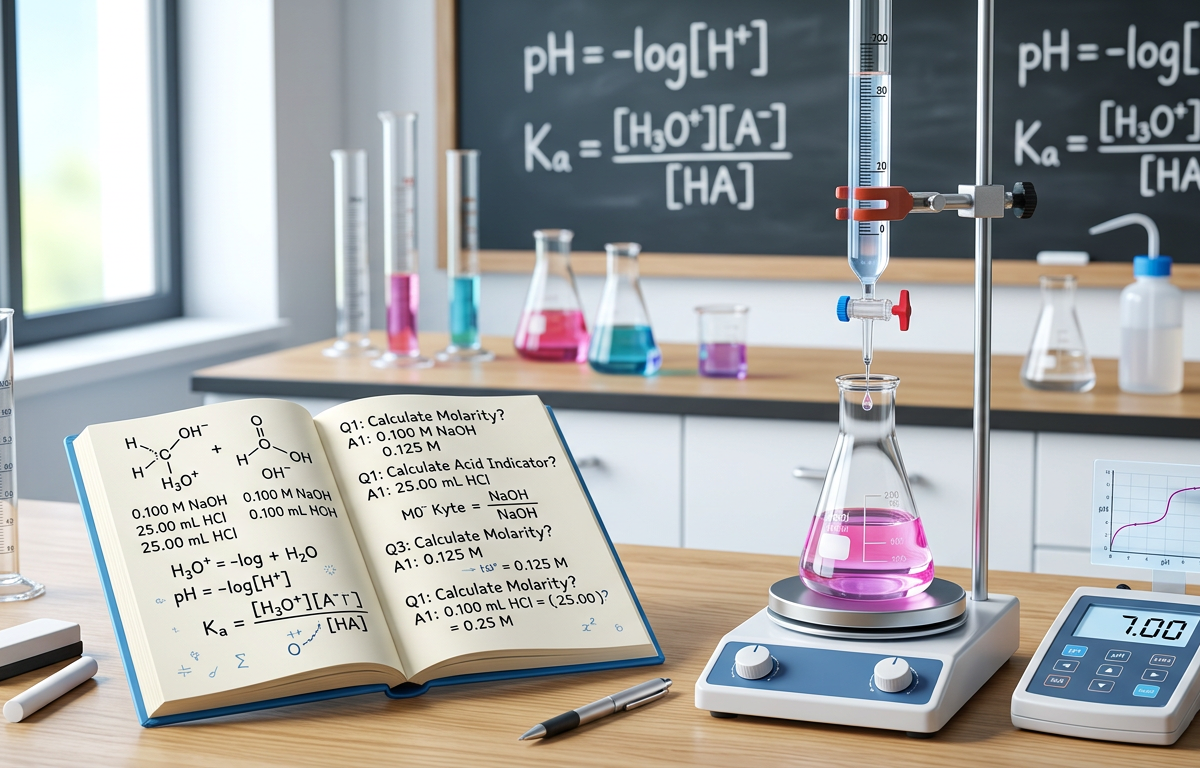
Acid-base titration is a quantitative analytical technique used to determine the unknown concentration of an acid or a base by reacting it with a standard solution of known concentration. This process relies on the neutralization reaction between hydrogen ions (H+) and hydroxide ions (OH-), which yields water and a salt. To identify the point where the reaction is stoichiometrically complete—known as the equivalence point—chemists use a pH indicator or a pH meter. Mastering this technique requires a solid understanding of stoichiometry practice questions and the ability to perform precise volumetric measurements. A successful titration involves carefully adding the titrant from a buret into the analyte until the end point is reached, signaling that the neutralization is finished.
Key terms in acid-base titration include:
Titrant: The solution with a known concentration, usually placed in the buret.
Analyte: The solution with an unknown concentration, usually placed in an Erlenmeyer flask.
Equivalence Point: The stage where the moles of acid exactly equal the moles of base according to the balanced chemical equation.
End Point: The physical point during the titration where an indicator changes color, ideally coinciding with the equivalence point.
According to LibreTexts Chemistry, the shape of a titration curve (a plot of pH vs. volume of titrant) depends on the strengths of the acid and base involved. For example, a strong acid-strong base titration will have an equivalence point at exactly pH 7.0, while a weak acid-strong base titration will have an equivalence point in the basic range (pH > 7).
Solved Examples
The following examples demonstrate how to apply molarity and stoichiometry to solve titration problems.
Example 1: Strong Acid-Strong Base Titration
Calculate the molarity of a 25.0 mL HCl solution if it requires 32.5 mL of 0.150 M NaOH to reach the equivalence point.
Write the balanced equation: HCl + NaOH → NaCl + H2O.
Calculate moles of NaOH: Moles = Molarity × Volume (L) = 0.150 mol/L × 0.0325 L = 0.004875 mol.
Use the 1:1 mole ratio to find moles of HCl: 0.004875 mol NaOH × (1 mol HCl / 1 mol NaOH) = 0.004875 mol HCl.
Calculate molarity of HCl: Molarity = Moles / Volume (L) = 0.004875 mol / 0.0250 L = 0.195 M.
Example 2: Titrating with a Diprotic Acid
How many milliliters of 0.200 M KOH are needed to neutralize 15.0 mL of 0.100 M H2SO4?
Write the balanced equation: H2SO4 + 2KOH → K2SO4 + 2H2O.
Calculate moles of H2SO4: 0.100 mol/L × 0.0150 L = 0.00150 mol.
Use the mole ratio practice questions logic to find moles of KOH needed: 0.00150 mol H2SO4 × (2 mol KOH / 1 mol H2SO4) = 0.00300 mol KOH.
Calculate volume of KOH: Volume (L) = Moles / Molarity = 0.00300 mol / 0.200 mol/L = 0.0150 L or 15.0 mL.
Example 3: Standardization of a Base
A student uses 0.450 g of potassium hydrogen phthalate (KHP, molar mass = 204.22 g/mol) to standardize a NaOH solution. If 22.1 mL of NaOH is used to reach the end point, what is the molarity of the NaOH?
Write the balanced equation: KHP + NaOH → NaKP + H2O (1:1 ratio).
Calculate moles of KHP: 0.450 g / 204.22 g/mol = 0.002203 mol.
Since the ratio is 1:1, moles of NaOH = 0.002203 mol.
Calculate molarity of NaOH: 0.002203 mol / 0.0221 L = 0.0997 M.
Practice Questions
Test your knowledge with these acid-base titration practice questions. Use the principles of active recall studying to test yourself before checking the answers.
A 50.0 mL sample of HNO3 is titrated with 0.125 M NaOH. If 43.2 mL of the base is required, what is the molarity of the acid?
How many grams of Ca(OH)2 are required to neutralize 250 mL of 0.500 M HCl?
If 15.0 mL of 0.250 M H3PO4 is titrated with 0.100 M NaOH, what volume of NaOH is required for complete neutralization?
Want unlimited practice questions like these?
Generate AI-powered questions with step-by-step solutions on any topic.
Try Question Generator Free →A 20.0 mL sample of 0.150 M acetic acid (CH3COOH) is titrated with 0.100 M NaOH. What is the pH at the equivalence point? (Hint: Consider the salt formed).
Calculate the concentration of an unknown Ba(OH)2 solution if 35.0 mL of it is neutralized by 28.4 mL of 0.500 M HCl.
What volume of 0.100 M HCl is needed to titrate 0.200 grams of Na2CO3 to the second equivalence point? (Molar mass of Na2CO3 = 105.99 g/mol).
In a titration of 25.0 mL of 0.100 M NH3 with 0.100 M HCl, what is the pH after adding 12.5 mL of HCl?
A 10.0 mL sample of vinegar (acetic acid) requires 35.2 mL of 0.100 M NaOH for titration. Calculate the mass percent of acetic acid in the vinegar (assume density = 1.00 g/mL).
What is the molarity of a lithium hydroxide solution if 20.0 mL is neutralized by 15.5 mL of 0.200 M H2SO4?
A chemist titrates 40.0 mL of 0.125 M NaOH with 0.250 M HCl. What is the pH after 10.0 mL of HCl has been added?
Answers & Explanations
0.108 M: Moles NaOH = 0.0432 L × 0.125 M = 0.0054 mol. Ratio is 1:1, so moles HNO3 = 0.0054. Molarity = 0.0054 mol / 0.050 L = 0.108 M.
4.63 g: Moles HCl = 0.250 L × 0.500 M = 0.125 mol. Ratio is 2 HCl : 1 Ca(OH)2. Moles base = 0.125 / 2 = 0.0625 mol. Mass = 0.0625 mol × 74.09 g/mol = 4.63 g.
112.5 mL: Moles H3PO4 = 0.015 L × 0.250 M = 0.00375 mol. Ratio is 1 acid : 3 NaOH. Moles NaOH = 0.01125 mol. Volume = 0.01125 mol / 0.100 M = 0.1125 L.
pH > 7 (Approx 8.72): At the equivalence point, the weak acid is converted to its conjugate base (CH3COO-), which undergoes hydrolysis to produce OH- ions, making the solution basic.
0.203 M: Moles HCl = 0.0284 L × 0.500 M = 0.0142 mol. Ratio is 2 HCl : 1 Ba(OH)2. Moles base = 0.0071 mol. Molarity = 0.0071 mol / 0.0350 L = 0.203 M.
37.7 mL: Moles Na2CO3 = 0.200 g / 105.99 g/mol = 0.001887 mol. Reaction to second point requires 2 moles HCl per mole carbonate. Moles HCl = 0.003774 mol. Volume = 0.003774 mol / 0.100 M = 0.03774 L.
pH = 9.25 (pKa of NH4+): At 12.5 mL, we are at the half-equivalence point. Here, [NH3] = [NH4+], so pH = pKa. According to Khan Academy, this is the buffer region.
2.11%: Moles NaOH = 0.0352 L × 0.100 M = 0.00352 mol = moles acetic acid. Mass = 0.00352 mol × 60.05 g/mol = 0.211 g. Mass percent = (0.211 g / 10 g) × 100 = 2.11%.
0.310 M: Moles H2SO4 = 0.0155 L × 0.200 M = 0.0031 mol. Ratio is 1:2. Moles LiOH = 0.0062 mol. Molarity = 0.0062 mol / 0.020 L = 0.310 M.
pH = 12.00: Initial moles OH- = 0.040 L × 0.125 M = 0.005 mol. Moles H+ added = 0.010 L × 0.250 M = 0.0025 mol. Excess OH- = 0.0025 mol. Total volume = 0.050 L. [OH-] = 0.0025 / 0.050 = 0.05 M. pOH = 1.3, pH = 12.7.
Frequently Asked Questions
What is the difference between the equivalence point and the end point?
The equivalence point is the theoretical stage where the moles of titrant and analyte are stoichiometrically equal. The end point is the actual stage during the experiment where the indicator changes color, which should ideally be as close to the equivalence point as possible.
Why is phenolphthalein often used in weak acid-strong base titrations?
Phenolphthalein changes color in the pH range of 8.2 to 10.0. Since the equivalence point of a weak acid-strong base titration is typically basic (above pH 7), this indicator accurately signals the completion of the reaction.
How do you choose the right indicator for a titration?
The best indicator is one whose pKa is close to the pH at the equivalence point of the titration. This ensures that the color change happens exactly when the stoichiometric neutralization is reached.
Can you perform a titration without a chemical indicator?
Yes, titrations can be performed using a pH meter to record the pH after each addition of titrant. The equivalence point is then found by identifying the point of steepest slope on the titration curve or by using a first-derivative plot.
What is a primary standard in titration?
A primary standard is a highly pure, stable, and non-hygroscopic solid used to prepare a solution of known concentration. It serves as the reference material to determine the concentration of other titrants through standardization.
What causes a titration curve to have multiple equivalence points?
Multiple equivalence points occur when titrating polyprotic acids (like H3PO4) or bases. Each point corresponds to the removal or addition of a single proton (H+) in successive steps.
Want unlimited practice questions like these?
Generate AI-powered questions with step-by-step solutions on any topic.
Try Question Generator Free →Enjoyed this article?
Share it with others who might find it helpful.
Related Articles
Medium Acid-Base Titration Practice Questions
Master medium acid-base titration practice questions with step-by-step solutions, pH calculations, and stoichiometry tips for chemistry students.
Mar 29, 2026
Hard Acid-Base Titration Practice Questions
Master complex chemistry with our hard acid-base titration practice questions. Includes step-by-step solutions for weak acid/base and polyprotic problems.
Mar 29, 2026
Solving Titration Math: From M1V1 to Polyprotic Stoichiometry
Master the basics of neutralization with our easy acid-base titration practice questions. Includes step-by-step solved examples and a quick quiz.
Mar 29, 2026

Calculating High-Stakes Meds: BSA Mosteller Formula Practice
Master hard body surface area-based dosage calculations with our comprehensive guide, solved examples, and practice questions for healthcare students.
May 17, 2026

Solving High-Stakes IV Titrations and Weight-Based Infusions
Master advanced IV flow rate calculations with these hard practice questions. Covers weight-based dosing, titrations, and dimensional analysis for nurses.
May 17, 2026

Solving Weight-Based Dosing: The 2.2 Conversion and Rounding Logic
Weight-Based Dosage Calculations Practice Questions with Answers
May 17, 2026
Predicting Periodic Anomalies: Beyond Basic Trend Rules
Hard Periodic Trends Practice Questions
Apr 4, 2026

Hard Electron Configuration Practice Questions
Hard Electron Configuration Practice Questions
Apr 4, 2026