How to Solve Molarity Problems: Step-by-Step Mastery

If you’re trying to learn how to solve molarity problems step-by-step, you don’t need more “tips.” You need a repeatable method, the three or four equations that actually show up, and enough worked examples to spot patterns fast. This piece gives you exactly that, plus the traps that quietly ruin scores on chemistry tests.
Molarity problems look different on the surface (grams here, dilution there, titration somewhere else), but they usually collapse into the same moves: convert to moles, get volume in liters, and apply the molarity formula with clean molarity units mol L. Once you see that, solution concentration chemistry stops feeling like a guessing game.
1. What “Molarity” Means (and Why It Matters)
Molarity means “moles of solute per liter of solution” (mol/L). If a solution is 2.0 M NaCl, that means every 1.0 L of the final solution contains 2.0 moles of NaCl dissolved in it, not 2.0 moles per liter of water, and not per liter of solvent.
You’ll see molarity in lab directions (“prepare 250.0 mL of 0.100 M HCl”), in real-world mixing tasks (pool chemicals, disinfectant dilution), and constantly in exams because molarity connects mass, volume, and reaction math. A typical test question might hide the volume in mL, the solute in grams, and the goal in mol/L, so you have to translate the language into the same few steps.
Solute vs solvent vs solution causes a lot of early confusion. The solute is what you dissolve (like NaCl). The solvent is what does the dissolving (often water). The solution is the final mixture, and its final volume is what matters for molarity.
How does molarity compare to other concentration units?
Molarity (M) = moles solute / liters of solution. Depends on volume, so it can change with temperature (because volume expands/contracts).
Molality (m) = moles solute / kilograms of solvent. Doesn’t depend on volume, so it stays steadier with temperature.
Mass percent = (mass solute / mass solution) × 100%. Common in consumer products and mixture labels.
Quick decision guide: if the problem gives volume in liters or mL and asks for “M” or “molarity,” it wants molarity. If it gives mass of solvent in kg and talks about temperature-dependent properties (like boiling point elevation), it’s likely molality. If it gives grams and asks “percent,” it’s mass percent.
For a deeper “why is this confusing?” breakdown, see why students struggle with molarity (and how to fix it fast).
2. The Core Molarity Formula and Rearrangements
The molarity formula is M = n / V. That’s it. Most molarity problems are just different costumes for that same relationship.
Here’s what each symbol means:
M = molarity, with molarity units mol L (mol/L)
n = moles of solute (mol)
V = liters of solution (L)
You’ll also use two rearrangements constantly:
n = M · V (when you need moles)
V = n / M (when you need volume)
If you hate memorizing rearrangements, use either algebra or the “cover-up” method. Cover the variable you want, and whatever remains tells you what to do. Cover n in M = n/V, and you see n = M·V. Cover V, and you see V = n/M.
Unit consistency is the #1 cause of wrong answers. Volume must be in liters, not milliliters, unless you keep it consistent in special cases like dilution where the units cancel.
Quick conversions you’ll use all the time:
1 L = 1000 mL
1 mL = 0.001 L
When you feel shaky on units or conversions, anchor yourself with dimensional analysis. Chemistry LibreTexts has solid reference explanations and examples if you want extra practice on unit logic.
3. Step-by-Step Method to Solve Any Molarity Problem
The most reliable way to solve molarity problems is to run the same checklist every time. This is the heart of how to solve molarity problems step-by-step, and it works for basic calculate molarity questions, moles to molarity conversions, dilution problems M1V1 M2V2, and even titrations.
Use this repeatable checklist (you can literally write “1–6” down the side of your paper):
Circle the target. What are you solving for M, n (moles), V, grams, or a final concentration?
List the givens with units. Write numbers with labels: “0.250 L,” “15.0 g,” “0.100 M.” No naked numbers.
Convert units early. mL → L, g → mol (if needed), and make sure volumes refer to final solution volume.
Convert grams ↔ moles if needed. Use molar mass from the periodic table: moles = grams ÷ (g/mol).
Choose the correct equation.
Basic molarity: M = n/V
Dilution problems M1V1 M2V2: M1V1 = M2V2
Mixing: add moles, then divide by total volume
Reaction-based: M → moles → stoichiometry → moles → M
Solve, label units, and sanity-check. Does the magnitude make sense? Did you accidentally use mL as L? Did dilution increase volume and lower concentration?
Dimensional analysis as a built-in lie detector: track units like algebra. If you’re calculating molarity, your final units must land on mol/L. If they don’t, something went off the rails.
Calculator and rounding tip: don’t round mid-problem unless the question demands it. Keep a few extra digits, then round at the end based on the least precise measurement (general significant figure logic). The U.S. National Institute of Standards and Technology has a useful reference on units and measurement thinking at NIST.
4. Worked Examples: Basic Molarity Calculations
Basic molarity problems use M = n/V with moles and liters. These are the cleanest reps you can do before the problems start mixing in grams, reactions, or dilution.
Example 1: Find molarity from moles and liters
Problem: You dissolve 0.750 mol of KCl to make 0.500 L of solution. What is the molarity?
Step-by-step:
Circle the target: M
Givens: n = 0.750 mol, V = 0.500 L
Use M = n/V
M = 0.750 mol ÷ 0.500 L = 1.50 mol/L = 1.50 M
Pattern for next time: If they hand you moles and liters, divide moles by liters.
Example 2: Find moles needed for a target molarity and volume
Problem: How many moles of glucose (C6H12O6) are needed to prepare 250.0 mL of a 0.200 M solution?
Step-by-step:
Circle the target: n (moles)
Convert volume: 250.0 mL = 0.2500 L
Use n = M·V
n = (0.200 mol/L)(0.2500 L) = 0.0500 mol
Pattern for next time: When you need moles, multiply molarity by liters of solution.
Example 3: Find volume required for given moles and molarity
Problem: What volume of 0.750 M NaNO3 contains 0.300 mol NaNO3?
Step-by-step:
Circle the target: V
Use V = n/M
V = 0.300 mol ÷ 0.750 mol/L = 0.400 L
Optional conversion: 0.400 L = 400 mL
Pattern for next time: When you need liters, divide moles by molarity.
5. Grams-to-Molarity Problems (Using Molar Mass)
Grams-to-molarity problems always go grams → moles → molarity. If you try to skip the middle step, you’ll usually end up dividing grams by liters and getting nonsense units.
First, you need molar mass. You compute it by adding atomic masses from the periodic table using the formula subscripts.
Common pitfalls:
Subscripts multiply. In CaCl2, you have 2 Cl atoms.
Parentheses multiply everything inside. In Al2(SO4)3, the “3” multiplies both S and O4.
Don’t round atomic masses too early. Keep sensible precision.
If you want a trustworthy molar mass reference table, you can cross-check atomic masses at PubChem (NIH), which is widely used and stable.
Example 4: Given grams of solute and solution volume, find molarity
Problem: You dissolve 5.85 g of NaCl to make 500.0 mL of solution. Find molarity.
Step-by-step:
Circle the target: M
Convert volume: 500.0 mL = 0.5000 L
Find molar mass: NaCl ≈ 22.99 + 35.45 = 58.44 g/mol
Convert grams → moles: n = 5.85 g ÷ 58.44 g/mol = 0.1001 mol
Calculate molarity: M = n/V = 0.1001 mol ÷ 0.5000 L = 0.200 M
Molar-mass mini-check: NaCl around 58.4 g/mol is a classic value. If you got 584 g/mol, a subscript probably went missing.
Pattern for next time: Convert grams to moles first, then divide by liters.
Example 5: Given molarity and volume, find grams needed to prepare a solution
Problem: How many grams of KNO3 are needed to prepare 250.0 mL of 0.150 M KNO3?
Step-by-step:
Circle the target: grams
Convert volume: 250.0 mL = 0.2500 L
Find moles needed: n = M·V = (0.150)(0.2500) = 0.03750 mol
Molar mass: KNO3 ≈ 39.10 + 14.01 + 48.00 = 101.11 g/mol
Convert moles → grams: grams = 0.03750 mol × 101.11 g/mol = 3.79 g
Preparation framing: “Weigh 3.79 g KNO3, dissolve in water, then dilute to a final volume of 250.0 mL.” That last clause matters because volume is the final solution, not the initial water amount.
If you want more practice on the grams-to-moles link that drives these, pair this with moles to grams practice questions with answers and mole concept practice questions with answers.
6. Dilution (M1V1 = M2V2) Step-by-Step
You can use M1V1 = M2V2 when you dilute the same solute by adding solvent. That means no reaction, no solute change, just spreading the same moles into a bigger volume.
Why does it work? Because moles of solute stay constant during a dilution.
Before: n = M1V1
After: n = M2V2
Set them equal: M1V1 = M2V2
Volume units tip: in dilution problems, volumes can be mL or L, and they’ll cancel as long as you use the same unit for V1 and V2. Still, writing units prevents mistakes.
Example 6: Making a dilute solution from a stock solution
Problem: You have 6.00 M HCl stock. What volume of stock is needed to prepare 250.0 mL of 0.500 M HCl?
Step-by-step:
Circle the target: V1 (stock volume)
Givens: M1 = 6.00 M, M2 = 0.500 M, V2 = 250.0 mL
Use M1V1 = M2V2
V1 = (M2V2)/M1 = (0.500 × 250.0 mL)/6.00 = 20.8 mL
Lab phrasing: “Pipet 20.8 mL of 6.00 M HCl into a volumetric flask and fill to 250.0 mL.”
Sanity check: concentration dropped from 6.00 M to 0.500 M, so volume had to increase a lot. Using only 20.8 mL of stock makes sense.
Example 7: Finding the stock concentration from dilution data
Problem: A student uses 35.0 mL of a sugar solution and dilutes it to 200.0 mL. The final concentration is 0.140 M. What was the original molarity?
Step-by-step:
Circle the target: M1
Use M1V1 = M2V2
M1 = (M2V2)/V1 = (0.140 × 200.0 mL)/35.0 mL = 0.800 M
Pattern for next time: dilution problems M1V1 M2V2 are “moles stay the same”, solve for the missing piece.
7. Mixing Solutions: Finding Final Concentration
To find molarity after mixing, add moles from each portion, then divide by total volume. Students often try to “average the molarities,” and that fails unless the volumes are equal.
The workhorse setup:
Convert each solution to moles: n = M·V
Add moles: ntotal = n1 + n2
Add volumes (intro assumption): Vtotal = V1 + V2
Compute final molarity: Mfinal = ntotal/Vtotal
This is the cleanest way to handle mixing molarity problems on homework and exams, where volumes are usually treated as additive. Real labs can deviate slightly due to contraction/expansion, but intro problems ignore that.
Example 8: Mixing two solutions of the same solute
Problem: Mix 100.0 mL of 0.200 M NaCl with 300.0 mL of 0.500 M NaCl. Find the final molarity.
Step-by-step:
Convert volumes to liters: 0.1000 L and 0.3000 L
Find moles from each:
n1 = 0.200 × 0.1000 = 0.0200 mol
n2 = 0.500 × 0.3000 = 0.150 mol
Add moles: ntotal = 0.170 mol
Add volumes: Vtotal = 0.4000 L
Mfinal = 0.170 ÷ 0.4000 = 0.425 M
Common trap: (0.200 + 0.500)/2 = 0.350 M is wrong because the 0.500 M portion had 3× the volume and dominates the mixture.
Example 9: Adding solid solute to a solution (conceptual approach)
Answer: Treat the solid as additional moles, then divide by final volume (if given).
Mini-problem: You add 0.050 mol NaCl to 0.200 L of 0.500 M NaCl and assume the volume stays 0.200 L. What’s the new molarity?
Original moles: n = M·V = 0.500 × 0.200 = 0.100 mol
New total moles: 0.100 + 0.050 = 0.150 mol
New molarity: 0.150 mol ÷ 0.200 L = 0.750 M
Want targeted sets on these patterns? Use molarity practice questions with answers and, when you’re ready, hard molarity practice questions.
8. Limiting Reagent and Reaction-Based Molarity Problems
Reaction-based molarity problems follow a predictable pipeline: M → moles → mole ratio → moles → M. If you keep that chain intact, the stoichiometry doesn’t feel like a maze.
Use this flowchart every time:
Step A: Convert each solution amount to moles: n = M·V
Step B: Balance the chemical equation (first, always)
Step C: Use coefficients to convert moles of reactant ↔ moles of product (or to find the limiting reagent)
Step D: Convert final moles to final molarity: M = n/Vfinal
If limiting reagent is involved, you’re basically asking: which reactant runs out first given the stoichiometric ratio?
Example 10: Using molarity to find moles of reactant consumed (1:1 reaction)
Problem: HCl(aq) + NaOH(aq) → NaCl(aq) + H2O(l). If 25.0 mL of 0.200 M HCl reacts completely with excess NaOH, how many moles of NaOH are consumed?
Step-by-step:
Convert volume: 25.0 mL = 0.0250 L
Moles HCl: n = 0.200 × 0.0250 = 0.00500 mol
Mole ratio (1:1): moles NaOH consumed = moles HCl = 0.00500 mol
Pattern for next time: Convert M·V to moles, then apply the balanced equation coefficients.
Example 11: Finding molarity of a product solution after reaction (simple 1:2 ratio)
Problem: H2SO4(aq) + 2 NaOH(aq) → Na2SO4(aq) + 2 H2O(l). You mix 50.0 mL of 0.100 M H2SO4 with 100.0 mL of 0.150 M NaOH. Assume volumes add. Find the molarity of Na2SO4 produced.
Step-by-step:
Convert volumes: 0.0500 L and 0.1000 L
Moles H2SO4: 0.100 × 0.0500 = 0.00500 mol
Moles NaOH: 0.150 × 0.1000 = 0.0150 mol
Find limiting reagent using the 1:2 ratio:
0.00500 mol H2SO4 needs 0.0100 mol NaOH
You have 0.0150 mol NaOH, so H2SO4 is limiting
Moles Na2SO4 produced (1:1 with H2SO4): 0.00500 mol
Total volume: 0.0500 + 0.1000 = 0.1500 L
Molarity: 0.00500 ÷ 0.1500 = 0.0333 M
If stoichiometry steps feel slow, practice the reaction pipeline with stoichiometry practice questions with answers and limiting reagent practice questions with answers.
9. Titration-Style Problems (Acid–Base Molarity)
Titration problems ask you to use the equivalence point to relate moles of acid and base. At equivalence, the reacting species have been mixed in exact stoichiometric proportions, no excess of the limiting neutralization partner.
The backbone is simple:
Convert volumes to liters
Compute moles from M·V for the known solution (often the titrant)
Use the balanced equation to convert to moles of the unknown
Compute unknown molarity: M = n/V
Example 12: Finding unknown molarity from titration data
Problem: A 25.00 mL sample of HCl is titrated with 0.1000 M NaOH. It takes 18.60 mL of NaOH to reach equivalence. Find the molarity of the HCl.
Step-by-step:
Balanced equation: HCl + NaOH → NaCl + H2O (1:1)
Convert titrant volume: 18.60 mL = 0.01860 L
Moles NaOH delivered: n = 0.1000 × 0.01860 = 0.001860 mol
At equivalence (1:1): moles HCl = 0.001860 mol
Convert analyte volume: 25.00 mL = 0.02500 L
Molarity HCl: M = 0.001860 ÷ 0.02500 = 0.07440 M
Common titration pitfalls:
Using the wrong volume. Use the delivered titrant volume (from the buret) to find titrant moles.
Forgetting coefficients. H2SO4 needs 2 NaOH; that “2” changes everything.
Skipping the mL → L conversion in M·V, which inflates moles by 1000×.
For more titration-style practice, pair this article with acid-base titration practice questions with answers.
10. Common Mistakes in Molarity Problems (and How to Avoid Them)
Most molarity mistakes come from units, not chemistry. Fixing them is less about being “smart” and more about being consistent.
Mistake: Treating 250 mL as 250 L → Fix: Convert first: 250 mL = 0.250 L.
Mistake: Using solvent volume instead of solution volume → Fix: M uses liters of final solution.
Mistake: Plugging grams into M = n/V → Fix: Convert grams → moles using molar mass.
Mistake: Averaging molarities directly when mixing → Fix: Add moles, then divide by total volume (weighted by volume automatically).
Mistake: Rounding too early → Fix: Keep guard digits and round once at the end.
Before you finalize an answer, ask yourself:
Do my final units make sense (mol/L for molarity)?
Did I convert mL to L anywhere M·V appears?
Did I use the final solution volume, not “water added”?
Does the magnitude match the story (dilution lowers concentration)?
If you want problem sets sorted by difficulty (so you don’t jump from “easy” to “impossible” in one page), use easy molarity practice questions and medium molarity practice questions as a ramp.
11. Quick Reference: Formulas, Conversions, and a One-Page Checklist
This is the print-and-save page: the formulas, conversions, and a decision tree for molarity problems. If you’re serious about how to solve molarity problems step-by-step, this section is the “no excuses” toolkit.
Essential formulas
M = n / V
n = M · V
V = n / M
Dilution: M1V1 = M2V2
Mixing (same solute): Mfinal = (n1 + n2)/(V1 + V2), with n = M·V
High-frequency conversions
mL → L: divide by 1000
L → mL: multiply by 1000
grams → moles: moles = grams ÷ (g/mol)
moles → grams: grams = moles × (g/mol)
Problem-type decision tree
Given moles and liters? Use M = n/V.
Given grams? Find molar mass → convert grams to moles → then use M = n/V.
Keyword “dilute,” “stock,” “make up to volume”? Use M1V1 = M2V2.
Keyword “mixing solutions” (same solute)? Add moles, divide by total volume.
Balanced equation involved? M → moles → stoichiometry → moles → M.
Titration / equivalence point? Use M·V to get moles of one side, apply coefficients, solve for unknown M.
Dimensional analysis remains the universal check. If your units don’t collapse to mol/L for molarity, you’re not done.
Bevinzey helps you practice the exact molarity patterns you just learned—basic molarity, grams-to-molarity, dilution problems M1V1 M2V2, mixing, and titrations—using targeted drills and spaced repetition so you stop relearning the same steps every week.
12. Practice Problems (With Answer Key)
The fastest way to improve at molarity problems is to do short sets with mixed formats. Follow your checklist from Section 3 each time, even when the problem feels “easy.” Speed comes after consistency.
Set A: Basic molarity (3–4 problems)
Calculate molarity: 0.125 mol of NaBr in 0.500 L of solution.
How many moles are in 750.0 mL of 0.0800 M KCl?
What volume (in mL) contains 0.0600 mol of solute in a 0.300 M solution?
A solution has 1.20 mol of solute in 2.00 L. What is the molarity?
Set B: Grams-to-molarity (3–4 problems)
Find molarity: 12.0 g of NaOH dissolved to make 600.0 mL of solution.
Find molarity: 4.90 g of H2SO4 in 250.0 mL of solution. (Assume H2SO4 stays as solute; focus on molarity math.)
How many grams of CaCl2 are needed to make 100.0 mL of 0.250 M CaCl2?
How many grams of glucose (C6H12O6) are needed to prepare 2.00 L of 0.0150 M solution?
Set C: Dilution and mixing (3–4 problems)
You have 3.00 M NaCl stock. What volume is needed to make 500.0 mL of 0.300 M NaCl?
A solution is diluted from 40.0 mL to 250.0 mL. If the initial molarity was 1.50 M, what is the final molarity?
Mix 200.0 mL of 0.100 M KNO3 with 100.0 mL of 0.400 M KNO3. Find Mfinal.
Mix 50.0 mL of 0.500 M NaCl with 150.0 mL of water. Find the new molarity. (Assume volumes add.)
Set D: Reaction/titration (2–3 problems)
HCl + NaOH → NaCl + H2O. How many moles of HCl are in 35.0 mL of 0.150 M HCl?
2 HCl + Ca(OH)2 → CaCl2 + 2 H2O. A 20.00 mL sample of Ca(OH)2 is titrated with 0.1200 M HCl and reaches equivalence at 30.00 mL. Find the molarity of Ca(OH)2.
N2 + 3 H2 → 2 NH3. If 0.300 mol of H2 is available and N2 is in excess, how many moles of NH3 can form?
Answer key (final answers with units)
A1: 0.250 M
A2: 0.0600 mol
A3: 200 mL
A4: 0.600 M
B1: 0.500 M (NaOH molar mass ≈ 40.00 g/mol)
B2: 0.200 M (H2SO4 molar mass ≈ 98.08 g/mol)
B3: 2.78 g (CaCl2 molar mass ≈ 110.98 g/mol)
B4: 5.41 g (glucose molar mass ≈ 180.16 g/mol)
C1: 50.0 mL
C2: 0.240 M
C3: 0.200 M
C4: 0.125 M
D1: 0.00525 mol
D2: 0.0900 M
D3: 0.200 mol NH3
If you want even more sets that look like real test formatting, use molarity practice questions with answers as your main bank and sprinkle in stoichiometry word practice questions with answers for the reaction wording that often appears with molarity.
Frequently Asked Questions
What is the easiest way to solve molarity problems?
The easiest way is a checklist: circle what you need, convert units (especially mL → L), convert grams → moles if needed, then use M = n/V (or M1V1 = M2V2 for dilution) and sanity-check units.
Do I use liters or milliliters in the molarity formula?
Use liters in M = n/V so your units come out as mol/L. In dilution (M1V1 = M2V2), you can use mL or L as long as V1 and V2 use the same unit.
How do you convert grams to molarity step-by-step?
Find molar mass (g/mol), convert grams to moles (grams ÷ g/mol), convert volume to liters, then calculate molarity with M = n/V.
When can I use M1V1 = M2V2 for dilution problems?
Use M1V1 = M2V2 when you’re diluting the same solute by adding solvent and no reaction occurs—moles of solute stay constant.
How do you find molarity after mixing two solutions?
Compute moles in each portion using n = M·V, add the moles, add the volumes (typical assumption), then divide: M_final = (n1 + n2)/(V1 + V2).
How do molarity problems work in titrations?
At equivalence, moles acid and base match according to the balanced equation coefficients. Use M·V to get moles of the known solution, convert by the mole ratio, then solve for the unknown molarity with M = n/V.
Start Learning Smarter Today
Join thousands of students using AI-powered study tools to achieve better results.
Enjoyed this article?
Share it with others who might find it helpful.
Related Articles
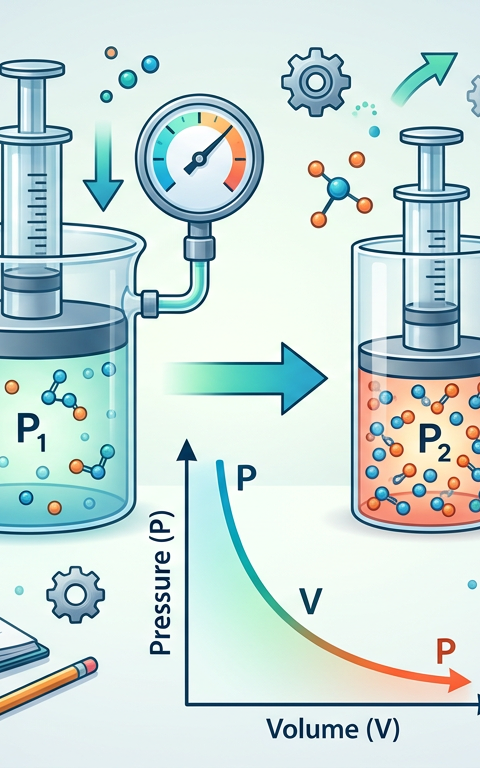
Solve Boyle's Law Problems Without Flipping the Pressure Ratio
Master Boyle’s Law with these easy practice questions and step-by-step solutions. Learn how pressure and volume interact at constant temperatures.
Apr 2, 2026
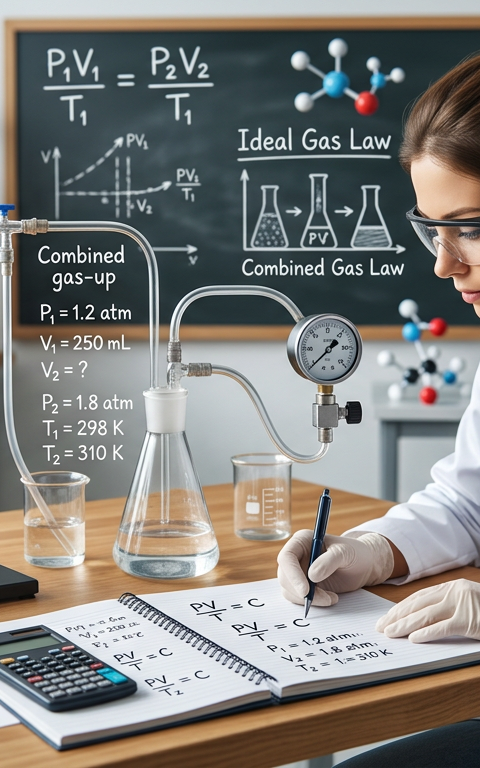
Solving Combined Gas Law Problems: Managing Three Changing Variables
Master the Combined Gas Law with this comprehensive guide featuring clear explanations, step-by-step solved examples, and 10 practice questions with answers.
Apr 2, 2026
Solving Complex pH Problems: Beyond Simple Strong Acids
Master advanced pH calculations with our guide on weak acids, polyprotic systems, and salt hydrolysis. Includes step-by-step solved examples and practice questions.
Mar 29, 2026

Calculating Mass Ratios: Percent Composition Mastery and Problems
Master percentage composition with our comprehensive guide featuring step-by-step solved examples, practice questions, and a quick quiz to test your knowledge.
Mar 26, 2026
Molarity vs Molality: The Essential Difference Explained
Master the difference between molarity vs molality. Learn the formulas, key differences, and when to use each in this comprehensive chemistry guide.
Mar 26, 2026
Why Molarity Matters: Converting Mass to Moles for Lab Solutions
Master chemistry with our guide to the molarity formula. Learn how to calculate concentration with step-by-step examples, units, and practical lab tips.
Mar 26, 2026
Avoid These 7 Common Molarity Mistakes in Chemistry
Master chemistry calculations! Avoid common molarity mistakes with our expert guide on unit conversions, dilution errors, and proper lab techniques.
Mar 26, 2026

Why Molarity Ratios Fail: Solving the Moles per Liter Logic Gap
Master molarity with ease. Discover why chemistry students struggle with concentration units and learn proven strategies to solve molarity problems fast.
Mar 26, 2026