Stoichiometry: Calculating Yields and Finding Limiting Reactants
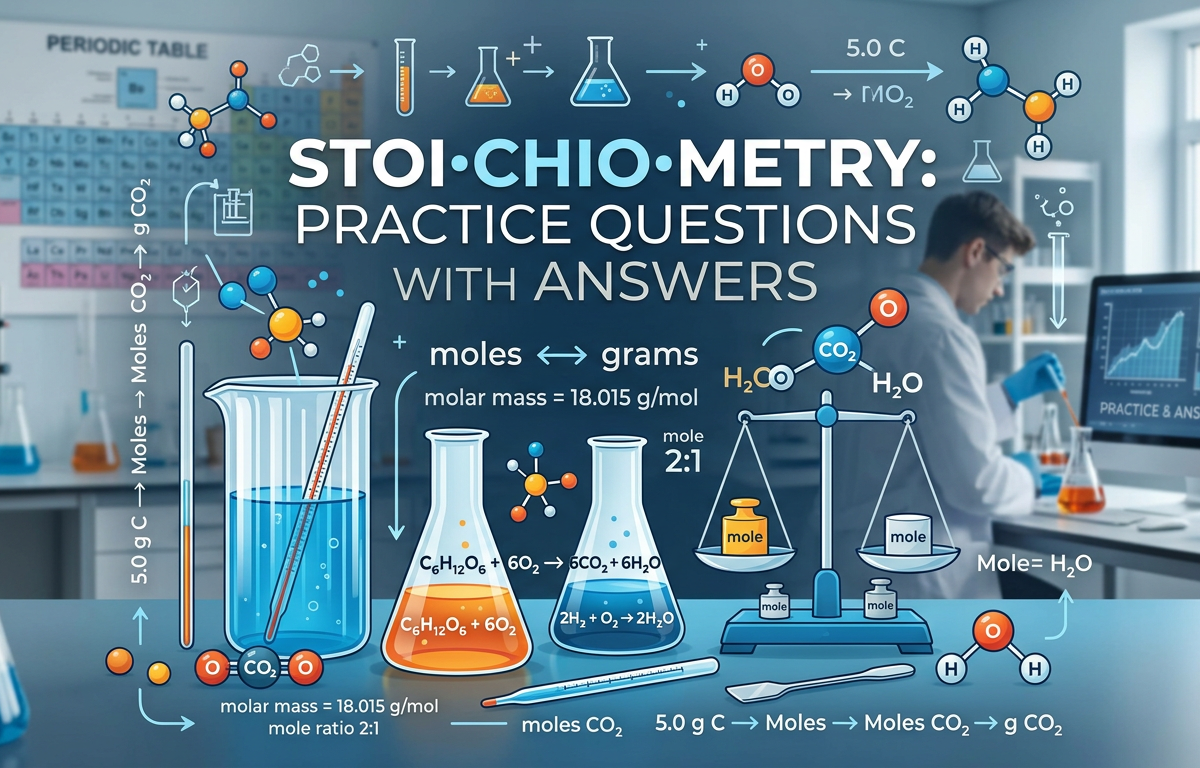
Imagine you are reacting 10 grams of magnesium with 10 grams of oxygen. A common error is assuming the oxygen is the limiting reactant simply because its molar mass is higher, or thinking the masses will react in a one to one ratio. In reality, the balanced equation 2Mg + O₂ → 2MgO dictates that you need two moles of magnesium for every single mole of oxygen. Without converting these masses into moles first, your yield predictions will fail. This numerical bridge between the microscopic world of molecules and the macroscopic world of the laboratory scale is where most calculation errors occur.
To solve these problems accurately, you must treat the coefficients in a chemical equation as a recipe rather than just numbers on a page. If you skip the step of comparing the available mole ratio to the required stoichiometric ratio, you cannot identify which substance will run out first. By focusing on the conversion from grams to moles using the periodic table, you can determine the theoretical yield of any reaction. The following practice set moves from basic mass to mass conversions to complex scenarios involving percent yield and excess reagents, ensuring you can navigate the quantitative logic of chemical change.
Stoichiometry Practice Questions with Answers
Mastering Stoichiometry Practice Questions with Answers is essential for any chemistry student looking to understand the quantitative relationships between reactants and products in chemical reactions. This branch of chemistry allows scientists to predict exactly how much of a substance is needed to react with another, or how much product will be formed under specific conditions. By applying the laws of conservation of mass and using balanced chemical equations, you can solve complex problems involving moles, mass, volume, and concentration.
The Logic of Molar Ratios
Stoichiometry is the quantitative study of the relationships between the amounts of reactants used and the amounts of products formed in a chemical reaction. It relies on the law of conservation of mass, which states that matter is neither created nor destroyed during a chemical change. To perform stoichiometric calculations, you must always start with a balanced chemical equation. The coefficients in these equations represent the molar ratios of the substances involved. For example, in the reaction 2H₂ + O₂ → 2H₂O, the ratio of hydrogen to oxygen is 2:1. Mastering this concept requires familiarity with the mole concept, Avogadro's number (6.022 × 10²³), and molar mass (g/mol). You will often encounter limiting reactants, which are substances consumed completely in a reaction, limiting the amount of product formed, and theoretical yield, which is the maximum amount of product that can be produced from a given amount of reactant.
Solved Examples
These examples demonstrate the step-by-step process of converting between mass and moles using stoichiometric ratios.
Example 1: Mass-to-Mass Calculation
How many grams of water (H₂O) are produced when 4.0 grams of hydrogen gas (H₂) react with excess oxygen?
Write the balanced equation: 2H₂ + O₂ → 2H₂O
Find the molar mass of H₂: 2 × 1.01 = 2.02 g/mol.
Convert mass of H₂ to moles: 4.0 g / 2.02 g/mol = 1.98 mol H₂.
Use the mole ratio: From the equation, 2 mol H₂ produces 2 mol H₂O (a 1:1 ratio). So, 1.98 mol H₂ produces 1.98 mol H₂O.
Convert moles of H₂O back to mass: Molar mass of H₂O is 18.02 g/mol. 1.98 mol × 18.02 g/mol = 35.68 g H₂O.
Example 2: Limiting Reactant Identification
If 10.0 g of Magnesium (Mg) reacts with 10.0 g of Oxygen (O₂), which is the limiting reactant?
Balanced equation: 2Mg + O₂ → 2MgO
Convert Mg to moles: 10.0 g / 24.31 g/mol = 0.411 mol Mg.
Convert O₂ to moles: 10.0 g / 32.00 g/mol = 0.313 mol O₂.
Determine required ratio: The equation requires 2 moles of Mg for every 1 mole of O₂.
Compare: To react all 0.313 mol of O₂, we would need 0.626 mol of Mg (0.313 × 2). We only have 0.411 mol of Mg. Therefore, Mg is the limiting reactant.
Example 3: Percent Yield
A student calculates a theoretical yield of 50.0 g of product but only collects 45.0 g in the lab. What is the percent yield?
Identify the formula: Percent Yield = (Actual Yield / Theoretical Yield) × 100.
Plug in values: (45.0 g / 50.0 g) × 100.
Calculate: 0.90 × 100 = 90%.
Practice Questions
Test your knowledge with these stoichiometry practice questions ranging from basic mole conversions to complex limiting reactant problems.
(Easy) How many moles of CO₂ are produced when 5 moles of C₃H₈ (propane) burn completely in oxygen? (Equation: C₃H₈ + 5O₂ → 3CO₂ + 4H₂O)
(Easy) Calculate the molar mass of Calcium Carbonate (CaCO₃).
(Medium) How many grams of AlCl₃ are produced if 25.0 grams of Aluminum react with excess Chlorine gas? (Equation: 2Al + 3Cl₂ → 2AlCl₃)
(Medium) If 50.0 g of N₂ reacts with 15.0 g of H₂, what is the limiting reactant for the production of NH₃? (Equation: N₂ + 3H₂ → 2NH₃)
(Medium) What volume of Hydrogen gas at STP is produced when 2.0 moles of Zinc react with Hydrochloric acid? (Equation: Zn + 2HCl → ZnCl₂ + H₂)
(Hard) In the reaction 4NH₃ + 5O₂ → 4NO + 6H₂O, if you start with 30.0 g of NH₃ and 40.0 g of O₂, what is the maximum mass of NO that can be produced?
(Hard) A reaction has a theoretical yield of 125 g. If the actual yield is 105 g, what is the percent yield?
(Hard) How many molecules of Oxygen are required to react with 10.0 g of Methane (CH₄) in a combustion reaction?
(Hard) If 15.0 g of Copper (II) Chloride reacts with 20.0 g of Sodium Nitrate, how many grams of Sodium Chloride are formed? Identify the excess reactant.
(Medium) How many moles of Oxygen are needed to produce 10 moles of water in the reaction: 2H₂ + O₂ → 2H₂O?
Answers & Explanations
1. 15 moles The mole ratio of C₃H₈ to CO₂ is 1:3. Therefore, 5 moles × 3 = 15 moles of CO₂.
2. 100.09 g/mol Ca (40.08) + C (12.01) + 3 × O (16.00) = 100.09 g/mol.
3. 123.6 g Moles Al = 25.0 / 26.98 = 0.927. Ratio Al:AlCl₃ is 1:1. Mass = 0.927 × 133.33 (molar mass AlCl₃) = 123.6 g.
4. N₂ Moles N₂ = 50/28.02 = 1.78. Moles H₂ = 15/2.02 = 7.43. N₂ needs 3x H₂ (5.34). We have enough H₂, so N₂ is limiting.
5. 44.8 L Ratio Zn:H₂ is 1:1. 2 moles Zn produce 2 moles H₂. At STP, 1 mole = 22.4 L. 2 × 22.4 = 44.8 L.
6. 30.0 g Moles NH₃ = 1.76; Moles O₂ = 1.25. O₂ is limiting. (1.25 mol O₂ × 4/5 ratio) × 30.01 g/mol NO = 30.0 g.
7. 84% (105 / 125) × 100 = 84%.
8. 7.52 × 10²³ Moles CH₄ = 10/16.04 = 0.623. Ratio CH₄:O₂ is 1:2. Moles O₂ = 1.246. Molecules = 1.246 × 6.022 × 10²³.
9. 13.04 g; NaNO₃ excess CuCl₂ + 2NaNO₃ → Cu(NO₃)₂ + 2NaCl. CuCl₂ is limiting. Moles NaCl = 2 × Moles CuCl₂.
10. 5 moles The ratio of O₂ to H₂O is 1:2. To get 10 moles of water, you need half as many moles of oxygen (10 / 2 = 5).
1. What must be true before you can perform any stoichiometric calculation?
Frequently Asked Questions
What is a mole ratio in stoichiometry?
A mole ratio is a conversion factor that relates the amounts in moles of any two substances involved in a chemical reaction. These ratios are derived directly from the coefficients of a balanced chemical equation.
How do you find the limiting reactant?
To find the limiting reactant, calculate the number of moles of each reactant and then determine how much product each could produce. The reactant that produces the smallest amount of product is the limiting reactant.
What is the difference between theoretical and actual yield?
Theoretical yield is the maximum amount of product predicted by stoichiometric calculations, whereas actual yield is the amount of product truly obtained from an experiment in a laboratory setting.
Why is stoichiometry important in real-world applications?
Stoichiometry is vital for industries like pharmaceuticals and engineering to ensure the correct amount of raw materials are used to create products efficiently without wasting expensive chemicals. It also helps in calculating fuel-to-air ratios in engines.
Can stoichiometry be used for gases?
Yes, stoichiometry applies to gases using the molar volume constant (22.4 L/mol at STP) or the Ideal Gas Law (PV=nRT) to convert between volume and moles. This allows for calculations involving pressure and temperature.
How do you calculate percent yield?
Percent yield is calculated by dividing the actual yield obtained in an experiment by the theoretical yield calculated from the balanced equation, then multiplying the result by 100. It measures the efficiency of a reaction.
Enjoyed this article?
Share it with others who might find it helpful.
Related Articles

Calculating High-Stakes Meds: BSA Mosteller Formula Practice
Master hard body surface area-based dosage calculations with our comprehensive guide, solved examples, and practice questions for healthcare students.
May 17, 2026
Calculating Kc: Mastering the Ratio of Equilibrium Concentrations
Master the Equilibrium Constant (Kc) with our comprehensive guide featuring solved examples, practice questions, and detailed explanations for chemistry students.
Mar 30, 2026
Calculating Enthalpy Changes Using Bond Enthalpy Data
Master bond energy calculations with our comprehensive guide. Includes solved examples, practice questions, and detailed explanations for chemistry students.
Mar 29, 2026
Calculating Enthalpy Changes: Hess’s Law Puzzle Solving Guide
Master Hess’s Law with our comprehensive guide featuring solved examples, step-by-step practice questions, and detailed answers for chemistry students.
Mar 29, 2026
Stoichiometry of the Flask: Calculating Solute Mass and Dilutions
Master solution preparation with these easy practice questions. Learn to calculate molarity, mass, and dilutions with step-by-step examples and a quick quiz.
Mar 27, 2026
Calculating Mass Ratios: Percent Composition Mastery and Problems
Master percentage composition with our comprehensive guide featuring step-by-step solved examples, practice questions, and a quick quiz to test your knowledge.
Mar 26, 2026
Closing the Efficiency Gap: Calculating Percent Yield in Chemistry
Learn the difference between theoretical and actual yield with our comprehensive guide. Includes formulas, solved examples, and 10 practice questions with answers.
Mar 21, 2026
Stoichiometry vs. Reality: Calculating Percent Yield in Chemistry
Master percent yield calculations with our guide. Includes step-by-step solved examples, practice questions, and a quiz to test your chemistry skills.
Mar 21, 2026