Stoichiometry: Finding the Reactant That Runs Out First
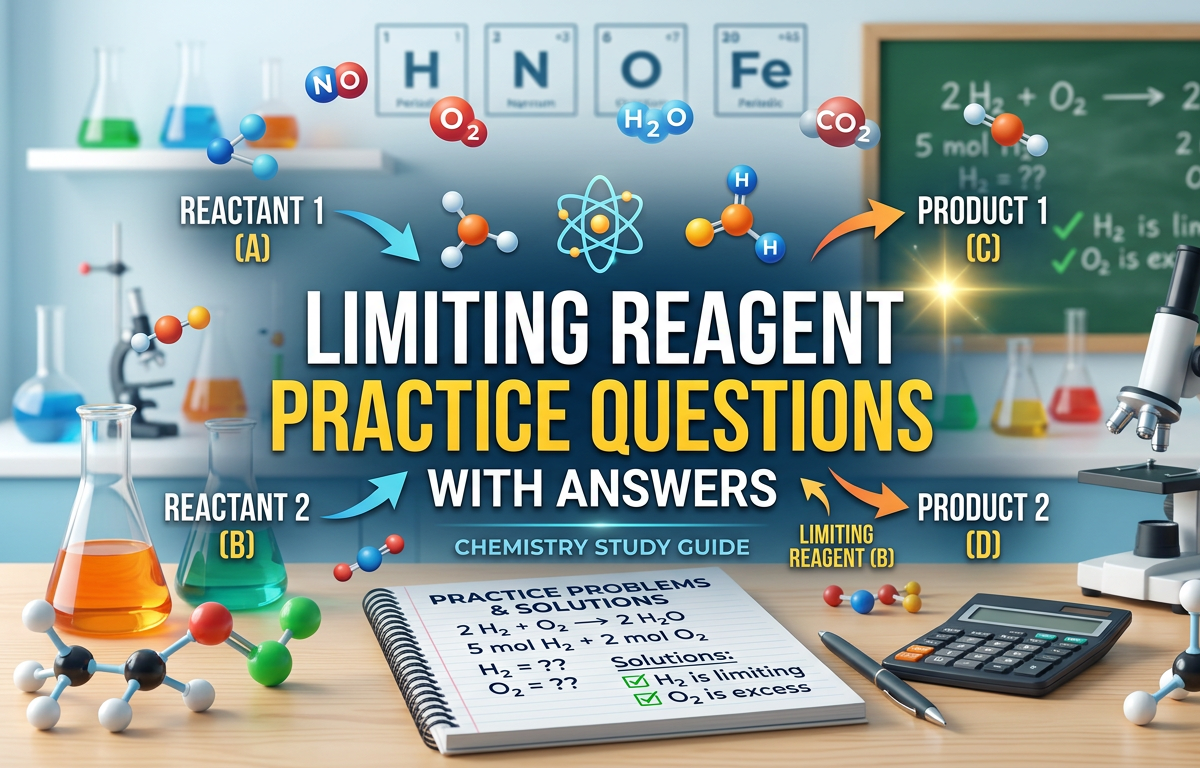
If you mix 10 grams of hydrogen with 10 grams of oxygen, it is tempting to assume they are present in equal measure. However, chemistry does not care about mass; it cares about count. Because an oxygen molecule is sixteen times heavier than a hydrogen molecule, that 10-gram pile of oxygen contains far fewer particles. In the reaction to form water, you quickly find yourself with a surplus of hydrogen and no oxygen left to pair it with. This bottleneck is the limiting reagent, the specific reactant that dictates exactly when a chemical process must grind to a halt.
Solving these problems requires moving past the visible weight of chemicals to the hidden math of the balanced equation. Students often stumble by assuming the substance with the smallest starting mass is the one that runs out first. To avoid this trap, you must convert every value into moles and compare them against the stoichiometric coefficients. Only by calculating the potential yield for each reactant can you see which one hits its theoretical limit first. The following practice set focuses on these critical conversions, helping you identify excess materials and calculate precise product yields for industrial and laboratory scenarios.
The Logic of Chemical Bottlenecks
A limiting reagent is the reactant in a chemical reaction that is completely consumed first, thereby determining the maximum amount of product that can be formed. In any chemical process involving two or more reactants, they are rarely present in the exact stoichiometric proportions required by the balanced equation. Once the limiting reagent is exhausted, the reaction stops, leaving any leftover amounts of other reactants as "excess reagents." Understanding this concept is vital for calculating theoretical yield and optimizing industrial chemical production.
To identify the limiting reagent, you must compare the mole ratio of the reactants used to the mole ratio required by the balanced chemical equation. A common mistake is assuming the reactant with the smallest mass is the limiting factor; however, because different substances have different molar masses, you must always convert masses to moles first. The process typically involves three steps: balancing the chemical equation, converting given quantities to moles, and calculating how much product each reactant could potentially produce. The reactant that yields the smallest amount of product is your limiting reagent.
This concept is a cornerstone of stoichiometry and is essential for laboratory work. By identifying which substance limits the process, chemists can reduce waste and calculate the percent yield by comparing the actual experimental results to the theoretical maximum determined by the limiting reagent.
Solved Examples
These examples demonstrate the step-by-step logic required to solve limiting reagent problems using molar mass and stoichiometric coefficients.
Example 1: Formation of Water
If 2.0 grams of Hydrogen gas (H₂) react with 16.0 grams of Oxygen gas (O₂) to form water, which is the limiting reagent? (H = 1.01 g/mol, O = 16.00 g/mol)
Write the balanced equation: 2H₂ + O₂ → 2H₂O.
Calculate moles of H₂: 2.0 g / 2.02 g/mol = 0.99 mol H₂.
Calculate moles of O₂: 16.0 g / 32.00 g/mol = 0.50 mol O₂.
Determine required ratio: The equation requires 2 moles of H₂ for every 1 mole of O₂.
Compare: To use all 0.50 mol of O₂, we need 1.00 mol of H₂ (0.50 × 2). We only have 0.99 mol.
Conclusion: H₂ is the limiting reagent because we have slightly less than the 1.00 mol required to react with all the Oxygen.
Example 2: Ammonia Synthesis
In the Haber process, 28 grams of Nitrogen (N₂) react with 9 grams of Hydrogen (H₂). Find the limiting reagent and the theoretical yield of Ammonia (NH₃).
Balanced equation: N₂ + 3H₂ → 2NH₃.
Moles of N₂: 28 g / 28.02 g/mol = 1.0 mol.
Moles of H₂: 9 g / 2.02 g/mol = 4.45 mol.
Product calculation from N₂: 1.0 mol N₂ × (2 mol NH₃ / 1 mol N₂) = 2.0 mol NH₃.
Product calculation from H₂: 4.45 mol H₂ × (2 mol NH₃ / 3 mol H₂) = 2.97 mol NH₃.
Conclusion: N₂ is the limiting reagent because it produces the smaller amount of NH₃ (2.0 mol). The theoretical yield is 2.0 mol × 17.03 g/mol = 34.06 g NH₃.
Example 3: Aluminum Oxide Production
4.0 moles of Aluminum react with 4.0 moles of Oxygen. Identify the limiting reagent for the reaction: 4Al + 3O₂ → 2Al₂O₃.
Identify the molar ratio from the equation: 4 moles Al : 3 moles O₂.
Calculate the ratio of available moles: 4 moles Al / 4 moles O₂ = 1.
Calculate the required ratio: 4 / 3 = 1.33.
Compare: Since the available ratio (1) is less than the required ratio (1.33), the numerator (Aluminum) is insufficient.
Conclusion: Aluminum is the limiting reagent.
Practice Questions
Test your knowledge with these limiting reagent practice questions. Work through them before checking the answers below.
(Easy) Given the reaction N₂ + 3H₂ → 2NH₃, if you have 2 moles of N₂ and 3 moles of H₂, which is the limiting reagent?
(Easy) 5.0 grams of Magnesium react with 5.0 grams of Oxygen to produce MgO. Identify the limiting reagent.
(Medium) 10.0 g of CH₄ reacts with 30.0 g of O₂ in a combustion reaction (CH₄ + 2O₂ → CO₂ + 2H₂O). Which reactant is in excess?
(Medium) If 100 g of Fe₂O₃ reacts with 50 g of CO (Fe₂O₃ + 3CO → 2Fe + 3CO₂), determine the limiting reagent.
(Medium) How many grams of AgCl are formed when 10.0 g of AgNO₃ reacts with 10.0 g of BaCl₂?
(Hard) 50.0 g of Copper reacts with 150.0 g of Silver Nitrate (Cu + 2AgNO₃ → Cu(NO₃)₂ + 2Ag). Calculate the mass of the excess reagent remaining.
(Hard) Phosphorus reacts with Bromine to form PBr₃. If 35.0 g of P₄ and 210.0 g of Br₂ are mixed, how many grams of PBr₃ can be produced?
(Hard) In the reaction 2Al + 3Cl₂ → 2AlCl₃, if 0.40 mol of Al and 0.60 mol of Cl₂ are available, which is limiting and what is the theoretical yield in grams?
Answers & Explanations
Answer: H₂. Explanation: The ratio required is 1 N₂ : 3 H₂. With 2 moles of N₂, you would need 6 moles of H₂. Since you only have 3 moles of H₂, Hydrogen is the limiting reagent.
Answer: Magnesium. Explanation: Moles Mg = 5.0/24.3 = 0.206. Moles O₂ = 5.0/32.0 = 0.156. The reaction 2Mg + O₂ → 2MgO requires 2 moles of Mg for every 1 mole of O₂. 0.156 moles of O₂ would require 0.312 moles of Mg. We only have 0.206, so Mg is limiting.
Answer: CH₄ is in excess. Explanation: Moles CH₄ = 10/16.04 = 0.623. Moles O₂ = 30/32 = 0.938. The reaction requires 2 moles of O₂ per mole of CH₄. 0.623 mol CH₄ would need 1.246 mol O₂. Since we only have 0.938 mol O₂, O₂ is limiting and CH₄ is in excess.
Answer: CO. Explanation: Molar mass Fe₂O₃ = 159.7 g/mol, CO = 28.01 g/mol. Moles Fe₂O₃ = 0.626. Moles CO = 1.785. Ratio required is 1:3. 0.626 mol Fe₂O₃ requires 1.878 mol CO. We have 1.785, making CO the limiting reagent.
Answer: 8.44 g AgCl. Explanation: AgNO₃ is limiting. Moles AgNO₃ = 10/169.87 = 0.0589. Moles BaCl₂ = 10/208.2 = 0.048. From the equation 2AgNO₃ + BaCl₂ → 2AgCl + Ba(NO₃)₂, 0.0589 mol AgNO₃ produces 0.0589 mol AgCl. Mass = 0.0589 × 143.32 = 8.44 g.
Answer: 21.9 g Cu. Explanation: Moles Cu = 0.787, Moles AgNO₃ = 0.883. AgNO₃ is limiting (requires 0.4415 mol Cu). Excess Cu = 0.787 - 0.4415 = 0.3455 mol. Mass = 0.3455 × 63.55 = 21.9 g.
Answer: 237.1 g PBr₃. Explanation: P₄ + 6Br₂ → 4PBr₃. Moles P₄ = 0.282. Moles Br₂ = 1.314. Br₂ is limiting (1.314/6 * 4 = 0.876 mol PBr₃). Mass = 0.876 × 270.67 = 237.1 g.
Answer: Neither (Stoichiometric proportions); 53.34 g AlCl₃. Explanation: The ratio 2:3 is exactly met (0.4/2 = 0.2; 0.6/3 = 0.2). Both are consumed. 0.4 mol Al produces 0.4 mol AlCl₃. Mass = 0.4 × 133.34 = 53.34 g.
1. Which reactant is the limiting reagent?
Frequently Asked Questions
What is a limiting reagent?
A limiting reagent is the substance in a chemical reaction that is totally consumed when the chemical reaction is complete. The amount of product formed is limited by this reagent, since the reaction cannot continue without it.
How do you identify the limiting reagent?
To identify the limiting reagent, convert the mass of each reactant to moles and divide by their respective coefficients from the balanced equation. The reactant with the smallest resulting value is the limiting reagent.
Can the limiting reagent be a liquid?
Yes, the limiting reagent can be in any state of matter, including solid, liquid, or gas. Its status depends purely on the number of moles available relative to the stoichiometry of the reaction.
Why is the limiting reagent important in industry?
In industrial chemistry, identifying the limiting reagent helps minimize costs by ensuring expensive chemicals are fully consumed. It also allows engineers to calculate the maximum possible output of a production line.
What happens to the excess reagent?
The excess reagent remains in the reaction vessel after the chemical process has stopped. It is often recovered, recycled, or removed as a byproduct depending on the specific chemical process involved.
Is the limiting reagent always the one with the smallest mass?
No, the limiting reagent is determined by the number of moles and the reaction stoichiometry, not mass. A substance with a very small mass might still have more moles than a heavy substance if its molar mass is low.
Ready to ace your exams?
Try Bevinzey's AI-powered study tools for free.
Enjoyed this article?
Share it with others who might find it helpful.
Related Articles
Stoichiometry: Calculating Yields and Finding Limiting Reactants
Master stoichiometry with our comprehensive guide featuring detailed explanations, solved examples, and practice questions with answers for chemistry students.
Mar 21, 2026
Stoichiometry: Using Molar Ratios to Bridge Reactants and Products
Master mole ratio calculations with our comprehensive guide, featuring solved examples, practice questions, and a quick quiz to test your stoichiometry skills.
Mar 21, 2026

Calculating High-Stakes Meds: BSA Mosteller Formula Practice
Master hard body surface area-based dosage calculations with our comprehensive guide, solved examples, and practice questions for healthcare students.
May 17, 2026

Solving High-Stakes IV Titrations and Weight-Based Infusions
Master advanced IV flow rate calculations with these hard practice questions. Covers weight-based dosing, titrations, and dimensional analysis for nurses.
May 17, 2026

Solving Weight-Based Dosing: The 2.2 Conversion and Rounding Logic
Weight-Based Dosage Calculations Practice Questions with Answers
May 17, 2026
Predicting Periodic Anomalies: Beyond Basic Trend Rules
Hard Periodic Trends Practice Questions
Apr 4, 2026

Hard Electron Configuration Practice Questions
Hard Electron Configuration Practice Questions
Apr 4, 2026
Medium Electron Configuration Practice Questions
Master medium-level electron configuration with our comprehensive guide, including solved examples, stability exceptions, and practice questions with answers.
Apr 4, 2026