Retrieval Practice vs Concept Mapping: Which Is More Powerful?
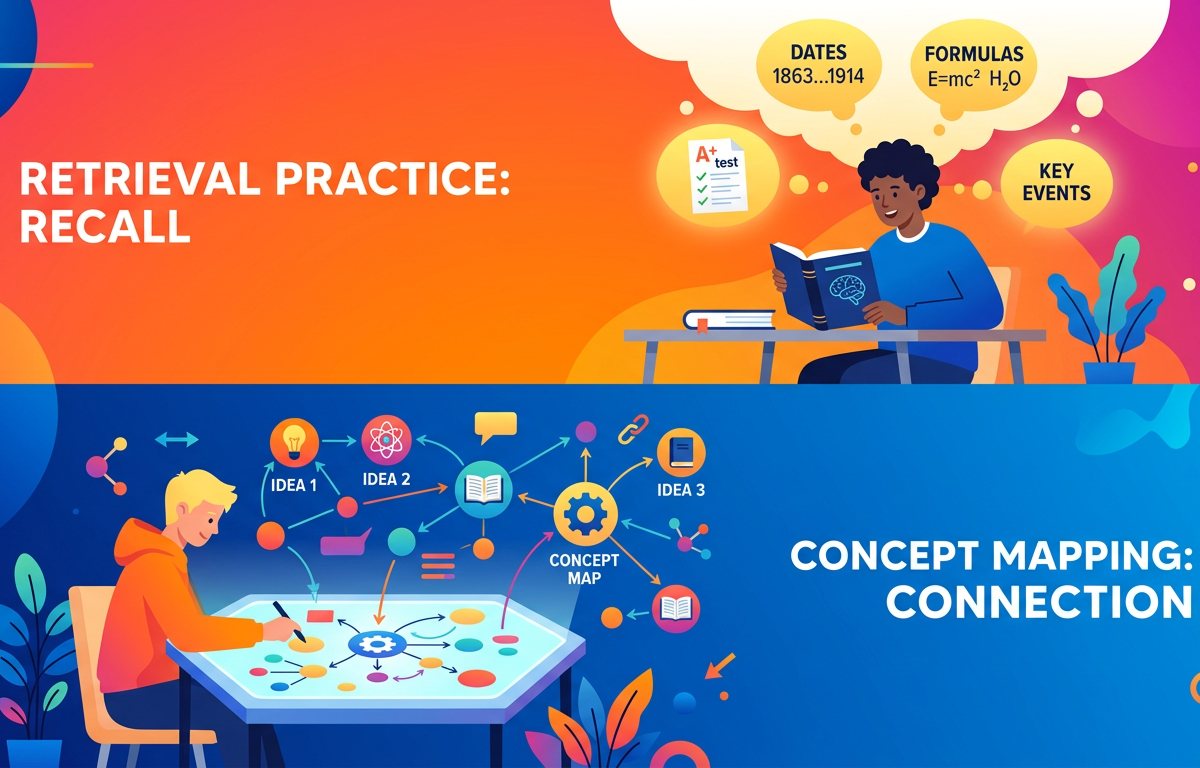
Most students spend their study hours highlighting textbooks or rereading notes, yet they often fail to recall that same information during an exam. This phenomenon is known as the "illusion of competence," where familiarity with the text is mistaken for actual mastery of the material. When evaluating Retrieval Practice vs Concept Mapping, we are looking at two of the most potent active learning strategies available to combat this illusion. While both techniques require significantly more mental effort than passive review, they serve distinct roles in the architecture of the human mind.
Active learning shifts the burden of work from the eyes to the brain. Instead of witnessing information, the student must generate or organize it. Scientists often compare retrieval, the act of pulling information out of the mind, with mapping, the act of organizing information into spatial hierarchies, to see which produces better long-term memory retention. While meaningful learning suggests that understanding relationships is key, cognitive science often points to the "testing effect" as the ultimate winner for raw recall. Understanding the nuance between these two can transform a struggling student into a top performer.
The transition from "re-reading" to evidence-based methods isn't just a trend; it is a necessity for anyone facing high-stakes environments. Whether you are a medical student or a high schooler, the strategy you choose dictates whether your knowledge evaporates after forty-eight hours or stays for a lifetime. If you've ever wondered why retrieval practice feels hard, it is because that very difficulty is what signals the brain to build permanent neural pathways.
What is Retrieval Practice? The Science of Remembering
Retrieval practice is the act of forcing your brain to recall information without the help of your notes or a textbook. This technique leverages the testing effect, a psychological phenomenon where the act of retrieving information from memory actually increases the long-term retention of that information. By pulling a fact from the "storage" of your brain, you are essentially telling your neurons that this specific piece of data is important, which causes the brain to thicken the neural trace associated with it.
There is a vital distinction between low-stakes and high-stakes retrieval. Low-stakes retrieval includes methods like using flashcards or taking a quick ungraded quiz at the end of a chapter. These allow for "error-driven retrieval," where getting an answer wrong actually helps you learn better, provided you receive immediate feedback. High-stakes retrieval, like a final exam, is where you prove mastery, but study success happens in the low-stakes, error-friendly zone.
Common examples of this strategy include:
Brain Dumps: Writing down everything you can remember about a topic on a blank sheet of paper.
Practice Tests: Answering questions in a format similar to your actual exam.
The Feynman Technique: Explaining a concept out of your head as if you were teaching a child.
What is Concept Mapping? The Science of Understanding
Concept mapping is a spatial learning technique that requires students to visualize the relationships between different ideas. Based on David Ausubel’s Theory of Meaningful Learning, this method posits that new knowledge is most effectively acquired when it is explicitly linked to existing cognitive frameworks. By creating a map with "nodes" (the concepts) and "linking phrases" (the relationships), students create a bird's-eye view of a subject's hierarchy.
One of the primary benefits of concept mapping is its ability to reduce cognitive load theory. By externalizing the complex structure of a subject onto a physical or digital canvas, the brain is freed from the burden of holding all those connections in working memory simultaneously. It allows the learner to see how a "branch" in biology, such as photosynthesis, connects to another "branch" like cellular respiration through the common node of energy transfer.
A well-constructed map is not just a drawing; it is a structural representation of comprehension. If you cannot draw a line between two concepts and describe their relationship with a verb, it reveals a gap in your understanding. This makes mapping an excellent tool for college students dealing with massive, interconnected curricula where "memorizing facts" simply isn't enough to pass.
Retrieval Practice vs Concept Mapping: Head-to-Head Comparison
Detailed research consistently shows that retrieval practice usually outperforms concept mapping when it comes to long-term memory retention. In a landmark 2011 study published in Science by Purdue University researchers Karpicke and Blunt, students who practiced retrieval remembered 50% more information a week later than those who used concept mapping. This remained true even when students predicted they would do better with mapping because it felt like they were learning more deeply.
However, when we look at the transfer of learning—the ability to apply knowledge to new, unfamiliar problems—the gap narrows. Concept mapping excels at helping students grasp the "big picture," which is critical for complex problem-solving. If your goal is to understand how a change in the interest rate affects the housing market, a map might provide more clarity than a flashcard. But if you can't remember the definition of an interest rate in the first place, the map fails. You might find more details on this in our guide on retrieval practice vs passive studying.
In terms of efficiency, retrieval practice is often the faster method. Setting up a complex concept map can take hours. Conversely, a session of retrieval practice and the testing effect can be triggered in short, five-minute bursts throughout the day. For the average student, the "bang for your buck" is significantly higher with retrieval-based methods, especially when preparing for fact-heavy exams like the SAT or MCAT.
Master Any Subject Faster
Turn your study notes into powerful retrieval quizzes automatically. Bevinzey uses AI to help you apply the science of learning without the manual effort.
Get Started FreeThe Cognitive Load Factors: When to Use Which?
The decision to use Retrieval Practice vs Concept Mapping often depends on your level of expertise in the subject. The "expertise reversal effect" suggests that beginners may benefit from the structure of concept mapping because it provides a necessary scaffold for their thinking. If you are entirely new to organic chemistry, a map helps you navigate the "why" before you focus on the "what."
Subject matter also dictates the strategy. Fact-heavy subjects like Anatomy or Law benefit immensely from spaced repetition and retrieval. There are simply too many discrete terms to rely on mapping alone. On the other hand, relationship-heavy subjects like Philosophy, History, or Literature benefit from mapping because the "fact" is often less important than the "influence" one concept has on another.
Consider the goal of the learner. If you are a medical student preparing for Step 1, retrieval is your best friend for memorizing drug interactions. However, if you are a doctoral candidate trying to synthesize a new thesis, concept mapping helps you identify the gaps in current research. The complexity of the material acts as the compass for your study choice.
The Best of Both Worlds: Integrating the Two Strategies
The most effective learners do not choose between these methods; they combine them into a strategy called "Retrieval Mapping." This involves putting away all your notes and drawing a concept map entirely from memory. This technique forces you to retrieve the facts (retrieval practice) while simultaneously organizing their relationships (concept mapping).
You can also use maps as a framework for future retrieval sessions. Once you have created a "master map" during your initial learning phase, use it as a prompt. Look at one central node and try to verbally explain every sub-connection without looking at the rest of the map. This creates a powerful study schedule that balances memory with understanding.
For high-stakes testing, such as trying to improve an SAT math score, you can map out various types of geometry problems and then use retrieval practice to master the specific formulas. Scaffolding with maps provides the "map" for your brain, while testing with practice provides the "fuel."
Practical Implementation for Students and Educators
Modern learners have access to digital tools that make both strategies easier to manage. For retrieval practice, software like Anki or Quizlet allows for automated spaced repetition. For concept mapping, platforms like Miro, Lucidchart, or Coggle allow for infinite canvases where you can collaborate with other students in real-time. Teachers can implement these in the classroom by starting a lesson with a "three-minute brain dump" or ending a unit with a group mapping exercise.
To implement these without burnout, follow these steps:
Review: Briefly look over a new topic to understand the general hierarchy.
Map: Create a basic concept map to visualize how ideas connect.
Retrieve: The next day, try to recreate that map from memory or use retrieval practice examples to test specific nodes.
Clarify: Go back to your notes to fill in the missing gaps and redraw the connections you missed.
By treating learning as an iterative process rather than a one-time event, you build "fluency." Educators should encourage students to focus on the process of retrieval rather than the grade on the practice quiz. The goal is to make the brain work; the harder the work, the better the result.
Conclusion: Choosing Your Path to Mastery
While the debate of Retrieval Practice vs Concept Mapping often pits the two against each other, they are two sides of the same coin. Retrieval practice is the engine of memory, ensuring that facts are available when you need them. Concept mapping is the blueprint, ensuring those facts are organized into a coherent structure of knowledge. If you are forced to choose just one for exam performance, the data points clearly toward retrieval as the superior method for long-term retention.
However, true mastery requires both. Use concept mapping to build your initial understanding and "see" the landscape of a subject. Then, use retrieval practice to "pave the roads" and ensure you can navigate that landscape under the pressure of an exam. Consistency in these active strategies will always outperform the passive methods of the past.
Ready to Boost Your Exam Scores?
Stop passively rereading and start actively retrieving. Use Bevinzey's AI-powered tools to create custom practice questions in seconds and master any concept.
Get Started FreeFrequently Asked Questions
Which is better: retrieval practice or concept mapping?
In terms of long-term memory retention and exam performance, retrieval practice is generally superior. However, concept mapping is often better for initial understanding and visualizing complex relationships between topics.
Can you combine retrieval practice and concept mapping?
Yes, and this is highly recommended. The most effective way to combine them is to draw your concept maps from memory (Retrieval Mapping), which forces you to recall both facts and their structural connections simultaneously.
Is concept mapping considered a form of passive or active learning?
Concept mapping is an active learning strategy. It requires the learner to synthesize information and make decisions about how concepts relate, unlike passive reading or highlighting which requires minimal cognitive effort.
How do I use retrieval practice for complex subjects?
For complex subjects, break the material down into smaller "chunks." Use retrieval practice to master the individual facts and definitions first, then use brain dumps to explain the complex processes that link those chunks together.
Does concept mapping take more time than retrieval practice?
Usually, yes. Creating a detailed, accurate concept map involves significant spatial organization and design, whereas retrieval practice can be done quickly through flashcards or mental recall sessions.
Reviewed by
Michael Danquah, MS, PhD
Dr. Michael Danquah is a professor of pharmaceutical sciences and founder of several educational technology platforms focused on improving student learning and performance.
Enjoyed this article?
Share it with others who might find it helpful.
Related Articles

How to Solve Molarity Problems: Step-by-Step Mastery
Learn how to solve molarity problems step-by-step with formulas, unit tips, and worked examples so you can calculate concentration with confidence.
Mar 26, 2026

Avoid These 7 Common Molarity Mistakes in Chemistry
Master chemistry calculations! Avoid common molarity mistakes with our expert guide on unit conversions, dilution errors, and proper lab techniques.
Mar 26, 2026

What Is Molarity? The Complete Guide to Molar Concentration
Master molarity with our complete guide. Learn the formula, step-by-step calculations, and the critical differences between molarity and molality.
Mar 26, 2026

Why Molarity Matters: Converting Mass to Moles for Lab Solutions
Master chemistry with our guide to the molarity formula. Learn how to calculate concentration with step-by-step examples, units, and practical lab tips.
Mar 26, 2026

Molarity vs Molality: The Essential Difference Explained
Master the difference between molarity vs molality. Learn the formulas, key differences, and when to use each in this comprehensive chemistry guide.
Mar 26, 2026