Discover Power Retrieval Practice Examples for Better Grades
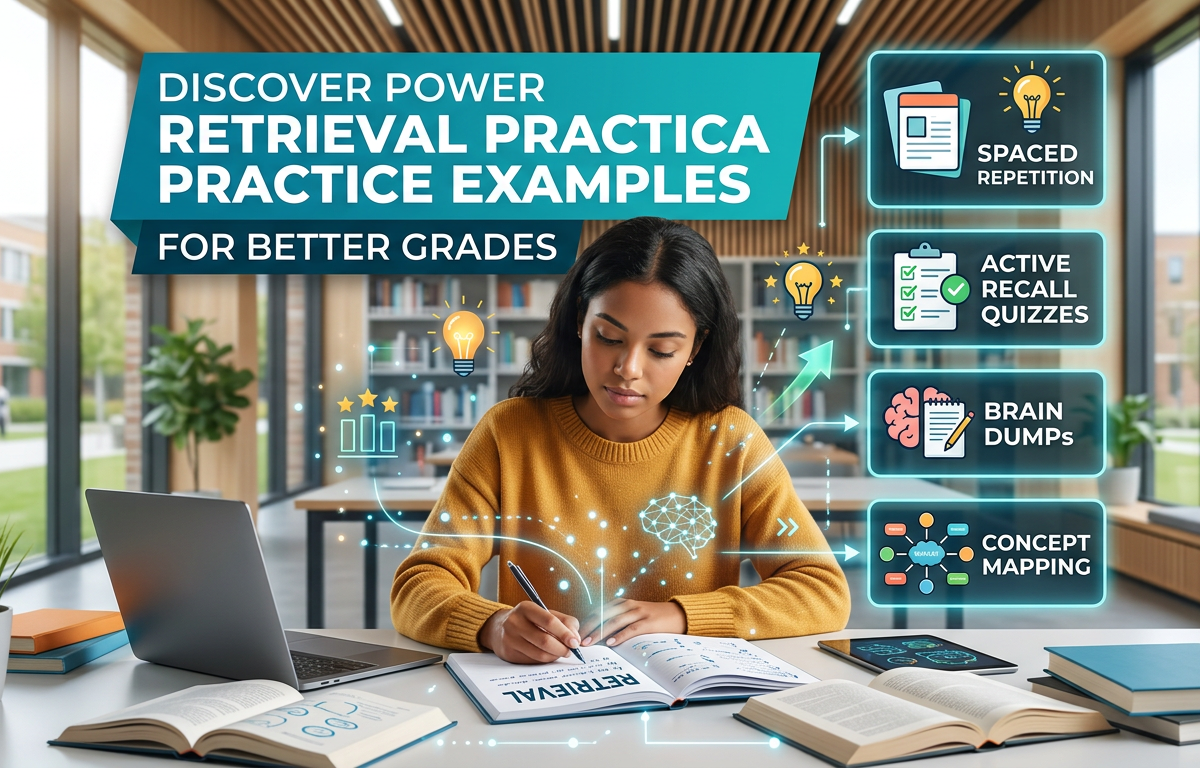
The Science Behind Retrieval Practice: Why Your Brain Craves the Struggle
Retrieval practice is the act of pulling information out of your head rather than trying to cram it in through repetitive exposure. Most students spend hours rereading textbooks or highlighting neon-yellow streaks across a page, but these are passive activities that create an "illusion of competence." You feel like you know the material because it looks familiar, but your brain isn't actually building the neural architecture required to store that data for the long term.
The "Testing Effect" explains why Retrieval Practice Examples are so effective: every time you successfully recall a fact, you change the memory itself, making it more robust and easier to access later. Research published by the Association for Psychological Science shows that students who use retrieval methods outperform those who use passive study habits by significant margins. By forcing your brain to work, you are literally "thickening" the connections between neurons. Why does "forgetting" feel so frustrating yet help us learn? This stems from the concept of "Desirable Difficulty." If a task is too easy, your brain assumes the information isn't important enough to store securely. When you struggle to remember a specific detail, your brain signal-pathways are strengthened through that effort. Understanding how retrieval practice boosts long-term memory helps reframe the struggle as a sign of progress rather than failure.
The 'Brain Dump' Technique: The Simplest Way to Start Retrieval Practicing
A brain dump is a "free recall" exercise where you write down everything you can remember about a topic onto a blank sheet of paper without looking at your notes. This technique forces you to organize your internal thoughts and identify where your knowledge is "fuzzy" or completely missing. It is perhaps the purest form of retrieval because it lacks the scaffolding provided by multiple-choice questions or prompts. To master the Blank Sheet Method, follow these steps:
Choose a specific topic (e.g., "The Nitrogen Cycle" or "Mitosis").
Set a timer for 10 minutes and write down every fact, diagram, or connection you can recall.
Once the timer stops, open your textbook and use a different colored pen to add the details you missed.
This two-color system is powerful because it provides immediate metacognitive feedback. You can see, at a glance, exactly what you knew and what you forgot. If you find your second color dominates the page, it's an indicator that you need to revisit the core concepts before the next session. This mimics the benefits of retrieval practice vs rereading, where the latter often masks these critical gaps. Timing is everything with free recall. Try a quick 5-minute scan after a lecture or before you go to bed. By doing this regularly, you prevent the steep drop-off of the forgetting curve. Many students find that mapping these dumps into a mind map—connecting related concepts with lines—helps visualize the "mental web" of their subject matter.
Low-Stakes Retrieval Practice Examples for Daily Study
"Blurting" is a favorite among modern students because it gamifies the retrieval process. You read a section of a book, close it, and immediately "blurt" out everything you remember onto a page or even out loud. It’s messy, fast, and incredibly effective for building foundational knowledge. Unlike a formal exam, blurting is low-stakes; there is no penalty for being wrong, which reduces the anxiety often associated with "testing." If you prefer a more structured approach, the Cornell Method of note-taking provides built-in Retrieval Practice Examples. Instead of just taking notes, you write "cue questions" in the left-hand margin. When you study later, you cover your notes and try to answer the questions you wrote for yourself. This turns a static piece of paper into a dynamic self-testing tool.
The Feynman Technique takes this a step further by requiring you to teach a concept to someone else—or even a rubber duck. If you cannot explain a topic in simple terms without using jargon, you don't actually understand it. This forces you to retrieve the "why" behind the facts, not just the facts themselves. It is one of the most effective active recall strategies used by top-tier university students. The Leitner System is a classic way to manage flashcards. You categorize cards into boxes based on how well you know them. Metadata from the National Institutes of Health suggests that spaced repetition, like the Leitner System, significantly improves recall in high-stakes environments like medical school.
Digital Tools and Apps for Automated Retrieval Practice
Software like AIflashcard.net, Anki and Quizlet has revolutionized how students handle massive amounts of data. These apps use algorithms to determine exactly when you are about to forget a piece of information, then they show you the flashcard at that precise moment. This maximizes Spaced Repetition benefits by ensuring you spend more time on difficult concepts and less time on things you’ve already mastered. Notion is another powerhouse for those who prefer an all-in-one workspace. By using the "Toggle" feature, you can write a question and hide the answer inside a dropdown.
This allows for seamless active recall during your daily review sessions. It’s a digital version of the Cornell Method that keeps your notes clean and your brain active. AI serves as a specialized tutor for scaffolding your retrieval. You can feed a transcript or a set of notes into ChatGPT and ask it to "create 10 challenging short-answer questions based on this text." This removes the friction of creating your own materials. However, be careful not to let the AI do the thinking for you—the value comes from you generating the answers, not the AI generating the questions. Digital tools offer the advantage of portability and data tracking, but analogue methods (pen and paper) often provide fewer distractions. If you find yourself scrolling through social media every time you open a study app, a physical notebook might be your best friend.
How to Incorporate Retrieval into Different Subjects
Retrieval isn't just for history dates or biology terms; it is vital for STEM subjects like math. Instead of looking at a "step-by-step" solution manual, try to solve the problem entirely from memory first. If you get stuck, look at only one line of the solution, then cover it and try to finish the rest. This builds the problem-solving "muscles" needed for success on the SAT or ACT.
In the humanities, retrieval focuses on building evidence-based arguments. Practice recalling the three primary causes of a historical event or the five main themes of a novel without looking at your syllabus. For literature, try to recite key quotes and then explain how they support a specific character arc. Foreign language learners can use "sentence synthesis." Instead of just translating words, try to retrieve entire sentence structures based on a prompt. This moves the brain from passive recognition to active production, which is the key to fluency. Whether you are working on easy SAT exponents practice questions or a complex French essay, the principle remains: retrieve, don't just recognize.
Master Your Exams with Scientific Precision
Stop wasting hours on rereading and start using the techniques that actually work. Our platform generates custom practice questions to trigger the testing effect and boost your scores.
Get Started FreeThe Power of Spaced Repetition: Scheduling Your Retrieval Sessions
Spacing is the antidote to cramming. If you have 10 hours to study, you will retain significantly more information by studying for one hour over 10 different days than by doing a single 10-hour marathon. This is because sleep helps consolidate memories, and the act of "re-retrieving" information after a short break signals to the brain that the data is essential for survival. The ideal intervals for spacing often follow a pattern like: 1 day, 1 week, 1 month. This schedule aligns with the Harvard Business Review’s findings on cognitive endurance and performance. By the time you reach the one-month mark, the information is often stored in long-term memory, requiring only occasional "top-off" sessions. Interleaving is another advanced strategy where you mix different topics in a single study session. Instead of doing 50 geometry problems and then 50 algebra problems, you mix them together. This forces your brain to first identify *what kind* of problem it is looking at before solving it. This technique is especially useful when mastering how to solve SAT questions faster, as the real exam won't categorize questions for you.
Overcoming the Mental Barrier: Making Retrieval a Habit
Retrieval practice is mentally taxing. It feels "hard" because your brain is actually doing the work of rewiring itself. Most students quit because they mistake this difficulty for a lack of progress. You must shift your mindset: "If this feels difficult, I am actually learning." Rereading is easy because it’s not doing anything; it’s the treadmill of the mind that never goes anywhere. Always close the feedback loop. Retrieval practice without checking your answers is useless, or worse, it can reinforce incorrect information. After every "blurt" or brain dump, always go back to the source material to verify your accuracy. This ensures you aren't just practicing, but practicing correctly. Lastly, avoid the "illusion of competence" at all costs. This happens most often during why students get SAT math questions wrong, they see the answer key and think "internalizing" it is the same as being able to produce it. It isn't. If you didn't produce the answer from your own mind, you don't know it yet. Keep practicing until the delivery is effortless.
Ready to Transform Your Study Habits?
Use our AI-powered retrieval tools to convert your notes into active recall challenges instantly and move past the frustration of forgetting.
Get Started FreeFrequently Asked Questions
What is the difference between retrieval practice and active recall?
In most educational contexts, they are the same thing. Retrieval practice is the overarching scientific term for the activity, while active recall is the specific strategy of mentally stimulating your memory to retrieve information without the help of notes.
Does retrieval practice work for subjects like math or art?
Yes. In math, it involves solving problems from scratch rather than following a guide. In art, it might involve sketching a figure's anatomy from memory to identify where your proportions go wrong, then correcting them using a reference.
How often should I use retrieval practice to see results?
Consistency beats intensity. Aim for short, daily retrieval sessions—even 15 minutes is enough to start seeing Spaced Repetition benefits. The key is to revisit the same topic multiple times over several weeks.
Is retrieval practice better than re-reading notes?
Substantially. Research consistently shows that retrieval practice leads to significantly better long-term retention and higher exam scores compared to passive techniques like re-reading or highlighting, which only provide a false sense of security.
Can I use retrieval practice if I haven't finished the chapter yet?
Absolutely. You can use it as you go. Read a page, then try to summarize the main point from memory before moving to the next. This "incremental retrieval" helps build the foundation for the more complex concepts that follow in the chapter.
How do I stop retrieval practice from feeling like a test?
Reframe your perspective: call it "practice" or "brain training" rather than a quiz. Focus on the fact that getting an answer wrong in a practice session is actually a win—it highlights exactly what you need to focus on next, saving you time in the long run.
Reviewed by
Michael Danquah, MS, PhD
Dr. Michael Danquah is a professor of pharmaceutical sciences and founder of several educational technology platforms focused on improving student learning and performance.
Enjoyed this article?
Share it with others who might find it helpful.
Related Articles

How to Solve Molarity Problems: Step-by-Step Mastery
Learn how to solve molarity problems step-by-step with formulas, unit tips, and worked examples so you can calculate concentration with confidence.
Mar 26, 2026

Avoid These 7 Common Molarity Mistakes in Chemistry
Master chemistry calculations! Avoid common molarity mistakes with our expert guide on unit conversions, dilution errors, and proper lab techniques.
Mar 26, 2026

What Is Molarity? The Complete Guide to Molar Concentration
Master molarity with our complete guide. Learn the formula, step-by-step calculations, and the critical differences between molarity and molality.
Mar 26, 2026

Why Molarity Matters: Converting Mass to Moles for Lab Solutions
Master chemistry with our guide to the molarity formula. Learn how to calculate concentration with step-by-step examples, units, and practical lab tips.
Mar 26, 2026

Molarity vs Molality: The Essential Difference Explained
Master the difference between molarity vs molality. Learn the formulas, key differences, and when to use each in this comprehensive chemistry guide.
Mar 26, 2026