Retrieval Practice vs Passive Studying: The Science-Backed Winner
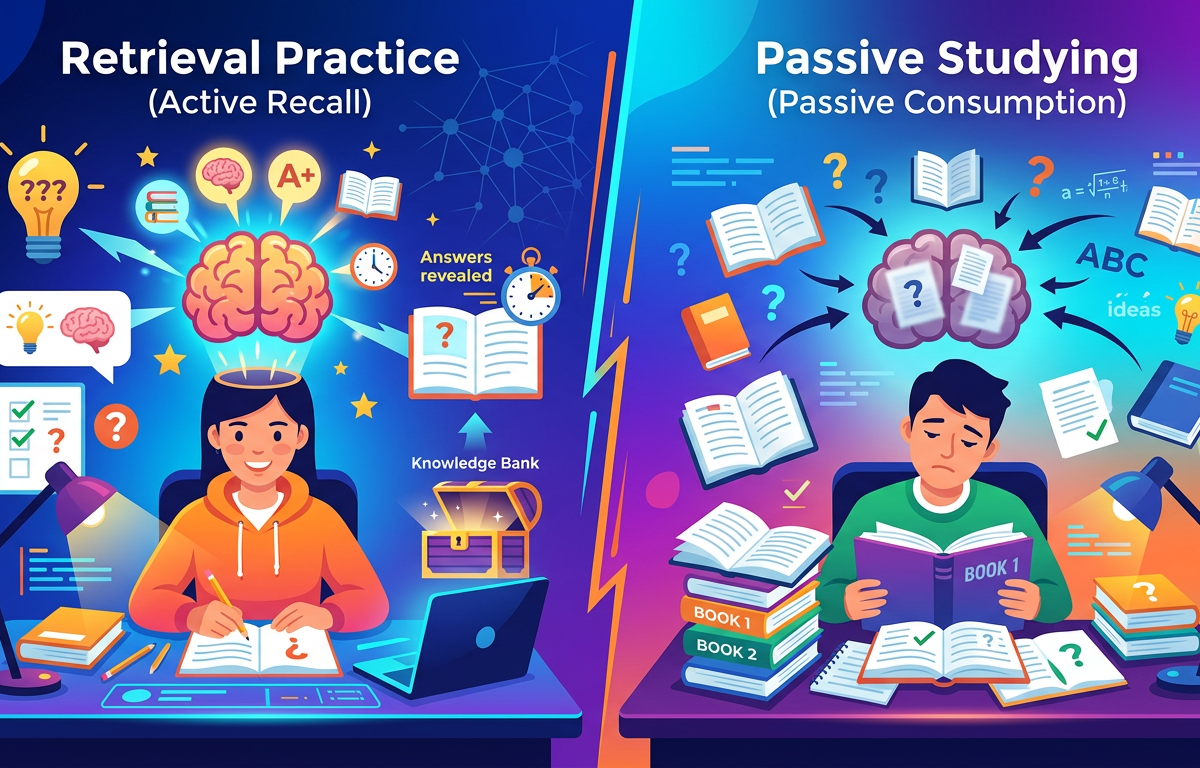
When you sit down to study, do you reach for a neon highlighter or a blank sheet of paper? Most students choose the highlighter. It feels productive, looks colorful, and involves very little mental friction. However, decades of cognitive research suggest that this preference is a mistake. Comparing Retrieval Practice vs Passive Studying reveals a stark reality: one builds long-term mastery while the other merely creates a temporary "glow" of familiarity that vanishes the moment you open an exam booklet.
The gap between these two methods isn't just about efficiency; it's about how the human brain actually encodes information. Passive studying involves taking information "in," while retrieval practice focuses on getting information "out." By shifting your focus from input to output, you change the physiological structure of your neural pathways. Understanding this distinction is the first step toward transforming your academic performance and making your study hours count for more.
The Science of Learning: Defining Retrieval Practice and Passive Studying
Retrieval practice is the act of forcing your brain to recall information from memory without looking at your notes. Think of it as a mental workout where the "weight" is the effort required to find a specific fact or concept in your mind. This process is often called active recall vs passive review because it requires the learner to be an active participant in their own cognition. Instead of letting information wash over you, you are hunting for it.
Passive studying, on the other hand, is the most common pitfall in education. It includes activities like rereading a textbook, highlighting sentences, or listening to a recorded lecture for the third time. While these methods are easy to perform, they rarely lead to long-term retention. Use of these methods often stems from a lack of metacognition in education, the ability to accurately judge what we actually know versus what we think we know.
A crucial concept here is the difference between "Storage Strength" and "Retrieval Strength." Robert Bjork, a psychologist at UCLA, pioneered this theory. Storage strength is how well a memory is embedded in the brain; retrieval strength is how easily you can access it. Passive study might increase storage slightly, but it does almost nothing for retrieval. Without retrieval practice, you might "know" the answer, but you won't be able to find it during a high-stakes test.
We often fall into the "Illusion of Fluency." When you reread a chapter, the text looks familiar. Your brain mistakes this ease of recognition for mastery. You tell yourself, "I know this," because your eyes glide over the words. In reality, you only recognize the information; you haven't actually learned how to produce it from scratch. To see how this looks in practice, you can explore power retrieval practice examples that bridge the gap between recognition and recall.
The Testing Effect: Why Your Brain Prefers a Workout
The testing effect proves that the act of taking a test, even a practice test, is a powerful learning tool in itself. Research by Henry Roediger and Jeffrey Karpicke in 2006 demonstrated this clearly. They found that students who studied once and took three practice tests performed significantly better on delayed exams than those who studied the material four times. Testing isn't just a way to measure learning; it is an engine for learning.
When you engage in retrieval practice, you are engaging in "desirable difficulty." This term describes a task that is hard enough to be challenging but not so hard that it's impossible. This struggle signals the brain that the information is important, triggering a process called consolidation. This is where the brain stabilizes a memory trace after the initial acquisition.
Every time you successfully retrieve a piece of information, you also engage in reconsolidation. The memory is pulled out, updated with new context, and then re-stored more deeply. This makes the neural pathway to that information more robust. It's essentially the difference between a faint footbridge and a six-lane highway across a canyon. If you want to know more about the biological side, check out this scientist's guide to long-term memory.
Furthermore, retrieval practice serves as a brutal but necessary feedback loop. It exposes what you don't know. Passive studying hides your weaknesses because the answers are always right there on the page. By testing yourself, you identify the "holes" in your knowledge early on, allowing you to focus your remaining study time on the concepts that actually need work.
Passive Studying: Why We Can't Quit Familiar Habits
Passive habits like highlighting and underlining are remarkably hard to break because they are low-stress. They don't require the mental "pain" of forgetting or struggling to remember. However, research published by the Association for Psychological Science ranked highlighting and rereading as having "low utility" for long-term learning. They provide a false sense of security while offering the lowest return on investment for your time.
The primary reason for this failure is the difference between recognition and recall. Recognition is seeing a multiple-choice option and thinking, "That looks right." Recall is being asked a question and having to generate the answer from thin air. Real-world applications, whether in a surgical suite or a courtroom, demand recall. If you only train your "recognition muscles," you will fail when the prompts are removed.
Is passive review ever useful? Occasionally. During the "initial exposure" phase, you must read or listen to understand the basic framework of a topic. You cannot retrieve what was never there. However, most students spend 90% of their time on this initial phase and only 10% on retrieval. The ratio should be inverted. Once you understand the core logic, you should move immediately to active recall.
Repeated reading sessions also suffer from diminishing returns. The second time you read a page, you gain some new insights. The fourth time you read it, your brain starts to "autopilot." You are moving your eyes across the page while thinking about what to have for dinner. This is the definition of wasted time. If you are preparing for high-stakes exams, staying in the passive zone is a recipe for disaster. This is especially true for specialized fields, as noted in this medical student guide to retrieval practice.
Active Recall vs. Passive Review: A Head-to-Head Comparison
When we weigh Retrieval Practice vs Passive Studying, the data on time efficiency is staggering. Passive review might yield good results on a test taken twenty minutes later, but those results plummet after 48 hours. Active recall requires more energy upfront, but it ensures the information stays accessible for weeks or months. This is why active learners often feel less stressed during finals week; they aren't "cramming" because they actually know the material.
Consider the mental load. Passive studying is "shallow processing." It involves looking at the surface of the words. Active recall is "deep processing." It requires you to make connections, visualize concepts, and organize data in your head. While this causes more fatigue in the short term, it builds the mental stamina required for higher-order thinking and complex problem-solving. This is a primary reason why students using active recall outperform their peers on application-based questions.
Preparedness levels also differ significantly. A student who has spent weeks rereading notes often feels "confident" until the first page of the exam. A student who has been using retrieval practice for college knows exactly what they can and cannot do. They have simulated the exam environment dozens of times, which naturally lowers test anxiety. They aren't hoping they'll remember; they already know they can.
Master Your Exams with Smart Retrieval
Stop wasting hours on passive rereading. Use Bevinzey to generate high-quality practice questions and turn your notes into a powerful active recall system today.
Get Started FreeCore Retrieval Practice Strategies You Can Use Today
One of the most effective ways to start is the **Blurting Method**. To do this, read a section of your notes, close the book, and "blurt" out everything you remember onto a blank piece of paper. Use a different color pen to check your notes afterward and fill in what you missed. The gap between your "blurt" and the actual notes is exactly where your learning needs to happen. This method is a staple in many high school study guides because it is so straightforward.
Optimization of flashcards is another game-changer. Don't just read the card; say the answer out loud before flipping it. Use the **Leitner System**, which involves moving cards into different boxes based on how well you know them. Cards you miss are reviewed daily, while cards you know are reviewed less frequently. This combines retrieval with spaced repetition, creating a double-whammy for your memory.
The Feynman Technique is also a form of retrieval. Pick a concept and explain it as if you were talking to a ten-year-old. If you stumble or can't find the right words, you’ve found a hole in your understanding. This forces you to retrieve the "logic" of the subject, not just the vocabulary. It’s particularly effective for subjects like math where understanding the "why" is as important as the "how." For those tackling specific tests, applying these methods to SAT math strategies can lead to massive score jumps.
Finally, move beyond multiple-choice questions provided by your textbook. Craft your own questions while you are first reading the material. Instead of writing "The mitochondria is the powerhouse of the cell," write "What is the primary function of the mitochondria?" Cover the answer and test yourself later. This simple shift turns a passive note-taking session into an active retrieval tool for the future.
Combining Retrieval with Other High-Utility Strategies
Retrieval practice is powerful, but it's even stronger when paired with spaced repetition. This is the practice of spreading your study sessions out over time rather than bunching them together. If you retrieve a fact once, you might remember it for a day. If you retrieve it again three days later, and then a week later, you slash the forgetting curve. Science shows that "forgetting" a little bit between sessions actually makes the next retrieval session even more effective.
Another technique is interleaving. Most students use "blocking", studying all of Chemistry on Monday and all of History on Tuesday. Interleaving means mixing them up. Solve three math problems, then define two history terms, then go back to math. This forces your brain to constantly "re-load" the context, which is exactly what happens during an actual exam. It prevents you from falling into a mindless rhythm and keeps your brain alert.
You should also include elaborative interrogation. When you retrieve a fact, ask yourself "Why?" or "How does this relate to X?" For example, if you recall that the Federal Reserve raised interest rates, ask yourself how that affects a local small business. Linking new information to existing knowledge structures makes the new memories much harder to lose. This creates a web of understanding rather than a list of isolated facts.
Overcoming the Challenges of Retrieval Practice
The biggest hurdle to retrieval practice is that it feels bad. It feels like you are failing because you can't remember everything immediately. You must embrace minimal success during your initial sessions. If you only remember 30% of your notes during a "blurt" session, that isn't a failure, it's a diagnostic. It's much better to fail in the privacy of your room than in the middle of a midterm.
Time management is also a concern. Students often say, "I don't have time to test myself; I'm still trying to get through the reading." The truth is that you don't have time not to test yourself. One hour of retrieval is worth three hours of rereading. If you are short on time, cut the reading in half and use the saved time for active recall. You will walk away with far more usable knowledge. This shift is critical for high-pressure fields, as seen in pharmacy student study guides.
Adopting a growth mindset is essential here. See every forgotten fact as a "data point" rather than a sign of low intelligence. Your brain is a muscle, and retrieval practice is the heavy lifting that makes it stronger. If it feels easy, you probably aren't learning. If it feels difficult, you are right in the "sweet spot" of cognitive growth. Don't fear the struggle; pursue it.
Implementing Retrieval Practice in Different Contexts
In high-volume fields like law or medicine, retrieval is the only way to survive the sheer amount of data. Medical students often use massive flashcard decks to keep thousands of symptoms and treatments fresh. In these cases, effective study strategies aren't just a bonus, they are a professional necessity. By using metacognitive tools, they can track precisely which medications they confuse and target those specifically.
In mathematics, many students make the mistake of reading through solved examples. This is passive. Instead, you should cover the solution and try to solve the problem yourself. Problem-solving is essentially "procedural retrieval." You are retrieving the steps and rules required to reach a conclusion. This is vital for avoiding common SAT math mistakes where students think they understand a concept until they have to apply it under a timer.
Even in corporate training or lifelong learning, retrieval holds weight. If you are learning a new language or a software coding transition, don't just watch tutorials. Build a small project or try to speak without your dictionary. The effort of trying to find the right word or the right line of code is what actually sticks the lesson to your brain. Whether you are 15 or 55, the mechanics of the science of learning remain the same.
Stop Guessing, Start Knowing
The evidence is clear: retrieval practice wins every time. Leverage the Bevinzey platform to create randomized practice tests and ensure you are truly prepared for exam day.
Get Started FreeFrequently Asked Questions
Why is retrieval practice more effective than rereading?
Retrieval practice is more effective because it strengthens neural pathways through effortful recall, whereas rereading only builds familiarity. Rereading creates an "illusion of fluency" where you recognize the text but cannot reproduce the information independently when the book is closed.
Is retrieval practice effective for all subjects?
Yes, retrieval practice works for everything from history facts to complex mathematical procedures. While the format changes—flashcards for vocabulary versus practice problems for math—the core principle of pulling information out of your brain remains the most effective way to learn.
How do I start using retrieval practice if I'm used to highlighting?
Start small by using the "Read-Recite-Review" method. Read a page (highlighting is okay), then close the book and recite or write down what you remember. Finally, review the page to see what you missed. Gradually increase the amount of time you spend in the "recite" phase.
Can retrieval practice be used for young children?
Absolutely. For young children, this can look like asking them to tell a story back to you or using "no-stakes" games to remember science facts. It helps build their foundational memory skills and encourages them to be active learners from an early age.
Does retrieval practice help with test anxiety?
Yes, it significantly reduces test anxiety by increasing "fluency" and confidence. Since you have already practiced retrieving the information under simulated test conditions, the actual exam feels like a familiar routine rather than a stressful unknown.
How often should I use retrieval practice before an exam?
Ideally, you should use retrieval practice in small bursts over several weeks. Instead of a single 5-hour session, do thirty minutes of active recall every other day. This utilizes spaced repetition to ensure the information is moved into your long-term memory.
Reviewed by
Michael Danquah, MS, PhD
Dr. Michael Danquah is a professor of pharmaceutical sciences and founder of several educational technology platforms focused on improving student learning and performance.
Enjoyed this article?
Share it with others who might find it helpful.
Related Articles

How to Solve Molarity Problems: Step-by-Step Mastery
Learn how to solve molarity problems step-by-step with formulas, unit tips, and worked examples so you can calculate concentration with confidence.
Mar 26, 2026

Avoid These 7 Common Molarity Mistakes in Chemistry
Master chemistry calculations! Avoid common molarity mistakes with our expert guide on unit conversions, dilution errors, and proper lab techniques.
Mar 26, 2026

What Is Molarity? The Complete Guide to Molar Concentration
Master molarity with our complete guide. Learn the formula, step-by-step calculations, and the critical differences between molarity and molality.
Mar 26, 2026

Why Molarity Matters: Converting Mass to Moles for Lab Solutions
Master chemistry with our guide to the molarity formula. Learn how to calculate concentration with step-by-step examples, units, and practical lab tips.
Mar 26, 2026

Molarity vs Molality: The Essential Difference Explained
Master the difference between molarity vs molality. Learn the formulas, key differences, and when to use each in this comprehensive chemistry guide.
Mar 26, 2026