Ultimate Retrieval Practice Study Schedule Template & Guide
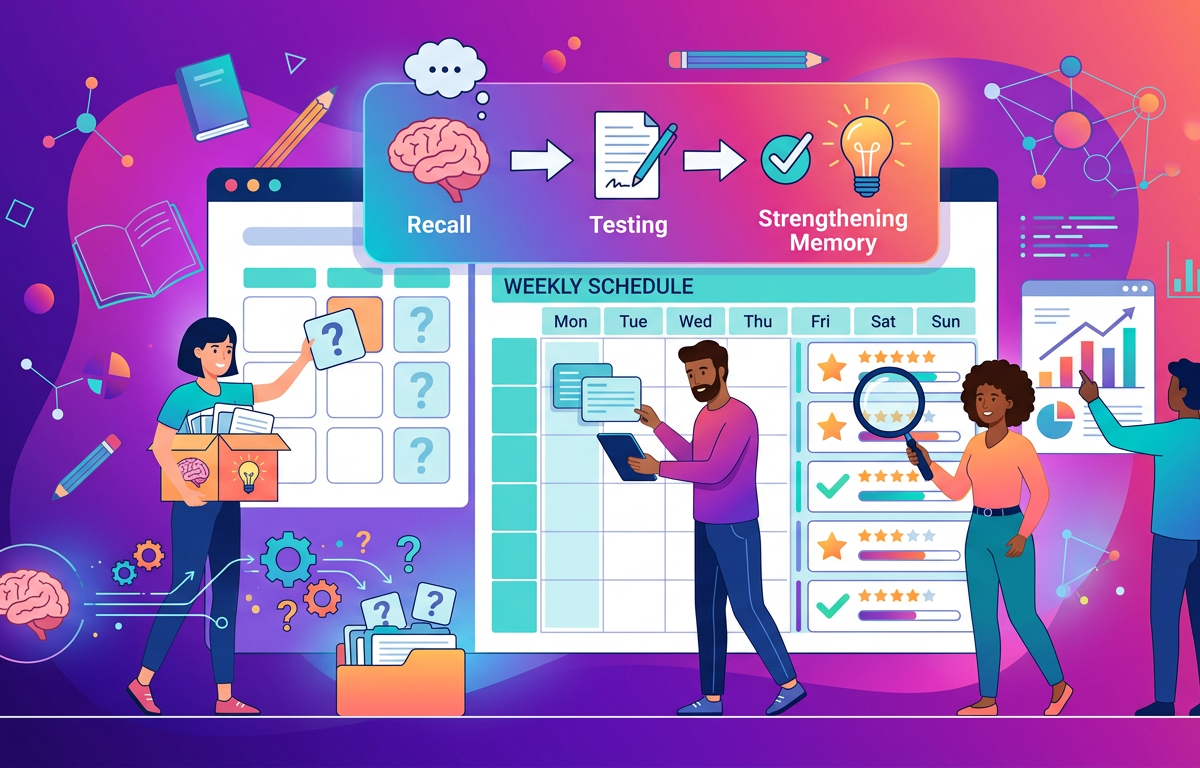
The Power of Retrieval Practice: Why Your Current Study Method is Failing You
Most students spend their lives rereading textbooks and highlighting passages in vibrant neon colors. Unfortunately, cognitive science suggests this is almost entirely a waste of time. To master complex material, you need a Retrieval Practice Study Schedule Template that forces your brain to work.
The psychology of effortful learning dictates that the harder you have to work to remember something, the more likely you are to keep it long-term. When you reread a chapter, you experience the "illusion of competence." You recognize the words on the page, so your brain tricks you into thinking you know the material, but recognition is not the same as mastery. As explored in why retrieval practice feels hard, the struggle is actually the moment learning happens.
Passive review feels good because it is easy. However, the "forgetting curve", a concept pioneered by Hermann Ebbinghaus, shows that we lose roughly 70% of new information within 24 hours if we don't actively try to recall it. Retrieval practice flattens this curve by pulling information out of your brain rather than trying to cram it in. It transforms the memory from a fragile state into a permanent one.
Retrieval practice is simply the act of calling information to mind without looking at your notes. Think of it like a mental workout. Just as you wouldn't expect to build muscle by watching someone else lift weights, you cannot build neural pathways by watching your eyes skim over a page. You must engage in an active recall study plan to see real results.
Core Components of an Effective Retrieval Practice Schedule
A successful Retrieval Practice Study Schedule Template relies on the "spacing effect." This involves spreading your study sessions out over time rather than grouping them together in one long session. Research from The American Psychological Association confirms that distributed practice leads to significantly better retention than massed practice.
Interleaving is the second pillar of an effective schedule. This means mixing different topics or types of problems within a single study session. Instead of doing 50 geometry problems in a row, you might do ten geometry problems, then ten algebra problems, and then ten statistics questions. This forces your brain to distinguish between different problem types, which is essential for solving SAT questions faster and performing under exam pressure.
Combining retrieval with spaced repetition creates a "Power Duo." You retrieve the information, and then you wait until you are just about to forget it before retrieving it again. This "desirable difficulty" ensures the brain works at its peak capacity. If it's too easy, you aren't learning; if it's impossible, you'll burn out. Your schedule should aim for that sweet spot where recall feels challenging but achievable.
How to Use the Retrieval Practice Study Schedule Template
To implement an evidence-based learning strategy, you must first audit your material. Break your syllabus down into "retrievable units"—small, discrete concepts or facts rather than broad chapters. Rank these topics by difficulty: Green for "I've got this," Yellow for "I'm shaky," and Red for "I have no clue."
Once audited, assign retrieval intervals using the 1-3-7-30 rule. This means you review new material after one day, then three days, then seven days, and finally 30 days. This frequency ensures you are hitting the forgetting curve at exactly the right moments. For many students, using retrieval practice with flashcards is the easiest way to manage these intervals.
Day 1: Initial Learning + First Retrieval (Brain Dump/Blurting).
Day 2: Quick Quiz (Active Recall).
Day 5: Flashcard Review + Practice Problem.
Day 12: Teaching the concept to an imaginary student.
Day 30: Comprehensive Review.
Visualizing your progress is vital for maintaining motivation. Many students use "heat maps" in Excel or Notion. A heat map is a simple grid where every cell represents a topic and the color represents your last retrieval success. Watching a "Red" topic turn "Green" over four weeks provides a dopamine hit that keeps you coming back to your Retrieval Practice Study Schedule Template.
Master Your Exams with Smart Practice
Stop wasting hours on passive reading. Use Bevinzey to generate high-quality retrieval questions tailored to your specific study material today.
Get Started FreeTailoring the Template for Different Subjects
A Retrieval Practice Study Schedule Template for a math major looks very different from one for a history major. In STEM subjects, use the "Open Problem" method. Instead of looking at the solution and saying "that makes sense," you must start with a blank page and work the problem until you reach the end, even if you get stuck. This is particularly effective for mastering hard SAT geometry practice questions.
Humanities students benefit more from "Blurting" and concept mapping. Set a timer for five minutes and write down everything you remember about the French Revolution or the themes in The Great Gatsby. Compare your "blurt" to your notes and identify what you missed. This gap-filling process is where the real neural connections are made. Medical students often find that mastering retrieval practice requires high-volume flashcard usage due to the sheer amount of terminology involved.
Language learning requires "Contextual Retrieval." Don't just translate words in a vacuum. Try to retrieve the word within a full sentence or during a simulated conversation. According to The U.S. Department of State, language proficiency is built through usage in varied contexts, making interleaving especially important for vocabulary retention.
Advanced Retrieval Strategies to Incorporate into Your Schedule
If you want to maximize your long-term memory, move beyond basic flashcards to "Elaborative Interrogation." As you retrieve a fact, ask yourself "Why is this true?" or "How does this relate to what I learned last week?" This anchors the new information to existing knowledge, making it much harder to forget.
Successive relearning is the "gold standard" of cognitive psychology. This involves practicing a task until you get it right, and then coming back to practice it again a few days later. It is a more intense version of spaced repetition that ensures near-perfect recall. You can see power retrieval practice examples that demonstrate how this works in real-world scenarios.
Another powerful tool is "Peer-to-Peer Retrieval." Find a study partner and take turns quizzing each other without looking at your notes. When you have to explain a concept to someone else, you are forced to organize the information logically in your own mind. This is often more effective than solo study because your partner can spot the "blind spots" in your knowledge that you might overlook yourself.
Common Pitfalls and How to Avoid Them
The most common mistake is over-retrieving. If you quiz yourself on the same five flashcards ten times in one hour, you are wasting your time. Once you have successfully retrieved a fact, move on. Diminishing returns set in quickly, and your time is better spent on dominated learning methods that cover new or forgotten ground.
Forgetting is frustrating, but it is a necessary part of the process. If you never forgot anything, your brain wouldn't know what was important enough to store permanently. When you fail a retrieval session, don't get discouraged. Review the correct answer immediately and schedule another soul-retrieval session for the next day. This "failed" session actually provides a stronger memory trace than a session where everything was easy.
Balance is also key. You cannot retrieve what you haven't learned. Ensure your schedule allocates about 30% of the time to "Input" (reading, watching lectures, taking notes) and 70% to "Output" (retrieval practice). Many students flip this ratio, which is why they struggle during finals. If you are a high schooler, check out the retrieval practice guide for high school to find the right balance for your workload.
Tools and Resources for Digital Retrieval Practice
For those who prefer a digital approach, Anki is the powerhouse of the spaced repetition world. It uses a complex algorithm to show you cards right before you are likely to forget them. While it has a steep learning curve, it is favored by medical and pharmacy students globally. If you are in that field, our guide for pharmacy students goes into detail on setting up these systems.
Notion and Google Sheets are excellent for building a "Do-It-Yourself" tracker. You can create a simple table with columns for "Topic," "Confidence Level," and "Next Review Date." By using basic formulas, you can even have the sheet tell you which topics are "due" for retrieval each morning. This keeps your Retrieval Practice Study Schedule Template organized and automated.
However, don't discount analog options. For some, the tactile act of writing on a physical planner or using paper flashcards helps with focus and reduces screen fatigue. The best tool is the one you will actually use consistently. Whether it's an app or a notebook, the goal remains the same: stop reading, start recalling, and watch your grades transform.
Stop Guessing, Start Mastering
Use our AI-powered platform to turn your notes into a customized retrieval practice schedule in seconds. Achieve the grades you deserve.
Get Started FreeFrequently Asked Questions
How long should I wait between retrieval practice sessions?
Start with a short gap of 24 hours. As you become more confident with the material, increase the interval to 3 days, then 1 week, and then 1 month.
Can I use retrieval practice for subjects like math or art?
Yes. In math, retrieval means solving problems from memory. In art, it might mean recalling the steps of a specific technique or the history of a movement without looking at your textbook.
What is the difference between active recall and retrieval practice?
These terms are often used interchangeably. Both refer to the process of actively pulling information from your memory rather than passively reviewing it.
How do I balance retrieval practice with learning new material?
A good rule of thumb is the 70/30 rule: spend 70% of your time retrieving previously learned material and 30% of your time acquiring new information.
Is retrieval practice effective for cramming before an exam?
Retrieval practice is better than rereading, even for cramming. However, the true benefits of retrieval—long-term retention—require the spacing effect over several weeks.
What are the best free tools for digital retrieval practice?
Anki (PC/Android), Quizlet (basic version), and Google Sheets are the most popular free options for building a custom study schedule.
Reviewed by
Michael Danquah, MS, PhD
Dr. Michael Danquah is a professor of pharmaceutical sciences and founder of several educational technology platforms focused on improving student learning and performance.
Enjoyed this article?
Share it with others who might find it helpful.
Related Articles

How to Solve Molarity Problems: Step-by-Step Mastery
Learn how to solve molarity problems step-by-step with formulas, unit tips, and worked examples so you can calculate concentration with confidence.
Mar 26, 2026

Avoid These 7 Common Molarity Mistakes in Chemistry
Master chemistry calculations! Avoid common molarity mistakes with our expert guide on unit conversions, dilution errors, and proper lab techniques.
Mar 26, 2026

What Is Molarity? The Complete Guide to Molar Concentration
Master molarity with our complete guide. Learn the formula, step-by-step calculations, and the critical differences between molarity and molality.
Mar 26, 2026
Why Molarity Matters: Converting Mass to Moles for Lab Solutions
Master chemistry with our guide to the molarity formula. Learn how to calculate concentration with step-by-step examples, units, and practical lab tips.
Mar 26, 2026

Molarity vs Molality: The Essential Difference Explained
Master the difference between molarity vs molality. Learn the formulas, key differences, and when to use each in this comprehensive chemistry guide.
Mar 26, 2026