Why Molarity Matters: Converting Mass to Moles for Lab Solutions
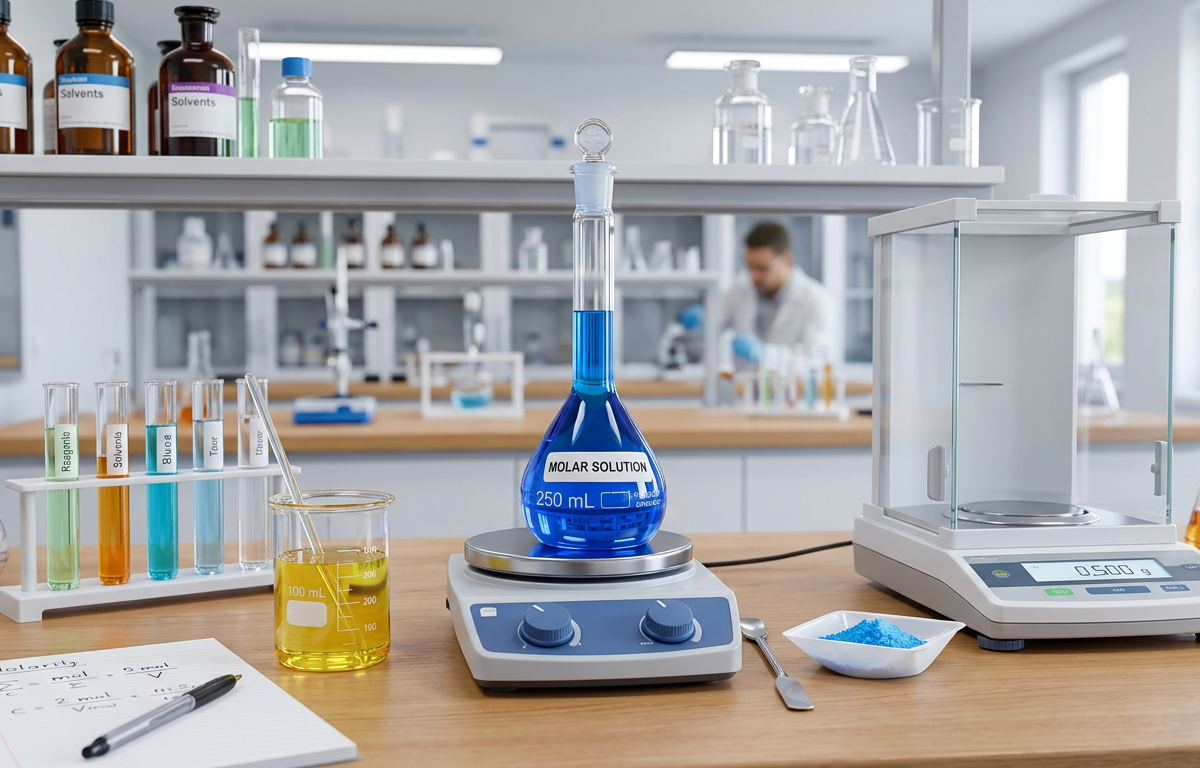
If you dissolve 58 grams of table salt into exactly one liter of water, you do not actually have a 1.0 M solution. This is the first trap students fall into. Because the salt itself occupies physical space, your final volume will exceed one liter, slightly diluting your intended concentration. To get the math right, you must add the solute first and then dilute with solvent until the total mixture hits the graduation mark. This distinction between solvent volume and solution volume is what separates a successful titration from a failed lab report.
Precision in chemistry relies on the molar concentration formula, which functions as a translator between the grams you weigh on a scale and the actual number of reacting molecules. When you see a bottle labeled 0.5 M HCl, the liquid inside contains exactly half a mole of hydrochloric acid particles for every liter of fluid. Mastering this ratio requires two distinct shifts in thinking: converting mass into the chemical counting unit known as the mole and ensuring your volume units are strictly in liters rather than milliliters.
What is Molarity? Defining Chemical Concentration
Molarity is the measure of the number of moles of a solute dissolved in exactly one liter of solution. In the world of chemistry, we need a precise way to communicate how "strong" or "weak" a liquid mixture is. The Molarity Formula Explained in its simplest form provides a quantitative bridge between the macroscopic world of milliliters and the microscopic world of molecules.
According to the International Union of Pure and Applied Chemistry (IUPAC), molar concentration is the amount of a constituent divided by the volume of the mixture. This standard allows scientists in Tokyo to replicate an experiment designed in New York with absolute precision. For more context on these definitions, you can reference the official IUPAC Gold Book.
To master this concept, you must distinguish between the solute (the substance being dissolved, like salt), the solvent (the substance doing the dissolving, like water), and the solution (the final combined mixture). Understanding this relationship is the first step in learning what is molarity and how it functions in a lab setting. Historically, molarity became the gold standard because measuring the volume of a liquid is significantly faster and more convenient than weighing it during a fast-paced titration.
The Molarity Formula: Breaking It Down
The standard equation for molarity is M = n / V, where 'M' represents molarity, 'n' represents the number of moles of solute, and 'V' represents the total volume of the solution in liters. Because molarity is a ratio, it describes the concentration regardless of how much solution you actually have in your beaker.
Units are the most frequent source of error for students. In the Molarity Formula Explained, the "V" must always be in liters (L). If your lab manual gives you a volume in milliliters (mL), you must divide by 1,000 before plugging it into the formula. A solution containing 1 mole of solute in 1 liter of solution is called a "1 Molar" solution, written simply as 1 M.
The symbol 'M' is shorthand for mol/L. When you see a bottle labeled "0.5 M HCl," it literally means there are 0.5 moles of hydrochloric acid for every one liter of that liquid. If you are struggling with the basic math behind these units, you might find it helpful to review why students struggle with molarity to avoid common cognitive traps.
Master Molarity with Bevinzey
Tired of confusing moles and milliliters? Use our AI-powered tools to practice chemistry problems effortlessly.
Get Started FreeHow to Calculate Molarity: A Step-by-Step Guide
Calculating molarity requires four specific steps to ensure accuracy. You cannot simply divide the mass of a powder by the volume of water; you must first convert that mass into the chemical "counting unit" known as the mole.
- Step 1: Identify the solute and its mass. Weigh your dry chemical on a balance. For example, you might have 5.00 grams of NaOH.
- Step 2: Convert mass to moles. Use the molar mass from the periodic table (Grams ÷ Molar Mass = Moles). For NaOH, 5.00g / 40.00g/mol = 0.125 moles.
- Step 3: Measure the total volume. Add your solute to a container and then add solvent until the total volume reaches your target. If you need a 250 mL solution, the volume is 0.250 L.
- Step 4: Divide moles by liters. Divide the moles from Step 2 by the liters from Step 3. (0.125 / 0.250 = 0.5 M).
A frequent error involves the "total volume vs. solvent volume" distinction. If you add 1 liter of water to a cup of sugar, the final volume will be more than 1 liter because the sugar occupies space. To get an accurate molarity, you must add "water up to the line" of a 1-liter mark, rather than adding 1 liter of water to the solute. For a detailed breakdown of these nuances, see our guide on how to solve molarity problems.
Molarity Calculation Examples (Practice Problems)
Let's look at Example 1: Sodium Chloride Solution. If you dissolve 58.44 grams of NaCl (which is exactly 1 mole) into enough water to make 2.0 liters of solution, what is the molarity? M = 1.0 mol / 2.0 L = 0.5 M NaCl. This is a classic example of moles of solute per liter of solution.
Example 2: Preparing a 0.5M Glucose Solution. Suppose you need to prepare 100 mL of 0.5 M Glucose (C6H12O6). First, convert mL to L: 0.1 L. Next, find the moles needed: 0.5 M * 0.1 L = 0.05 moles. Finally, convert moles to grams using the molar mass of glucose (roughly 180.16 g/mol): 0.05 * 180.16 = 9.008 grams. You can test your skills with molarity practice questions with answers.
Example 3: The Dilution Formula. When you have a concentrated "stock" solution and want to make it weaker, you use M1V1 = M2V2. If you have 10 M HCl and want to make 100 mL of 1 M HCl, the math is: (10 M) * V1 = (1 M) * (100 mL). Solving for V1 gives you 10 mL. You would take 10 mL of the concentrate and add water until you reach the 100 mL mark. This is essential for standard solution preparation in medical and research laboratories.
Molar Mass and Its Role in Concentration
Molar mass is the weight in grams of one mole of a substance. To find it, you must sum the atomic weights of all atoms in the chemical formula using a standard periodic table. For instance, the molar mass of H2SO4 is calculated by adding the weights of two Hydrogen atoms, one Sulfur atom, and four Oxygen atoms (approx. 98.08 g/mol).
Precision depends heavily on significant figures. If your scale only measures to one decimal place, your final molarity calculation shouldn't provide five decimal places. This "false precision" is a common reason students lose points on chemistry exams. Using accurate molar masses for common reagents like NaOH (40.00 g/mol) or HCl (36.46 g/mol) ensures your aqueous solution calculations are reliable.
If you're still uncomfortable with the transition from weight to moles, practicing moles to grams practice questions is the best way to build muscle memory. Chemistry is as much about unit consistency as it is about reactions.
Molarity vs. Molality: Key Differences to Know
While molarity (M) is moles per liter of solution, molality (m) is moles per kilogram of solvent. Why does this distinction matter? Volume is sensitive to temperature. When a liquid heats up, it expands, which means the volume increases and the molarity decreases, even though the amount of chemical hasn't changed.
This "temperature problem" makes molarity unreliable for experiments involving extreme heat or cold. Molality, however, relies on mass, which does not change with temperature. You will typically use molality when studying colligative properties, such as boiling point elevation or freezing point depression. In most standard laboratory titrations at room temperature, molarity remains the preferred unit due to the ease of volumetric measurement.
Choosing between these chemistry concentration units depends on your environment. In a stable room-temperature lab, molarity is king. In high-precision thermodynamics, molality is the necessary standard. To avoid mixing these up, check out our list of 7 common molarity mistakes.
Practical Applications: Molarity in the Laboratory
The standard solution preparation process almost always involves a volumetric flask. These glass flasks are calibrated to contain a very specific volume at a specific temperature. To prepare a solution, you add the solute first, add about half the solvent to dissolve it, and then carefully "fill to the mark" with a dropper. This ensures the total solution volume is exactly what you intended.
In acid-base titrations, molarity allows us to determine the unknown concentration of a sample. By reacting a known volume of a "standard" (a solution with a known molarity) with the unknown, we can use stoichiometry to calculate the hidden concentration. This is the foundation of analytical chemistry, used everywhere from testing swimming pool pH to monitoring blood glucose levels.
Safety is also a factor. When converting percentage concentrations found on industrial jugs (like 37% HCl) to molarity, you must account for the density of the liquid. Handling these concentrated stocks requires an understanding of how molar concentration calculation translates to real-world safety protocols. For more advanced practice, try these acid-base titration practice questions.
Common Pitfalls and Mistakes in Molarity Calculations
The "Milliliter Trap" is the number one cause of failed chemistry exams. Because lab equipment like graduated cylinders and pipettes are marked in mL, students often forget to convert to L. Using 500 instead of 0.5 in the denominator of your Molarity Formula Explained will result in an answer that is off by a factor of 1,000.
Another pitfall is assuming volumes are perfectly additive. If you mix 50 mL of ethanol and 50 mL of water, the final volume is actually slightly less than 100 mL due to molecular packing! This is why you must always dilute to the final volume mark rather than adding pre-measured amounts of liquid together. If you're ready to test your knowledge against tougher scenarios, dive into some hard molarity practice questions.
Crush Your Next Chemistry Exam
Don't let molarity problems slow you down. Bevinzey's adaptive learning platform helps you master concentration calculations, stoichiometry, and more with ease.
Get Started FreeFrequently Asked Questions
What is the difference between molarity and molality?
Molarity (M) measures moles per liter of solution and is temperature-dependent. Molality (m) measures moles per kilogram of solvent and remains constant regardless of temperature changes.
Can molarity change with temperature?
Yes. As temperature increases, most liquids expand in volume. Since molarity is moles divided by volume, an increase in volume causes the molarity to decrease.
How do you calculate molarity from density and mass percent?
Multiply the density (g/L) by the mass percent (as a decimal) to find the mass of solute per liter. Then, divide that mass by the solute's molar mass to get the molarity.
Is molarity the same as concentration?
Molarity is a type of concentration. While concentration is a general term for the amount of solute in a mixture, molarity specifically refers to moles per liter.
What are the units for molarity?
The standard units for molarity are moles per liter (mol/L), often abbreviated with a capital "M".
How do you find the volume of a solution if you know the molarity and moles?
Rearrange the molarity formula (M = n/V) to solve for volume: V = n / M. Divide the number of moles by the molarity to find the volume in liters.
Enjoyed this article?
Share it with others who might find it helpful.
Related Articles

Avoid These 7 Common Molarity Mistakes in Chemistry
Master chemistry calculations! Avoid common molarity mistakes with our expert guide on unit conversions, dilution errors, and proper lab techniques.
Mar 26, 2026

Why Molarity Ratios Fail: Solving the Moles per Liter Logic Gap
Master molarity with ease. Discover why chemistry students struggle with concentration units and learn proven strategies to solve molarity problems fast.
Mar 26, 2026
Predicting Radioactive Decay: Solving for Mass and Time Intervals
Master half-life calculations with our comprehensive guide featuring step-by-step solved examples, practice questions, and detailed answers for students.
Apr 2, 2026
Mastering pKa Calculations: Converting Ka and Conjugate Pairs
Master pKa and pKb calculations with this comprehensive guide, featuring concept explanations, solved examples, and practice questions.
Mar 28, 2026
Mastering Acid Ionization: Solving for Ka and pH in Weak Solutions
Master the difference between strong and weak acids with practice questions, detailed explanations, and a quick quiz.
Mar 28, 2026

Stoichiometry of the Flask: Calculating Solute Mass and Dilutions
Master solution preparation with these easy practice questions. Learn to calculate molarity, mass, and dilutions with step-by-step examples and a quick quiz.
Mar 27, 2026

Calculating Mass Ratios: Percent Composition Mastery and Problems
Master percentage composition with our comprehensive guide featuring step-by-step solved examples, practice questions, and a quick quiz to test your knowledge.
Mar 26, 2026
Empirical Formulas: Solving Ratios from Mass and Percent Data
Master empirical formula calculations with 10 practice questions, worked answers, and a free step-by-step calculator for mass, percentage, and combustion problems.
Mar 26, 2026