Retrieval Practice vs Spaced Repetition: The Ultimate Guide
Understanding the Science of Learning: An Introduction
Most students spend hundreds of hours rereading highlighted textbooks, believing they are mastering the material. This common habit creates an "illusion of competence." When you read a familiar paragraph, your brain recognizes the words, leading you to mistake recognition for actual knowledge. Unfortunately, American Psychological Association research shows that this familiarity evaporates the moment you face a blank exam paper.
Effective learning is not about how much information you can shove into your brain; it is about how easily you can pull it back out. This shift from "input" to "output" defines the modern understanding of cognitive science. Instead of passive review, experts now prioritize methods that force the brain to work. These strategies focus on cognitive endurance and the ability to apply concepts in novel situations rather than rote memorization.
Two strategies dominate educational psychology: retrieval practice and spaced repetition. These aren't just trendy buzzwords. They are evidence-based pillars of Retrieval Practice vs Passive Studying research. While they are often grouped together, they solve two different problems in the memory cycle. Understanding the nuances of Retrieval Practice vs Spaced Repetition is the first step toward slashing your study time in half while doubling your retention.
What is Retrieval Practice? The Power of Active Recall
Retrieval practice is the act of forcing your brain to retrieve a memory without looking at your notes. Every time you recall a fact, you aren't just checking if it’s there; you are physically changing the memory trace. Neuroscientists have found that the act of retrieval strengthens the neural pathways associated with that information, making it more resistant to forgetting.
Think of your memory like a forest. Information is a destination, and retrieval is the path you walk to get there. Rereading is like looking at a map of the forest. Retrieval practice is actually walking the path. The more often you walk it, the clearer and more permanent the trail becomes. This is a core part of the Harvard University pedagogical framework, often referred to as the "testing effect."
A central concept here is "Desirable Difficulty." Learning shouldn't feel easy. In fact, Why Retrieval Practice Feels Hard is exactly why it works. If you are struggling to remember an answer, your brain is working harder to build that path. Low-stakes testing, like quick quizzes or brain dumps, provides immediate feedback. This allows you to identify "metacognition" gaps, where you realize you don't actually know what you thought you knew.
Examples of Retrieval Practice in Action
Flashcards: Seeing a prompt and stating the answer before flipping the card.
The Blurting Method: Writing down everything you remember about a topic on a blank sheet of paper.
Practice Problems: Solving equations or cases without looking at the step-by-step guide.
Teaching: Explaining a concept to a peer or an imaginary audience.
What is Spaced Repetition? Distributing Your Learning
Spaced repetition informs you exactly when to study to prevent forgetting. In the late 19th century, psychologist Hermann Ebbinghaus discovered the "Forgetting Curve," which demonstrates that humans lose about 50-80% of new information within days if it isn't reviewed. Spaced repetition fights this decay by scheduling reviews at increasing intervals.
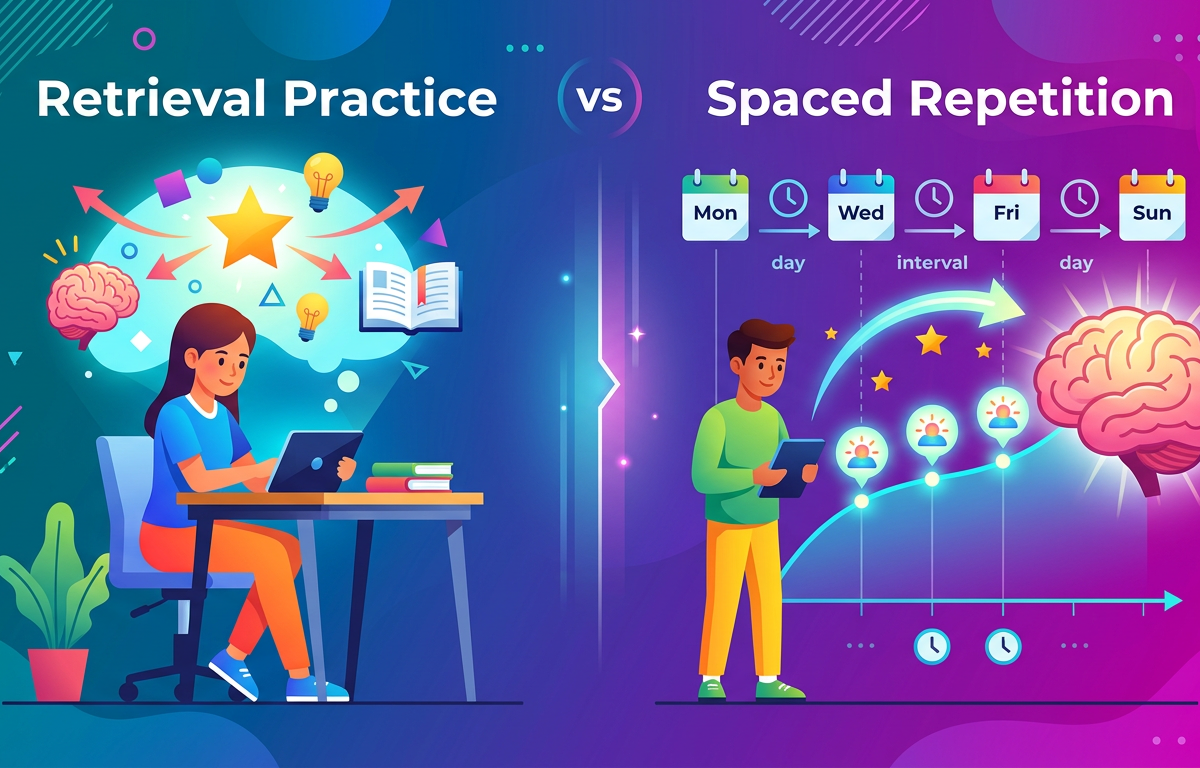
Instead of "massed practice" (cramming all night), you might review a concept after 1 day, then 3 days, then 10 days, and finally 30 days. This distribution exploits the "spacing effect." By waiting until you are just about to forget the information before reviewing it again, you force the brain to work harder during the retrieval process, which cements the data into your long-term memory.
Recent studies from The National Institutes of Health suggest that sleep is the "secret sauce" of this process. When you space your learning, you allow for multiple sleep cycles. During sleep, the hippocampus "replays" the day's learning, moving it into the neocortex for long-term storage. If you cram, you only have one sleep cycle to consolidate a massive amount of data, which leads to the rapid "dumping" of information after the exam.
The Ultimate Retrieval Practice Study Schedule Template can help you visualize how these intervals look in a typical semester. The goal is to reach a point where you only need to review a concept once every few months to maintain perfect recall.
Retrieval Practice vs Spaced Repetition: Key Differences Explained
The primary difference between retrieval practice and spaced repetition is that the former is a learning technique (the "what"), while the latter is a scheduling strategy (the "when"). Retrieval practice is the cognitive act of pulling information out. Spaced repetition is the logistical framework that tells you the best time to perform that act.
In terms of cognitive load, retrieval practice is high-intensity. It requires focus and mental energy. Spaced repetition is more about management; it reduces the total "load" over time by ensuring you aren't wasting energy reviewing things you already know well. If you only use retrieval practice without spacing, you might over-learn a topic in one day but forget it by next week. If you use spacing without retrieval (like rereading on a schedule), your retention will remain shallow.
These two methods target different stages of the National Center for Education Statistics memory model. Retrieval practice targets encoding and retrieval strength—how well the data is "hooked" into your existing knowledge. Spaced repetition targets storage strength—how long that data stays accessible in your mind. Using one without the other is like having a car with a powerful engine but no wheels, or a sleek body with no motor.
Ready to Master Your Exams?
Stop wasting hours on passive rereading. Use Bevinzey's intelligent tools to turn your notes into powerful retrieval practice sessions instantly.
Get Started FreeThe Symbiotic Relationship: Why You Need Both
Retrieval practice and spaced repetition are most effective when combined into a framework called "Successive Relearning." Researchers Katherine Rawson and John Dunlosky found that students who practiced a task until they got it right (retrieval), and then did so again several days later (spacing), outperformed all other groups. This combination is the gold standard for Retrieval Practice and the Testing Effect.
Successive relearning ensures that you aren't just memorizing facts, but building a deep, durable knowledge base. For instance, a medical student might use Retrieval Practice for Medical Students to learn drug interactions. They use active recall to ensure they understand the mechanism of action, and spaced repetition to ensure they don't forget that interaction when they are on their clinical rotations three years later.
This "double-threat" approach also builds metacognition. By regularly testing yourself on a set schedule, you become acutely aware of your own "forgetting curve." You start to notice which topics are "leaky" and require more frequent spacing, and which ones are "sticky." This self-awareness allows you to pivot your study time toward your weakest areas, maximizing efficiency.
Tools and Technologies for Modern Learners
You don't need to be a data scientist to manage your own spacing and retrieval. Several software solutions, known as Spaced Repetition Systems (SRS), automate the process. These apps track how difficult a concept was for you and calculate the exact date you should see it again. For many, Using Retrieval Practice With Flashcards via these apps is the most efficient way to study.
Anki is the powerhouse of the SRS world. It is highly customizable and popular among medical and language students. Quizlet offers a more user-friendly interface with gamified features, though its spacing algorithms are often locked behind a premium tier. For those who prefer analog methods, the Leitner System uses physical boxes to cycle flashcards based on how well you know them. If a card is answered correctly, it moves to the next box (longer delay); if wrong, it goes back to Box 1.
Beyond flashcards, many students are finding success with "blurting." This involves reading a chapter, closing the book, and writing everything you recall. You then go back with a red pen to fill in what you missed. This is a pure form of retrieval that doesn't require any digital tools, yet perfectly aligns with the principles of Retrieval Practice for College Students.
Practical Implementation: How to Apply These Strategies Today
To start using Retrieval Practice vs Spaced Repetition today, stop taking linear notes. Instead of writing summaries, write questions. If you are learning about the French Revolution, don't write "The Bastille was stormed on July 14, 1789." Instead, write "When was the Bastille stormed and why was it significant?" During your next study session, answer the question before looking at the back of the page.
For high-stakes prep, like learning How to Improve SAT Math Score, apply the 24-hour rule. Every math problem you got wrong today should be attempted again tomorrow morning. This immediate spacing ensures the correction actually "sticks." If you get it right, move it to a 3-day bucket. If you get it wrong again, it stays in the daily rotation.
"The goal of learning is not to pass a test, but to acquire knowledge that stays with you forever. Retrieval and spacing are the only proven ways to make that happen."
Managing the mental fatigue is the hardest part. Because active learning is difficult, your brain will try to convince you to go back to highlighting. Resist this urge. Set a timer for 25 minutes of intense retrieval followed by a 5-minute break. This "Pomodoro" approach helps mitigate the "Resistance to Effort" that often accompanies these high-level cognitive strategies.
Common Pitfalls and How to Avoid Them
The most dangerous pitfall is "Pseudo-Retrieval." This happens when your flashcards or questions provide too many hints. If the front of the card says "The capital of France starts with a P...", you aren't actually retrieving the information; you are just finishing a pattern. Ensure your retrieval cues are challenging enough to trigger a genuine search of your memory.
Another issue is "The Backlog." In spaced repetition software, if you miss a few days, the cards pile up. This can be overwhelming. To avoid this, focus on quality over quantity. Don't make 500 cards for one chapter. Use Retrieval Practice Examples to identify the "high-yield" concepts—the 20% of information that will account for 80% of your progress.
Finally, never skip the "Understanding" phase. Retrieval practice is for fixing information in your mind, but you can't retrieve what isn't there. Spend 15-20 minutes truly grasping a concept before you try to memorize it. If you try to use Retrieval Practice for High School on subjects you don't understand, you’ll just be memorizing strings of nonsense words.
Supercharge Your Study Sessions
Experience the perfect blend of spacing and active recall with Bevinzey's custom-built practice tools designed for long-term retention.
Get Started FreeFrequently Asked Questions
Can I use retrieval practice and spaced repetition together?
Yes, combining them is the most effective way to learn. Retrieval practice is the action you take, and spaced repetition is the schedule you follow to maximize long-term retention.
What are some examples of retrieval practice tools?
Common tools include digital flashcard apps like Anki and Quizlet, the "blurting" method, practice test generators, and the Leitner box system for physical cards.
Which is better for short-term vs long-term memory?
Retrieval practice is essential for both, but spaced repetition is specifically designed for long-term memory. Cramming (massed retrieval) might help for a test tomorrow, but the knowledge won't last without spacing.
Is flashcard use considered retrieval practice or spaced repetition?
The act of answering the card is retrieval practice. The system of reviewing those cards at specific intervals (like every 3 days) is spaced repetition.
How often should I space my study sessions?
A standard effective interval sequence is 1 day after initial learning, then 1 week, then 1 month, and then 6 months. Adjust based on how difficult the material feels.
Reviewed by
Michael Danquah, MS, PhD
Dr. Michael Danquah is a professor of pharmaceutical sciences and founder of several educational technology platforms focused on improving student learning and performance.
Enjoyed this article?
Share it with others who might find it helpful.
Related Articles

How to Solve Molarity Problems: Step-by-Step Mastery
Learn how to solve molarity problems step-by-step with formulas, unit tips, and worked examples so you can calculate concentration with confidence.
Mar 26, 2026

Avoid These 7 Common Molarity Mistakes in Chemistry
Master chemistry calculations! Avoid common molarity mistakes with our expert guide on unit conversions, dilution errors, and proper lab techniques.
Mar 26, 2026

What Is Molarity? The Complete Guide to Molar Concentration
Master molarity with our complete guide. Learn the formula, step-by-step calculations, and the critical differences between molarity and molality.
Mar 26, 2026

Why Molarity Matters: Converting Mass to Moles for Lab Solutions
Master chemistry with our guide to the molarity formula. Learn how to calculate concentration with step-by-step examples, units, and practical lab tips.
Mar 26, 2026

Molarity vs Molality: The Essential Difference Explained
Master the difference between molarity vs molality. Learn the formulas, key differences, and when to use each in this comprehensive chemistry guide.
Mar 26, 2026