Retrieval Practice: The Ultimate Guide for College Students

What is Retrieval Practice? The Science of Remembering
Retrieval practice for college students is the act of mentally searching for information to bring it to the surface, effectively pulling knowledge out of the brain rather than trying to force it in. While most university students spend hours highlighting textbooks or color-coding notes, cognitive scientists have found that these passive activities produce surprisingly little long-term learning. Instead, the most effective way to solidify a memory is to try to remember it.
The "testing effect" is the psychological phenomenon where the act of taking a test actually increases your memory of the material. Research published by the American Psychological Association demonstrates that retrieval is not just a tool for measurement; it is a powerful catalyst for neural change. Every time you struggle to recall a fact, your brain strengthens the pathway to that information, making it easier to find next time.
The Psychology of the Testing Effect
Testing yourself changes your brain because it transforms static information into usable knowledge. When you read a page of biology notes, your brain is in a receptive state, which is relatively low-effort. When you close the book and ask, "What were the three stages of cellular respiration?", your brain must engage in a high-effort search, which signals that this information is vital for survival. You can learn more about how retrieval practice boosts long-term memory to understand the neurological benefits of this shift.
Recognition vs. Recall: The Trap of Familiarity
Why do so many students feel confident after re-reading their notes, only to freeze during the actual exam? This happens because they confuse recognition with recall. Recognition is that warm, fuzzy feeling of "I've seen this before" when you look at a highlighted sentence. Recall is the ability to produce that information from scratch without any cues. High-stakes university exams almost always require recall, yet students spend 90% of their time practicing recognition, which creates an "illusion of competence."
Why Retrieval Practice is Essential for College Success
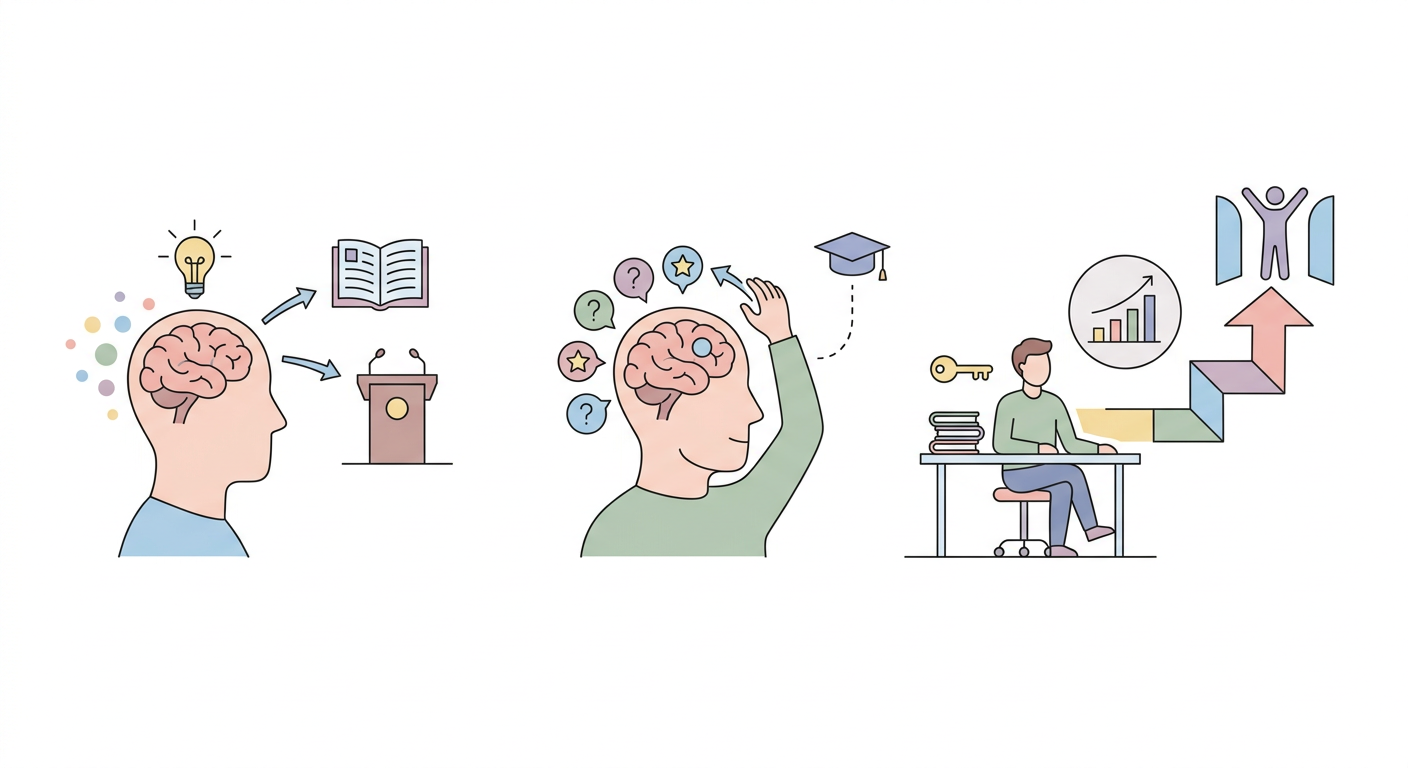
Implementing retrieval practice for college students is the fastest way to stop the exhausting cycle of cramming and forgetting. By shifting your focus from "input" to "output," you gain a realistic understanding of what you actually know. This builds metacognition—the ability to think about your own thinking—allowing you to stop wasting time on material you've already mastered and focus on your true weaknesses.
Breaking the Cycle of Cramming
Cramming works for the next eight hours, but the knowledge evaporates the moment you hand in your paper. Because college courses often build upon previous semesters, this "leakage" makes upper-level classes feel impossible. Retrieval practice ensures that the foundations stay solid. If you are preparing for high-stakes standardized tests, you might see how retrieval practice for high school students sets the stage for these more advanced academic demands.
Building Metacognitive Awareness: Knowing What You Don't Know
Standard study habits often mask ignorance. When you use retrieval, you get immediate feedback: you either can answer the question or you can't. This honesty prevents the panic that occurs halfway through a midterm when you realize you only "recognized" the concepts but never truly learned them. It turns your study sessions into a diagnostic tool. This same principle applies heavily in professional fields, such as when one must master retrieval practice as a medical student to ensure patient safety.
Standard Retrieval Practice Methods for University Coursework
The most effective retrieval practice for college students involves moving away from linear note-taking and toward active interrogation. You should spend less time looking at your laptop screen and more time staring at a blank wall while you try to piece together a concept in your head. Transitioning to this lifestyle requires a tactical shift in how you handle everyday assignments.
The Power of Flashcards and Digital SRS Tools
Flashcards are the bread and butter of retrieval, but they are often used incorrectly. To get the most out of them, you must use the Leitner System, which organizes cards by how well you know them. Digital tools like Anki or Quizlet utilize algorithms to automate this process. We have seen this be particularly effective for specialized fields; for instance, you can use these methods to master retrieval practice for pharmacy school, where memorizing drug interactions is a daily requirement.
Transforming Your Notes into Self-Tests
Stop writing summaries and start writing questions. During a lecture, instead of writing "The Treat of Versailles was signed in 1919," write "When was the Treaty of Versailles signed?" in the margin. When you review your notes later, cover the right side of the page and try to answer your own questions. This small tweak turns a passive document into an interactive study tool. If you're looking for more ways to implement this, check out these power retrieval practice examples for better grades.
Concept Mapping from Memory
Try the "Read-Recite-Review" method for dense textbooks. Read a section, close the book, and try to draw a map of the key ideas. Only after you’ve exhausted your memory should you reopen the book to see what you missed. This "gap" between what you remembered and what was on the page is where the most significant learning happens. It’s significantly more effective than the passive habit of re-reading which researchers have debunked as an inefficient use of time.
Ready to Stop Forgetting?
Turn your study materials into powerful practice sessions instantly with Bevinzey's AI-powered retrieval tools.
Get Started FreeAdvanced Strategies: Applying Retrieval to Complex Subjects
Retrieval practice for college students isn't limited to simple rote memorization of dates and definitions. You can use it to master complex problem-solving in STEM or deep analytical thinking in the humanities. The key is to force your brain to generate the steps of a solution rather than just following along with a professor's examples in class.
The Brain Dump: Harnessing Free Recall
The "Brain Dump" is perhaps the simplest and most effective retrieval strategy. Take a blank sheet of paper and write down everything you remember about a specific topic for five minutes. Don’t look at your notes. Once you’re done, use a different colored pen to add the details you forgot after checking your textbook. This visual "map" of your memory gaps is incredibly motivating and helps prioritize your next study session.
Peer Teaching and The Feynman Technique
Named after physicist Richard Feynman, this technique involves explaining a concept in simple terms as if you were teaching a child. Doing this from memory forces you to retrieve not just the "what" but the "why." If you can't explain it simply, you don't understand the underlying structure. This is especially useful for subjects like Organic Chemistry or Physics where conceptual clarity is vital.
Generating Practice Problems for STEM Subjects
In math-heavy courses, retrieval means solving problems from scratch. Don't look at the solution key until you are genuinely stuck. Better yet, try to create your own practice problems or variations of homework questions. For example, if you are working on hard probability questions or trying to improve an SAT math score, the act of generating the problem structure yourself provides a much deeper level of mastery than simply solving what is on the page.
Optimizing Retrieval with Spaced Repetition and Interleaving
Retrieval is most effective when it is combined with two other "big" learning strategies: spaced repetition and interleaving. Learning shouldn't happen all at once in a marathon session. Instead, it should be distributed over time to ensure the neural connections have time to harden. This is often referred to as "brain-based learning" because it respects the biological limits of human memory.
Defeating the Forgetting Curve with Spacing
The Harvard Medical School blog notes that memory decays rapidly if not refreshed. Spaced repetition counteracts this "forgetting curve" by scheduling retrieval sessions just as you are about to forget. Reviewing a concept one day later, then three days later, then a week later is far more effective than reviewing it five times in one night. This "distributive practice" is the gold standard for university-level achievement.
Interleaving: Why Mixing Topics Boosts Mastery
Interleaving is the practice of mixing different topics or question types during a single study session. While it feels slower and more difficult than "blocking" (focusing on one topic for hours), it forces your brain to constantly distinguish between different types of problems. For instance, instead of doing 20 geometry problems, mix in five medium statistics questions and a few area and volume problems. This forces you to learn how to identify which strategy to use, a skill that is essential for cumulative finals.
Common Barriers and How to Overcome Them
The biggest hurdle to retrieval practice for college students is that it feels "harder" than highlighting. In cognitive science, this is known as "desirable difficulty." The very struggle of trying to remember is what creates the learning. If your study session feels easy, you probably aren't learning much. If it feels frustrating and taxing, you are likely making massive gains.
Why Retrieval Feels Like It's Not Working
In the short term, students who re-read notes often perform better on immediate quizzes, giving them a false sense of security. However, those who use retrieval outperform the re-readers significantly just two days later. You must trust the process. Don't be discouraged if you can only remember 40% of the material during your first brain dump. That 40% is now permanently etched in your brain, and the other 60% will be easier to catch the next time.
Time Management and Study Efficiency
Many students claim they don't have time for retrieval. The reality is that retrieval is a time-saver. By spending 20 minutes on active recall now, you save yourself hours of panicked re-studying later. It is much more efficient to do targeted practice for speed than to wander aimlessly through 50 pages of a textbook for the third time in a week.
A Step-by-Step Guide to Implementing Retrieval Practice This Week
You don't need to overhaul your entire life to start using retrieval. Start small. Pick one class that feels difficult and dedicate 15 minutes a day to active recall. As you see your quiz scores rise, you can expand the technique to other courses. Follow this simple framework to get moving today.
Step 1: The Pre-Test. Before you even attend a lecture or read a chapter, spend two minutes writing down what you already know about the topic. Even if you know nothing, "pre-testing" primes your brain to look for answers.
Step 2: Question-Based Note Taking. During class, write down three high-level questions that the lecture answered. These will be your "retrieval cues" for later.
Step 3: The 24-Hour Dump. Within one day of the class, take a blank piece of paper and write down the key concepts from memory. Compare this to your notes and fill in the gaps.
Step 4: Use Practice Problems. If you're in a STEM course, find sets like medium geometry questions or hard exponents questions and work through them without looking at the answers.
Step 5: Schedule Reviews. Put a "retrieval session" on your calendar for three days from now to revisit the hardest concepts.
Unlock Your Academic Potential
Stop passive studying and start mastering your coursework. Join thousands of students using Bevinzey to automate retrieval practice and crush their exams.
Get Started FreeFrequently Asked Questions
How many times should I practice retrieval before an exam?
Aim for at least three to five retrieval sessions for each major concept, spaced out over several days or weeks. The exact number depends on the complexity of the material, but research suggests that "overlearning"—retrieving several times even after you think you know it—is key for long-term retention.
Is retrieval practice better than re-reading notes?
Yes, retrieval practice is significantly more effective. Multiple studies have shown that students who use active recall retain about 50% more information a week later compared to students who simply re-read their notes or textbooks multiple times.
Can retrieval practice work for math and science subjects?
Absolutely. In math and science, retrieval involves solving problems from scratch without looking at examples or formulas. This forces your brain to retrieve the correct procedural steps, which is much more effective than reading a solved example in a textbook.
How do I deal with the frustration of not remembering an answer?
Embrace the frustration as a sign that your brain is working. When you can't remember, try for at least 30 seconds before looking at the answer; that "struggle" actually primes your brain to store the correct information more deeply when you finally see it.
What are some free apps that help with retrieval practice?
Anki is the most popular open-source tool for spaced repetition and retrieval. Quizlet offers a free version with digital flashcards, and platforms like Bevinzey provide AI-powered tools to generate practice questions directly from your study materials.
Does retrieval practice help with long-term retention?
Yes, it is specifically designed for long-term retention. Unlike cramming, which targets short-term working memory, retrieval practice strengthens the neural pathways in long-term memory, making the information accessible months or even years later.
Reviewed by
Michael Danquah, MS, PhD
Dr. Michael Danquah is a professor of pharmaceutical sciences and founder of several educational technology platforms focused on improving student learning and performance.
Enjoyed this article?
Share it with others who might find it helpful.
Related Articles

How to Solve Molarity Problems: Step-by-Step Mastery
Learn how to solve molarity problems step-by-step with formulas, unit tips, and worked examples so you can calculate concentration with confidence.
Mar 26, 2026

Avoid These 7 Common Molarity Mistakes in Chemistry
Master chemistry calculations! Avoid common molarity mistakes with our expert guide on unit conversions, dilution errors, and proper lab techniques.
Mar 26, 2026

What Is Molarity? The Complete Guide to Molar Concentration
Master molarity with our complete guide. Learn the formula, step-by-step calculations, and the critical differences between molarity and molality.
Mar 26, 2026

Why Molarity Matters: Converting Mass to Moles for Lab Solutions
Master chemistry with our guide to the molarity formula. Learn how to calculate concentration with step-by-step examples, units, and practical lab tips.
Mar 26, 2026

Molarity vs Molality: The Essential Difference Explained
Master the difference between molarity vs molality. Learn the formulas, key differences, and when to use each in this comprehensive chemistry guide.
Mar 26, 2026