Retrieval Practice and the Testing Effect: The Ultimate Guide

Most students spend hundreds of hours highlighting textbooks and re-reading notes, yet they struggle to recall basic facts during an exam. This frustration stems from a fundamental misunderstanding of how the human brain encodes and retains information. In this guide, Retrieval Practice and the Testing Effect Explained, we explore why traditional study habits often fail and how shifting your focus from "putting info in" to "pulling info out" can transform your academic performance.
The science of forgetting is relentless. Within 20 minutes of learning something new, the average person forgets nearly 40% of the material. By the next day, that number often climbs to 70%. We often fall into the "illusion of competence", the feeling that because a page looks familiar while we re-read it, we have actually mastered the content. In reality, familiarity is not the same as mastery. To combat this, we must utilize active recall techniques that force the brain to work harder.
Retrieval practice is the act of calling information to mind from memory without the help of materials. It is a mental workout that changes the architecture of your brain. While re-reading is passive and comfortable, retrieval is active and challenging. When you engage in this process, you trigger the "testing effect," a psychological phenomenon where the act of retrieving information actually increases the likelihood of remembering it later. It flips the traditional model on its head: instead of testing being the final assessment, testing becomes the primary vehicle for learning itself.
What is Retrieval Practice? A Deep Dive into Cognitive Mechanics
Retrieval practice is a learning strategy where we purposefully bring information to mind to solidify our memory of it. Unlike recognition memory, which only requires you to identify a correct answer among distractors, retrieval requires you to reconstruct a concept from scratch. This effortful process strengthens the mental "pathway" to that specific piece of knowledge, making it easier to find the next time you need it.
When you retrieve a memory, you aren't just pulling a file out of a cabinet; you are actively re-linking neurons. Research in the cognitive psychology of learning suggests that every time you recall a fact, that memory becomes more "plastic" and can be integrated with new information. This is why Retrieval Practice vs Passive Studying is such a lopsided debate in scientific literature; one merely grazes the surface, while the other builds deep structural roots in the mind.
Psychologists often distinguish between "storage strength" and "retrieval strength." Storage strength is how deeply a memory is embedded, while retrieval strength is how easily it can be accessed at a moment's notice. You might "know" a friend's phone number (high storage), but if you haven't called them in years, your retrieval strength is low. Retrieval practice focuses on boosting that access speed. As many frustrated students discover, the "struggle" to remember is not a sign of failure, it is the sound of the brain working. Without that struggle, the memory remains fragile and ephemeral.
The Testing Effect Explained: From Lab to Classroom
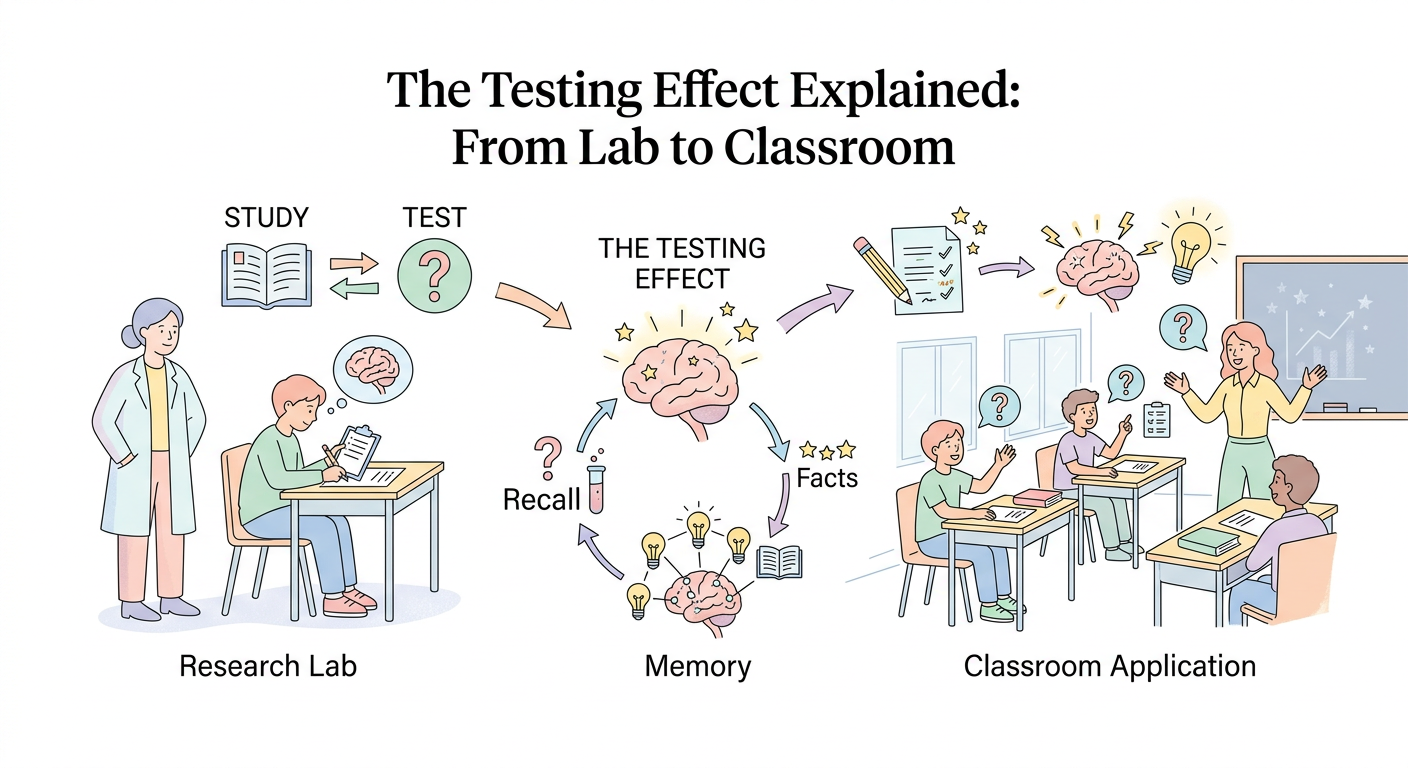
The testing effect is the finding that taking a test on a set of material leads to better long-term retention than spending the same amount of time studying that material. This isn't just a modern theory; it is backed by over a century of data. Early researchers like E.H. Cameron (1907) and A.I. Gates (1917) noticed that students who spent a portion of their time reciting facts rather than just reading them outperformed their peers significantly.
The most famous modern evidence comes from a Roediger and Karpicke study published in 2006. In this experiment, students were divided into groups: some studied the material repeatedly, while others studied and then took a practice test. While the "study" group felt more confident and performed better on immediate tests, the "test" group outperformed them by nearly 30% on a delayed exam one week later. This study proved that how retrieval practice boosts long-term memory is far superior to rote memorization.
In a classroom setting, the testing effect transforms the exam from a "gotcha" moment into a powerful learning tool. When teachers use low-stakes quizzes, they are helping students identify gaps in their knowledge early. This creates a feedback loop where students can focus their energy on what they don't know rather than wasting time on what they have already mastered. It shifts the perception of a test from a stressful evaluation to a valuable exercise in long-term memory retention.
Ready to Master the Testing Effect?

Don't just read about retrieval practice—put it into action. Bevinzey uses AI-powered tools to turn your notes into custom quizzes, leveraging the science of the testing effect to help you score higher with less stress.
Get Started FreeWhy Retrieval Practice Works: The Psychological Theories
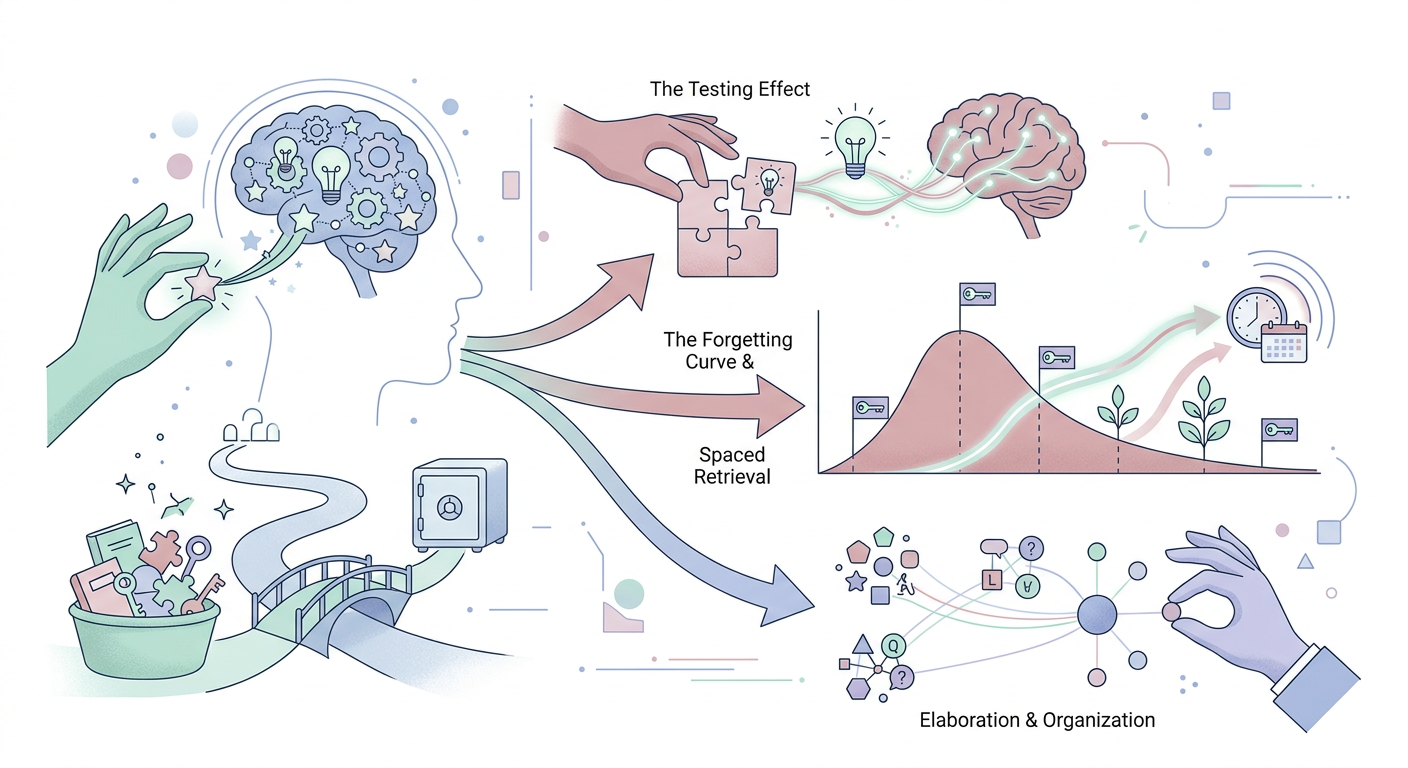
Learning is most effective when it is difficult. This concept, known as "desirable difficulties," was coined by Robert Bjork at UCLA. The core idea is that making the learning process harder in the short term, by forcing your brain to retrieve info, leads to better performance in the long term. If a study session feels easy and "flowy," you probably aren't learning as much as you think you are.
Another major reason retrieval works is the **Bifurcation Model**. When you attempt to recall a fact, you either succeed or you fail. If you succeed, that memory path is reinforced. If you fail, you become acutely aware of a gap in your knowledge. This increases your metacognition and study habits, allowing you to pay closer attention the next time search for that answer. You are essentially building a "mental map" where every successful retrieval adds a new "hook" or landmark, making the entire network of information more stable.
Furthermore, retrieval practice involves the Mediator Effect. When we try to remember a hard-to-recall fact, our brains often search for related "mediators" or internal cues to find the answer. For example, if you're trying to remember the capital of South Dakota (Pierre), you might think of the French name or a specific image. This search process creates multiple entry points to the same piece of data. For more on this, check out our guide on Retrieval Practice vs Rereading to see why these hooks are so vital.
The Synergistic Power of Spaced Repetition and Retrieval
Retrieval practice is powerful on its own, but it becomes unstoppable when combined with the spaced repetition benefits. Spacing is the opposite of "cramming." Instead of retrieving info ten times in one hour, you retrieve it once a day for ten days. This timing exploits the way our brains naturally prune unused connections, forcing the brain to keep the connection "live" because it is used consistently over time.
Hermann Ebbinghaus, a pioneer in memory research, discovered the "Forgetting Curve." He found that each time we retrieve a piece of information, the curve flattens. This means we forget more slowly after each session. To maximize efficiency, you should time your retrieval practice just as you are about to forget the material. This keeps the "difficulty" at a desirable level without causing total frustration.
Interleaving is another critical strategy. Instead of studying all your Math notes in one block and then all your History notes in another, you should mix them. By jumping between topics, you force your brain to constantly "reset" and reload different types of information. This mirror-images the reality of a final exam where questions don't appear in the exact order they were taught in the textbook. This is particularly helpful for specialized students, such as those using our Medical Student Guide to Retrieval Practice.
Practical Strategies for Implementing Retrieval Practice
You don't need a PhD in psychology to start using these methods today. The simplest form of retrieval is low-stakes quizzing. After reading a section of a book, close the book and write down everything you remember. This "brain dump" is one of the most effective ways to reveal what you actually know versus what you think you know.
The Leitner System: A flashcard method where cards you know well are moved to a box you review less frequently, while difficult cards stay in the "daily" box.
The Cornell Note-Taking System: Use the "cue" column to write questions for yourself, then cover your notes and try to answer those questions.
Pre-testing: Research shows that even if you guess the wrong answer to a question before you've learned the topic, you will remember the correct answer better once it's revealed.
When creating practice questions, aim for variety. Multiple-choice questions are great for recognition, but short-answer questions are better for deep retrieval. If you are preparing for a standardized test, you might look at Hard SAT Geometry Practice Questions to see how varied phrasing can increase the difficulty of your retrieval. The goal is to make the practice as close to the real-world application as possible.
Retrieval Practice for Different Learners and Environments
Retrieval isn't just for college students; it's a lifelong skill. In K-12 education, teachers are increasingly replacing traditional lectures with "retrieval starters", five-minute sessions at the beginning of class where students recall what was covered the day before. This helps bridge the gap between sessions and ensures that foundational knowledge is locked in before moving to more complex topics.
In high-stakes professional environments, such as Law or Medicine, retrieval is the difference between passing and failing. Medical students, for instance, use retrieval to memorize the thousands of drug interactions and anatomical structures required for their boards. See our Pharmacy Students' Guide for specific examples of how to apply these techniques to complex scientific nomenclature.
Even in the corporate world, Retrieval Practice and the Testing Effect Explained can save companies thousands of dollars in training costs. Most corporate workshops are "forgotten" within a week. By implementing follow-up retrieval quizzes via mobile apps or email, companies can ensure that employees actually retain the skills they were taught, significantly improving the return on investment for professional development.
Common Mistakes and How to Avoid Them
The biggest mistake learners make is neglecting feedback. Attempting to retrieve an answer you don't know is helpful, but only if you eventually find out the correct answer. If you practice retrieval without checking the results, you risk "learning" your own mistakes. Always verify your answers immediately after the retrieval attempt to ensure you are reinforcing accurate information.
Another pitfall is focusing solely on "factoid" retrieval. While it's great to know dates and definitions, high-level learning requires conceptual retrieval. Instead of asking "When did WWII start?", ask "What were the three primary economic factors that led to WWII?" This forces you to retrieve associations and logic, not just isolated data points. Managing your cognitive load is also vital; don't try to retrieve 100 new concepts in one sitting. Break them down into manageable chunks.
Finally, avoid "checking the answer" too quickly. The benefit of retrieval comes from the struggle. If you look at the back of the flashcard after only two seconds of thinking, you have bypassed the neurological "heavy lifting" required to build a lasting memory. Give yourself at least 10–15 seconds of honest effort before giving up and checking the source material.
Stop Re-reading. Start Mastering.
The science is clear: retrieval practice is the fastest way to memorize and understand complex topics. Join Bevinzey today and use our intelligent study tools to lock in knowledge for the long term.
Get Started FreeTransforming Into a High-Performance Learner
The journey from a passive reader to an active learner requires a shift in mindset. You must learn to love the "productive struggle." Most students quit when a subject feels hard because they think they aren't "smart enough." In reality, that feeling of hardness is exactly what desirable difficulties in education look like. It is the feeling of your brain actually growing stronger.
Try a 30-day challenge: for one month, replace half of your re-reading time with self-testing. Use active recall techniques for every subject, whether it's History or SAT prep. You can find many Power Retrieval Practice Examples to get you started. By the end of the month, you’ll likely find that you spend less time "studying" but feel much more prepared for your exams.
As we move toward a more evidence-based education system, the old ways of "cram and forget" are being left behind. Learning isn't something that happens to you while you sit in a lecture; it's something you do through effort and retrieval. Remember: a test isn't just a measure of what you've learned—it is the very act of learning itself.
Frequently Asked Questions
What is the difference between retrieval practice and active recall?
While the terms are often used interchangeably, "active recall" is the general principle of stimulating memory, whereas "retrieval practice" is the specific educational strategy of using that recall as a study method to leverage the testing effect.
How often should I use retrieval practice to see results?
Consistency is more important than duration. Even 10-15 minutes of daily retrieval practice can yield significant improvements in long-term retention compared to one-time marathon study sessions.
Does retrieval practice work for all types of subjects and learners?
Yes. Research from the American Psychological Association shows that retrieval practice is effective across age groups (from preschoolers to seniors) and across subjects ranging from creative arts to complex mathematics.
Is the testing effect the same as taking a high-stakes exam?
No. The testing effect works best in "low-stakes" environments where the fear of a bad grade is removed. This allow the brain to focus on the retrieval process itself rather than the anxiety of performance.
Why does retrieval practice feel harder than re-reading?
Retrieval practice requires your brain to work harder to reconstruct information, creating a "desirable difficulty." Re-reading is easy because it relies on recognition, which doesn't actually build strong memory pathways.
Can retrieval practice help with exam anxiety?
Absolutely. By frequently practicing retrieval in a low-stakes environment, you build confidence and "fluency" with the material. This reduces the cortisol spike often felt when seeing a test question for the first time during a real exam.
Reviewed by
Michael Danquah, MS, PhD
Dr. Michael Danquah is a professor of pharmaceutical sciences and founder of several educational technology platforms focused on improving student learning and performance.
Enjoyed this article?
Share it with others who might find it helpful.
Related Articles

How to Solve Molarity Problems: Step-by-Step Mastery
Learn how to solve molarity problems step-by-step with formulas, unit tips, and worked examples so you can calculate concentration with confidence.
Mar 26, 2026

Avoid These 7 Common Molarity Mistakes in Chemistry
Master chemistry calculations! Avoid common molarity mistakes with our expert guide on unit conversions, dilution errors, and proper lab techniques.
Mar 26, 2026

What Is Molarity? The Complete Guide to Molar Concentration
Master molarity with our complete guide. Learn the formula, step-by-step calculations, and the critical differences between molarity and molality.
Mar 26, 2026

Why Molarity Matters: Converting Mass to Moles for Lab Solutions
Master chemistry with our guide to the molarity formula. Learn how to calculate concentration with step-by-step examples, units, and practical lab tips.
Mar 26, 2026

Molarity vs Molality: The Essential Difference Explained
Master the difference between molarity vs molality. Learn the formulas, key differences, and when to use each in this comprehensive chemistry guide.
Mar 26, 2026