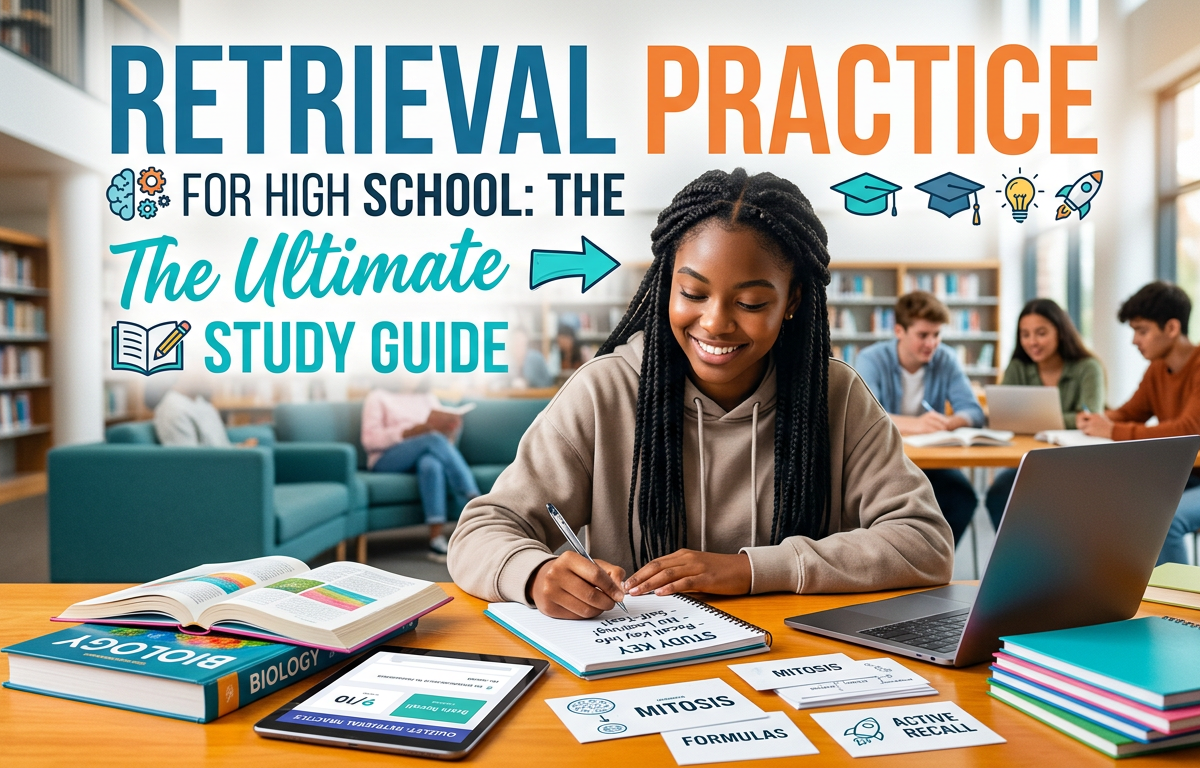
Retrieval Practice for High School: The Ultimate Study Guide
The Science of Learning: Why Retrieval Practice Is a Game Changer
Most teenagers believe that reading a textbook three times is the best way to prepare for a midterm. However, cognitive science suggests this is one of the least effective methods available. Retrieval Practice for High School Students shifts the focus from "input" (reading) to "output" (recalling), fundamentally changing how the brain stores and accesses information.
Retrieval practice is the act of pulling information out of your head rather than trying to cram it in. Think of it like a mental workout: every time you force your brain to remember a fact, you strengthen the neural pathway to that memory. Researchers call this the "Testing Effect," which demonstrates that frequent, low-stakes testing is actually a powerful learning tool, not just a way to measure progress.
When you struggle to remember the causes of the French Revolution or the steps of mitosis, your brain undergoes "memory consolidation." This neuropsychological process stabilizes a memory trace after its initial acquisition. Passive studying fails because it creates a false sense of familiarity; you recognize the words on the page, but you can't produce them on your own during an exam. By choosing retrieval practice vs rereading, you are choosing to build deep, durable knowledge that lasts long after the final bell rings.
The Retrieval Toolkit: Proven Strategies for High School Success
Retrieval Practice for High School Students works best when students use diverse methods to challenge their memory from different angles. Effective study sessions should feel slightly difficult, a concept psychologists call "desirable difficulty." If it feels easy, you probably aren't learning as much as you think you are.
One of the most accessible entry points is "Brain Dumping." Take a blank sheet of paper, set a timer for five minutes, and write down absolutely everything you can remember about a specific topic. No notes, no textbook, no cheating. This simple act of free-recall forces your brain to organize stray thoughts into a coherent structure. Once the timer stops, use your notes to see what you missed, highlighting the gaps in your knowledge for your next session.
Flashcards are another staple, but only when used correctly via the Leitner System. This method involves moving cards between different boxes based on how well you know them. Cards you miss stay in the "daily" box, while cards you get right move to a box that you check only every three days or once a week. For students interested in more advanced applications, checking out power retrieval practice examples can provide a roadmap for more complex subjects.
Concept mapping from memory is a third essential tool. Instead of looking at a diagram in a biology book, try to draw the entire carbon cycle on a whiteboard from scratch. This doesn't just test your memory of facts; it tests your understanding of how those facts connect. If you can't draw the link between two concepts, you have identified a specific weakness in your mental model.
How to Integrate Spaced Repetition into a Busy Schedule
Success in high school isn't about how many hours you study, but rather how you distribute those hours over time. The "Spacing Effect" proves that learning is much more effective when study sessions are spaced out rather than bunched together. This is because of the "Forgetting Curve," a mathematical formula showing that we forget about 70% of new information within 24 hours if we don't actively recall it.
Day 1: Learn the material in class.
Day 2: Do a 10-minute brain dump of yesterday's lesson.
Day 4: Complete a few practice problems or quiz questions.
Day 8: Review the most difficult concepts again.
By spacing out your sessions, you allow your brain to slightly forget the material. The effort required to "re-learn" it actually cements the information more deeply in your long-term memory. This prevents the need for stressful all-nighters before a big exam. Managing a schedule filled with sports, clubs, and social life requires a calendar that prioritizes 15-minute high-impact sessions over four-hour marathons.
Understanding how retrieval practice boosts long-term memory is the key to working smarter. Instead of trying to keep information fresh through constant repetition, let it fade a little and then pull it back. This cycle of "forgetting and retrieving" is the secret to academic endurance. It is especially helpful for high-stakes environments like the SATs, where you might need to know easy SAT number properties just as well as complex calculus.
Subject-Specific Retrieval Strategies for High Schoolers
Retrieval Practice for High School Students should look different depending on whether you are studying for AP Calculus or Honors English. In Mathematics, retrieval isn't about memorizing formulas; it's about retrieving the process. Put away your notes and try to solve a problem you've never seen before. When you get stuck, don't look at the answer immediately, try to retrieve the next step from memory first.
For science subjects, the Feynman Technique is remarkably effective. Explain a complex process, like photosynthesis or chemical bonding, as if you were teaching it to a sixth-grader. If you stumble or use too much jargon, it’s a sign that you haven’t fully retrieved the underlying logic of the concept. This verbal retrieval is often more demanding than simply writing notes.
In History and English, try the "Table of Contents" challenge. Look at a chapter title or a theme, such as "The Great Gatsby: Symbols of Wealth", and try to list all the supporting evidence you recall before opening the book. For those preparing for college entrance exams, applying these techniques to specific sections is vital. For example, if you want to know how to improve your SAT math score, you should focus on retrieving specific problem-solving strategies under timed conditions.
Master High School Exams with Ease
Stop wasting hours on passive reading and start using the science of retrieval practice to earn higher grades with less stress.
Get Started FreeOvercoming the 'Illusion of Competence'
Why do most students stick to highlighting and re-reading? They do it because those methods feel good. Reading a chapter repeatedly makes the text feel familiar, leading to an "illusion of competence." You think you know the material because you recognize it, but recognition is a much lower cognitive bar than recall.
Retrieval practice feels difficult, and that’s exactly why it works. When you sit with a blank page and struggle to remember a definition, your brain is actually doing the hard work of building memory. This discomfort is what educational researchers call "metacognition", the ability to think about your own thinking. By using retrieval, you quickly realize what you don't know, which is the most valuable information a student can have.
Ditch the highlighters. Research from the American Psychological Association suggests that highlighting can actually hinder learning by focusing the brain on individual facts rather than the big picture. Instead of coloring your pages, use that time to quiz yourself. It might be frustrating in the moment, but that mental effort is the price of genuine mastery.
Tech and Tools: Best Apps for Retrieval Practice
In the digital age, Retrieval Practice for High School Students is easier to implement thanks to sophisticated software. Anki is the gold standard for many, as it uses an algorithm to automate spaced repetition. It shows you cards you struggle with more frequently and pushes easy cards further into the future.
Quizlet remains a favorite for its ease of use, but students should move beyond the basic "Match" games. The "Write" and "Test" modes are much more effective because they require active production of the answer rather than just clicking a button. For a more collaborative experience, platforms like Kahoot allow students to engage in competitive retrieval, which can lower the stress usually associated with "tests."
AI study assistants like ChatGPT can also serve as powerful retrieval tools. You can paste your notes into the AI and ask it to "Generate 10 challenging short-answer questions based on this text." This provides an endless supply of fresh practice questions, preventing you from simply memorizing the order of your flashcards. Just be careful to avoid digital distractions; the best app in the world won't help if you spend half your study time on TikTok.
A Guide for Educators and Parents: Supporting the Shift
Teachers can foster an environment where Retrieval Practice for High School Students becomes the norm by using bell-ringers and exit tickets. A "bell-ringer" is a two-minute quiz at the start of class about what was learned the previous day. This isn't for a grade; it's a "low-stakes" way to prime the brain for new information. By making these exercises frequent and non-threatening, teachers help students overcome test anxiety.
Parents can also play a vital role without becoming "the homework police." Instead of asking, "Did you do your homework?" try asking, "Can you explain that concept you learned in Biology today?" Or, while driving to soccer practice, ask them to name three causes of the Cold War. These casual prompts force the student to retrieve information in a relaxed setting, which builds confidence and reinforces the learning habit.
Ultimately, the goal is to foster a growth mindset. According to Stanford University research, students who view challenges as opportunities to grow outperform those who view intelligence as a fixed trait. Mistakes made during retrieval practice aren't failures; they are data points that tell the student exactly what to study next. When kids feel safe enough to get an answer wrong during practice, they are much more likely to get it right on the exam.
For those looking ahead to specialized fields, the habits built now will pay off later. For example, the same principles used for AP History are essential for retrieval practice for medical students and even specialized paths like retrieval practice for pharmacy students. Starting early gives high schoolers a massive head start on their professional futures.
Unlock Your Full Academic Potential
Use our AI-powered retrieval tools to convert your notes into practice questions instantly. Start studying smarter, not harder.
Get Started FreeFrequently Asked Questions
How is retrieval practice different from regular studying?
Most "regular" studying is passive, involving re-reading notes or highlighting text. Retrieval practice is active; it requires you to produce an answer from memory without looking at your resources, which creates much stronger neural connections.
Does retrieval practice work for subjects like math or art?
Yes. In math, it involves solving problems from scratch without looking at a step-by-step guide. In art, it might involve recalling the principles of color theory or identifying the techniques used in a specific art movement from memory.
How can parents help high schoolers with retrieval practice?
Parents can help by providing low-stakes quizzes and asking "how" and "why" questions about what the student is learning. Keeping the atmosphere light and focused on "checking for understanding" rather than "checking for a grade" is key.
Is retrieval practice effective for students with ADHD?
Research suggests it is highly effective for students with ADHD because it breaks studying into short, interactive bursts. The active nature of retrieval can be more engaging than the passive reading that often leads to mind-wandering.
How often should a student use retrieval practice before a big exam?
Ideally, a student should use retrieval practice at increasing intervals: the day after learning, three days later, one week later, and then twice a month leading up to the exam. This reflects the spaced repetition strategy for maximum retention.
Reviewed by
Michael Danquah, MS, PhD
Dr. Michael Danquah is a professor of pharmaceutical sciences and founder of several educational technology platforms focused on improving student learning and performance.
Enjoyed this article?
Share it with others who might find it helpful.
Related Articles

How to Solve Molarity Problems: Step-by-Step Mastery
Learn how to solve molarity problems step-by-step with formulas, unit tips, and worked examples so you can calculate concentration with confidence.
Mar 26, 2026

Avoid These 7 Common Molarity Mistakes in Chemistry
Master chemistry calculations! Avoid common molarity mistakes with our expert guide on unit conversions, dilution errors, and proper lab techniques.
Mar 26, 2026

What Is Molarity? The Complete Guide to Molar Concentration
Master molarity with our complete guide. Learn the formula, step-by-step calculations, and the critical differences between molarity and molality.
Mar 26, 2026
Why Molarity Matters: Converting Mass to Moles for Lab Solutions
Master chemistry with our guide to the molarity formula. Learn how to calculate concentration with step-by-step examples, units, and practical lab tips.
Mar 26, 2026

Molarity vs Molality: The Essential Difference Explained
Master the difference between molarity vs molality. Learn the formulas, key differences, and when to use each in this comprehensive chemistry guide.
Mar 26, 2026